
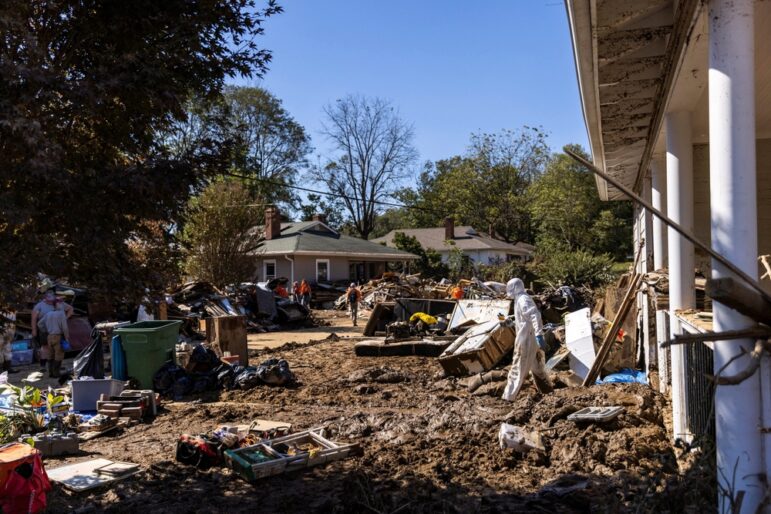
Damage to a neighborhood from Hurricane Helene. Image: Shutterstock
How The Washington Post Combined Data and Human Stories to Cover Hurricane Helene’s Aftermath
Climate change is both vast and personal, making it an ideal subject for immersive stories that combine visuals, data, and human narratives. Behind these seamless interactive pieces is collaboration, data analysis and firsthand reporting.
We spoke to Brady Dennis, a Washington Post climate reporter about how his team created its immersive story about Hurricane Helene, The Unending Storm, which documented one street in North Carolina months after the disaster.
Dennis spoke about the importance of collaboration, how to narrow in on such a large story, and the importance of constructing a story with data and human experience to make powerful journalism. This conversation has been edited for length and clarity.
Storybench: How does a story like this come together? Does it start with all of the elements in mind or does it evolve?
Brady Dennis: It happens in different ways, but it helps to look for ways to marry these things together. Sometimes, the data leads you to find stories.
Other times, like Hurricane Helene, some disaster strikes and you need to cover it. What are the smartest ways to do that? How can data guide us in explaining what happened here and why this place was vulnerable? That’s the reverse — a story that demanded attention, and then we looked for ways to tell that story. Part of it is just having the mindset to use those tools whenever it makes sense to and knowing that they work well together.
Storybench: What does collaboration look like when working on a story like this?
BD: It’s constant communication, brainstorming, and planning together from the start. It’s not just different people going off and doing different things, then squishing it all together at the end. It works best when people with different skills are all on the same page about the story they want to tell.
As we were planning, I said it would be great to really focus on this one street. What was clear from being there was: Several months go by, the world moves on, but if you’re in a place like this, the storm isn’t over. How do we tell that story? All these other people had great ideas from photographers about how to photograph a story like that. We had a videographer get people on camera talking about their experiences. My colleague Sarah Kaplan helped find all the residents along that street.
Then there was data showing how the flooding had swallowed the street and which houses had been affected. The idea was simple, but all these people had their own way of looking at it and that made it so much better.
Storybench: When telling a story about a large-scale disaster, why focus on something like just one street?
BD: The bigger the story, the smaller the focus. Helene was such a massive disaster. Many people died, thousands were driven out of their homes.
It’s hard to capture that in a way people can relate to. Things become numbers or descriptions of really bad damage. The risk is it seems so far away and massive that you can’t wrap your head around it. People can understand living on a street when the whole street gets wiped out.That’s a more powerful way to tell these stories because the human brain can relate to it.
Storybench: What’s your biggest challenge when covering communities like this?
BD: You’re meeting people during one of the worst times they’ve experienced, whether it’s a hurricane or some other awful situation. It’s important to be aware and respectful of that. The one way to do this well is to spend as much time as possible there, witnessing what people are wrestling with.
Also be transparent, I don’t ever try to surprise anyone in stories like this… I don’t mean that we show people stories but I double and triple-check everything. There’s nothing that I’ve shared that would embarrass or anger them or that they didn’t want out in the world. That doesn’t mean you write only good things — that’s not real — but you have to go in with humility and honesty about your intent.
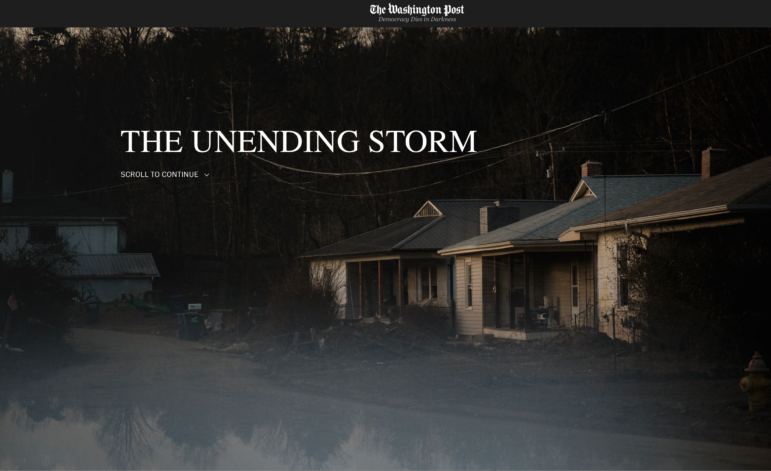
Image: Screenshot, The Washington Post
Storybench: What do you hope journalism like this accomplishes beyond just informing a reader?
BD: I have a lot of hopes. And I hope it can get us past the initial headlines—disaster and destruction — to a better understanding that there are real people and places affected by these events.It’s having people better understand, but also relate and empathize in a way that’s hard to do when something seems so distant.
I hope it illuminates the problems that remain in situations like this— that aid doesn’t come fast enough and these disasters are not over for people for a really long time. I hope there’s a better understanding of that.
Editor’s Note: This story was originally published on Storybench and is reprinted here with permission.
 Isabelle Warren is third year journalism student at Northeastern University.
10 Investigative Questions to Ask after a Natural Disaster
Popular Myths About Climate Adaptation Journalists Should Know
Reporting Guide to Holding Governments Accountable for Climate Change Pledges
GIJN’s Guide to Investigating Sea Level Rise
How to Tell the Stories of People Behind Data Points
Despite Losses, Puerto Rican Journalists Keep Reporting After Hurricane

Tips for Interviewing Victims of Tragedy, Witnesses, and Survivors
Journalists in Africa and South America Are Mapping the Mines Devouring the World’s Rainforests

This work is licensed under a Creative Commons Attribution-NoDerivatives 4.0 International License
Republish our articles for free, online or in print, under a Creative Commons license.
Republish this article
This work is licensed under a Creative Commons Attribution-NoDerivatives 4.0 International License
Read Next
Data Journalism Methodology
How to Tell the Stories of People Behind Data Points
At the NICAR26 data journalism summit, a panel of veteran data reporters shared tips on how to amplify and contextualize data-driven public interest stories with ordinary people at the short end of policy.
News & Analysis Reporting Tools & Tips
Despite Losses, Puerto Rican Journalists Keep Reporting After Hurricane
In the wake of Hurricane Maria’s devastating impact on Puerto Rico, amid shortages of food, water and electricity, international and local media have set up shop in the island’s Convention Center, creating a de facto newsroom where officials give press conferences and citizens look for resources. Among those leading the way are journalists from GIJN member Centro de Periodismo Investigativo.
News & Analysis
Tips for Interviewing Victims of Tragedy, Witnesses, and Survivors
There is no infallible method for interviewing people who have been victims and survivors of traumatic events such as violence, crimes, disasters, or accidents. But Marcela Turati, co-founder of Mexican investigative journalism nonprofit Quinto Elemento Lab, shares recommendations that can be used as a roadmap to conduct a humane, sensitive, and respectful interview.
Data Journalism
Journalists in Africa and South America Are Mapping the Mines Devouring the World’s Rainforests
Two journalism and technology projects are sharing tools and methods across continents to map where mining is devastating the Amazon and Congo basins.