
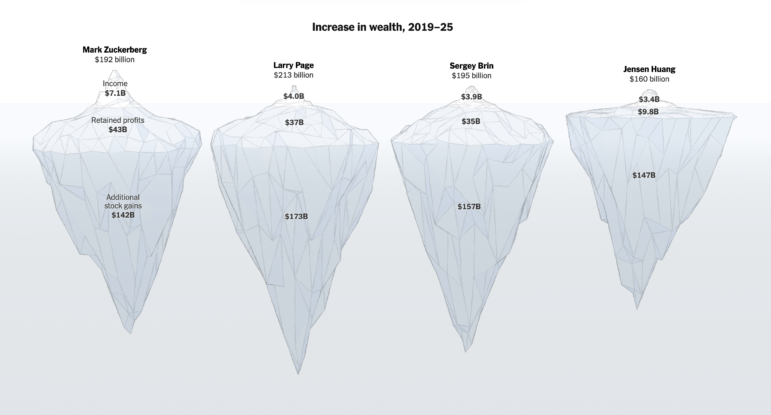
A new tax proposal in California aimed at billionaires seeks to account for the vast amounts of wealth they often accumulate in stock holdings, which can dwarf their other assets. Image: Screenshot, The New York Times
‘Super’ El Niño Threat, Myanmar Villages Razed, California’s Billionaire Tax Bill, and South Africa’s Murder Rate

Editor’s Pick: Best of Data Journalism from 2025

From Data to Storytelling: Concept and Design Tips from the Financial Times’ John Burn-Murdoch
Mapping Conflict: Using Satellite Radar Data to Track the War Damage in Gaza

Introduction to Investigative Journalism: Data Journalism
Global temperatures are at record highs, and forecasters now predict that the El Niño weather pattern emerging in the tropical Pacific could be one of the warmest on record, causing more extreme weather events around the world. The BBC mapped weather data showing the impact of El Niño on different regions and how it compares to previous El Niño and La Niña periods. Our roundup of the Top 10 in Data Journalism, looking at stories from May 20 to June 3, also includes a Bellingcat investigation into the destruction of villages across Myanmar’s Rakhine State, The New York Times’ analysis of how a 5% tax on billionaires in California could raise enough cash to offset healthcare cuts, and ARIJ’s examination of the impact of poor terms of employment for Egypt’s journalists.
El Niño Threatens Highest Warming on Record
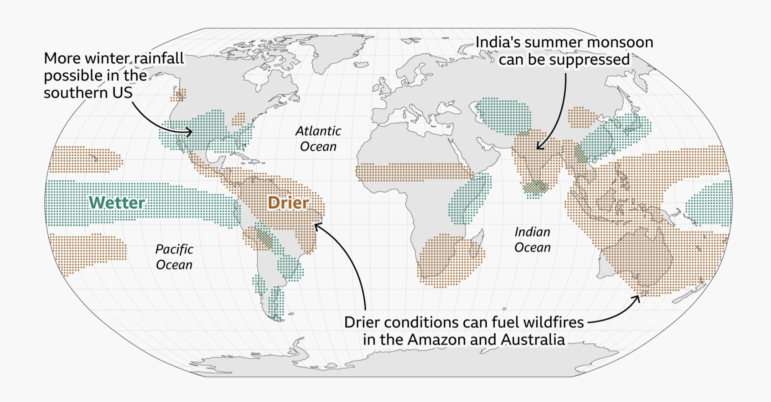
Image: Screenshot, BBC
Global average temperatures are already at record highs, and a gathering Pacific weather system threatens to push them higher. El Niño, the warming of surface waters across the central and eastern tropical Pacific, is intensifying at a pace that forecasters believe could be “the strongest in decades,” and the UN has warned that it could reshape weather worldwide. The BBC analyzed sea surface temperature records against the 1991–2020 baseline, historical readings from NOAA’s Oceanic Niño Index, and precipitation impact data, visualizing their findings through a series of maps and line charts. While every El Niño disrupts rainfall and wind patterns globally, a “super” event, triggered when Pacific temperatures exceed two degrees Celsius above baseline, amplifies the risk of droughts, wildfires, and flooding across South America, southeast Asia, and Australia simultaneously.
Erasure of Villages in Myanmar’s Rakhine State
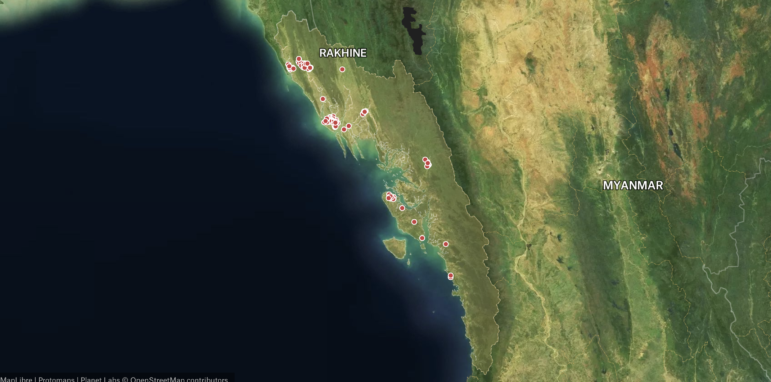
Image: Screenshot, Bellingcat
The scale of destruction across Myanmar’s Rakhine State, where almost half a million people are internally displaced, is only now becoming clear after mass killings that happened over a year ago have been confirmed, according to a recent Human Rights Watch report. Bellingcat used satellite imagery, NASA fire detection data, news reports, and Armed Conflict Location and Event Data Project (ACLED) records to investigate 115 villages that have been partially or completely destroyed since the February 2021 military coup, many by clashes between the ethnic armed group Arakan Army (AA) and Myanmar’s military junta, others by what appeared to be systematic attacks against Rohingya civilians. Using maps superimposed on satellite imagery, the findings reveal a pattern of systematic erasure to make the villages uninhabitable. Several destroyed villages no longer appear on UN maps at all. Bellingcat analyzed ACLED data showing military junta air and drone strikes in Rakhine rose from 30 in 2023 to 461 in 2024, after the AA resumed its offensive.
California’s Proposed Billionaire Tax Bill
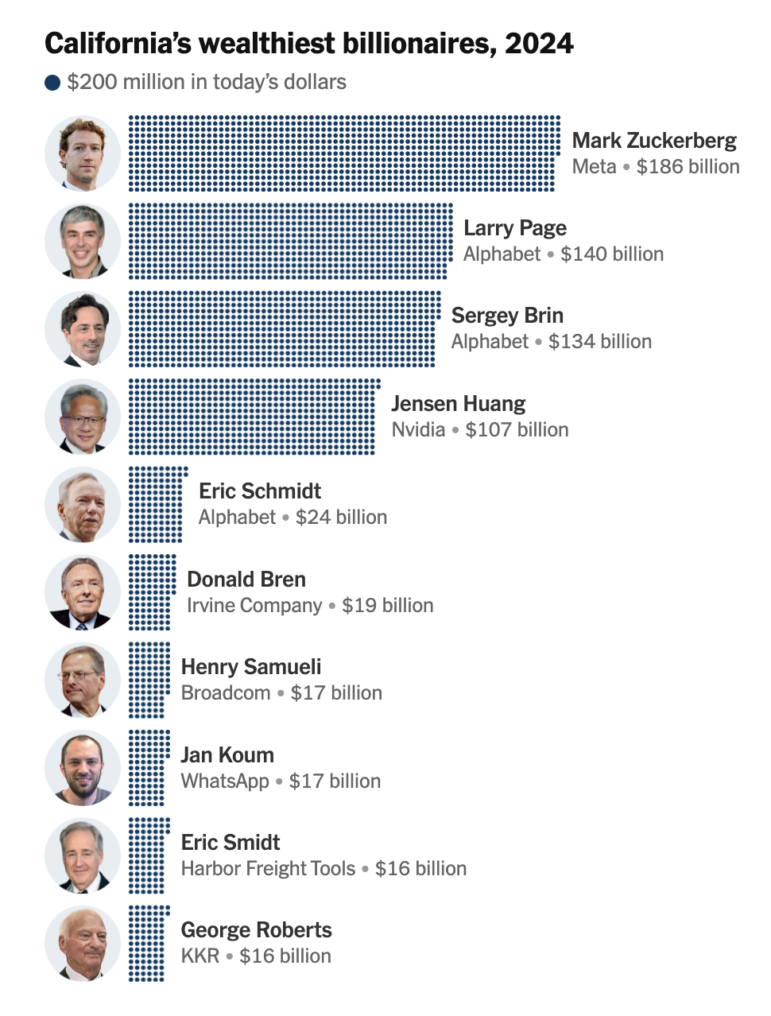
Image: Screenshot, The New York Times
California voters will decide in November whether to approve the 2026 Billionaire Tax Act — a one-time 5% levy on billionaire wealth spread over five years. If signed, it is projected to raise roughly US$100 billion, enough to offset federal Medicaid cuts the Trump administration imposed on the state. The New York Times reports that the combined wealth of the state’s 10 richest residents now exceeds half of California’s entire annual economic output; a bar chart shows the growth of billionaire wealth over time. A working paper by economists Emmanuel Saez and Gabriel Zucman, drawing on Forbes wealth data since 1982, SEC filings, and California income tax statistics, tracked how the super-wealthy accumulated their fortunes. From 2019 to 2025, the state’s billionaires saw wealth grow at over 15% annually while paying just 0.26% of that wealth in state income taxes. To illustrate the point, the authors used an iceberg analogy where visible income sits above the waterline, that is taxable, but beneath it lies the unrealised appreciation of stock holdings, which are untaxed unless sold.
Exploitation of Egyptian Journalists
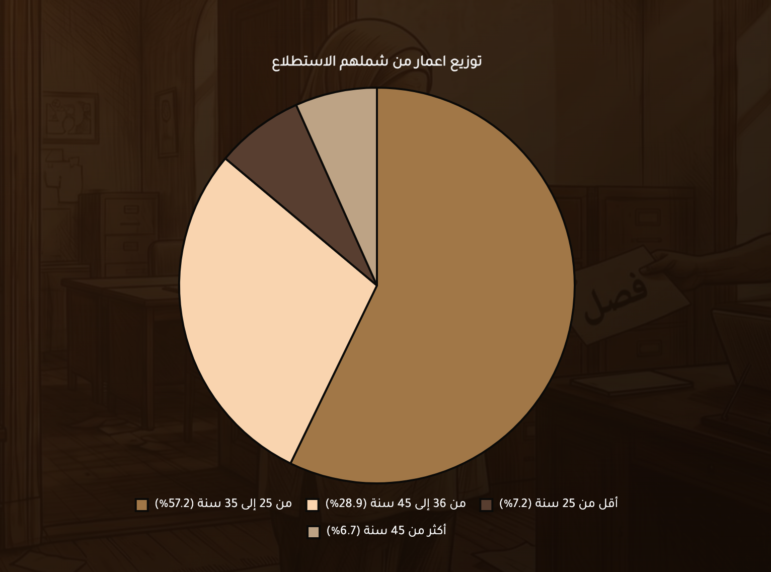
Age distribution of Egyptian journalists in a survey carried out by ARIJ. Image: Screenshot, ARIJ
ARIJ investigated the scale of exploitation facing journalists inside Egypt’s private media sector, exposing how the profession is held together by fear, informal deals, and laws written to exclude the rights of journalists. Drawing on a survey of 152 journalists across Egyptian governorates, roughly evenly split by gender, ARIJ found that the crisis fell hardest on those most active in the field, those aged 25 to 35. Most were working multiple jobs simultaneously without contracts, insurance, or realistic access to union membership. Pie charts illustrate the distribution of the surveyed journalists across age groups and unfair working conditions. While union membership is technically available, the investigation documented a widespread “back door” system, with prices for membership running from 50,000 to 150,000 Egyptian pounds (roughly US$1,000 – 3,000). The law meant to protect journalists, Article 16 of Press and Media Regulation Law No. 180 of 2018, requires investigation and syndicate notification before any dismissal. In practice, as individual testimonies gathered by the investigation reveal, it is routinely ignored, with pregnant women dismissed, resignations forged, and staff let go en masse.
South Africa’s Murder Rates Dropping
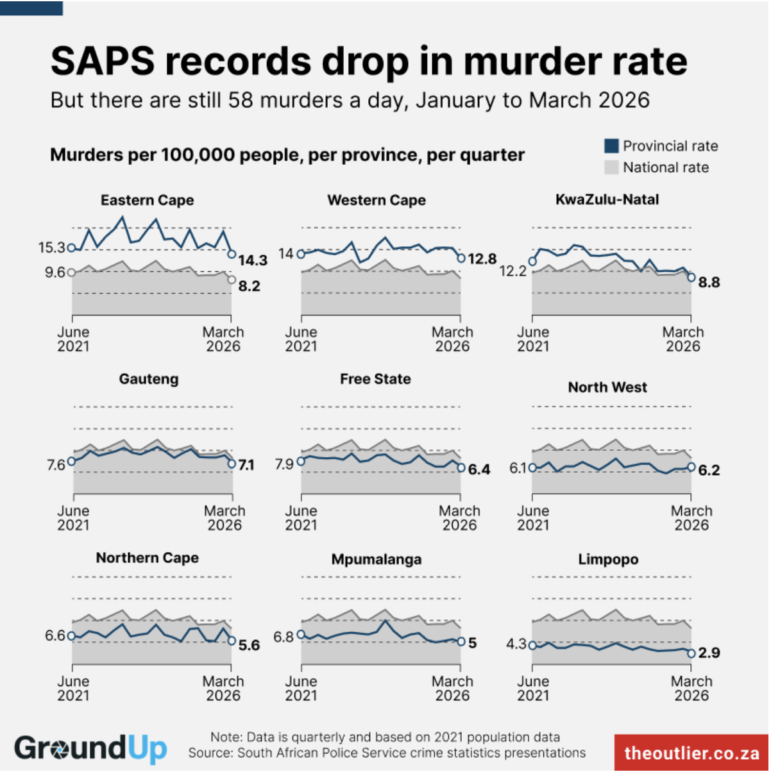
Image: Screenshot, GroundUp, The Outlier
South Africa’s murder rate is falling, but still exceeds the global average. South Africa Police Service (SAPS) data shows the national homicide rate dropped to 8.2 murders per 100,000 people in the first quarter of 2026. That’s an annual rate of more than 36 per 100,000, which is down from the rate of 40.7 per 100,000 in 2025 — and totals have now declined every quarter for three years. GroundUp and The Outlier visualized the trend through a series of miniature line charts, one per province, each plotting the provincial murder rate against the national rate as a shaded baseline from June 2021 to March 2026. The charts show every province tracking downward, but Eastern Cape, Western Cape, and KwaZulu-Natal remain well above the national average. At 58 murders each day between January and March, South Africa’s rate of 12.7 murders per 100,000 people remains more than 100% higher than the international average of 5.6 per 100,000. “Arguments, misunderstandings, provocations, and road rage” were by far the leading drivers of murders, followed by vigilantism and mob justice; most take place in public places.
Singapore’s Senior Caregivers
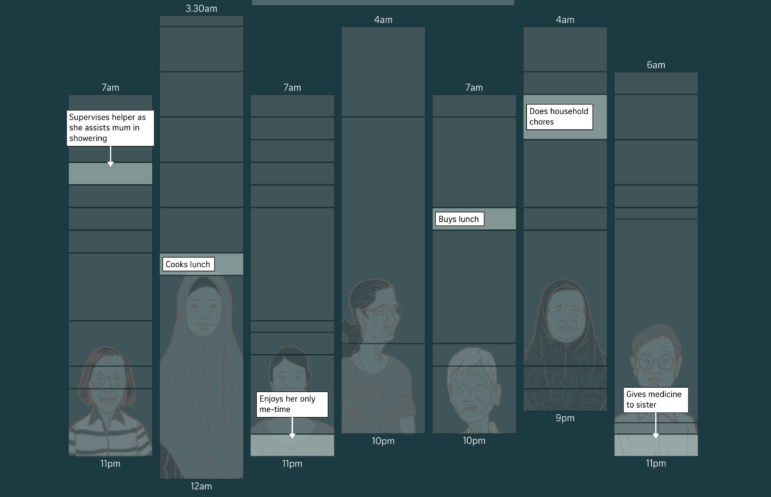
Image: Screenshot, The Straits Times
Singapore has become a super-aged society in 2026, and the people absorbing much of that burden are elderly themselves. The proportion of seniors providing unpaid care to other seniors rose from 6% in 2019 to 7.4% in 2023-24, according to national survey data from Duke-NUS Medical School. The Straits Times spoke to seven caregivers, all aged 65 and above, mapping each of their daily routines through annotated vertical columns representing their day from the early hours to midnight, with care tasks marked against the clock to show how little of each day belongs to the caregivers themselves. The charts reveal start times as early as 3:30am and days stretching past midnight. Physical decline, financial strain, and psychological pressure compound in elderly caregivers, where they face managing chronic pain while pushing wheelchairs, stretching fixed savings across rising care costs, and living with the fear of what happens to a dependent spouse if they themselves fall ill first, with caregiving falling disproportionately falling to women.
How the Japanese Yen Has Become Weaker
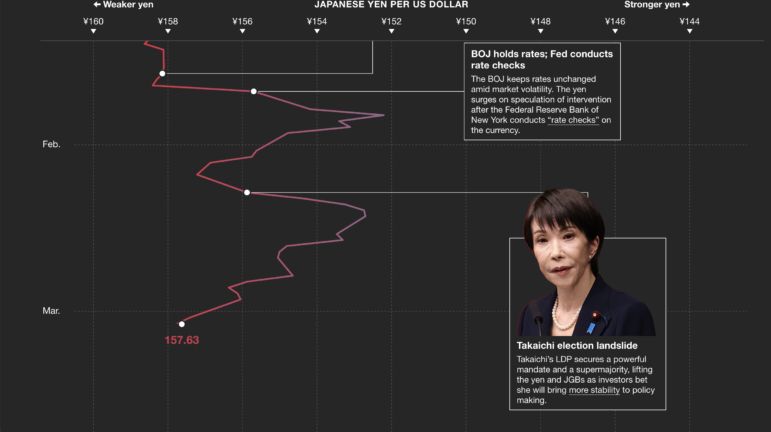
Image: Screenshot, Bloomberg
The Japanese yen has spent the past year in near-continuous retreat, and Japan’s attempts to stop its slide are already losing their beneficial effect. An annotated line chart tracking the yen against the US dollar from May 2025 to May 2026 maps each policy decision and political shock against the currency’s movement, from Trump’s April 2025 tariff announcements through domestic political upheaval as former prime minister of Japan Shigeru Ishiba was replaced by Sanae Takaichi, to a rate hike in January — the highest in roughly 30 years, that still failed to reverse the trend. Bank of Japan account analysis indicates Tokyo spent as much as ¥10 trillion (US$63 billion) intervening after the dollar-yen conversion rate crossed 160 yen to one US dollar. With the conflict in the Middle East adding pressure on Japan’s energy-import-dependent economy, traders are cautious of a further slide.
Can Argentina Win the World Cup Again?
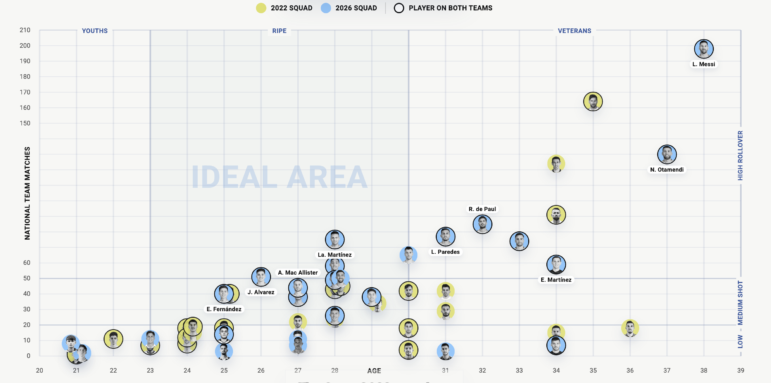
Image: Screenshot, La Nación
Argentina will be arriving at the 2026 World Cup with many of the same players that won the 2022 World Cup, but with more four years more of experience. La Nación analyzed Opta Stats performance data and national team appearance records to compare manager Lionel Scaloni’s 2026 squad against the Qatar 2022 winners, visualizing findings through two scatter plots. The first — the “ideal zone” chart — cross-references each player’s age against their number of international appearances, placing them in quadrants from youth to veteran; it shows how players who arrived in Qatar with fewer than 15 caps — appearances in international matches —now enter the tournament with 40 or more. The second — the “premium zone” chart — plots individual player rating against club competitiveness to rank them according to form and the level of competition they face. Of the 26 players called up, 17 were present in Qatar, the highest continuity rate of any Argentine squad defending a World Cup title.
Pesticide Use in the EU
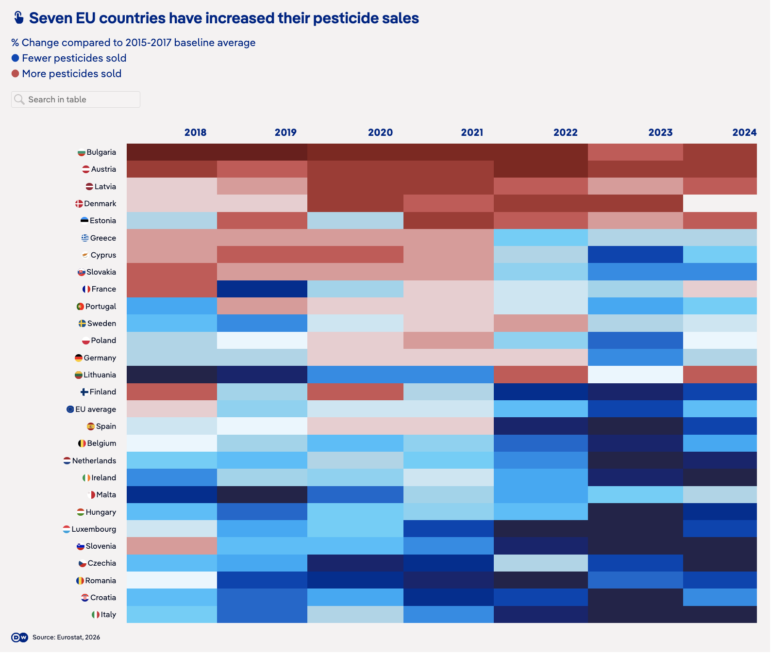
Image: Screenshot, Deutsche Welle (DW)
EU pesticide use was supposed to be halved by 2030, but instead the binding target has been shelved and sales are climbing. Deutsche Welle analyzed FAO estimates and Eurostat sales figures across all 27 member states with a series of charts, including a dot plot of rivers with pesticides exceeding thresholds, where only two member states stayed within recommended river safety thresholds in 2023. Bar charts and heat maps compared national sales by country and showed the five largest agricultural producers accounted for 76% of 2024 sales, which ran 10% above the previous year. Sales of highly hazardous pesticides rose 27% year-on-year.
Minneapolis Police Limited Responses to ICE Calls
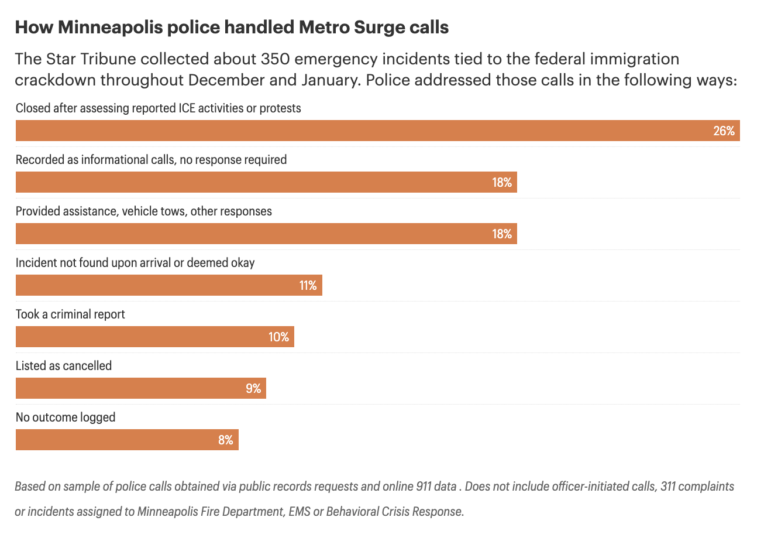
Image: Screenshot, Minnesota Star Tribune
A Minnesota Star Tribune analysis showed that the Minneapolis Police Department (MPD) racked up huge overtime costs as they prioritized preventing civil unrest when responding to emergency calls about unlawful force used by Immigration and Customs Enforcement (ICE) agents during federal immigration operations in the city. Over two months, the MPD spent US$10 million on overtime and standby pay, yet it responded to only a fraction of the emergency calls received. The Star Tribune’s analysis of more than 350 immigration-related 911 calls found that in roughly a quarter of cases, officers chose not to respond at all, with just 10% resulting in a criminal report. Total 911 volume across the city held close to its winter average, a column chart of annual call volumes shows. Over the course of a month, 118 officers each received between $8,000 and $20,000 in additional pay, logging anywhere from 250 to 475 hours on call between early January and early February. At the high end, that worked out to officers being on standby for nearly two-thirds of the entire 32-day period.
Hanna Duggal is the writer of GIJN’s fortnightly Top 10 in Data Journalism column, and a data journalist at AJ Labs, the data, visual storytelling, and experiments team of Al Jazeera. She has reported on issues such as policing, surveillance, and protests using data, and reported for GIJN on data journalism in the Middle East, investigating algorithms on TikTok, and on using data to investigate tribal lands in the US.
Editor’s Pick: Best of Data Journalism from 2025
From Data to Storytelling: Concept and Design Tips from the Financial Times’ John Burn-Murdoch
Mapping Conflict: Using Satellite Radar Data to Track the War Damage in Gaza
Introduction to Investigative Journalism: Data Journalism

How Middle Eastern Data Outlets Use Data to Challenge Narratives and Advance Accountability

How to Tell the Stories of People Behind Data Points

Rare Earth Rivalry, Falling Birth Rates, Violence in the Sahel, and 70 Years of Eurovision Lyrics

Developing a Data State Of Mind: Key Tips for Editors

This work is licensed under a Creative Commons Attribution-NoDerivatives 4.0 International License
Republish our articles for free, online or in print, under a Creative Commons license.
Republish this article
This work is licensed under a Creative Commons Attribution-NoDerivatives 4.0 International License
Read Next
Data Journalism MENA Focus Week
How Middle Eastern Data Outlets Use Data to Challenge Narratives and Advance Accountability
Data journalism in the Middle East has been driven by organizations that have produced collaborations and projects that combine innovative techniques with nuanced local knowledge.
Data Journalism Methodology
How to Tell the Stories of People Behind Data Points
At the NICAR26 data journalism summit, a panel of veteran data reporters shared tips on how to amplify and contextualize data-driven public interest stories with ordinary people at the short end of policy.
Data Journalism Top 10
Rare Earth Rivalry, Falling Birth Rates, Violence in the Sahel, and 70 Years of Eurovision Lyrics
Also highlighting China’s squid fishing fleet off Argentina, how redistricting is shaping America’s midterms, and why 2.1 billion people still lack safe drinking water.
Data Journalism
Developing a Data State Of Mind: Key Tips for Editors
Data is woven into how journalists cover everything from local government spending to global climate change patterns, but for editors without a specialist background, it can be daunting.