

Image: Gloria Mendoza (Better Images of AI), Creative Commons BY 4.0 license

Resource Guide
Tech Focus Project

Resource Guide Chapter
The Investigative Agenda for Tech and AI Journalism
Resource Guide Chapter
Radical Collaboration: Why It’s the Antidote to Big Tech

Resource Guide Chapter
Holding the Power of Big Tech Accountable
Resource Guide Chapter
Gabriel Geiger Shares Tips and Tools on Investigating Government Use of AI

Resource Guide Chapter
Making Tech Surveillance a Reporting Beat
Resource Guide Chapter
John Scott-Railton Shares Tips and Tools to Protect Yourself Digitally

Resource Guide Chapter
Investigating Location-Tracking Surveillance Systems

Resource Guide Chapter
Investigating Disinformation in the Age of AI
Resource Guide Chapter
Karen Hao on AI Narratives Reporters Should Deconstruct

Resource Guide Chapter
Leveraging AI and Technology to Investigate Power
Resource Guide Chapter
Tips for Using AI as a Reporting Tool to Uncover Wrongdoing
Resource Guide Chapter
Gina Chua on 4 Tips for Innovative Journalism in the Age of AI
Global Academy Webinars Resource Guide Chapter
Webinar: Detecting AI-Generated Content – Updated Tools and Techniques
Resource Guide Chapter
Athandiwe Saba Shares Practical Tips on Investigating Big Tech in Africa
Resource Guide Chapter
Investigating the Human Cost of Tech

Resource Guide Chapter
Techniques for Investigating Data Centers
Resource Guide Chapter
Credits and Acknowledgments



Editor’s Note: This is the sixth excerpt taken from GIJN’s in-depth report on “The Investigative Agenda for Technology and AI Journalism,” based on a day-long pre-conference event held on November 20 at GIJC25, where 100 investigative journalists, editors, tech experts, and researchers from nearly 50 countries and territories convened to examine the most urgent technology-related challenges and opportunities facing investigative journalism today. Credits and acknowledgments for this project can be found here.
One of the most persistent narratives surrounding artificial intelligence and digital technologies is that of immateriality. AI systems are frequently described as “cloud-based” and “virtual,” framing that suggests distance from the physical world and from human labor. This narrative is not only misleading, it actively obscures the environmental, social, and political costs of these technologies. Investigative journalism has played, and must continue to play, a crucial role in dismantling this myth, revealing instead the very material infrastructures, labor regimes, and extractive dynamics that underpin today’s AI boom.
Hidden Human Labor Behind ‘Automated’ Systems
Despite widespread claims that AI replaces human labor, countless investigations have shown that AI systems rely heavily on invisible, precarious, and often exploitative forms of work. Content moderators, data annotators, and so-called “click workers” perform the foundational labor that allows machine learning systems to function at scale.
As early as 2014, an investigation by Wired exposed the psychological toll borne by Facebook content moderators tasked with filtering extreme violence, hate speech, and abuse, often with little institutional support and under intense productivity pressure. When asked about the practice of moderation, the three tech giants Microsoft, Google, and Meta “offered vague statements” to Wired and declined to go into further detail.
In 2023, TIME revealed how OpenAI outsourced data labeling and content moderation to workers in Kenya earning less than $2 per hour. These workers were asked to read and classify deeply disturbing content in order to make ChatGPT “less toxic,” raising urgent questions about consent, mental health, and the global outsourcing of harm. In response to questions about this story, an OpenAI spokesperson “confirmed that Sama employees in Kenya contributed to a tool it was building to detect toxic content, which was eventually built into ChatGPT.”
Beyond data work, platform-based labor (delivery drivers, ride-hail drivers) has also been reshaped by algorithmic management. Automated systems determine pay, routes, penalties, and even job termination, often without transparency or meaningful avenues for appeal. These harms are particularly acute in low-income contexts, where labor protections are weaker and algorithmic decisions can have devastating economic consequences.
Environmental Footprint of AI Infrastructure
The myth of immateriality extends beyond labor to the environment. AI systems are often framed as clean, digital solutions, yet their environmental footprint is immense. Large-scale data centers require vast amounts of electricity, water, land, and rare minerals (resources whose extraction and consumption frequently impact vulnerable communities).
In recent years, investigative reporting has increasingly focused on these infrastructures, notably through the Pulitzer Center’s AI Spotlight Series. Their work highlights the methodological challenges of measuring AI’s environmental impact.
Projects such as Backyard AI have shown how data centers are often built with limited transparency, sometimes bypassing environmental impact assessments altogether. The costs (higher energy prices, noise pollution, water scarcity) are borne locally, while the economic benefits remain highly concentrated.
Journalist Francisca Skoknic, who participated in the GIJC25 pre-conference event, has documented how the authorities quietly deregulated the data center industry in Chile. Her reporting reveals how governments often replicate corporate talking points (promising jobs and innovation) while downplaying trade-offs related to water use, electricity grids, and long-term environmental sustainability. These investigations show the importance of identifying less visible actors beyond major tech brands: energy providers, real estate developers, infrastructure intermediaries, and lobbyists who shape policy outcomes behind the scenes.
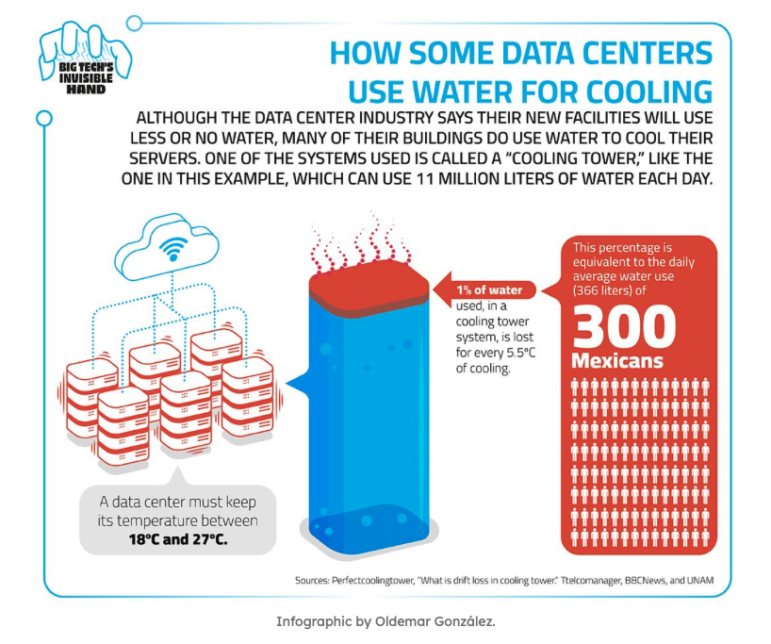
As part of the Invisible Hand of Big Tech project — led by Agência Pública and El CLIP — Tech Policy Press examined the environmental and natural resource impact of living in close proximity to data centers. Image: Screenshot, Tech Policy Press (illustration by Oldemar González)
Disproportionate Harm in the Global South
Across both labor and environmental dimensions, the harms associated with AI and digital infrastructure are disproportionately concentrated in the Global South. Data labeling and content moderation are outsourced to countries with lower wages and fewer worker protections; data centers and mining operations are sited where regulation is weakest; and automated decision-making systems are often deployed on populations with limited digital literacy or legal recourse.
As discussed during the pre-conference day, journalists in Africa, Latin America, and South Asia are increasingly documenting how automated systems function as “black boxes” for affected communities, deciding access to credit, welfare, education, or healthcare without explanation. In such contexts, algorithmic opacity exacerbates existing inequalities and erodes trust in public institutions.
These investigations are often conducted under difficult conditions: restricted access to data, limited transparency obligations, and significant power imbalances between local communities and multinational corporations.
AI and the Changing Nature of Conflict
The use of AI in armed conflict represents another rapidly expanding investigative beat. Recent reporting shows how machine learning systems are being integrated into military decision-making with profound ethical and humanitarian implications.

Image: Screenshot, +972 Magazine
A landmark investigation by +972 Magazine and Local Call revealed how the Israeli military deployed an AI targeting system known as “Lavender” during the war in Gaza. According to the investigation, the system was used to generate tens of thousands of individual assassination targets with minimal human oversight and a permissive approach to civilian casualties. The reporting exposed how automation accelerated the pace of violence while diluting accountability, a development with far-reaching consequences for international humanitarian law.
At the same time, AI-assisted techniques are increasingly used by journalists to investigate conflicts. A notable example is a 2023 investigation by The New York Times, which combined satellite imagery, video analysis, and open source intelligence to show that Israel had dropped 2,000-pound bombs in areas where civilians were instructed to seek safety. This work demonstrates that while AI can intensify harm in conflict settings, it can also strengthen accountability when used transparently and responsibly in investigative reporting.
Priorities Identified:
-
- Debunk the myth of AI as immaterial or neutral technology.
- Make visible the human labor behind automated systems.
- Investigate the environmental and climate costs of AI infrastructure.
- Center disproportionate harm to vulnerable and Global South communities.
- Scrutinize the use of AI in conflicts, surveillance, and warfare.
 Sandrine Rigaud is the Program Director of the Global Investigative Journalism Network. She is an investigative journalist, director, and Emmy-winning producer who served as editor-in-chief of Forbidden Stories from 2019 to 2024. In that position, she led international collaborations to continue the work of assassinated or under threat reporters. She coordinated investigations involving up to 100 journalists and 30 media outlets, including Le Monde, The Washington Post, The Guardian, Der Spiegel, Haaretz, and El País. She teaches investigative journalism at the School of Journalism of Sciences Po Paris and is co-author of Pegasus: How a Spy in Your Pocket Threatens the End of Privacy, Dignity, and Democracy (2023), translated into several languages. She previously co-authored a book on the power struggles at the heart of France’s Socialist Party (PS: Coulisses d’un jeu de massacre, 2008). A Nieman Fellow at Harvard in 2024/2025, she worked on global investigative collaborations, leaked data management, and Artificial Intelligence.


This work is licensed under a Creative Commons Attribution-NoDerivatives 4.0 International License
Republish our articles for free, online or in print, under a Creative Commons license.
Republish this article
This work is licensed under a Creative Commons Attribution-NoDerivatives 4.0 International License
Read Next
Resource Guide Chapter
The Investigative Agenda for Tech and AI Journalism
Power has become more concentrated than ever before in the hands of Big Tech companies, whose economic — and increasingly political — influence has reached unprecedented levels.
Resource Guide Chapter
Holding the Power of Big Tech Accountable
Covering AI requires examining the power structures and decisions that shape how these systems are built and deployed, and who ultimately benefits from them.
Resource Guide Chapter
Investigating Disinformation in the Age of AI
In high-velocity information wars, investigative value lies less in disproving every falsehood than in documenting patterns, tactics, and systemic vulnerabilities.
Resource Guide Chapter
John Scott-Railton Shares Tips and Tools to Protect Yourself Digitally
In this masterclass video, John Scott-Railton, senior researcher at The Citizen Lab, shares practical steps investigative journalists can take to reduce digital risks on sensitive stories.