

Illustration: Joanna DeMarco
Many of GIJN’s most memorable original stories in 2025 reported on new thinking and innovative strategies to tackle emerging journalistic challenges in an era of dwindling resources and rising threats for independent media.
Numerous pieces dealt with sustainability strategies flowing from the dismantling of USAID and other funding headwinds, and GIJN’s pages featured many more stories on new opportunities and challenges facing Asian newsrooms, in the run-up to the first-ever Global Investigative Journalism Conference (GIJC25) held in Asia, which recently concluded in Malaysia. The need for solidarity, innovation, and radical collaboration among investigative teams was a frequent theme, and powerfully underlined by Nobel laureate Maria Ressa at the GIJC25 keynote session.
In the curated list below, we highlight a diverse set of 10 stories from GIJN contributors in 2025: a mix of our most popular stories, inspiring reads, game-changing tipsheets, and features that reveal new tools triggered from smart thinking.
New Tools to Reduce the Risks for Whistleblowers

Image: Shutterstock
For potential whistleblowers, there is more to worry about than the legal and security risks of sharing privileged information. Experts and whistleblowers themselves say they also worry about the broader stakes of coming forward: the degree to which their lives might change.
One important GIJN story this year revealed a new effort among civil society organizations to broaden disclosure to journalists — and deepen whistleblower protection — by reducing those stakes with tools and help that address the many reasons leakers might hesitate. The piece included revelations by key sources, including former Uber whistleblower Mark MacGann, that systems are urgently required to offer true anonymity to public interest leakers and to address the “first mover” problem, in which people are generally fearful of becoming the only employee to share information.
The piece highlighted a highly innovative service from a nonprofit called Psst.org, which offers a secure digital safe for even small disclosures, flexible or immediate pro bono legal support, and — in an innovative twist — can match a potential whistleblower with others who have similar concerns.
Established in late 2024, the service is designed to address the various worries, threats, and security risks facing potential leakers in government departments and the tech industry. As the website states: “Psst lets you deposit the information and get help without having to go full ‘whistleblower.’” GIJN’s reporting reveals that Psst has already received roughly 100 whistleblower support requests in its first year, including submissions by 55 concerned employees to a beta version of its encrypted safe.
Advice from a Pioneer of Investigative Journalism in the Chinese-Speaking World

Image: Nyuk for GIJN
In a highlight of GIJN’s regular 10 Questions series that focuses on leading investigative reporters and editors, this piece by GIJN Chinese editor Joey Qi unearthed key sustainability insights from a pioneering Taiwanese journalist, Sherry Lee Hsueh-li.
Now the deputy CEO of The Reporter — Taiwan’s first nonprofit media outlet established by a public foundation — Lee offered practical and inspirational insights on both kinds of sustainability: a successful business model for public interest journalism, and ways for stressed investigative journalists to avoid burnout and keep digging. Remarkably, both involve reader input.
Concerned about dwindling resources for in-depth investigations — and inspired by nonprofit newsrooms such as ProPublica, Germany’s Correctiv, and South Korea’s Newstapa — she reveals how her team at The Reporter earned reader support through consistent story impact, transparency, and no paywalls.
Lee also revealed the value of a deep focus on a single topic, in describing The Reporter’s cross-border collaboration with Indonesia’s Tempo, Slaves of the Far-Sea Fishing, which exposed human trafficking and labor exploitation in the region, and triggered policy changes. In addition to warnings about the context limits of AI use, she shared helpful open source tools for resource-challenged newsrooms and a key warning that even the consent of an anonymous source to your protection plan is often not enough.
Of the future, Lee said: “I also hope for a deeper public understanding of the sheer difficulty and value of investigative journalism.”
How Planespotter and Other Transportation Enthusiast Sites Can Unlock Investigations

Bellingcat used the special knowledge of a marine hobbyist to unlock the identity of this capsized vessel — a towed barge — and hold its owners accountable for the vast oil spill it caused in the Caribbean. Image: Screenshot, Office of the Chief Secretary of Tobago
As investigative tipsheets go, this story was surely a first. That’s because amateur transportation hobbyists are rarely taken seriously by people outside of their areas of enthusiasm, and the data they curate is almost never grouped with traditional data sources. However, as this piece revealed, some expert investigators insist that “planespotters,” retired engineers passionate about their hardware, and other enthusiasts represent a largely untapped source of data and media-friendly leads and information.
In eye-opening insights shared at the NICAR25 data journalism summit, researchers from the investigative nonprofit group Bellingcat revealed how data from amateur enthusiast sites and chatrooms had unlocked several otherwise “stuck” investigations involving the ownership and movement of ships and aircraft. For instance, information from two sites — ShipSpotting.com and tugboatinformation.com — was key to identifying a capsized barge that created a vast oil spill in the Caribbean, as well as the tug that abandoned it.
The piece included practical tips for finding hobbyist sites, such as using search terms like “log a sighting,” and an example list of reliable sites.
Bellingcat researcher Logan Williams also revealed yet another little-known benefit of reading hobbyist forums: discovering the precise jargon to use in onward technical search. For instance, the story detailed how the team’s discovery of two terms — “WS3” for “weapons storage and security system,” and “PAS” for aircraft shelters — helped Bellingcat expose alarming nuclear weapons security breaches in Europe.
Data Cleaning Tools and Techniques for Non-Coders

Image: Shutterstock
In one of the most popular GIJN tips stories of the year, Turkish editor Pinar Dag produced a strong introductory tipsheet on how reporters without coding skills can clean up the messy datasets that governments often share.
As the piece noted: “Today, around 80% of digital data is unstructured, posing a significant challenge for journalists: before conducting meaningful analyses or uncovering stories, the data must first be cleaned and organized.”
The story also featured clear steps for data cleaning; easy-to-use tools; ethical considerations; and simple formulas to organize unstructured information in spreadsheets. Audiences learned easy ways to delete duplicate spreadsheet rows; convert all dates to a standard format; merge duplicate records; and visually organize data.
Dag concluded: “Think of yourself as a storyteller, not an engineer — but remember: every strong story depends on solid data. With the right tools and methods, even non-coders can clean data and turn it into reliable news.”
2025 Global Shining Light Award Finalists: Large Outlets

Image: GIJN
Stories on the finalists chosen for the Global Shining Light Award (GSLA) tend to make annual GIJN’s Top Stories lists, simply because of the practical inspiration the highlighted investigations offer for the global community. And this year was a prime example.
Divided into categories for large and small/medium outlets, this prize honors watchdog journalism in developing or transitioning countries carried out under threat, or in perilous conditions, and the 2025 edition attracted 410 entries from 97 countries.
This round–up of the shortlist described seven powerful exposés in the large category, including stories on pressing topics such as immigration, organized crime, and human rights violations in war zones. It highlighted a blockbuster investigation by Mongabay, which uncovered links between a network of drug trafficking airstrips in the Peruvian Amazon to a campaign of violence and assassinations against Indigenous leaders and communities. Another summary focused on a collaborative project co-led by El CLIP, which revealed a hidden, lethal safety threat to migrants being trafficked within Mexico. It also described the courage and ingenuity of reporters working on hyper-difficult topics in Gaza, Ukraine, Nigeria, and Turkey.
- Be sure also to read GIJN’s story recapping the GSLA small and medium outlets finalists, which describes six outstanding investigations from smaller newsrooms in Peru, Libya, Chile, Syria, India, and Egypt.
Investigative Journalism in Asia: Resistance, Transformation, and Solidarity Amidst Mounting Press Challenges
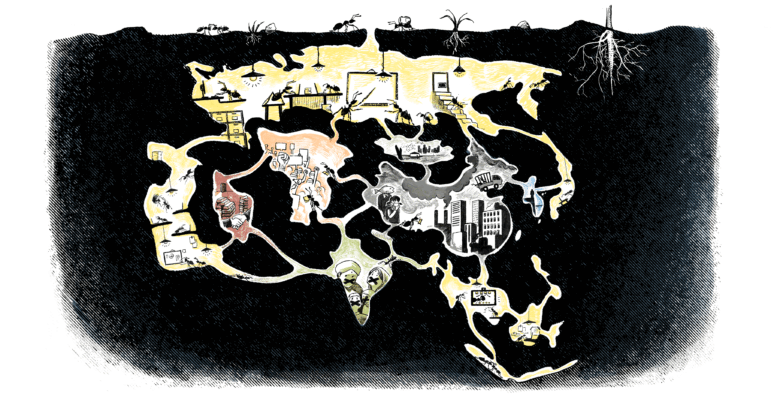
Illustration: Nyuk for GIJN
Serving as the anchor piece for a major, two-week “Asia Focus” story series, this story by Pınar Dağ and GIJN’s Asia editors set out both the growing challenges and collaborative opportunities facing that continent’s independent media community.
“While journalism in Asia is currently besieged by authoritarian state structures, censorship, and digital misinformation threats, it is also being redefined by younger generations armed with new media tools, and remains an invaluable method for holding power to account,” it pointed out.
The fundamental obstacle facing Asian journalists is chillingly displayed in one embedded graphic, showing a dramatic decline in press freedom in the past decade. But it also reveals growing public support for investigative journalism in places such as Indonesia, Thailand, and — especially — the Philippines, where independent newsrooms continue to inspire with innovative models for investigation and public engagement.
It also summarized the results of a survey of GIJN’s more than 30 Asian member organizations, and included regional deep dives on issues facing Central Asia; India, Pakistan, and Sri Lanka; Southeast Asia; and China, Hong Kong, and Taiwan.
Looking Back on Five Years: How the Sigma Awards Have Rallied and Inspired Data Journalism Excellence
Image: GIJN, Sigma Awards
Recognizing the Sigma Awards’ new home at the Global Investigative Journalism Network, this piece dug into the impact and future of the premier prize recognizing the best data journalism around the world.
The richly-sourced story explained how the 2,875 project entries from more than 100 countries in the competition’s first five years have served as a catalyst for more ambitious and innovative public interest projects for newsrooms of all sizes in every region, and also as a map for the evolution of data journalism itself.
As former Sigma executive director Marianne Bouchart explains: “The Sigmas aren’t just about who’s best — they’re about what’s possible.”
Topics tackled by shortlisted entrants over the five years represent a showcase of the world’s most pressing challenges, from COVID-19 response failures and hidden climate change impacts to rising authoritarianism and the growth of cross-border organized crime networks. Asked for favorite entries that blazed new trails on what is possible, jury members cited the Financial Times’ How China is Tearing Down Islam — which used free satellite imagery to show that three quarters of the 2,312 mosques analyzed in China had been physically modified to erase Islamic features — and Mapping Makoko, in which the group Code for Africa used drones, document analysis, and an active partnership with residents to literally put a neglected Nigerian informal settlement on the map.
Gina Chua, chair of the Sigma Prize Committee, also reveals two key innovations that led to a dramatic growth of entries from the Global South: the expansion of the application form to eight languages, and the elimination of all prize categories. This expansion is well illustrated via an interactive graphic within the story. (Applications for the 2026 awards are now open.)
Why Any Reporter Can Now Source Free, Quality Satellite Images of Almost Anywhere on Earth

In a map that reveals the global reach of free satellite data, the areas in green (above) are those imaged by the medium to high-resolution Sentinel 2 satellite constellation every five to six days. Image: European Space Agency
A richly useful and popular GIJN webinar on free satellite image access this year led to a blockbuster panel at the NICAR data journalism summit in the US, and also to this broader story on the game changing availability of this technology for investigative teams. The webinar itself was triggered by the popularity of an earlier GIJN feature sharing the insights of the ultimate sources on the access topic: journalists who were formerly engineers with private satellite companies. This series of GIJN training resources reflects both a vast appetite for free remote sensing evidence among journalists around the world, and the new availability of images from space at ever-higher resolution.
While a misperception persists among many newsrooms that satellite imagery either involves high cost or special media arrangements with private companies, Carl Churchill, graphics reporter at The Wall Street Journal, noted: “Most satellite data is free, open, and global.”
The 2025 story highlights the powerful, easy-to-use features of the open source Copernicus Browser, which allows single image downloads, a simple cloud cover filter, data overlays, and compelling timelapse displays. The story also revealed new use-cases for these images, such as scouting perilous field reporting trips prior to travel. And it quotes a former satellite company engineer — data journalism trainer Laura Kurtzberg — on numerous tips to pitch commercial providers for the use of ultra-high resolution imagery in investigations.
The USAID Crisis and Funding the Future of Independent Media

Image: Shutterstock
This emergency response story in February set out the sudden crisis for independent nonprofit media from the shock freeze on USAID foreign assistance funding, as well as mitigation strategies and inspirational solidarity from the investigative community.
In response to the sudden loss of US$268 million in agreed grants for independent media in more than 30 countries, key sources shared urgent tips on legal challenges, reader support models, and funding diversification strategies. But the story also showed the devastating harm to public interest journalism caused by the Trump administration’s decision, including grave threats for exiled outlets and independent media in places such as Ukraine, Cameroon, and throughout Central America. The piece shows how Ukraine’s Slidstvo.info, an award-winning independent investigative agency, lost 80% of its funding in a single day in January, and how the independent Organized Crime and Corruption Reporting Project (OCCRP) was forced to lose the services of 43 valued reporters and staff, after losing 29% of its total funding.
Chaos and Credibility: A Snapshot of How AI Is Impacting Press Freedom and Investigative Journalism

Imagen: Shutterstock
In future-oriented reflection on the occasion of World Press Freedom Day, this piece unpacks the dual threats to independent journalism from rising authoritarianism and the rampant advance of AI.
It also illustrates the alarming landscape journalists already faced in 2025, including a Reporters Without Borders finding that the global state of press freedom had reached an unprecedented low point — with the worldwide press freedom situation ranked as “difficult” in the World Press Freedom Index, and “poor” for half of all countries.
While noting some important new opportunities and use-cases for investigative reporting presented by new tools — including some generative AI platforms — sources cited in the story explain how this technology can pose a threat to the sustainability of newsrooms, to accountability in the public interest, to minority rights, and to democracy itself. Indeed, it reveals that investigative journalism, in particular, serves as “as an antidote to the scourge of AI manipulation and misinformation” — and profiles a series of powerful investigative projects around the world that have already exposed both intentional and unintentional harms flowing from these algorithmic systems.
 Rowan Philp is GIJN’s global reporter and impact editor for GIJN. Rowan was formerly chief reporter for South Africa’s Sunday Times. As a foreign correspondent, he has reported on news, politics, corruption, and conflict from more than two dozen countries around the world.

Reporter’s Guide to Detecting AI-Generated Content

Guide to Investigating Social Media Algorithms

Guide to Investigating Fossil Fuels

GIJN Guide to Investigating Foreign Lobbying

GIJN’s 10 Must-Read Stories of 2024
The USAID Crisis and Funding the Future of Independent Media

Chaos and Credibility: A Snapshot of How AI Is Impacting Press Freedom and Investigative Journalism

‘Ghost’ Prisoners, Missing Children, Anti-Corruption Wiretaps: 2025’s Best Investigative Stories from Ukraine

This work is licensed under a Creative Commons Attribution-NoDerivatives 4.0 International License
Republish our articles for free, online or in print, under a Creative Commons license.
Republish this article
This work is licensed under a Creative Commons Attribution-NoDerivatives 4.0 International License
Read Next
Editor's Picks News & Analysis
GIJN’s 10 Must-Read Stories of 2024
Featuring a showcase of game-changing reporting methods based on insider tips from real-world investigations and conference presentations.
News & Analysis Sustainability
The USAID Crisis and Funding the Future of Independent Media
Across the investigative journalism community, GIJN has heard uniform voices of solidarity, and numerous creative strategies for surviving this fundraising crisis.
News & Analysis Press Freedom
Chaos and Credibility: A Snapshot of How AI Is Impacting Press Freedom and Investigative Journalism
GIJN offers a snapshot of how watchdog reporters are confronting algorithmic abuses and misinformation while also employing AI as a key newsroom tool.
Editor's Picks News & Analysis
‘Ghost’ Prisoners, Missing Children, Anti-Corruption Wiretaps: 2025’s Best Investigative Stories from Ukraine
Despite domestic threats to press freedom and power cuts and sleepless nights from Russian attacks, Ukrainian independent journalists continue their work with depth and skill.