
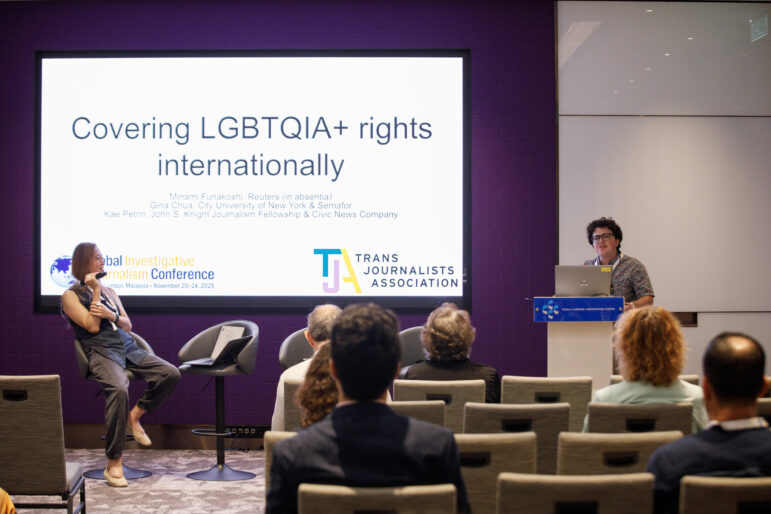
Gina Chua (left), executive director of the Tow-Knight Center at the Craig Newmark Graduate School of Journalism, and Kae Petrin, John S. Knight fellow & co-executive director of the Trans Journalists Association, speaking at the 2025 Global Investigative Journalism Conference (GIJC25). Image: Suzanne Lee, Alt Studio for GIJN
Around the world, LGBTQ+ issues have become flashpoints in wider political, cultural, and authoritarian movements. Laws around gender identity, migration, civil rights, education, and even sports increasingly use LGBTQ+ people as rhetorical and legislative targets.
“One of the things that queer people do is they shine a light on society — how society is organized and what we take for granted,” said Gina Chua, executive director of the Tow-Knight Center at the Craig Newmark Graduate School of Journalism, speaking at a session at the 14th Global Investigative Journalism Conference (GIJC25).
The impact reverberates far beyond queer communities and individual struggles.
This political pattern, Chua and co-panelist Kae Petrin, a John S. Knight journalism fellow and co-executive director of the Trans Journalists Association, warned, is spreading transnationally. Authoritarian-leaning governments are using the oppression of queer communities to justify restrictions that extend beyond LGBTQ+ people.
Navigating a Field of Underrepresentation
Investigating LGBTQ+ stories requires navigating a reporting environment defined by scarcity of data, safety concerns, and inconsistent newsroom support. These challenges shape not only how these stories are told, but whether they are told at all.
The GIJN25 panelists emphasized that the LGBTQ+ reporting beat contains opportunities for high-impact investigations, but accepted that there are still challenges.
Data Does Not Exist, Is Fragmented, or Both
Data about LGBTQ+ experiences and identities is either missing, mislabeled, inconsistently collected, contradictory, or trapped in dozens of incompatible systems. When data doesn’t exist, journalists must collect it and create it.
“The data is a mess,” said Petrin, while encouraging reporters to collaborate with outside experts such as NGOs and community organizers, in addition to data journalists.
Activists often have access to unpublished surveys, community-gathered records, or regional reports with information about hard-to-reach populations that can be plugged into datasets.
“Some of the most successful [LGBTQ+] investigations combined data from dozens of sources into a single holistic set,” Petrin explained, while cautioning that reporting methodologies should always be transparent about data limitations.

Gina Chua, executive director of the Tow-Knight Center at the Craig Newmark Graduate School of Journalism, shared insights on how to cover stories impacting the LGBTQ+ community. Image: Suzanne Lee, Alt Studio for GIJN
In Honduras, Dunia Orellana investigated and revived the cold case murder of trans woman Vicky Hernández by reconstructing the broader pattern of anti-LGBTQ+ violence. She obtained records for more than 200 victims and traced each case through the justice system, finding that only 24 had advanced judicially. By piecing together disparate police files, court documents, and historical evidence, Orellana built a comprehensive picture of systemic impunity. Her investigation became key evidence in an Inter-American Court ruling that held Honduras responsible for Hernández’s murder — for failing to prevent, investigate, and prosecute the death of a trans person.
Nurturing Sensitivity, Trust, and Safety in Interviewing Sources
Interviewing LGBTQ+ people, especially those living in hostile environments that criminalize gender diverse identities, requires careful reporting. Sources may be traumatized, at risk, undocumented, or unfamiliar with media.
Zahra Nader, an Afghan-Canadian journalist, who attended the discussion, asked: “I don’t want to speak for LGBTQ people because I’m a cisgender woman. I want to give them representation. I want them to represent themselves and tell their stories. How do I do that?”
As a starting point, Petrin suggested reporters and editors read “Why Should I Tell You? A Guide to Less Extractive Reporting,” published by the University of Wisconsin-Madison School of Journalism and Mass Communications for conducting trauma-informed and survivor-focused interviews. While the guide is not only focused on LGBTQ+ reporting, the lessons on preventing harm during and after the interview apply.
Tips include, first and foremost, letting the source know what to expect when a story comes out. Some sources are not used to dealing with the media and may not be fully aware of how a story may affect them once it is published. The guide suggests asking specific questions, such as if any of the information an interviewee shares could potentially put them or family members living in another country in danger.
The guide also suggests giving some of the editorial control back to the respondent by having the story read back to them before publication. The time between the interview and the publication can mean changes in the level of risk faced. A readback allows the source to decide whether or not to omit certain information.
In areas where LGBTQ+ sources face criminalization, such as Afghanistan and some Middle Eastern or African states, the panelists suggested partnering with groups who are familiar with the local context and culture and can assess potential risks.
Local partners such as NGOs and advocacy groups can advise on how to approach sources, help identify who is safe to speak, and give guidance on what questions may retraumatize.
Getting Stories Into Mainstream Media
Some mainstream newsrooms resist LGBTQ+ investigative work, dismissing it as low-interest or limited in scope.
QueerAF, a community outlet in the UK, uncovered extreme delays in gender-affirming healthcare, finding that wait times at some UK clinics would, in theory, stretch to an astonishing 224 years. To document the situation, the team worked closely with community organizers, advocacy groups, and clinic-level sources to gather and verify data.
There was initially little interest in the story among mainstream newsrooms, yet once published, The Gender Clinic Files garnered over half a million views and became the outlet’s most widely read story, driven by strong community engagement and widespread public concern. The story has since been picked up by other local outlets.
For stories to have broader reach and wider resonance, the panelists emphasized the need for reframing stories to show systemic failures, and to identify where LGBTQ+ stories intersect with other pressing issues.
“Frame them as governance failures that cause administrative chaos, violate federal law, or cost taxpayers money, not [only] ‘identity stories,’” Chua urged.
Other sources
- ILGA-Europe “Guidelines for Journalists” contains practical advice on reporting on queer issues and includes tips on how to talk to and about LGBTQ+ subjects, language and pronouns, and specific recommendations for developing stories that involve trans and intersex people. A list of essential resources with relevant data is also included
- Taboom Media‘s reporting guide for investigating how US-based faith groups and NGOs fund and support “hate groups that aim their vitriol at sexual and gender minorities in the US and abroad.” The guide offers tips on using public records to uncover these groups’ finances and hidden activities, along with a list of known anti-LGBTQ+ propagators which include key financiers, NGOs, and individuals.
- GLAAD Media Reference has specific sections on conversion therapy practices, sports and underrepresented sexual identities such as non-binary and intersex people.
Using FOIA to Track Trans Rights in Trump’s America
LGBTQ Resources: Data, Documents and Sources
LGBTQ Resources: Investigative Reports
LGBTQ Resources: Media Guides

Maria Ressa on the Battle for Truth, the Role of America’s Social Media Platforms, and What Comes Next
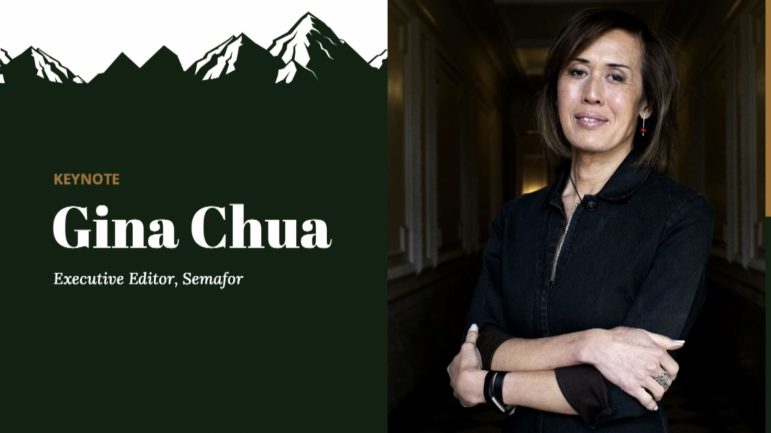
Gina Chua on How to Reach Underserved Communities: Journalism For – Not About – Them

From Mentoring to Refusing to Stay Silent: Strategies for Women in Investigative Journalism
Tips for Investigating Hate Crimes and Violence When Government Data Sources Fail

This work is licensed under a Creative Commons Attribution-NoDerivatives 4.0 International License
Republish our articles for free, online or in print, under a Creative Commons license.
Republish this article
This work is licensed under a Creative Commons Attribution-NoDerivatives 4.0 International License
Read Next
Maria Ressa on the Battle for Truth, the Role of America’s Social Media Platforms, and What Comes Next
Before she could even start to speak, Maria Ressa received a standing ovation, which brought tears to her eyes. She was out on bail, and was forced to pay a travel bond in order to leave the Philippines and come to Hamburg, where she gave a keynote address to an auditorium full of fellow investigative journalists from around the world.
News & Analysis
Gina Chua on How to Reach Underserved Communities: Journalism For – Not About – Them
Gina Chua’s keynote address to the IRE22 conference in Denver, in the US, emphasized how rebuilding public trust in investigative journalism requires a diverse workforce that truly represents and engages with the communities it serves.
GIJC25
From Mentoring to Refusing to Stay Silent: Strategies for Women in Investigative Journalism
Women investigative reporters face harassment, surveillance, and personal risk. Here are practical strategies to confront these challenges from female journalists on the front lines.
Data Journalism Methodology News & Analysis
Tips for Investigating Hate Crimes and Violence When Government Data Sources Fail
Journalist Rachel Chitra used news reports to build a database on hate crimes and violence in India. Here she gives tips for reporters facing a data gap, and offers lessons learned from her research about how journalists can reliably step in to gather, clean, and publish data when the government fails to keep track of important information.