

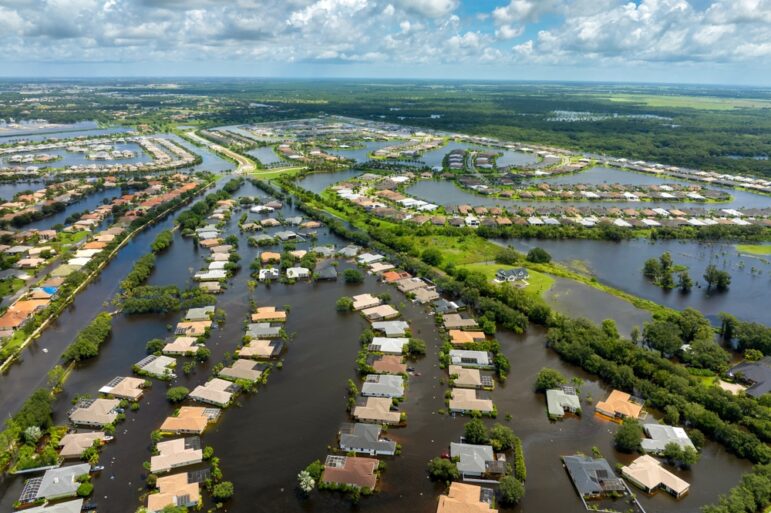
Flooding across a neighborhood in central Florida in the aftermath of a hurricane. Image: Shutterstock
Tips for Choosing Climate Stories that Make an Impact
Read this article in
Climate change touches everything — from housing insurance to food security to global finance — and so reporters at South America’s small Consenso newsletter could have chosen almost any angle when they decided to explore the topic in Paraguay last year.
Instead, they listened to the concerns of vulnerable communities in Paraguay’s major cities, and chose to investigate a particularly urgent issue very likely to trigger reader interest: the needless suffering of children at school.
Their story — accompanied by an interactive map — revealed that more than 115,000 children attended schools in sweltering urban “heat islands” and suffered from a deficit of drinking fountains, air conditioning, and bathrooms, putting them at increased risk of everything from dehydration to breathing problems and absenteeism.
In a recent webinar titled How Climate Investigations Get Results, hosted by The Centre for Investigative Journalism (CIJ), Consenso reporter Maximiliano Manzoni said the heat islands story immediately led to public hearings in the nation’s congress, and also the creation of a commission to share the findings with educational institutions.
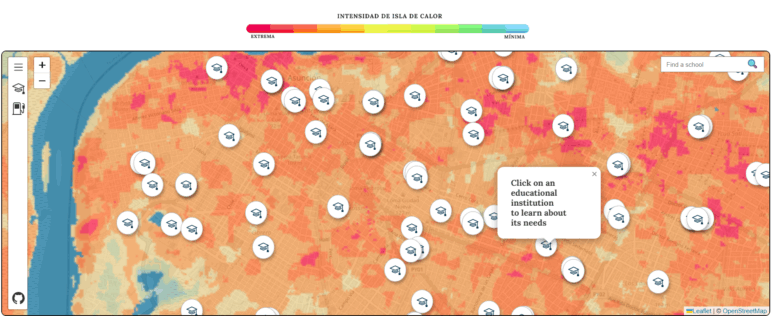
Consenso’s mobile-friendly interactive map of schools and color-coded “heat islands” in Asunción, Paraguay. Image: Screenshot
Given widespread misinformation, climate skepticism, and growing autocracy around the world, Manzoni and three fellow environmental journalists urged webinar attendees to approach more climate and environmental investigations in this way: by including likely impact or affected parties in their story choices. For instance, if reporters think of readers as parents, potentially powerful story ideas may begin with questions such as: ‘Are major oil or agricultural companies quietly influencing school curricula?’
The webinar recognized the achievements of CIJ’s Open Climate Reporting Initiative (OCRI) and also included the speakers Nina Lakhani, climate and environmental justice reporter at Drilled Media; Adeolu Adekola, OCRI Project Manager; and Syed Nazakat, Founder and CEO of DataLEADS in India.
OCRI, a CIJ initiative that seeks to raise the standard of environmental investigations, has trained journalists from 58 countries in the past three years. In a collaboration with OCRI, Africa’s Oxpeckers investigative environmental newsroom recently produced an insightful example of how to gather data and investigate the financing of green energy schemes, with its Investigating Renewable Energy in Southern Africa project. (Inclusive Development International’s Follow The Money Toolkit includes a comprehensive list of global resources on renewable energy projects.) Notably, OCRI includes an excellent list of climate-related databases and impactful investigations globally in its Tools and Resources page.
The panelists agreed that reporters should now view the climate change crisis as a newsroom-crossing “theme” or “lens,” rather than merely a “topic.”
Panelists also offered up other useful pathways for climate and environment investigations that strongly resonate with audiences.
Find new impacts via all other newsroom beats. “Climate crisis is something impacting every person and every single beat,” Lakhani noted. “The Miami Herald has multiple real estate reporters, and one is now just focused on climate change impacts on real estate in Miami. Unless we make climate a newsroom-wide issue, like we do for the economy and politics, we’re never going to keep up.” Added Manzoni: “We need more journalists adding climate in their everyday beats; we need more local reporters using the climate lens; more economy and sports and fashion journalists, because climate change only increases inequalities.”
Consider an emotive or popular focal point for climate investigations, such as impact on children, sports, or entertainment. Describing the Paraguay heat islands story, Manzoni said: “This impact happened because we aimed for it. We talked with the team before starting the investigation, because we wanted to think about climate not as a topic, but rather as a lens — and we wanted to talk about children, heat, and education. We talked to the communities about the lack of infrastructure at schools — like water, ventilation, even bathrooms — and how we could present it in a way you can share it with your neighbors, and, also, the cheapest way possible.”
This was echoed in a recent GIJN story, titled Tips to Investigate Climate Change Impacts in an Era of Science Denialism, where Tracy Wholf, an environmental coverage producer for CBS News, noted that a successful greenwashing investigation looked into how fossil fuel companies advertise during popular sports events in the US, such as the March Madness college basketball tournament. “Or you can look at something like Christmas trees — there are a lot of climate issues involving Christmas trees,” she added.
Consider sharing your methodology with official environmental agencies. With impact as a key goal, Manzoni said newsrooms could even consider sharing their investigative methodologies with government agencies to avoid potential environmental mistakes.
He recalled a case where one Latin American government had been genuinely unaware that the boundaries of a lithium mining license it had issued overlapped onto protected Indigenous land, as he had found using open source research methods. After he shared his own methodology with the relevant department, it has since made it a practice to check for potential oversights going forward.
“We were very critical about the fact that the ministry had failed to see that the mining license was on protected land, but, at the same time, we showed the department: ‘This is how we identified it, and you can use it for other cases,” he recalled. “Being very firm, but also being transparent and respectful, can also get lasting impact.”
Try to connect climate issues to “kitchen table” cost-of-living issues. “The toughest job in climate journalism is finding story ideas,” said Nazakat. “Unless you make climate change relevant to daily life, it will not resonate with people. We see IPCC UN discussions: ‘policy frameworks.’ Audiences do not really understand this language. What about if we show people: ‘Because of climate change, your food supply is becoming disturbed;’ ‘You may not have this vegetable in two years, or this fruit in the normal season;’ or ‘Climate change may actually increase your electricity bill next year?’ Then answer how.”
He added: “And instead of saying 1,000 people die per year [in your country] because of heat deaths, better to say X number of people are dying per day.”
New visualization tools can themselves lead to better impacts. Manzoni said Leaflet — an open source library for interactive maps that requires minimal coding skills — was a good example of a tool that can demonstrate climate-related issues and how they affect communities, by using interactive popups and mobile-friendly zoom features. He added that web-based visualization tools such as Datawrapper, Google Maps, Global Forest Watch, and Sentinel satellite imagery (via browsers such as Copernicus) offer powerful ways to increase reader awareness and engagement.
Collaborate with experts far from the daily news agenda. Panelists noted that reporters should take advantage of the fact that scientists and academic researchers often study climate impacts that newsrooms rarely consider. “I’d encourage reporters to collaborate with people outside of journalism: with economists, climate scientists, medical examiners, nonprofit researchers,” Lakhani advised. “There are things that are just beyond the time and data resources that journalists have.”
Changing the current narrative on climate counts as impact. “When we’re thinking about impact, a large part is just changing the narrative,” Lakhani explained. “By thinking about how we tell these stories, we can have impact on so many levels — from moving one reader to offer help, to changing a national policy or seeing a corrupt mayor being ousted from his job.” Manzoni said some of these stories gain traction in unexpected ways — such as the emergence of a compelling character, or sheer luck in the timing of news events that coincide with publication, but that you have to continue to pursue climate stories to discover these benefits. “Sometimes impact can be only moving the Overton Window on a topic: sometimes it’s about planting a flag by saying ‘This is happening,’ and someone else will take that flag forward,” Manzoni said. “Impact is not always linear in that way.”
He added: “It can be about exposing greenwashing claims. Sometimes adding a fresh discussion so you keep it in the collective mind. You can aim to trigger specific policy change, but sometimes it’s a matter of luck — such as a story in a particular election year.”
“Misinformation around climate is now very location-specific and targeted, so we need to be country- and region-specific in our approach,” Lakhani added. “I spent a lot of time last year reporting on communities hit hard by hurricanes and floods in Appalachia [in the US], where it was very hard to meet anyone that didn’t think climate change was a hoax. But I also spent time in Acapulco, Mexico, hit by two hurricanes, where everyone was talking about climate change.”
The panel noted that a rich trove of stories and impacts lie in the fact that the climate change era is beset with greed, disinformation, supply chain harms, and inequality.
“We are not all in it together: not everyone has contributed to the climate crisis; not everyone is impacted in the same way; and not everyone has access to the solutions available,” Lakhani explained. “And there are a lot of corporations and interests invested in the status quo.”
 Rowan Philp is GIJN’s global reporter and impact editor for GIJN. Rowan was formerly chief reporter for South Africa’s Sunday Times. As a foreign correspondent, he has reported on news, politics, corruption, and conflict from more than two dozen countries around the world.

GIJC23 – Climate: Investigating Impacts

Climate Change Accountability: Guide to Investigating Methane

GIJN Guide to Investigating Extreme Heat
Full Report: The Investigative Agenda for Climate Change Journalism
Tips to Investigate Climate Change Impacts in an Era of Science Denialism
How to Investigate the Impact of Global Energy Companies on Local Public Health

Measuring Journalism’s Impact — What We Know Now That We Didn’t Before
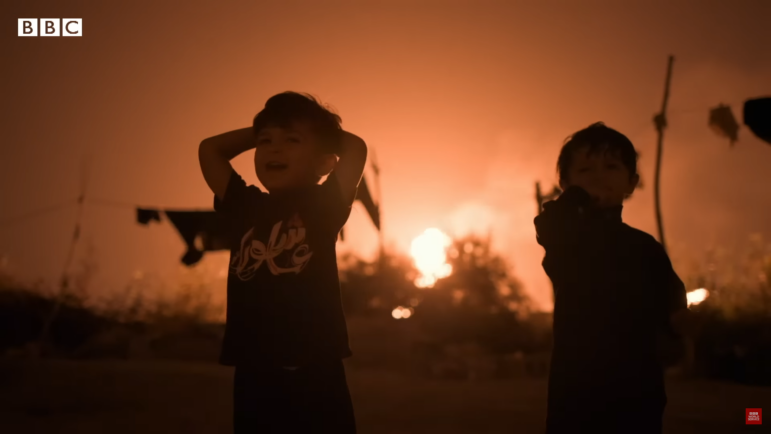
How a BBC Investigation Exposed the Impact of Gas Flaring on Iraqi Communities

This work is licensed under a Creative Commons Attribution-NoDerivatives 4.0 International License
Republish our articles for free, online or in print, under a Creative Commons license.
Republish this article
This work is licensed under a Creative Commons Attribution-NoDerivatives 4.0 International License
Read Next
Reporting Tools & Tips
Tips to Investigate Climate Change Impacts in an Era of Science Denialism
As oligarchs and populist governments ratchet back the gathering and dissemination of climate-related information, journalists can use these techniques to find relevant sources and track impact.
GIJC25
How to Investigate the Impact of Global Energy Companies on Local Public Health
Multimedia investigations across Africa and the Middle East highlight the links between environmental damage and public health, while seeking to expose who is responsible.
Methodology Sustainability
Measuring Journalism’s Impact — What We Know Now That We Didn’t Before
Recent research suggests that the effects of investigative and collaborative reporting are more far-reaching on the journalism community than we had imagined.
Case Studies
How a BBC Investigation Exposed the Impact of Gas Flaring on Iraqi Communities
In “Under Poisoned Skies,” an award-winning investigation from BBC News Arabic, reporters headed to southern Iraq to explore the impact of gas flaring on the environment and public health.