
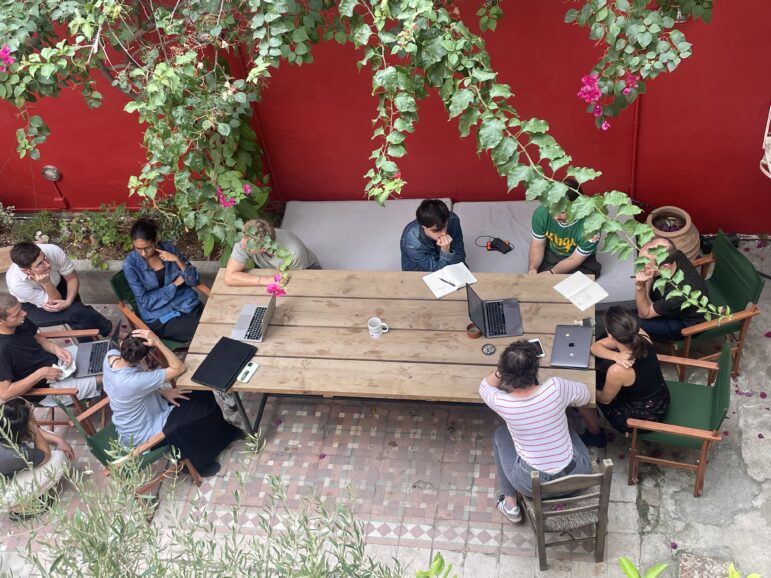
Image: Ariadne Papagapitos, Lighthouse Reports
How Just an Email’s Tone Can Threaten Collaboration — and Other Lessons Learned from Seven Years of Multi-Partner Investigations
Read this article in
The best kinds of collaborations can feel effortless: Where every partner is heard and pulls their weight, where differences elevate discussions and the final investigation is greater than the sum of everyone’s work.
But seasoned editors know just how much effort they involve. It takes grit and otherworldly calm to power through the new variables that collaborative investigations constantly throw up. There is no universal template to follow, even when journalists are united by a desire to expose injustice and seed change.
At Lighthouse Reports — which was founded in the Netherlands in 2019 and which now publishes an average of 12 investigations a year — members of our impact team reach out to partners for feedback after each investigation. These debriefs help us document disputes that are invariably played down after publication.
Cultural differences, for example, nearly caused one of our partners to pull out midway through a recent investigation. He was upset over the “businessy” tone of emails sent by one of my colleagues, and would have quit had another partner not intervened. He shared this frustration during a debrief, prompting us to pay closer attention to our communication styles.
But such insights are hard to get. Power dynamics, shrinking funding, and plain overwork prevent many journalists from speaking honestly about their experiences. So in September 2025, we set out to expand the debrief process by launching an anonymous survey of 198 people who had collaborated with us on recent investigations, who range from individuals in legacy media outlets and exiled newsrooms to freelancers. We worked with independent consultants Rosie Maguire and Anna Dent to ask our partners what they wanted from a collaborative investigation, and how our processes helped or failed them. While the questions and responses were specific to our work at Lighthouse, we feel the answers can also offer helpful tips to others running collaborative investigations.
Seventy-six people responded, with a clarity of purpose that was honestly humbling. We asked respondents to pick three collaboration objectives from a menu of seven, as well as suggest others. This was how the goals stacked up in order of priority.
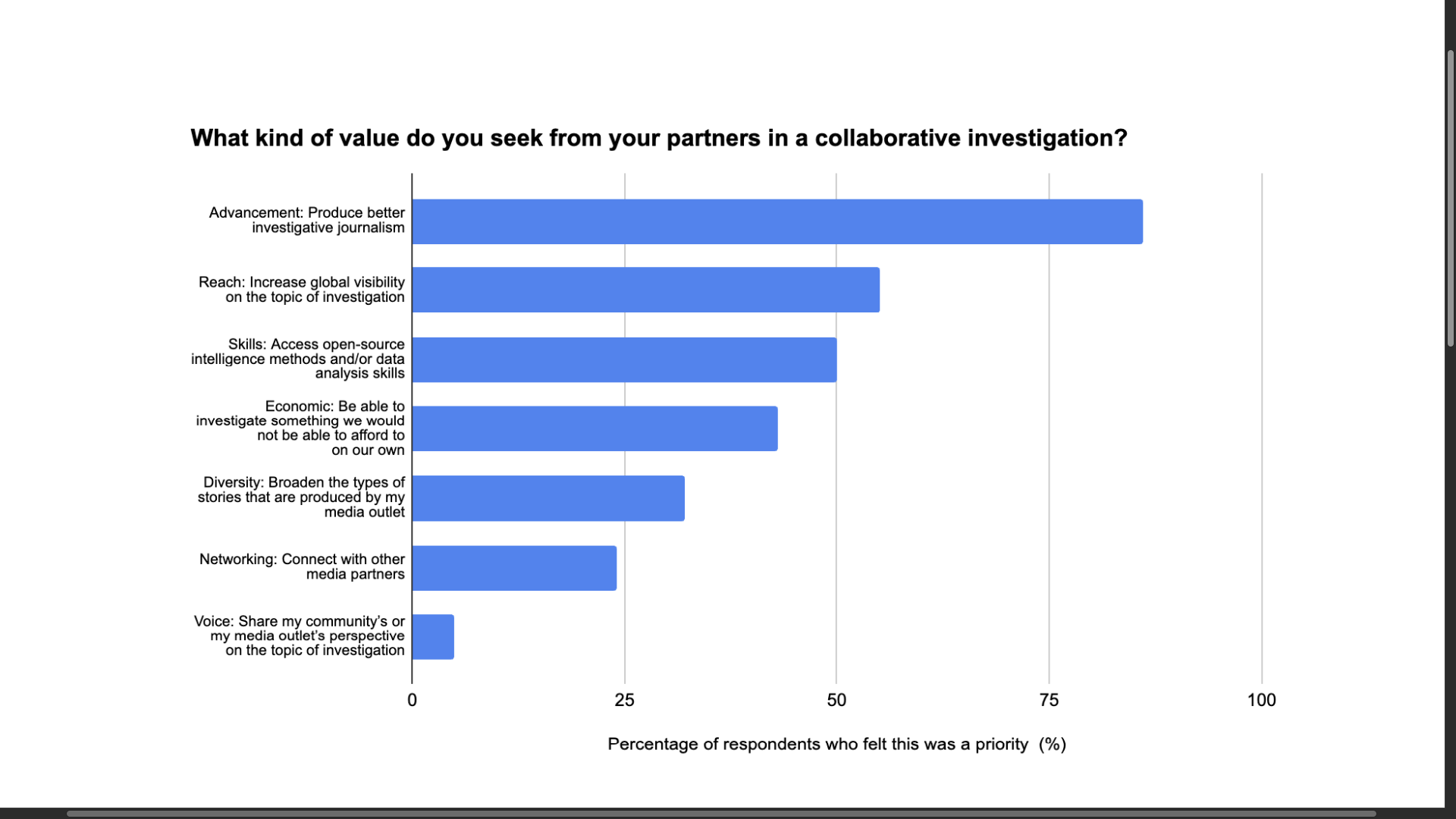
In the qualitative feedback, our partners said they valued work that had real-world impact, collaborations that centered around a clear, bold vision, and also projects that had space for creativity. They sought mutual respect and equity. On a more practical level, they wanted reliable and responsive collaborators who manage investigations with a clear direction. They said that it was important for there to be clarity on their role and that of other partners in the same investigation.
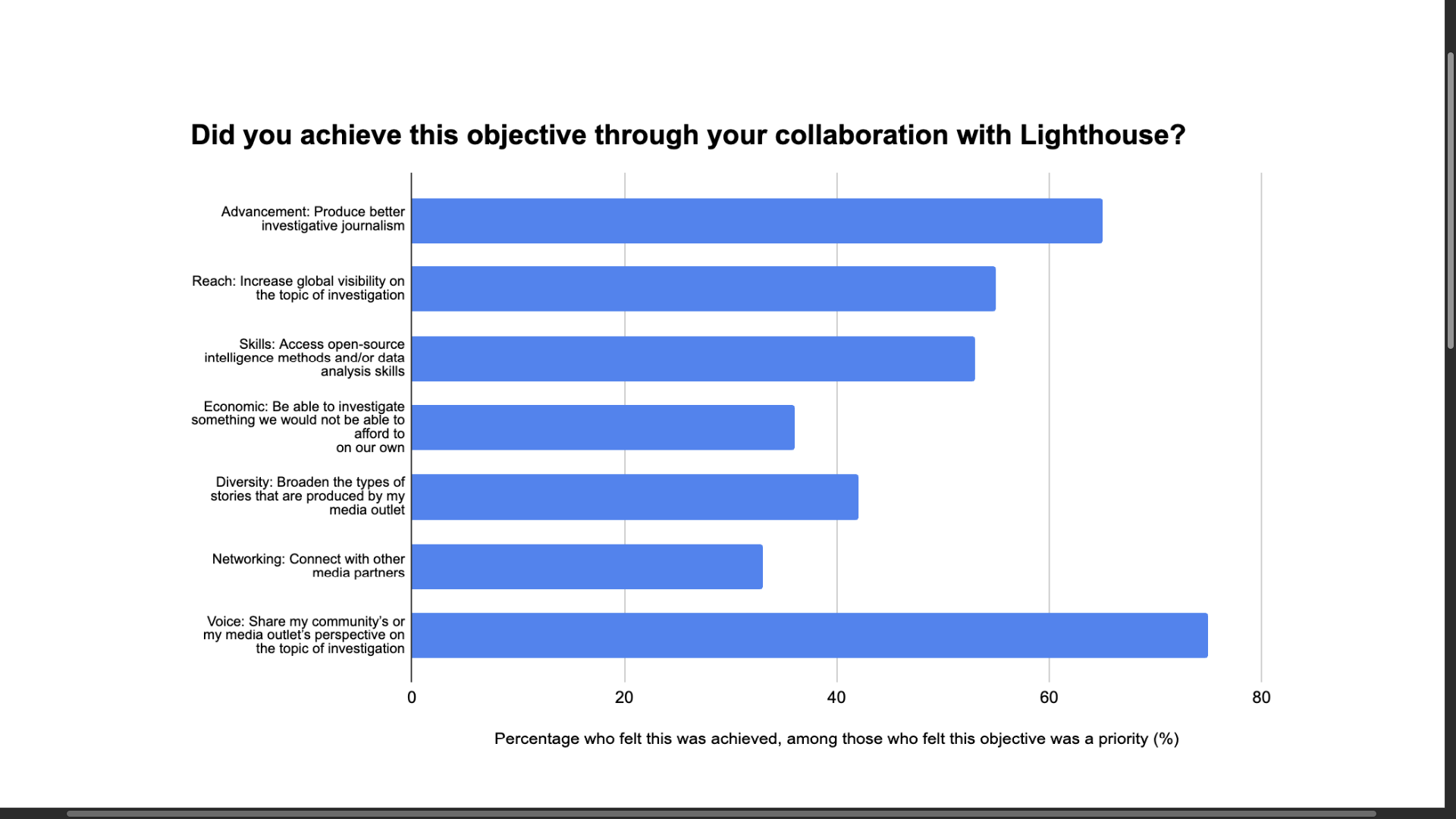
By and large, respondents felt they achieved many of their key objectives in their collaborations with us. But we wanted to zoom in even more to find out satisfaction rates on the issues that partners identified as being a top priority for them, and there, the picture was not always so rosy.
Less than half of partners who really cared about broadening the type of stories covered by their media outlet felt they achieved that through their recent collaboration with us. Ditto for those who prized collaborations for their potential to investigate something they would not be able to conduct on their own, and for those who felt it was important that collaborations connect them with media partners beyond Lighthouse.
There was a lot to chew over, but respondents thankfully gave suggestions on directions we could take. Much of it involved communicating and managing expectations. Respondents want our fact-checking process, for example, to be shared upfront and agreed upon to avoid undue stress downstream. They wanted clarity on what is needed to ensure impact. They wanted to be clear about Lighthouse’s role in facilitating follow-up investigations.
Crediting and publication timelines were a source of contention. Respondents observed that bigger media outlets had more say over publication timelines than smaller ones, and that staff journalists who came onboard late in the investigation got the same credit as freelancers who did the heavy lifting. They wanted Lighthouse to manage this by making decisions fairly and transparently.
We are reflecting on these concerns. While we think of how to do better, we are also conscious that some things are beyond our control. In collaborations led by Lighthouse, we are not referees but team captains: We cajole, mediate, and try to model better behavior to nudge investigative coalitions towards collectively desired outcomes. Trade-offs are routine.
This is not to say that everything is complicated. One of the sections of our survey dealt with the platforms and methods for communication. We were curious about how our partners wanted information to be shared. Do we, for example, use reporting memos, investigation road maps, or summary tables to keep everyone up to date? Do we coordinate work on Signal, Slack, or WhatsApp? What worked best?
Turns out, the answer was “anything.” No matter which method or platform was used in their investigations, similarly high proportions of partners said they received regular and comprehensive updates. Our partners didn’t really care how we kept them informed, as long as we kept them informed.
Now that’s an easy win to reprise, while we mull over the thornier elements of collaboration.
 Hui Yee Tan is the managing editor of Lighthouse Reports, a nonprofit organization that publishes collaborative investigations in multiple formats with its partners. The outlet focuses on deeply reported public interest investigations that cross borders, blending traditional approaches like freedom of information with data science and visual forensics. Prior to joining Lighthouse Reports, she was The Straits Times’ Bangkok-based bureau chief, helming its coverage of Thailand, Myanmar, Laos, Cambodia, and Vietnam.
Radical Collaboration: Why It’s the Antidote to Big Tech

Project Management: Collaborative Journalism

Project Management: Team Dynamics and Collaboration

Introduction to Investigative Journalism: Collaborations
Managing the Collaboration: The Growing Importance of the Investigative Coordinator

Teaching Cross-Border Collaborations: 7 Tips for Journalism Educators

The Power of Collaboration: El CLIP and the Plan to Transform Latin America’s Investigative Ecosystem

The Top 10 Journalism Collaborations of 2025, according to the Center for Cooperative Media

This work is licensed under a Creative Commons Attribution-NoDerivatives 4.0 International License
Republish our articles for free, online or in print, under a Creative Commons license.
Republish this article
This work is licensed under a Creative Commons Attribution-NoDerivatives 4.0 International License
Read Next
Getting the Story Out
Managing the Collaboration: The Growing Importance of the Investigative Coordinator
The role is frequently described as a lynchpin in investigations, and the more moving parts, partners, and countries, the more vital this position becomes.
Getting Started in Investigative Journalism Teaching & Training
Teaching Cross-Border Collaborations: 7 Tips for Journalism Educators
Two veteran journalists and educators share their experiences running a program to teach aspiring reporters how to collaborate across borders.
LATAM Focus Member Profiles News & Analysis
The Power of Collaboration: El CLIP and the Plan to Transform Latin America’s Investigative Ecosystem
CLIP was founded by three leading journalists who shared the conviction that to mirror the transnational challenges journalists face in Latin America, the stories had to be cross-border too.
News & Analysis
The Top 10 Journalism Collaborations of 2025, according to the Center for Cooperative Media
Of note this year are projects tackling everything from cryptocurrency crime to climate action, from transnational repression to immigrant news infrastructure.