
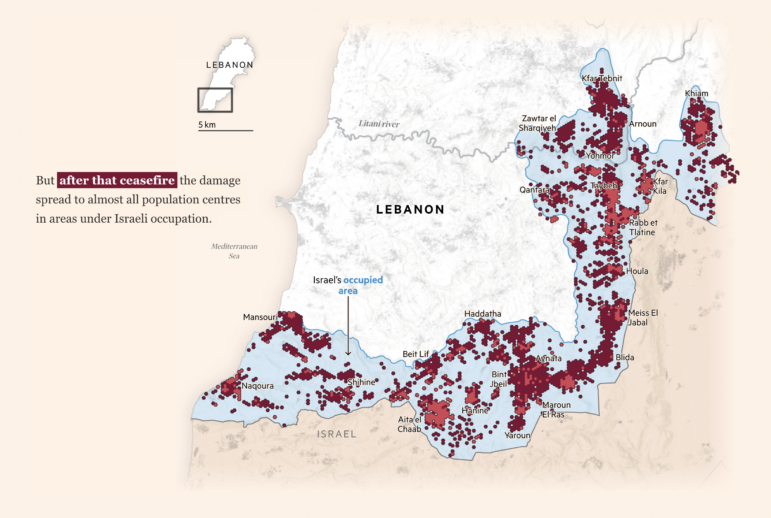
The Financial Times examined Israel's occupation zone in southern Lebanon and its military's dismantling of civilian infrastructure before the April 2026 ceasefire (light red dots) and after (dark red). Image: Screenshot, Financial Times
Israel’s Occupation of Southern Lebanon, The US$1 Trillion Pentagon Budget, How Amazon’s AI Eats Rare Books, Tracing Britain’s DNA History
Israel’s military campaign in southern Lebanon has displaced more than one million people and destroyed thousands of homes. Using satellite imagery analysis, a Financial Times investigation examined the widespread destruction that has occurred before and after an initial ceasefire in April. Our latest Top 10 in Data Journalism round-up, looking at stories from August 12 to 25, also includes a piece from The Economist comparing how school-aged children perform when using AI, a Bellingcat investigation following the journey of a Russian-sanctioned ship from the Sea of Japan to the west of Africa, and a ProPublica analysis of the unprecedented Pentagon military spending on programs that are increasingly expensive and delayed.
How Israel Is Dismantling Southern Lebanon
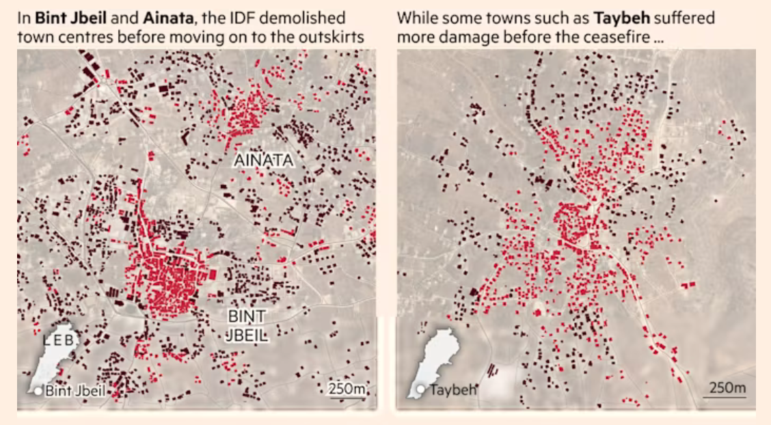
Comparing destruction before the April 2026 ceasefire (red dots) and after (brown dots). Image: Screenshot, Financial Times
Israel intensified its military operations in Lebanon on March 2, shortly after the US-Israel war on Iran began. Its campaign has devastated much of Lebanon’s south, displacing more than one million people. An initial ceasefire was announced on April 17, but Israeli forces continued to occupy and flatten parts of the south after the truce. A Financial Times visual investigation with Lighthouse Reports found systematic destruction across Israeli-occupied areas of southern Lebanon, including tens of thousands of homes, schools, farmland, and forests. Satellite imagery, open source data, and verified footage show that much of the damage occurred after Israeli forces established control over emptied villages in mid-April. Reporters used satellite imagery to map destruction across Bint Jbeil, Khiam, Taybeh, and Haddatha, finding widespread damage caused by demolitions, bulldozing, and air strikes, including to historic and UNESCO-listed sites. The story reveals how Israel’s occupation has become entrenched; the “yellow line” — an Israeli military-imposed buffer zone — now covers about 6% of Lebanese territory.
AI’s Impact On Exams
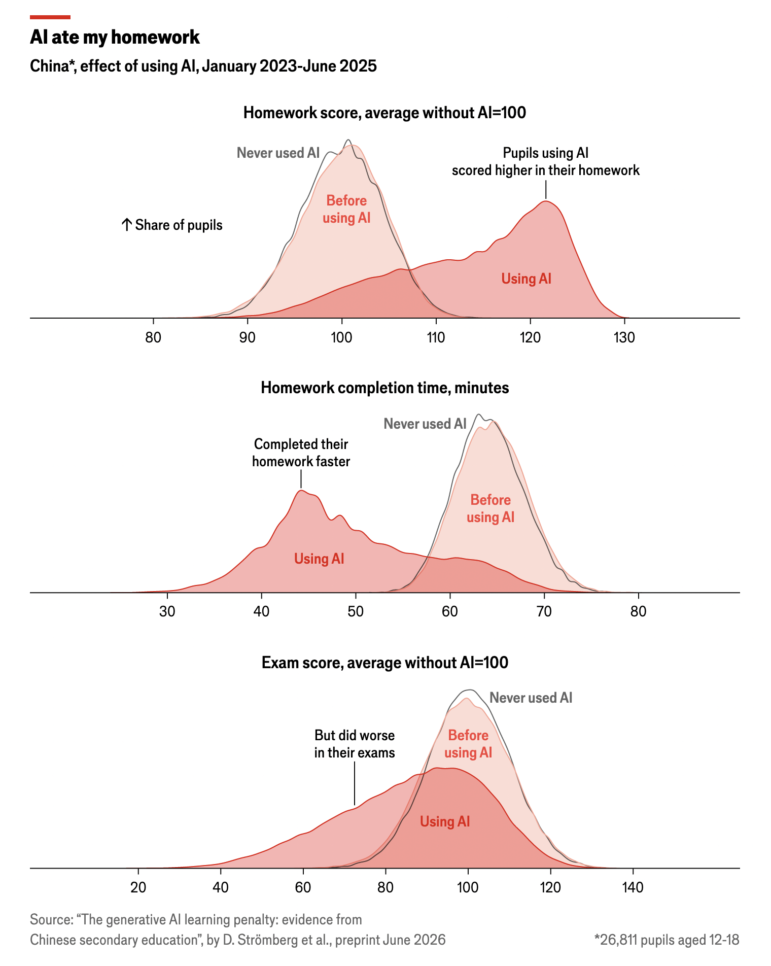
Image: Screenshot, The Economist
Students are using AI more and more to complete their homework, but research suggests that relying on it too heavily can lead to poor exam performance. Researchers from Stockholm University and the University of Hong Kong tracked 26,811 school-age pupils in China, where about 80% reported using AI. Comparing students, the study found that those who used AI saw homework scores rise by 18% while the time they took to complete their assignment fell from 64 to 45 minutes; however, they scored 20% lower in exams after six months. The Economist visualized the findings using density charts comparing pupils before and after adopting AI with those who never used it. It also noted that students who used AI as a tutor rather than to simply complete assignments performed better.
How the Pentagon Spends US$1 Trillion
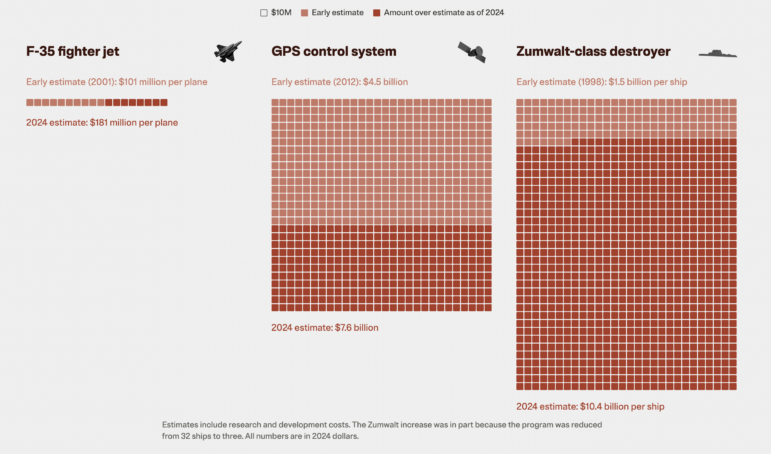
Image: Screenshot, ProPublica
The Pentagon’s budget has reached unprecedented levels, with Congress appropriating US$1 trillion for defense this year as some of the military’s most ambitious weapons programs have become increasingly expensive and delayed. ProPublica launched an investigative series examining how the money is spent, analyzing financial records and Congressional documents behind the F-35 fighter jet, the Next Generation Operational Control (GPS) System, and Zumwalt-class naval destroyers. The analysis revealed how projects initially promoted as affordable repeatedly exceeded their budgets and delivery schedules. A waffle chart compared original estimates with 2024 costs, showing that the price of F-35s rose from US$101 million to US$181 million per plane, GPS systems for satellites increased from US$4.5 billion to US$7.6 billion, and Zumwalt ships’ costs climbed from US$1.5 billion to US$10.4 billion each.
Tracking a Sanctioned Russian Vessel
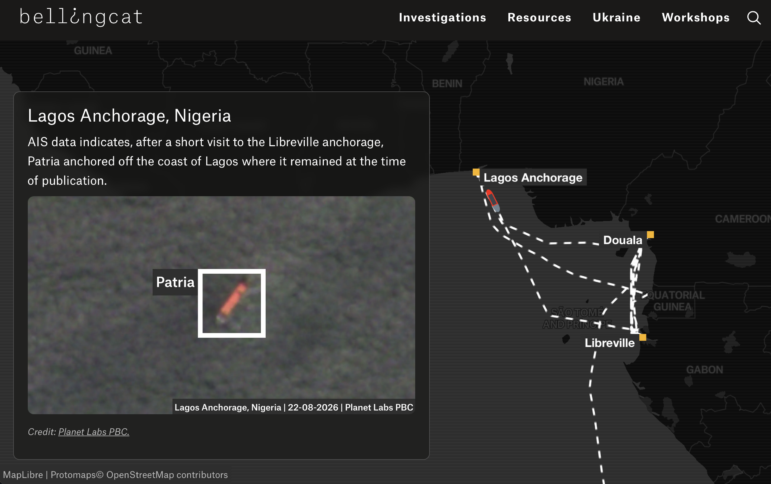
Image: Screenshot, Bellingcat
A sanctioned cargo vessel previously linked to transporting weapons for Russian forces has spent months making unusual journeys between ports across West Africa. Bellingcat used satellite imagery and AIS data to trace the Patria from Russia’s Port of Olga in the Sea of Japan to Cameroon, Gabon, Nigeria, and Equatorial Guinea, matching its reported positions with satellite observations. A scrolling map followed the vessel’s months-long journey, while analysis of its draught — the distance between the bottom of a ship and the waterline, which changes depending on how heavily it is loaded — revealed it repeatedly became lighter after visits to Douala and heavier after calls at Owendo, suggesting a pattern of unloading and loading. The investigation also found the ship spent more than 30 days anchored off Lagos, far longer than comparable vessels, raising questions among experts over whether it could be transporting supplies for “Russian or allied forces in the Sahel.”
The Education Level of Peru’s Electoral Candidates
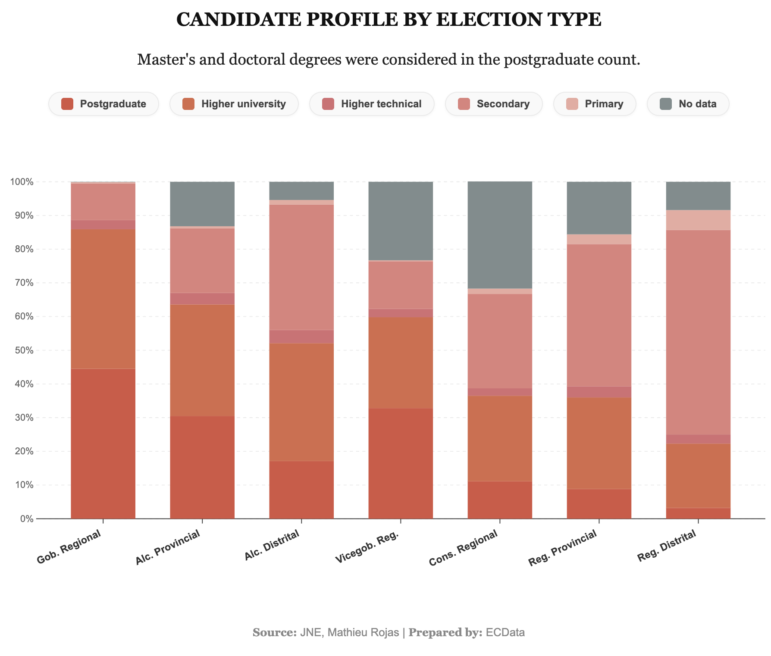
Image: Screenshot, El Comercio
On October 4, more than 90,000 candidates will compete for regional and municipal offices across Peru, of whom nearly 57% have not completed higher education, according to analysis of resumes submitted to the National Elections Board. El Comercio analyzed candidates’ educational and professional backgrounds, using bar charts to compare education levels across different offices and found that those running for regional governor were more likely to have higher education than candidates for district-level positions. An interactive search tool allowed readers to explore the profiles of candidates from different political parties, revealing that education and engineering were the most common professions.
Tracking Rare Books to Amazon’s AI

Image: Screenshot, 404 Media
AI companies are increasingly seeking printed books as training data, with material unavailable online becoming a valuable resource for developing new models. A 404 Media investigation placed a tracking device inside a rare book in a large shipment to trace who bought it and where it would end up. A scrolling map followed the book’s journey from California through Wisconsin and Colorado before it arrived at an Amazon warehouse in Las Vegas. The investigation found that employees at the facility received large quantities of books, removed their bindings, and scanned their contents, destroying the physical copies in the process. By tracking the shipment across the country, 404 Media uncovered Amazon’s previously unreported operation to acquire, digitize, and then discard printed books as part of its AI training data push.
DNA Reveals The Migrations That Transformed Britain
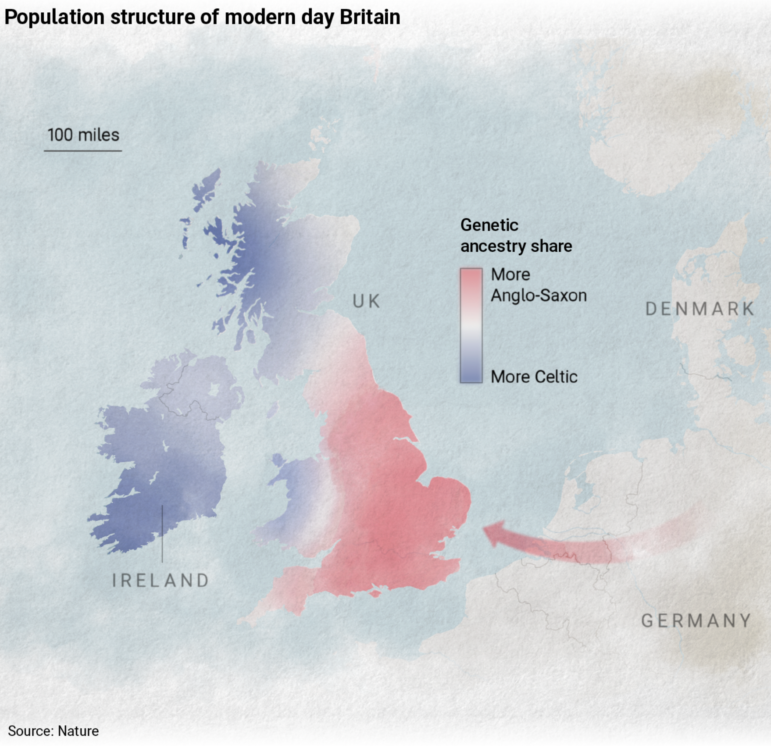
Image: Screenshot, The Times
Britain’s population has been repeatedly reshaped by migration, replacement, and genetic mixing over almost 900,000 years. The Times drew on ancient DNA and archaeological evidence to trace how Neanderthals, hunter-gatherers, Neolithic farmers, and the Bell Beaker people arrived, disappeared, or transformed the islands. Illustrated maps followed the movements of different populations across Europe and into Britain over time, showing the successive groups that shaped its population. The analysis found that Neolithic farmers replaced more than 99% of the earlier hunter-gatherer gene pool, while Bell Beaker migrants — named after the inverted-bell drinking vessel used at the beginning of the European Bronze Age — replaced at least 90% of Britain’s ancestry within a few centuries. Later Roman, Anglo-Saxon, and modern migrations added further to the country’s genetic history.
Where South Africa’s Children Rely Most on Free School Meals
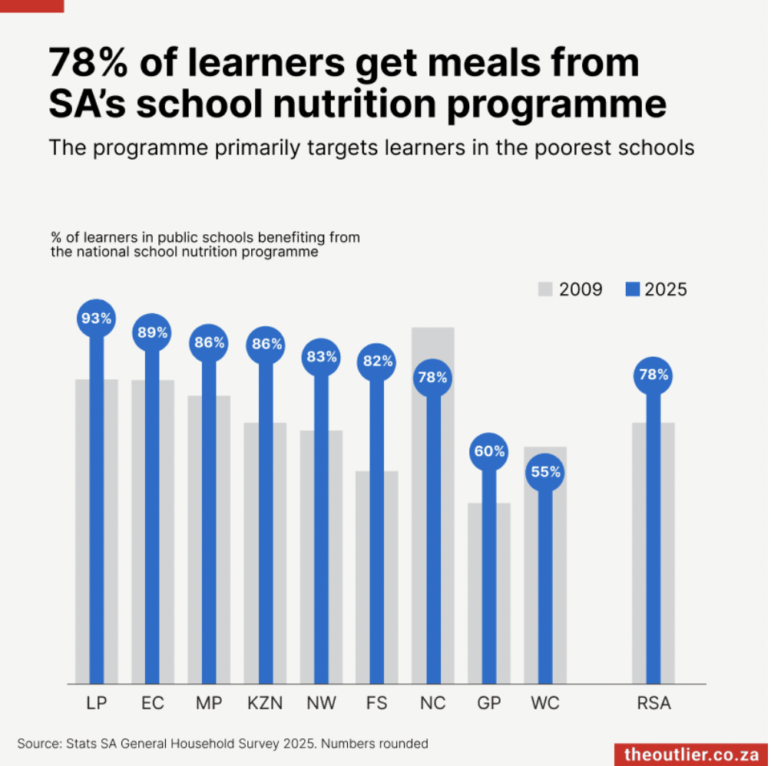
Image: Screenshot, The Outlier
Almost 80% of South African public school learners — around 9.5 million children — receive free meals through the National School Nutrition Programme. The Outlier used a lollipop bar chart to compare coverage in 2009 and 2025, showing the rise and regional differences. According to The Outlier, poorer provinces such as Limpopo and the Eastern Cape had the highest coverage, while Gauteng and the Western Cape had a much lower rate. Overall, the program expanded from 63% of school learners in 2009 to 78% in 2025.
More Football Club Jerseys Than Ever Before
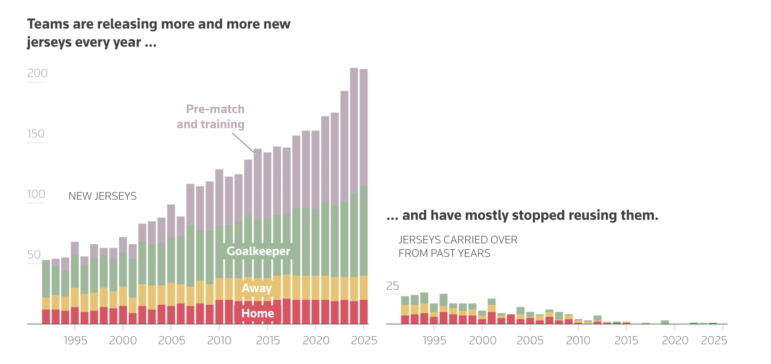
Image: Screenshot, Reuters
The Premier League football season has kicked off, and for many fans, a new jersey is part of supporting their club — even as some now cost well over £100 (US$136). English teams are releasing more shirts than ever before, with kit sales becoming an important source of revenue for clubs. Using data from the Football Kit Archive, Reuters analyzed men’s jerseys for all 20 clubs in the 2026-27 Premier League all the way back to 1992, and found that the number of new shirts has steadily increased, while fewer are reused from one season to the next. Stacked bar charts show that the growth has been driven mainly by goalkeeper, pre-match, and training jerseys. An interactive timeline visualized the trajectory of home and away colors for all teams, while the analysis also traced competition between manufacturers, showing how Adidas has become the league’s leading kit supplier — where once Umbro reigned back in the 90s.
What Genres of Music Are Played at Concerts in Europe
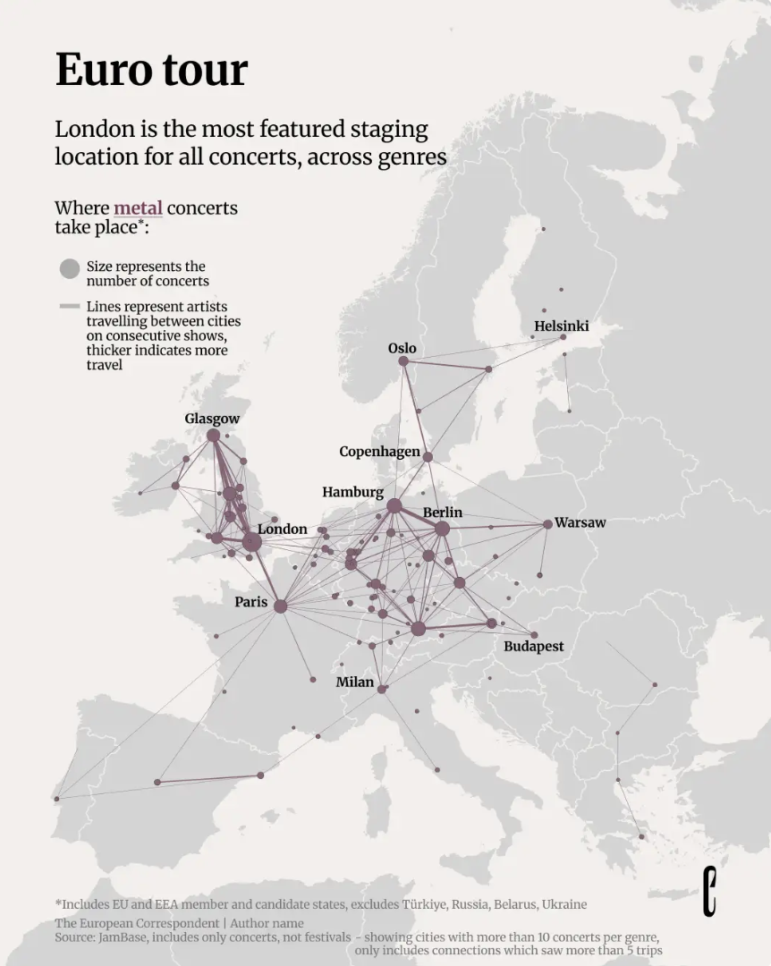
Image: Screenshot, European Correspondent
Europe hosted more than 125,000 concerts last year, making it one of the world’s busiest regions for live music. Using data from JamBase, The European Correspondent analyzed concert activity across 34 countries and found that pop and rock dominated most of the continent, while EDM was the leading genre in Albania, Bosnia and Herzegovina, and Malta. Pop, the most common genre almost everywhere, was excluded from the analysis, which mapped the second-most popular genre in each country. The analysis also traced how artists moved between countries and compared Europe’s concert hubs, finding that London hosted more shows than any other city, while Madrid emerged as the main destination for Latin music, and Berlin the main one for classical performances.
Hanna Duggal is a data journalist at AJ Labs, the data, visual storytelling, and experiments team of Al Jazeera, and a GIJN contributor. She has reported on issues such as policing, surveillance, and protests using data, and reported for GIJN on data journalism in the Middle East, investigating algorithms on TikTok, and on using data to investigate what tribal lands in the US.
International Research Guide: How to Find Experts and Hidden Documents on Any Topic

Guide to Investigating Tech and AI in Modern Warfare
Turning Copernicus Satellite Data Into Public-Interest Climate Stories

10 Practical Tips for Verifying Scientific Claims
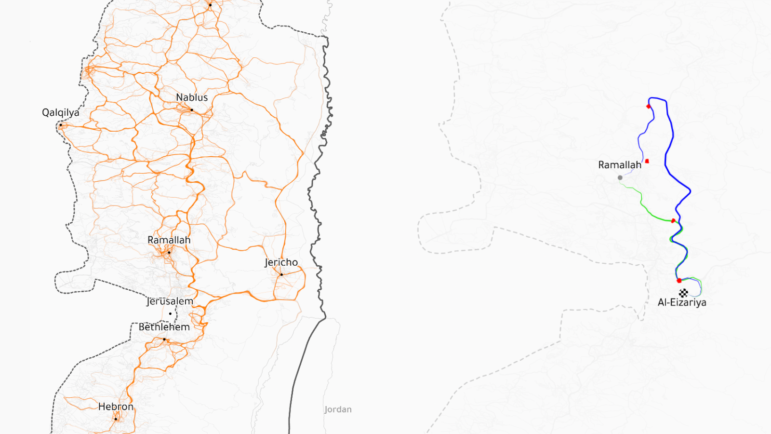
Israeli Checkpoints in the West Bank, Arctic Global Warming, Brazil’s Women Legislators, Inventing a Migrant Crisis in Ukraine

Peruvians Fighting for Russia, Israel’s Illegal Settlements, Mali’s Drone War, and the Data Center Heat Effect

German Far Right’s TikTok Reach, Iran War’s Impact on Cooking Gas, Mapping the Nepal Floods, and ‘Strongest’ Country Passports
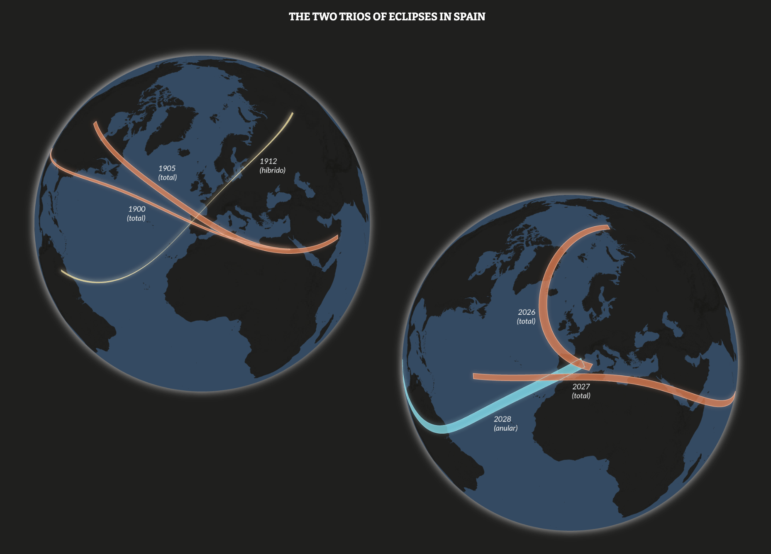
Spain’s Solar Eclipses, Russia-Ukraine Drone Warfare, ICE Detention Camp Overcrowding, and Tracking the Spread of Fake News

This work is licensed under a Creative Commons Attribution-NoDerivatives 4.0 International License
Republish our articles for free, online or in print, under a Creative Commons license.
Republish this article
This work is licensed under a Creative Commons Attribution-NoDerivatives 4.0 International License
Read Next
Data Journalism Top 10
Israeli Checkpoints in the West Bank, Arctic Global Warming, Brazil’s Women Legislators, Inventing a Migrant Crisis in Ukraine
Also highlighting how pro-Russian channels fabricated a mass migration threat in Ukraine, charting South Africa’s micro schools, and how beliefs in an afterlife vary around the world.
Data Journalism Top 10
Peruvians Fighting for Russia, Israel’s Illegal Settlements, Mali’s Drone War, and the Data Center Heat Effect
Also highlighting social media attacks against Brazil’s female political candidates and investigating Myanmar’s jade trade.
Data Journalism Top 10
German Far Right’s TikTok Reach, Iran War’s Impact on Cooking Gas, Mapping the Nepal Floods, and ‘Strongest’ Country Passports
Also highlighting coverage of Nvidia’s role in financing AI companies, how US adults engage with AI chatbots, and a story investigating children’s care homes in the UK.
Data Journalism Top 10
Spain’s Solar Eclipses, Russia-Ukraine Drone Warfare, ICE Detention Camp Overcrowding, and Tracking the Spread of Fake News
Also highlighting overcrowding in ICE detention facilities, foreign-owned natural resources in Argentina, and mapping the journeys in classic novels.