
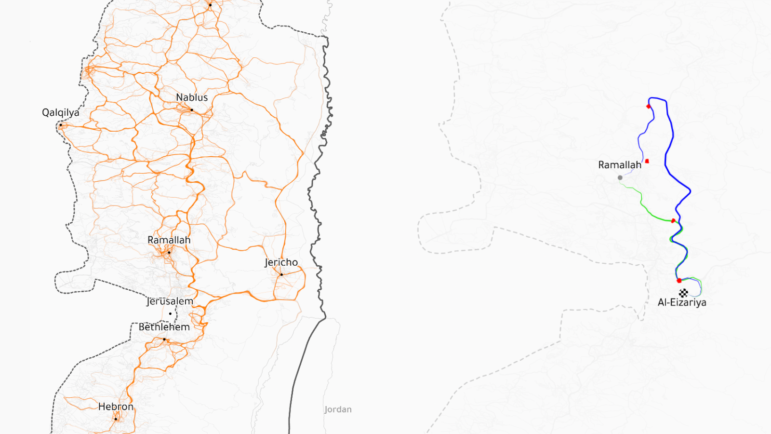
ARIJ looked into the growth of Israeli checkpoints in the West Bank and how they are affecting the lives of Palestinians. Image: Screenshots, ARIJ
Israeli Checkpoints in the West Bank, Arctic Global Warming, Brazil’s Women Legislators, Inventing a Migrant Crisis in Ukraine
A joint investigation by ARIJ, Evident, Palestine Reporting Lab, WIRED, and Lighthouse Reports found that average wait times at Israeli checkpoints in the occupied West Bank have risen by more than half since October 2023 with detours costing the average commuter about 90 minutes a week. To measure the toll, the team spent 18 months analyzing vehicle GPS readings and checkpoint status reports posted by Palestinians on Telegram. Our roundup of the Top 10 in Data Journalism, looking at stories from September 24 to October 6, also includes a CommonWealth Magazine feature that follows Taiwanese scientists to the Arctic as they track the signs of a rapidly warming region and an Outlier analysis showing that more than half of South Africa’s struggling micro schools are in the Eastern Cape.
Checkpoints in the West Bank
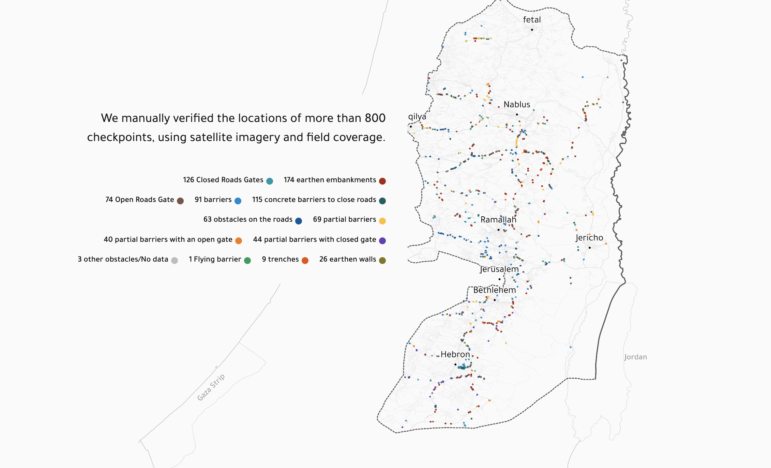
Image: Screenshot, ARIJ
The number of Israeli checkpoints and barriers in the occupied West Bank has reached 942, according to a joint investigation, which charted a web of movement restrictions reshaping lives and “preventing access to jobs, education, and healthcare.” An 18-month data investigation by ARIJ, the Palestine Reporting Lab, Evident, WIRED, and Lighthouse Reports analyzed tens of thousands of checkpoint status reports posted by Palestinians on a Telegram channel and 2.6 billion GPS readings made by cars traversing closures in the West Bank. They found that checkpoints, gates, and concrete blocks cost the average Palestinian commuter about 90 minutes a week in detours, that average delays have increased by more than 50% since 2023, and that nearly four in five Palestinians say they travel less than three years ago. The team mapped locations of more than 800 checkpoints and routes showing how Palestinians are forced onto roundabout routes, sometimes setting off in the opposite direction from their destination. One route that used to take 10 minutes now takes about 50 minutes in each direction, reporters found, while a routing simulation showed that closing one checkpoint, Wadi al-Nar, would essentially cut off travel from the southern West Bank to the center and north. ARIJ reporters said the system is “dispersing families, disrupting the economy, and hindering Palestinian access to basic services, including schools and hospitals.”
Measuring Arctic Warming
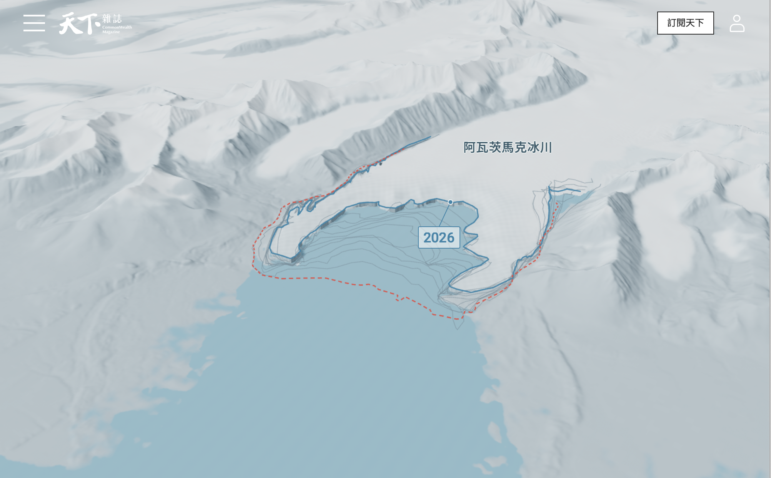
Taiwan’s CommonWealth magazine mapped the retreat of Aavatsmark Glacier on Svalbard island, Norway, since 2015 (red dotted line). Image: Screenshot CommonWealth magazine
CommonWealth Magazine reported that Svalbard, the Norwegian archipelago home to the world’s northernmost town, Longyearbyen, is warming seven times faster than the global average, and that its Aavatsmark Glacier is retreating about 150 meters a year, nearly triple its earlier rate. Reporters traveled more than 15,000 kilometers (9,320 miles) with Taiwanese scientists on their first chartered Arctic icebreaker expedition, mapping the route. A chart of Longyearbyen’s daily temperatures since 2005 shows summers growing hotter, and a scroll-driven 3D model animates the glacier’s retreat. Arctic sea ice has shrunk 30% in half a century, the report noted, with researchers warning that meltwater could push the Atlantic’s ocean circulation past a point of no return as early as 2057. A map of arctic shipping routes underscores how the melting ice is fueling maritime ambitions among the US, China, and Russia.
Iran War Prompts Massive Increase in US Military Spending Request
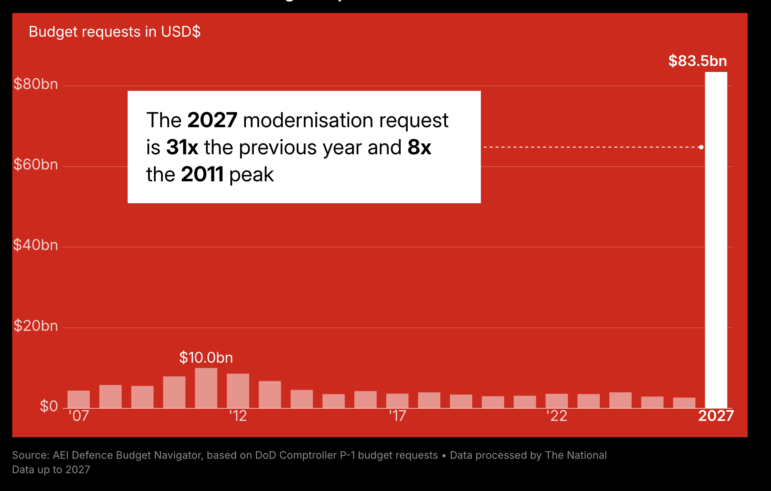
Image: Screenshot, The National
The US has fired more than 13,000 munitions in its conflict with Iran as of August 1, according to data from the Pentagon and the Centre for Strategic and International Studies. This includes expending more than 1,400 Patriot interceptors and 1,100 Tomahawk cruise missiles, in a war the Congressional Budget Office estimates has cost taxpayers US$38 billion. But the face of modern warfare is changing, and this piece in The National looked at how the US is shifting from a military budget that prioritizes traditional military warships to one that aims to ensure the US is ready for a new “way of war.” Washington’s proposed $1.5 trillion defense budget for 2027 would see a surge in the amount committed to developing and buying new weapons, the piece explains. Drawing on budget data from the Department of Defense, an animated treemap shows procurement shifting from shipbuilding and aircraft toward “modernization,” and a column chart shows requests for Patriot and THAAD interceptors rising more than seven-fold. The push coincides with a more than three-fold rise in China’s military spending since 2010.
Brazil Elects Record Number of Women to State Office
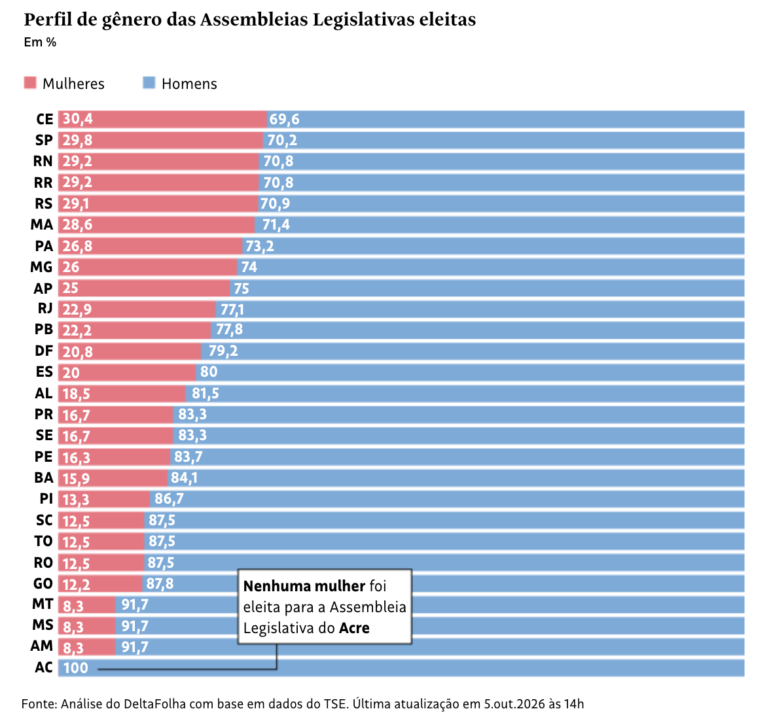
Image: Screenshot, Folha de S.Paulo
Women won 21% (218 of the 1,059) of seats in Brazil’s state legislatures in the October 4 elections, 27 more than in 2022, according to a Folha de S.Paulo analysis of election results. The count has risen in every election since 2014, though women still hold only about one in five seats. Sixteen of the 27 legislatures increased the proportion of women, led by Ceará, where women now make up 30.4% of representatives, São Paulo (where the figure is 29.8%), and Rio Grande do Norte (29.2%). But not everywhere saw increases in female political representation: In the far western Amazonian state of Acre, female state deputies fell from three to zero. An interactive hemicycle chart let readers filter each incoming assembly by gender, race, age, and party, while a stacked bar chart ranked states by gender split.
Inventing a Migrant Crisis in Ukraine

Texty tracked the steps in a social media disinformation campaign that sought to manufacture public fears about a supposed migration crisis in Ukraine. Image: Screenshot, Texty.org.ua
In 2023, Ukraine’s Ministry of Economy estimated that the country would need 4.5 million additional workers to help rebuild an economy devastated by war. But the figure was recast online as a government plan to bring in millions of migrants from Asia and Africa. The claim was pushed by pro-Russian channels and then Ukrainian bloggers and “far-right radicals,” military figures, and lawmakers carried it into the mainstream. Reporters at Texty collected posts containing keywords such as “migrant,” “labor migrants,” and “illegal immigrants” from 300 Telegram channels, 50 Facebook groups and pages, and more than 100 YouTube channels between February 2022 and August 2026. They plotted the posts on dot timelines by platform, which showed the spread of misinformation peaking in 2026. Embedded TikTok videos, viewed millions of times, showed AI-generated crowds of migrants.
Tracing Gold Exports From Africa to the UAE
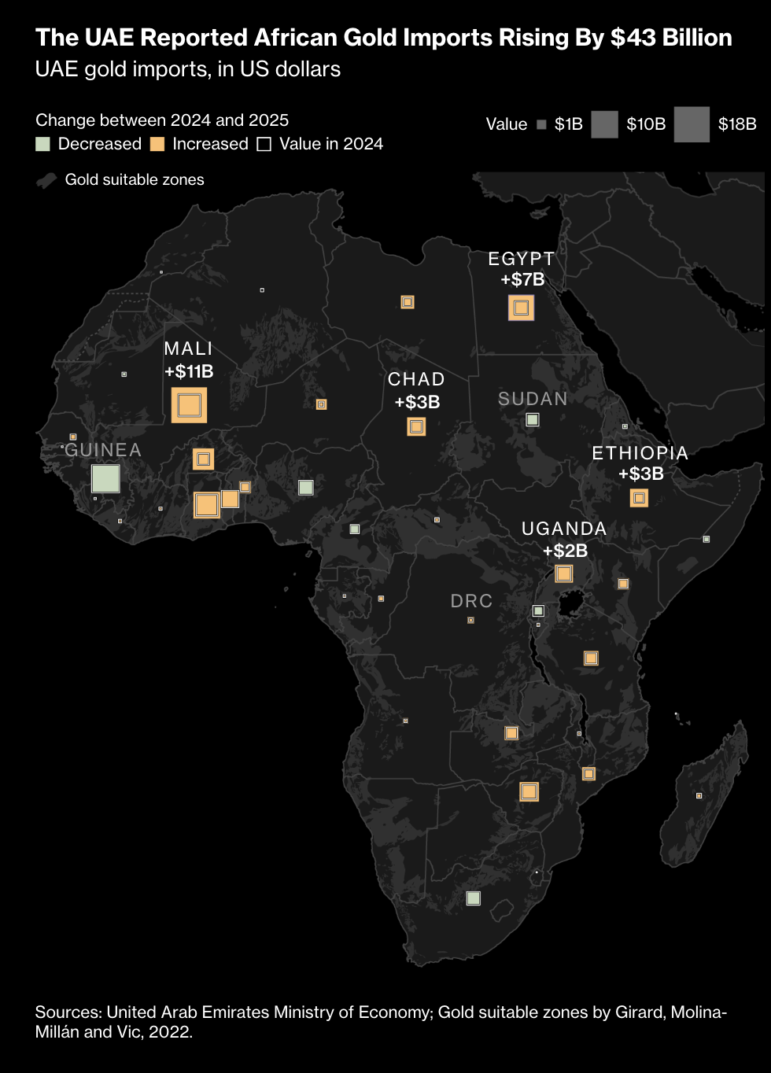
Image: Screenshot, Bloomberg
Four years after the US sanctioned a Belgian gold trader and his refinery for helping to finance armed groups in the eastern Democratic Republic of the Congo (DRC), an investigation has found that a company listed at the same address now handles nearly half of Uganda’s gold exports. Reporters at Bloomberg analyzed customs records from Big Trade Data and corporate filings, and conducted interviews with officials and merchants, finding the two firms shared staff and suppliers. The gold trader and the majority owner of the new company deny any connection. A stacked area chart showed Uganda’s gold exports over time, while a flow map traced smuggling routes from the DRC and Sudan, and a proportional-symbol map showed the UAE’s imports of African gold rising by US$43 billion between 2024 and 2025.
Retracing the Near Crash of Flydubai Flight 1073
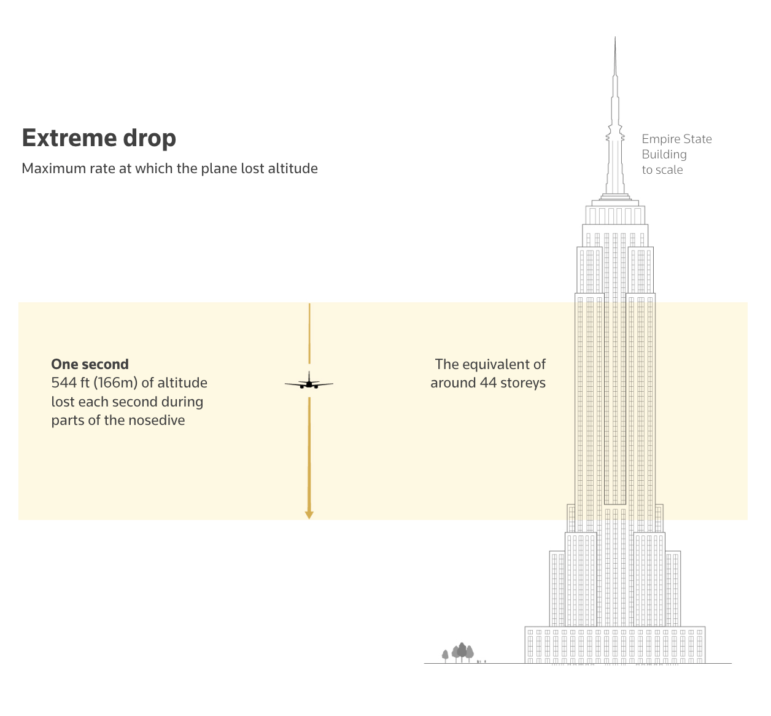
Image: Screenshot, Reuters
On September 30, a Flydubai flight carrying more than 170 people from Dubai to Tel Aviv dropped about 16,000 feet in under one minute. Israeli officials say that passengers and crew stopped the co-pilot from crashing the plane as it flew over Saudi Arabia. Reuters recreated the flight on a 3D terrain map using Flightradar24 tracking data, then plotted its altitude, vertical speed, and ground speed showing the jet jolted through violent climbs and dives and surged to nearly 600 knots, about 45% faster than its cruising pace. A chart compares the descent with those of several past airline crashes. A to-scale illustration shows that at its steepest, the jet lost about 544 feet (166m) a second, roughly 44 storiess of the Empire State Building, before a reserve crew took control and safely landed the aircraft.
Does AI Make Students Lazy?
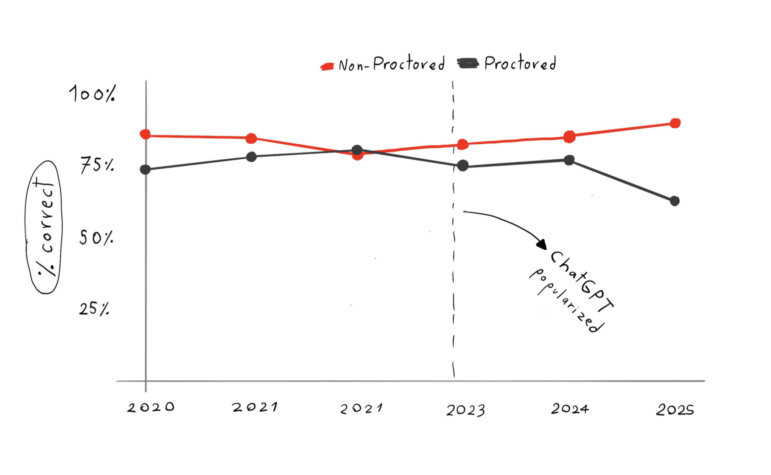
Image: Screenshot, The New York Times
Since ChatGPT’s release in 2022, students on an online learning platform have scored better on questions a chatbot could answer, yet worse than before on invigilated (proctor-monitored) tests, according to research reported by The New York Times. Researchers from the University of California, Irvine, and education company McGraw Hill analyzed millions of math sessions from the fifth grade to college, separating text-based problems easily pasted into a chatbot from visual or multi-step ones. A hand-drawn line chart showed non-invigilated scores climbed toward 90% correct by 2025, while invigilated scores for tests that students took without access to their computers slid down to the low 60’s, with results “worse than they had been before AI.” In a separate experiment, one group of students was allowed to use AI for a writing task, while a second group could not. The same groups were given a second assessment in which neither group could use AI. What happened? While those who had relied on AI to draft entire essays did best in the first round, the same students struggled in the second challenge, and their scores fell.
Where Are South Africa’s Micro Schools

Image: Screenshot, The Outlier
Across South Africa, nearly 3,000 public primary schools have fewer than 135 students, the government’s threshold for “micro” schools. Some 43% of the Eastern Cape’s primary schools fall into this category, versus just 0.4% in Gauteng, South Africa’s economic center, according to The Outlier and The Education Desk. A strip plot maps every public primary school by enrollment, highlighting micro schools and each province’s median school size. The Department of Basic Education (DBE) says micro schools tend to have weaker results and more run-down facilities. Some 77% of these micro schools have learners at different grades in a single class, which the Outlier says places “a huge burden on teachers.”
Who Believes in the Afterlife?
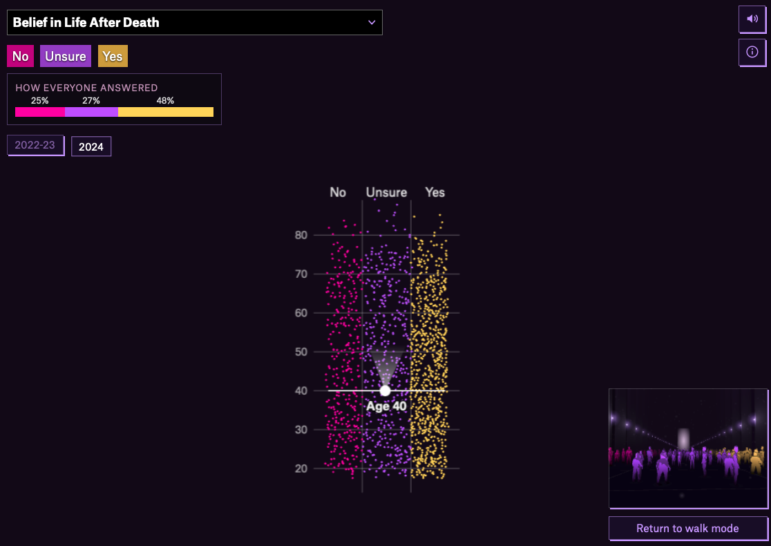
Image: Screenshot, The Pudding
People who are religious are more likely to believe in life after death, but belief in an afterlife isn’t confined to the religious, according to this interactive by Alvin Chang for The Pudding. Chang drew on responses to the Global Flourishing Study from nearly 130,000 people across 23 countries. Readers move through a virtual room of 1,500 representative participants, who gather on one side or the other depending on whether they believe in an afterlife, each figure color-coded by their answers to key questions. A strip plot in the corner tracks the reader’s progress through age groups, while a series of line charts show how people in different age groups have changed their beliefs between the study’s two waves (2022-23 and 2024). Other charts compare citizens of Western and non-Western countries who believed in an afterlife without being religious. The piece also drew on research which found that afterlife belief helped people cope with anxiety about death.
Hanna Duggal is the writer of GIJN’s fortnightly Top 10 in Data Journalism column, and a data journalist at AJ Labs, the data, visual storytelling, and experiments team of Al Jazeera. She has reported on issues such as policing, surveillance, and protests using data, and reported for GIJN on data journalism in the Middle East, investigating algorithms onTikTok, and on using data to investigate tribal lands in the US.

Guide to Investigating Tech and AI in Modern Warfare
Turning Copernicus Satellite Data Into Public-Interest Climate Stories
10 Practical Tips for Verifying Scientific Claims

Reporter’s Guide to Investigating Cryptocurrency

German Far Right’s TikTok Reach, Iran War’s Impact on Cooking Gas, Mapping the Nepal Floods, and ‘Strongest’ Country Passports

Visualizing a Trillion Dollars, India’s Warming Cities, Russian Mercenaries at Sea, and World Cup Player Physiques
‘Super’ El Niño Threat, Myanmar Villages Razed, California’s Billionaire Tax Bill, and South Africa’s Murder Rate

Cheap Drones Reshaping Warfare, Strait of Hormuz as Energy Chokehold, Starvation Strategy in Sudan, an Iceberg’s Final Journey

This work is licensed under a Creative Commons Attribution-NoDerivatives 4.0 International License
Republish our articles for free, online or in print, under a Creative Commons license.
Republish this article
This work is licensed under a Creative Commons Attribution-NoDerivatives 4.0 International License
Read Next
Data Journalism Top 10
German Far Right’s TikTok Reach, Iran War’s Impact on Cooking Gas, Mapping the Nepal Floods, and ‘Strongest’ Country Passports
Also highlighting coverage of Nvidia’s role in financing AI companies, how US adults engage with AI chatbots, and a story investigating children’s care homes in the UK.
Data Journalism Top 10
Visualizing a Trillion Dollars, India’s Warming Cities, Russian Mercenaries at Sea, and World Cup Player Physiques
Also highlighting how films portray Ukrainians, increasing tree cover in Spain, and how couples meet.
Data Journalism Top 10
‘Super’ El Niño Threat, Myanmar Villages Razed, California’s Billionaire Tax Bill, and South Africa’s Murder Rate
Also highlighting exploitation of journalists in Egypt, Argentina’s returning World Cup squad, and the strain on Singapore’s aging caregivers.
Data Journalism Top 10
Cheap Drones Reshaping Warfare, Strait of Hormuz as Energy Chokehold, Starvation Strategy in Sudan, an Iceberg’s Final Journey
Our round-up also highlights India’s highly polluted Yamuna River, a flash flood in Argentina’s Bahía Blanca, and how good (or bad) humans are at identifying AI-generated music.