
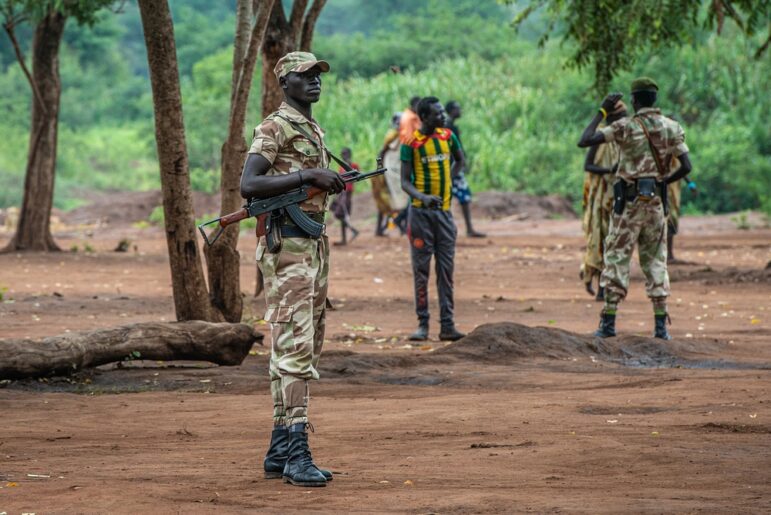
Ethiopian soldiers at the Kule refugee camp in Gambela, Ethiopia. Image: Shutterstock, Richard Juilliard
Investigating Inside Conflict Zones and Areas Controlled by Armed Groups: Lessons from Africa
Read this article in
For investigative journalists in Africa, getting into an area controlled by armed groups may not be the most dangerous part of an assignment. The real challenge is figuring out how to report safely when armed groups control territory, access is restricted, information is unreliable, and the people who speak to you may face reprisals.
Journalists working in these environments make difficult decisions at every stage of an investigation: when it is safe to travel, whom to trust, how to reach sources, how to verify claims, and when to abandon a reporting plan.
Sometimes, staying away from the most dangerous areas and finding other ways to gather evidence becomes the safest option. According to Reporters Without Borders, more than 50 media professionals have been killed in Somalia since 2010, making it one of Africa’s most dangerous countries for journalists. In Mali, insecurity and political instability have restricted journalists’ access to information, while Ethiopia’s conflicts have raised fears of reprisals against journalists. In northern Nigeria, journalists encounter difficulties reporting on terrorist groups, bandits, and other armed actors involved in killings and abductions.
Six African journalists who have investigated conflicts and areas controlled or heavily influenced by armed groups across the continent shared lessons from their experiences.
Know the Terrain and the People Before You Go
When Damilola Banjo, a Nigerian investigative journalist, travelled to Zamfara state in northwestern Nigeria to investigate killings and abductions attributed to bandits, she had never been to the state and did not speak Hausa, the language widely spoken there. She knew she needed someone who understood the terrain.
Banjo’s local contact helped identify communities and assess where it was safe to travel. On two occasions, she came close to arriving in villages shortly after attacks. In one village, she interviewed a man whose four sons had been killed by bandits. The attack happened only hours earlier, and the burial ground was still marked by fresh blood stains.
“We could have met the bandits on the road,” she says, looking back at the moment. “Who knows what could have happened?”
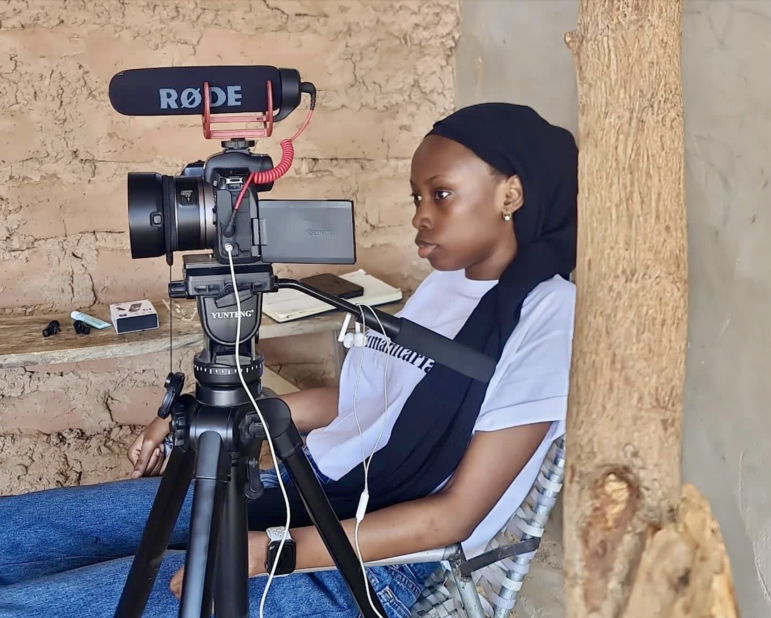
Zubaida Baba Ibrahim records an interview with Nigerians who fled insecurity in northwestern Nigeria and relocated across the border to Maradi in the Niger Republic. Image: Courtesy of Ibrahim
Local knowledge is therefore about more than finding an interviewee or translating questions. It can determine where a journalist understands where to go, how to behave, and when to leave.
Zubaida Baba Ibrahim, a Nigerian journalist and sub-editor of Nigeria Health Watch, saw this in Niger Republic in 2024. After traveling overland from Abuja through Kano and Katsina to Maradi, she was taken to a police station shortly after checking into her hotel. Her Nigerian passport and status as a journalist raised concerns amid tensions between Niger Republic and Nigeria following the 2023 military coup and ECOWAS sanctions.
Her fixer followed the police to the station, and he provided documentation, including authorization from Niger’s Ministry of Information, to help resolve the situation and get her released from custody.
Access Is Not Safety
Abdalle Mumin, a Somali journalist and press freedom advocate, learned this lesson while exposing corruption in Somalia’s humanitarian aid system. The investigation revealed how internally displaced people were forced to surrender part of the aid they received to powerful camp “gatekeepers.” Those who resisted could face expulsion or even death.
His reporting began with a tip from people inside the camps, but almost everyone was afraid to speak. Mumin repeatedly visited the camps, built trust with residents and, at times, chose to hide his identity while gathering information to protect himself.
For David Dembélé, a Malian investigative journalist and chairperson of CENOZO, just because you have access doesn’t always mean it’s wise to use it. While investigating allegations of mass killings of civilians by Malian forces and the Russian Wagner mercenary group, he purposely avoided some villages where the alleged killings took place. Instead, he remained in Mopti and worked through contacts who could provide evidence from the affected communities. “Terrorism, insecurity, [and] safety issues should not stop journalists from doing their work,” he notes. “But we have to think about our safety.”
Follow the Evidence, Not the Most Dramatic Claim
Competing narratives, propaganda, and emotionally charged allegations are common in conflicts. The more dangerous the environment, the greater the temptation to rely on what people say because independent verification is difficult.
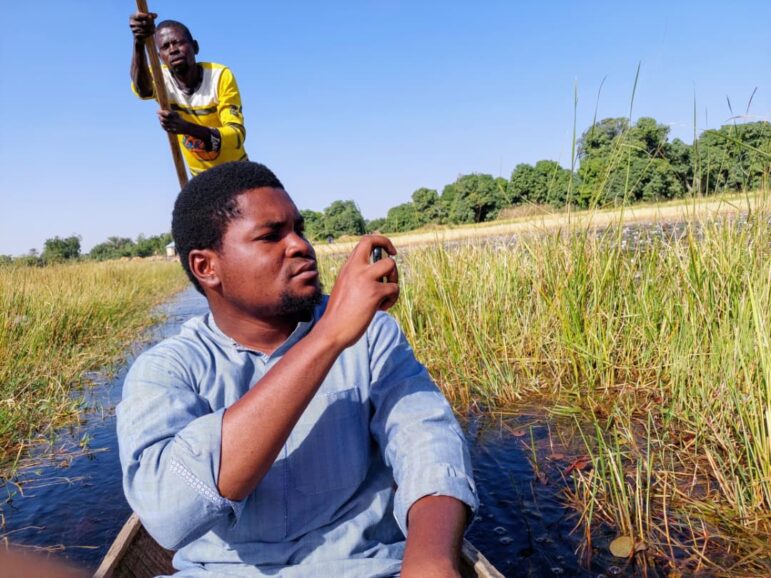
Reporter Kunle Adebajo reporting in the field in Nguru, northeastern Nigeria, Image: Courtesy of Adebajo
Kunle Adebajo, former investigations editor at HumAngle, reported across Nigeria’s northwest and crossed into Niger to report on Nigerian refugees. His work was based mostly on interviews and observation, and he sometimes encountered sensational claims that defied verification: “For example, when people claim that millions of cattle were rustled from communities.”
Banjo followed a similar approach in Zamfara. When survivors described attacks, she checked dates and details against previous news reports and compared accounts. If she could not support a claim independently, she dropped it.
Adebajo says journalists should be open to and prioritize victims’ experiences, especially in conflict zones where there can be little to no accountability or civil society checks. But he adds that they still must adhere to a high standard of accuracy, so it’s important to only publish claims that can be supported by other evidence. “Journalists should be as objective as possible,” he says. “Follow the facts…”
Be Ready to Change How You Report the Story
While reporting on malnutrition in Katsina, Ibrahim wanted to move into other local government areas after struggling to obtain access to stabilization centers.
For security reasons, her fixer strongly advised against it, believing the move would expose her to unnecessary danger. So, she returned to Abuja and conducted interviews by phone instead, giving her sources anonymity.
Dembélé faced a similar situation in Menaka, where a language barrier and inaccessible locations limited his reporting.
The lesson is not that journalists should abandon difficult stories. It is that a commitment to a story does not require a commitment to the original plan, but to be flexible in the logistics about how to cover it.
Protect Sources From the Consequences of Your Reporting
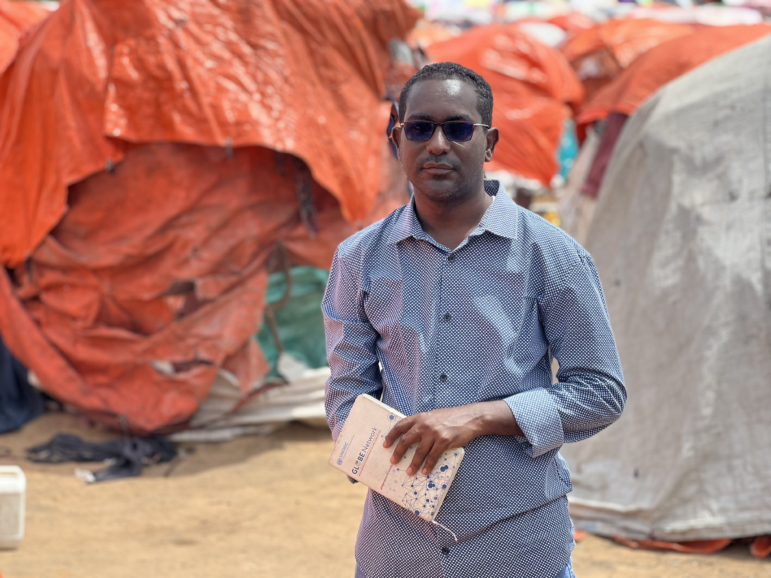
Abdalle Mumin reporting from the outskirts of Mogadishu, near Afgooye, Somalia. Image: Courtesy of Mumin
Mumin emphasizes that source protection should not be an afterthought for reporters, particularly in war-torn regions or conflict zones. People living under the influence of armed groups may have valuable information, but have little or no ability to protect themselves if their identities are exposed.
“Protecting the sources is my highest priority,” Mumin explains. “I use secure communication methods where possible, avoid collecting unnecessary personal information, and anonymize sources when publishing stories that could expose them to retaliation.”
Mumin says he has even abandoned investigations when the risks to sources or colleagues became too high. “The experience taught me that courage in journalism is not only about taking risks; it is also about making difficult ethical decisions,” he says.
Remember That Both Sides May Be Watching
Ermias Mulugeta, an Ethiopian investigative journalist, struggled to obtain permission to travel to the conflict-ridden Tigray region and faced restrictions on what journalists could report. He was also concerned about the consequences of publishing allegations of abuses by government forces.
In conflict zones, he points out, journalists could face attacks from the government, armed groups, and even members of the public. Mulugeta advises journalists entering areas controlled by armed groups to examine their own public history beforehand. “First, diagnose yourself. Make sure you’ve not said anything negative about that radical group,” he advises.
Dembélé notes that preparation also means physical and digital security training. He eventually went into exile after receiving threats linked to his reporting.
In an ethnically divided country such as Ethiopia, he adds, journalists can even face hostility from fellow journalists: “It is like having an enemy within, which is a very dangerous path.” Mulugeta also recommends that journalists keep their editors informed throughout an investigation to guard against attempts to discredit their work.
He also offers a practical warning about interviewing armed groups. Journalists should not assume they will be able to rely on the most basic reporting methods, like snapshots on your phone or even taking notes.
“Armed groups are not normal people. They kill people,” he warns. “When you go there, try to memorize everything you see, because they may not allow you to take pictures, or record voices.”
Knowing When — and When Not to — Take Risks
Mumin recalls taking risks when he was younger that he would not take today. During a 2013 assignment documenting the illegal charcoal trade in southern Somalia, an armed militia stopped his vehicle and pointed guns at him. He escaped when his driver accelerated away.
“Today, I approach investigations with far greater caution than I did a decade ago, while remaining committed to reporting stories that matter despite the risks,” he explains.
Banjo likewise says she would approach her Zamfara investigation differently now. She would conduct more extensive desk research before traveling and give greater attention to security planning and local intelligence. For Adebajo, risk assessment would extend beyond the threat of armed attacks to include more extensive planning for accommodation, transportation, food, cultural differences, and communication with the newsroom.
A successful investigation is not just one in which a reporter reaches the most dangerous village and gets all the information needed. It is one in which the journalist finds a way to uncover what happened, tests the evidence, protects the people who helped reveal it, and remains safe enough to keep reporting.
Editor’s Note: This story is the second installment of an ongoing series in which GIJN looks at regional best practices from investigative journalists around the world on how they protect sources and maintain physical security while navigating high-risk reporting environments. You can read the first installment from South Asia and MENA regions.
 John Chukwu is a freelance journalist based in Lagos, Nigeria. He writes about politics, health, social justice, conflict, and technology in sub-Saharan Africa. His work has been published by Foreign Policy, Nieman Reports, and IJNet, among others.

International Research Guide: How to Find Experts and Hidden Documents on Any Topic

Guide to Investigating Tech and AI in Modern Warfare
Turning Copernicus Satellite Data Into Public-Interest Climate Stories
10 Practical Tips for Verifying Scientific Claims
Investigating Inside Conflict Zones and Areas Controlled by Armed Groups: Lessons from South Asia and the Middle East
What Every Fixer Should Know Before Supporting an Investigative Reporting Assignment
How We Investigated the Hidden Costs of the World’s Farmed Seafood
Israeli Checkpoints in the West Bank, Arctic Global Warming, Brazil’s Women Legislators, Inventing a Migrant Crisis in Ukraine

This work is licensed under a Creative Commons Attribution-NoDerivatives 4.0 International License
Republish our articles for free, online or in print, under a Creative Commons license.
Republish this article
This work is licensed under a Creative Commons Attribution-NoDerivatives 4.0 International License
Read Next
News & Analysis
Investigating Inside Conflict Zones and Areas Controlled by Armed Groups: Lessons from South Asia and the Middle East
In conflict zones, access is rarely secured through official accreditation alone. It is negotiated through local trust, personal relationships, and an understanding of community dynamics.
News & Analysis News & Analysis News & Analysis
What Every Fixer Should Know Before Supporting an Investigative Reporting Assignment
Local producers are key figures vital to the success of many overseas investigations. Here are best practices for fixers when working with foreign reporters.
How They Did It
How We Investigated the Hidden Costs of the World’s Farmed Seafood
Over the past five years, an international team of journalists at The Outlaw Ocean Project has examined the largely overlooked $313-billion food-for-feed aquaculture industry.
Data Journalism Top 10
Israeli Checkpoints in the West Bank, Arctic Global Warming, Brazil’s Women Legislators, Inventing a Migrant Crisis in Ukraine
Also highlighting how pro-Russian channels fabricated a mass migration threat in Ukraine, charting South Africa’s micro schools, and how beliefs in an afterlife vary around the world.