
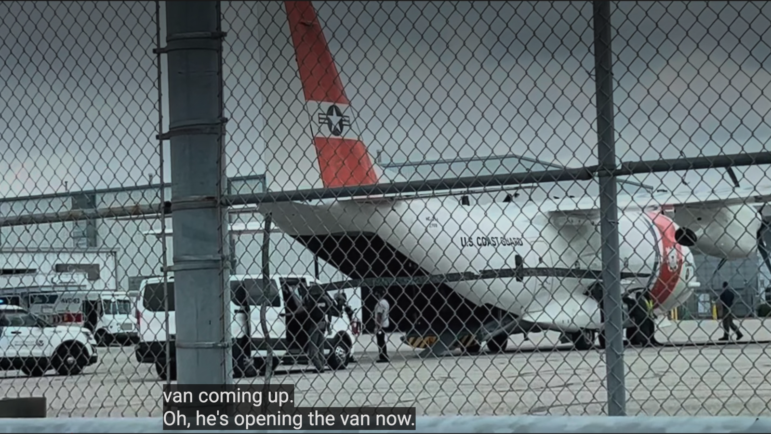
A video by independent reporter Gillian Brockell provides additional proof that US Coast Guard planes meant for search and rescue — this one, staging at Baltimore — are used by US Immigrations and Customs Enforcement (ICE) to relocate captured US immigrants. Screenshot Image: Courtesy, Brockell
How Gillian Brockell Investigates ICE Removal Flights from US



Gillian Brockell pioneered a critical full-time investigative beat, which covers the widespread deportation and removal of migrants by air from the US to third-party countries — now up to 35 nations — by the US Immigration and Customs Enforcement agency (ICE).
Her dozens of stories since August 2025 have painted a shocking picture of shackled deportees being forced to soil themselves on chartered planes with hidden tail numbers; of a lucrative new ICE aviation contracting industry with its own brokers; of government aircraft being re-tasked from search–and-rescue missions to removals; of “stateless” asylees arriving in unsafe countries that have deals with the US, only to be immediately imprisoned or flown back to their countries of origin, where they face even more lethal threats.
Her prolific work on so-called ICE flights has revealed an average of 70 domestic and international ICE flights each day of the Trump Administration, and how an astonishing 25,000 migrants and asylum seekers have been sent to nearly three dozen unfamiliar or unsafe countries.
In an interview with GIJN, Brockell insists that reporters and GIJN member newsrooms in those dozens of “host countries” — from Ghana to Egypt and Eswatini — have important investigative stories and collaborative projects just waiting to be done. That’s because, she says, the world simply doesn’t yet know what has become of thousands of these renditioned people, nor the precise fate of the money that has been handed to those governments to deal with unwanted US migrants. (Editor’s Note: See Brockell’s full list of confirmed host countries.)
Brockell’s initial interest in this topic stemmed from one BlueSky post on May 20, 2025, just four months into the second Trump administration. That’s when an account for an immigration advocacy group noted that a US District Court had ruled that the Trump Administration could not deport seven migrants from the US to a third country — in this case, South Sudan: a country to which the individuals had no connection — and that a plane chartered by an ICE agency had since departed for that country with those detainees aboard anyway.
From her home in Baltimore, Brockell thought: “I wonder if I can track that flight?”An independent reporter since late 2023, Brockell was previously on staff at The Washington Post’s Retropolis section, which dug into little-known US history.
Before that, she had worked as a flight attendant, and those experiences guided her in that moment. She knew what to look for, first, in the basic flight tracking app on her phone, and then, on a second, more advanced flight monitoring site. She wanted to know: the kind of aircraft (was it capable of Transatlantic crossings?); the tail number; the likely timing, and the departure airport nearest the relevant immigration detention center in Texas. Ultimately, she was able to identify the jet and its stopover at Shannon Airport in Ireland, as well as its final destination, Djibouti, on the Horn of Africa.

Gillian Brockell. Photo: Courtesy of Brockell
In posts to her personal BlueSky account, Brockell suggested that the detainees had been likely rerouted to a US military base in Djibouti in order for them to technically remain in US custody, rather than travel to their official destination of South Sudan.
“That was a very specific moment for me,” she recalls. “I’ve always been an aviation geek; into planes. I tracked that flight just as a curiosity. I had no idea about ‘ICE Air’ or the network or that there were dozens of ICE flights every day; I had no idea everyone was shackled [in their airline seats].”
She adds: “A huge problem is that a lot of people are being sent to these countries with no identification. Even if they get free from prison, they are stateless, because they have no ID. Their country of origin would not release a temporary travel document, of course.”
Several outlets have published powerful investigations into the Trump administration’s dramatically expanded immigrant rendition program, including GIJN member Forbidden Stories, whose interactive Deportation Project Map offers a portal into individual deals, per country, for the dumping of third-country nationals.
However, Brockell believes that “as far as I’m aware I’m the only journalist covering ICE Air full-time.”
In the past year, Brockell has published almost 30 reports on ICE flights on various platforms; created her own Third-Country Removals Tracker; created an ICE flights primer for other reporters on a dedicated website; and is the go-to reporter for whistleblowers, immigration attorneys, and fellow journalists needing real-time information on where detainees are being flown.
Dedication and Obsession Help Build a Specialized IJ Beat
Brockell admits that “being super-obsessed” with the topic has been key to the success of her investigative endeavor. However, she stresses she is far from the first person dedicated to tracking these flights daily. Rather, she says a network of activists, concerned citizens, and at least one key ex-military officer have been tracking deportation flights for months or years, and that she gained valuable techniques from several of these as she was establishing her reporting beat.
Her work on this new beat has been built on these major steps: identifying the tail numbers of aircraft chartered by ICE; searching their movements daily; interviewing removed people via their families and immigration attorneys; following the money for ICE Air through its maze of contracts and brokers; and learning the conditions on flights from former airline employees.
“There are about 100 planes in the network right now, and so I’d wake up early in the morning, and it took me about 45 minutes to go through those 100 registration numbers for what they did the day before,” she explains. “I looked at the military planes and the charter aircraft and the planes that DHS (Department of Homeland Security) has purchased. Now, because I’m more focused on third-country removals, I’m mostly focused on those 10 planes that I know have done those removals.”
Finding human sources — especially airline employees and people removed to unsafe countries — emerged as a bigger challenge than finding secretive ICE planes, but Brockell says the dedicated beat itself has created its own source access path.
“After my investigative Mother Jones story this year — that was the first time I was able to break through that source wall,” she says. “A bunch of people who had just quit those airlines contacted me, and told me what I had suspected, plus other things — the safety issues with shackling; how awful it was inside the plane. Some would say: ‘Honestly, it depends on the mood of the guards. Particularly about the use of the lavatory: some guards will let people soil themselves in their seats.’”
Brockell says the following cutting-edge tools are central to her ICE flights beat.
ADS-B Exchange (Premium) and FlightRadar24 (Gold)
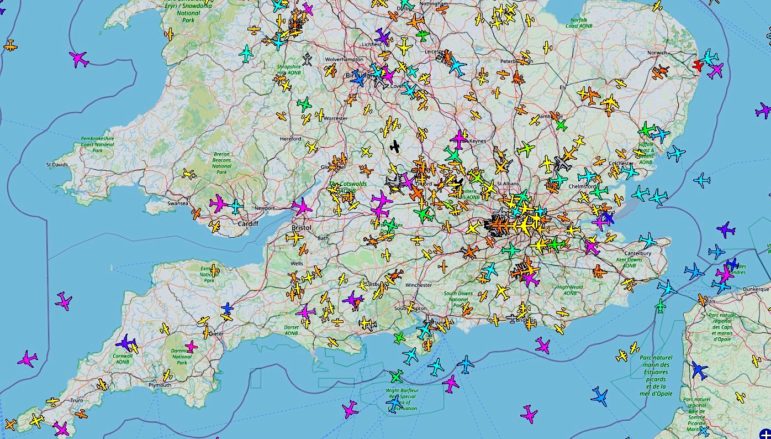
“[For the South Sudan flight,] I started on FlightRadar24, which is just like a tracking app on your phone, and I started looking at the departures from Harlingen, Texas, which I knew was the airport closest to where their ICE detention center was,” she recalls. “Then I realized that they’re probably using this thing called ‘LADD.’ In the US, an aircraft owner can apply to the FAA for a LADD designation, which will hide the tail number and call sign from flight tracking apps that get their data from government-owned receivers. This is important for tracking ICE flights, because, last April, the FAA gave LADD designations to all ICE charter airlines. So I used ADS-B Exchange, which doesn’t block registration numbers, and it’s not that difficult to use. I have its Premium account to avoid the pop-up ads, and then I use the FlightRadar24 Gold level to access all the functions.”
- Since the ADS-B Exchange search bar will show all planes with the registration numbers you input, including non-relevant small aircraft, Brockell suggests that reporters also search those letters by the tool’s call sign option. “The easiest way to look for a plane is to pop its registration number into the main search bar,” she says. “But if you don’t know the registration number or are looking for something different, there are a lot of other, more fine-tuned ways to search their flight data. You can search by aircraft type, call sign, country registration — and you can search for only military aircraft, or only aircraft with LADD designation.”
- Brockell warns that ADS-B Exchange has some significant geographic coverage gaps, and should therefore be used in conjunction with a satellite-based tracker. “The advantage of ADS-B Exchange is that it doesn’t hide tail numbers, whether the government likes it or not — but it has a lot of dead zones that its receivers don’t cover, particularly in Africa,” she explains. “Since it uses government sources including satellites, FlightRadar24 has much better coverage but hides tail numbers. So for the work I do, I have to use both together.”
- Because there is a pattern to the type of aircraft for certain ICE routes — for instance, the regular use of Gulfstream V jets to West Africa — she says searching by aircraft type — in this case “GLF5” — can also help.
- Brockell also notes that ADS-B Exchange uses “a lot of your computer memory” — and that each additional filter might increase the risk of computer crash.
She adds: “People can also try Airplanes.live — that’s almost the same as ADS-B Exchange — and a lot of activists also use FlightAware.”
(Hear more technical tips on flight tracker use from Brockell’s recent training for Bellingcat.)
Habeas Flight Watch — and the JJinDC BlueSky account
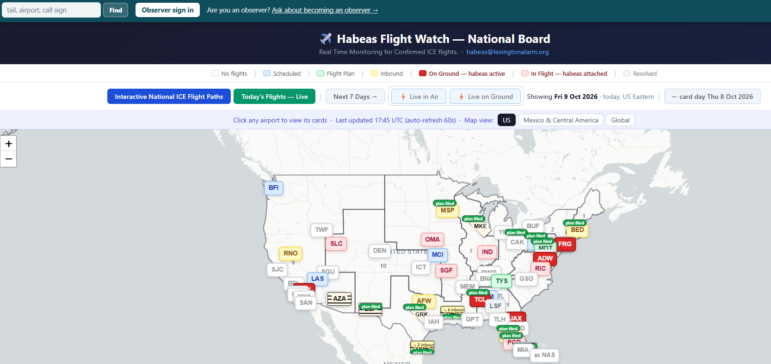
The Habeas Flight Watch dashboard. Image: Screenshot, Habeas Flight Watch
“I think the best way to get into this beat is to follow the handle @JJinDC on Bluesky,” she says. “He’s anonymous online, though I know him in real life now; he’s former military, with a deep level of expertise on these flights. He’s one of the activists going to airports and filming and counting the number of people being taken.”
She notes that JJ, along with the activist group Lexington Alarm!, has built a website that is particularly helpful to journalists, Habeas Flight Watch. “It’s a live map of all of the ICE flights,” she explains. “Immigration attorneys also use it to help build their habeas petitions before their clients land somewhere else. JJ [and his collaborators] have gotten to a point where they can predict ICE flight schedules, and have built a dashboard with a predictive schedule.”
Brockell adds: “Another really good tool I have used recently is HabeasDockets.org: a website for all the habeas petitions for immigrants going on in US federal court, which you can search things by country; by name of client, etc.”
Planespotters.net
“How do I find tail numbers for these charter airline fleets? — there are a couple of ways,” she says. “Some of them put their fleet numbers on their company website. Another way is to search an aviation enthusiast site called Planespotters.net. It’s like a Wikipedia for airplane pictures. Planespotter folks share their photos there, and most of the time they have pretty good fleet lists. In the search bar, if you want to put in ‘N279GX’ — a plane in the GlobalX airline fleet — you can search it, and then scroll to where it says ‘GlobalX,’ and it will show you an entire fleet list.”
Still, Brockell warns that even excellent hobbyist sites are not always accurate, and should be used as a source of leads, rather than evidence or verification. She adds that reporters can also search the government database FAA Registry to find out who owns an aircraft, or to find other aircraft with the same owner.
Third Country Deportation Watch and Brockell’s Third Country Removals Tracker
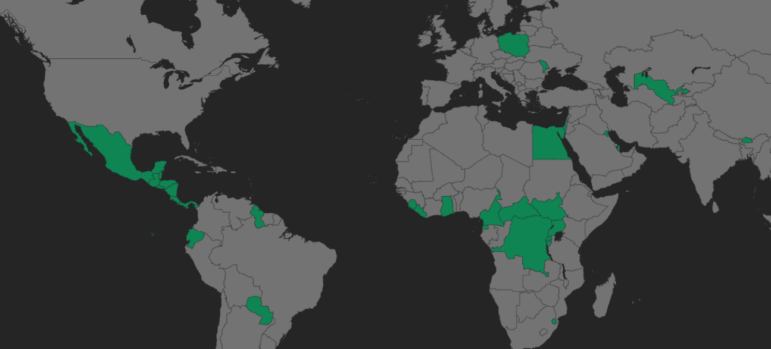
A map on Brockell’s Third Country Removal Tracker showing the countries where US immigration authorities have dumped third-country nationals in the US. Image: Screenshot, Third Country Removal Tracker
Brockell says these two tools — her own Third Country Removal Tracker and Third Country Deportation Watch, run by Refugees International and Human Rights First — represent very similar, reliable databases that reporters can use to trace the fate of the 25,000 people removed from the US to unfamiliar countries.
“Their tracker and mine mostly overlap, but they’re a little different,” she explains. “Third Country Deportation Watch has more detailed info on the deals with host countries, and my tracker has more detailed info on the flights used for removals. I also count ‘transfer removals,’ where a third country is briefly used to transfer immigrants back to their unsafe country of origin, like Egypt for Russian nationals and Kuwait for Iranian nationals.”
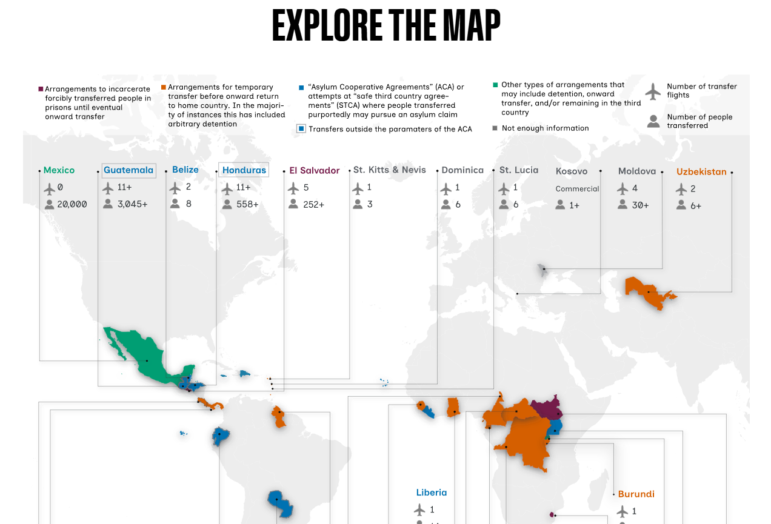
A map on the Third Country Deportation Watch showing third-country removals categorized by the kind of deals between host countries and the Trump Administration. Image: Screenshot, Third Country Deportation Watch
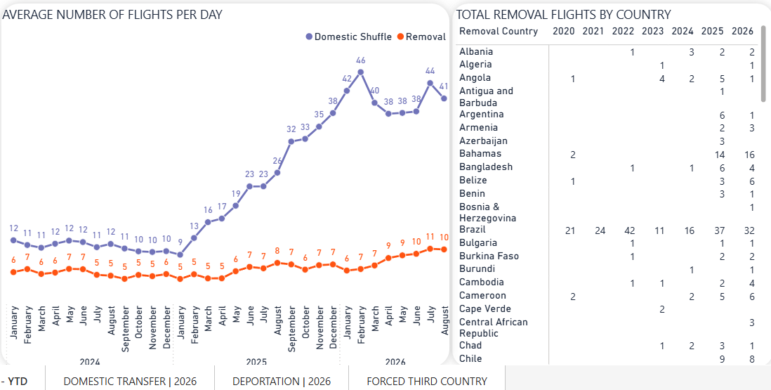
Some of the interactive datasets on ICE Flight Monitor. Image: Screenshot
The ICE Flight Monitor includes an interactive ICE Air dashboard, an archive of removal flights by country, and detailed monthly reports. Now hosted by Human Rights First, it builds on data and methodology developed by retired JP Morgan executive Tom Cartwright, who has tracked some 40,000 immigration enforcement flights since 2020.
“Tom Cartwright is like the ultimate expert on ICE flight tracking,” Brockell explains. “He’s basically turned over his operations to Human Rights First. But I had a really helpful few calls with Tom in my first few months on the beat, and I just pored over these remarkable monthly reports he was publishing for those years.”
Unlike other trackers that focus on third country removals, Brockell notes that the ICE Flight Monitor project produces reports on all ICE flights.
She adds: “One of the things I noticed from Tom was that he was saying ‘removals’ not ‘deportations,’ which I think other reporters should also consider — because deportations are a legal process to safe countries. I’m bringing that word ‘removals’ to the third-country removals we’re seeing.”
LiveATC.net and app.airframes.io
“LiveATC.net has air traffic control recordings, and they have an archive function, but it only goes back 24 hours, so you’ve got to go there fast,” she advises. “I only use this if a flight has had some kind of emergency; to learn more about it.
“You can also find data from ACARS, which are like text messages the flight deck and ground can send to each other,” she adds. “There is a website called app.airframes.io where you can search ACARS, though you need the plane’s ‘hex’ number (an airframe transponder identifier) to search that database. This can be useful for military ICE flights that go ‘dark,’ and I found one that landed in West Africa this way.”
Investigations from Host Countries
Brockell says her next goal is to collaborate with investigative journalists in countries whose governments are collaborating with ICE.
Where does the money go? “Ghana is a big question for this,” says Brockell. “What are the deals made with the US government?”
She says even the fate of Ukrainian migrants sent on third-country flights to southern Poland is “completely unknown,” and that reporters there can dig into who actually takes custody of these detainees.
Brockell says stories on the very rare cases — among the 25,000 people removed to unfamiliar countries — where deportees have not found a horrific outcome are also important, if only to illustrate the overall inhumanity of the program.
“Somewhere else where there could be more reporting is Costa Rica,” she notes. “I believe some of the people initially sent there in February 2025 were able to appeal for asylum and receive it.”
“My biggest struggle has been trying to connect in the host countries, to journalists; to nonprofits; to lawyers who are helping people sent there,” she says. “Local journalists need to know what is happening. I talked to a journalist from Guyana in South America [recently] who had no idea that there were third-country nationals there. Reporters can look at my tracker to know if their country is a confirmed third-country host nation. There are also countries I haven’t put on the map yet that I suspect are doing third-country removals that I haven’t been able to prove.”
 Rowan Philp is GIJN’s global reporter and impact editor. Rowan was formerly chief reporter for South Africa’s Sunday Times. As a foreign correspondent, he has reported on news, politics, corruption, and conflict from more than two dozen countries around the world, and has also served as an assignments editor for newsrooms in the UK, US, and Africa.

This work is licensed under a Creative Commons Attribution-NoDerivatives 4.0 International License
Republish our articles for free, online or in print, under a Creative Commons license.
Republish this article
This work is licensed under a Creative Commons Attribution-NoDerivatives 4.0 International License
Read Next

Resource Guide Chapter
Latest Tools to Help Reporters Investigate Methane Emissions
New sources can help investigative journalists hold to account those responsible for emitting methane gas, a major cause of global warming.

Organized Crime Reporting Tools & Tips
Investigating Arms Trafficking
National laws that govern arms dealing are uneven, contradictory, influenced by corrupted leadership, and rife with loopholes. Other barriers to exposing the weapons trade range from maritime and aviation secrecy concealing the transportation of arms; corporate entities that shield dealers and operators; the role of neighboring countries as conduits, and a barter system that allows one illicit commodity, such as ivory, to be exchanged for another.

Data Journalism My Favorite Tools
My Favorite Tools: Sigma Award-Winning Data Journalist Leonardo Nicoletti
The data visualization expert and former academic stresses the importance of having an ‘interdisciplinary mindset’ when approaching data-driven stories.

10 Questions
Finding Joy in the Public Service of Journalism
Citra Dyah Prastuti reflects on her 24 years with KBR, Indonesia’s public radio broadcaster, and on centering public service, joy, and rigorous journalism in every story.