

A panel at the 14th Global Investigative Journalism Conference 2025 (GIJC25) in Malaysia shared insights into the changing dynamics between newsrooms and their audiences. Image: Zahid Hassan for GIJN
With traditional revenue streams continuing to decline, newsrooms are reimagining how to fund investigative reporting. Their most promising solutions go beyond paywalls and donation drives and focus instead on centering their readers and redefining the relationship they have with the audiences they serve.
“Instead of asking how we can get our audiences to care about our journalism, how about showing our audiences that we deeply care about them?” said Florence Wild, the chief development officer at CORRECTIV, a Berlin- and Essen-based newsroom.
During a panel at the 14th Global Investigative Journalism Conference (GIJC25) in Malaysia, Wild and other journalists shared insights into a changing dynamic between newsrooms and their audiences. When people feel invited to participate, collaborate, and help drive real-world change, they go from being passive readers to engaged collaborators and, ultimately, financial investors in journalism they value.
Caring for the Audience
CORRECTIV has no paywall, no membership system, not even an email wall, yet operates on an annual budget of roughly €10 million (US$11.5 million) a year, explained Wild.
What they do have is a daily newsletter that generates a daily conversation and feedback loop with readers. “Sometimes we do surveys. Sometimes we do a choose-your-own-adventure style of investigations where we ask people to share tips or expert knowledge to help us while we’re working on an investigation,” said Wild.
This, combined with other innovative outreach strategies, has resulted in a revenue stream where about 60–65% comes from recurring and one-off donations, and the remaining 35% comes from philanthropic donations.
One of their investigations, which revealed that high-ranking politicians from Germany’s far-right party were plotting the forced deportations of millions of people living in Germany, drove more than three million people to the streets across the country in protest. It was the largest pro-democracy mobilization since the reunification of Germany.
One week after publication, the story was translated and performed as a reading on a theater stage, where another part of the investigation previously not reported was revealed. The performance was also live-streamed on the CORRECTIV website and through the public broadcasters, amplifying its reach. Additionally, the report was translated into 10 languages, including easy and sign language, “to make sure that everyone who was most affected by this secret plan would be able to understand the message of the investigation,” said Wild.
The harassment and threats against the reporters surged, but so did donations.
Wild said the CORRECTIV model is built on the radical idea that everyone can be a journalist. The nonprofit freely shares its methodology and research tools, teaches reporting strategies through its online academy, and also has the CORRECTIV Crowdnewsroom, which offers other strategies for reader involvement and participation.
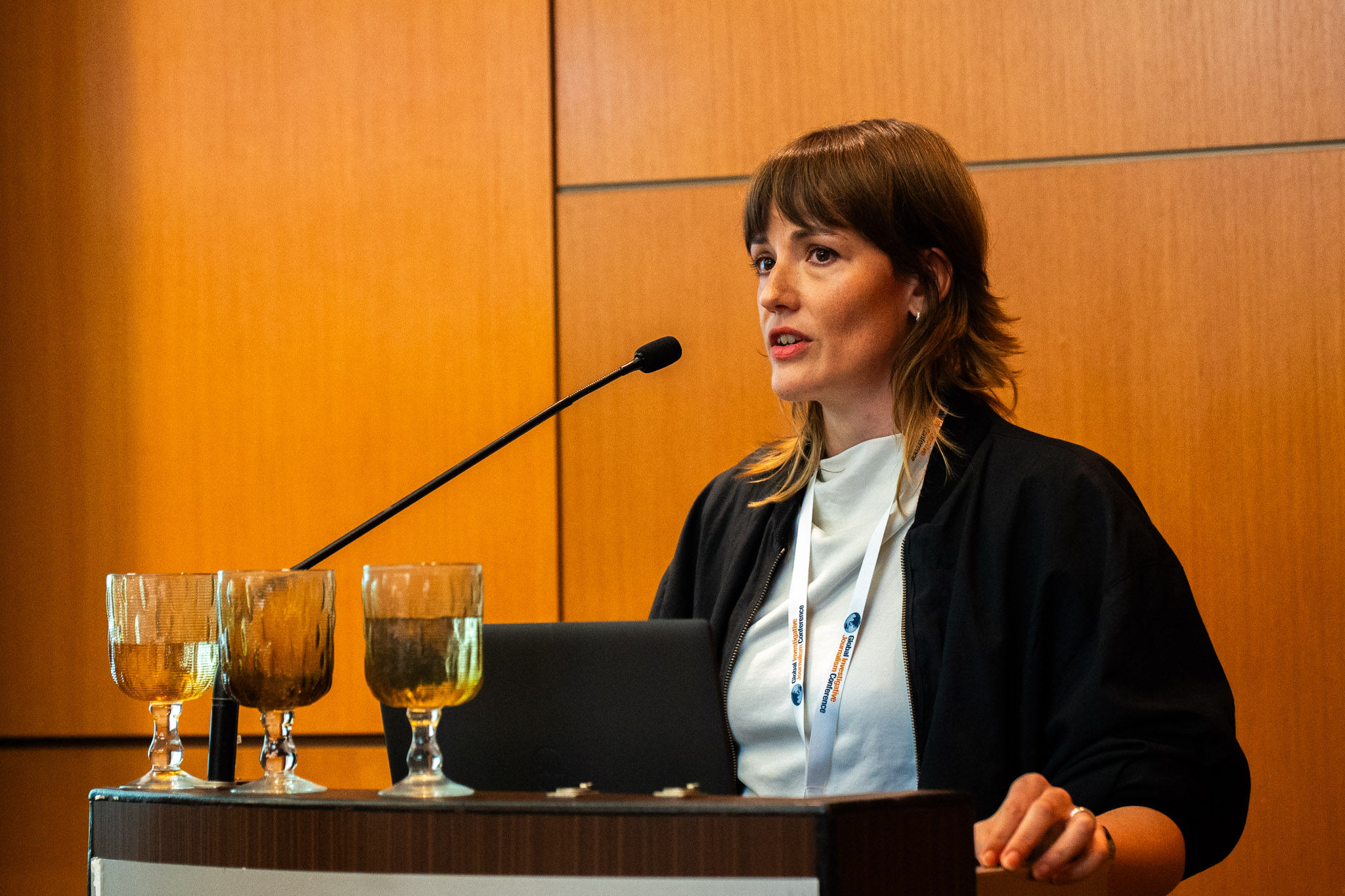
Florence Wild, chief development officer at CORRECTIV, speaking at the GIJC25 in Kuala Lumpur. Image: Zahid Hassan for GIJN
From Readers to Fellow Changemakers
For French investigative nonprofit Disclose, impact is at the center of their reporting strategy and a key motivation of their supporter base.
“We explain to our audience how we are useful… Don’t support us for the sake of investigative journalism, support us because ultimately our investigations could lead to change and improve our society,” said Pierre Leibovici, environment editor at Disclose.
The Disclose Team has invested in trying to generate impact after every investigation, measuring impact, and communicating the impact to audiences.
One week after the publication of their investigations, which cover topics such as environmental crime and illegal arms trade, call-outs for donations are sent out.
Parallel to this, the newsroom tracks about 20 categories of impact that include government responses, legal actions, public mobilization, protests, and policy changes, as well as tips sent by citizen reporters or crowd fact-checking. Each of these outcomes is meticulously recorded in a database and reported back to readers through an annual impact report that is free to access. A donation call-out campaign is also launched during the release of the yearly impact report.
Throughout the year, Disclose sends “impact emails” after publication, updating the readers who engaged most with the story, sometimes even months after a story was published.
Leibovici recalled an impact email they sent to readers 28 months after an investigation into an offshore LNG terminal. The state ultimately mandated TotalEnergies’ CEO to dismantle the project.
“These kinds of emails about long-term impacts are important to build loyalty with our audience and to show them why they have to support us,” said Leibovici.
Sustainable journalism is not about squeezing out donations or revenue but more about cultivating relationships — reporters and readers are partners who are both contributing and investing in a shared vision of change for the better.
Other Tips Shared:
Create new ways for audiences to experience and engage with the story.
- When thinking of events or public interventions, consider places that people from all walks of life frequent, such as laundromats, bakeries, cinemas, or bars.
- Pop-up newsrooms or temporary reporting spaces set up in public areas where people can talk to journalists offer another engagement avenue.
- Try not to do a panel discussion. Experiment with other activities such as speed-dating with experts, free legal consultation, and a guided tour. “Connecting your investigation with a place and an activity is creating an experience for your audience,” said Wild.
Experiment with alternative payment channels.
Sanne Breimer, of SembraMedia, was the research manager for Global Project Oasis, which mapped the business models, revenue strategies, and sustainability practices of hundreds of digital-native newsrooms.
In countries where supporting newsrooms through subscriptions or donations is not a popular practice, experimenting with alternative payment channels can be a way to break through resistance.
General Enumero, a Brazilian outlet, is experimenting with PIX, Brazil’s instant, no-fee payment system, which allows people to make one-off donations and contributions. General Enumero launched an experiment using PIX tied to an investigative story series on Indigenous women for COP30 in Belém, Brazil.
Transparency is essential
Whether revenue comes from donations, memberships, or grants, newsrooms have to be open about their funding sources and spending. Transparency is the backbone of credibility that assures audiences that their support does not compromise independence, but rather strengthens it
Hire a salesperson
According to Breimer, one of the strongest findings from SembraMedia’s global research was that investing in a revenue-focused staff member dramatically increases income. In some European newsrooms, the study found a dramatic jump in revenue if the outlets have a combination of a finance person, a tech person, and a sales person.
“Sometimes it feels like chicken and egg. We don’t have the money to invest. But then… if you do invest in a person with these skills, it will also come back to you,” said Breimer.

‘Theater, Fact-Checked:’ Investigative Journalism on Stage

Lessons on Solving the Media Membership Puzzle

5 Journalism Tips from Edwy Plenel
2025 Conference Resources

At GIJC25, Nobel Prize Laureate Maria Ressa Calls for ‘Radical Collaboration’ to Combat Disinformation and Preserve Press Freedom

The Scam Supply Chain: How to Uncover Transnational Fraud Operations

Nobel Laureate Urges Journalists to Investigate the Systems and Enablers that Foster Corruption Worldwide

Forbidden Stories Goes to the Theater

This work is licensed under a Creative Commons Attribution-NoDerivatives 4.0 International License
Republish our articles for free, online or in print, under a Creative Commons license.
Republish this article
This work is licensed under a Creative Commons Attribution-NoDerivatives 4.0 International License
Read Next
GIJC25
At GIJC25, Nobel Prize Laureate Maria Ressa Calls for ‘Radical Collaboration’ to Combat Disinformation and Preserve Press Freedom
In her keynote address, the Rappler CEO issued an urgent call for the investigative reporting community to embrace creative solutions in pursuit of the facts and a sustainable future.
GIJC25
The Scam Supply Chain: How to Uncover Transnational Fraud Operations
Scams now function as sprawling transnational criminal enterprises. But journalists can expose these networks by following inconsistencies, mapping operations, and collaborating across borders.
Nobel Laureate Urges Journalists to Investigate the Systems and Enablers that Foster Corruption Worldwide
In a keynote conversation, the economist said reporters have a key role to play in probing Western financial institutions and the rules that lead to wealth being laundered from the Global South.
Getting the Story Out
Forbidden Stories Goes to the Theater
For one night, the French nonprofit media site brought its staff and projects to a Paris theater to share its investigations into journalists who have been killed or silenced.