
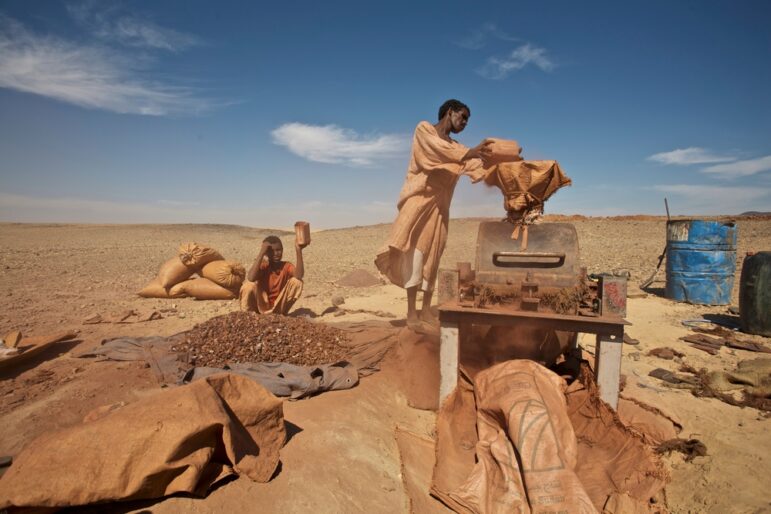
An unlicensed gold mine being operated in the Sudanese desert. Image: Shutterstock
Following the Money Fueling Environmental Destruction in War: A Case Study from Sudan
Read this article in
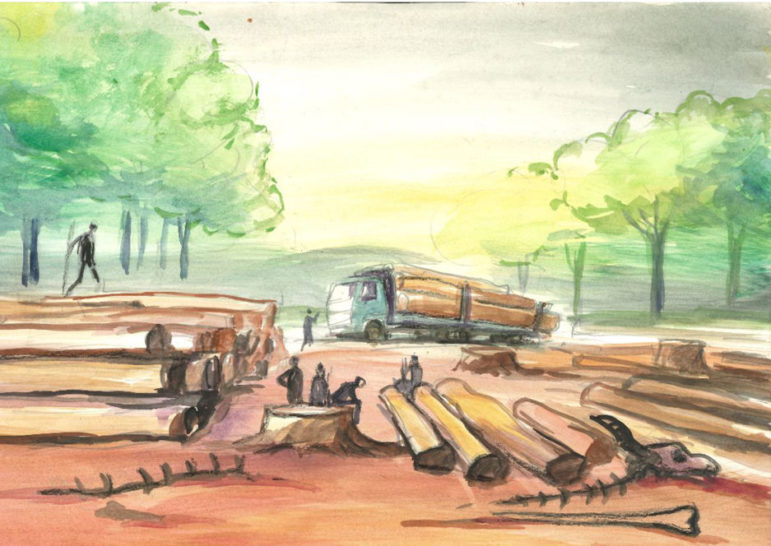
Guide to Investigating Organized Crime in Africa: Chapter 1 — Environmental Crimes
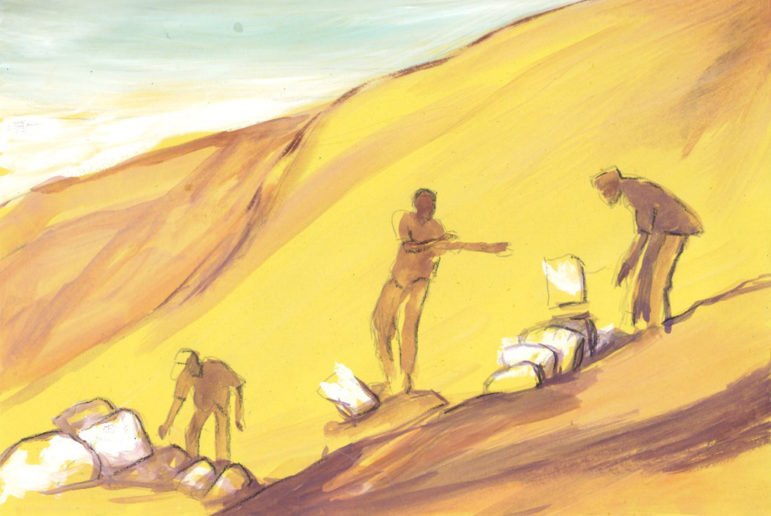
Guide to Investigating Organized Crime in Africa: Chapter 5 — Natural Resources Theft
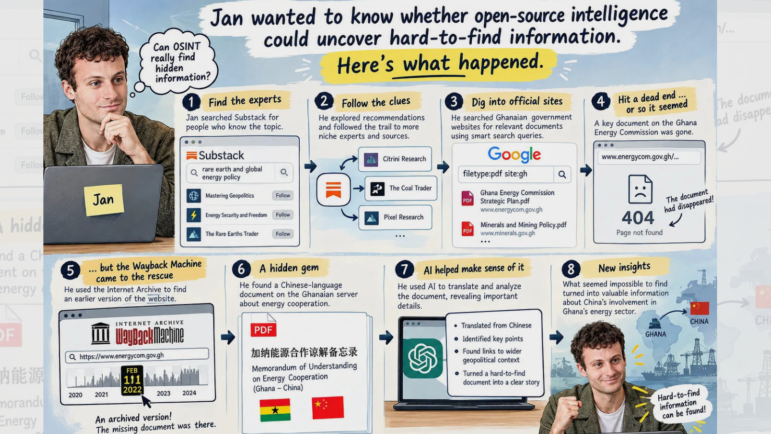
International Research Guide: How to Find Experts and Hidden Documents on Any Topic

Guide to Investigating Tech and AI in Modern Warfare
In fragile, conflict-ridden states like Sudan, environmental harm is a byproduct of the economic strategies. When companies or state-linked entities avoid the high costs of treating industrial pollution or waste, their saved money eventually acts as an unreported subsidy that journalists can trace to understand why pollution is permitted to continue.
While we usually think of a subsidy as a direct payment from a government to a business, this hidden subsidy is an indirect benefit gained by shifting the costs of pollution onto the public.
The core investigative question for reporters is: Who profits from the absence of regulation? There is no doubt that responsibility is often obscured by conflict, but financial flows provide a path to accountability. For example, The New York Times reported that a confidential UN Security Council report estimated that, in 2024, approximately US$860 million worth of gold was extracted from mines in the Darfur region under the control of the paramilitary Rapid Support Forces (RSF). For journalists, the key is to ask why environmental damage is framed as inevitable when the capital saved by bypassing safeguards may be fueling conflict or consolidating power.
Reporting Constraints: Problems and Solutions
Traditional investigative processes often fail in places like Sudan due to the absence of functioning regulators and the perilous situation on the ground. However, reporters can overcome some of these barriers by using specific workarounds to help them document physical environmental damage and identify the financial and institutional actors responsible for it in conflict-affected regions.
Problem: Suppressed or non-existent data.
Solution: Investigative journalists can establish accountability by cross-referencing community testimony, via online accounts and user-generated content, with emerging technologies, like satellite imagery. To search for local witness evidence like commentary, photos, and video uploaded to social media, they can search for specific keywords in Arabic related to gold (ذهب), mining (تعدين), and specific geographic place names. Reporters can also use satellite imagery tools like Google Earth or Sentinel to visualize environmental damage that is often hidden or inaccessible. For instance, when residents adjacent to unregulated mining activity report severe health conditions and neurological disorders, including birth defects, blindness, or paralysis, satellite imagery could verify the presence of unregulated mercury-contaminated waste pits or “tailings heaps” situated near residential areas. If government officials or industry public relations spokespersons claim sustainable practices, but your data shows massive downstream vegetation die-off or water discoloration, you have strong evidence to the contrary.
Problem: Lack of physical access due to an active conflict. For example, the ongoing war between the Sudanese Armed Forces (SAF) and the Rapid Support Forces (RSF) makes many sites unreachable.
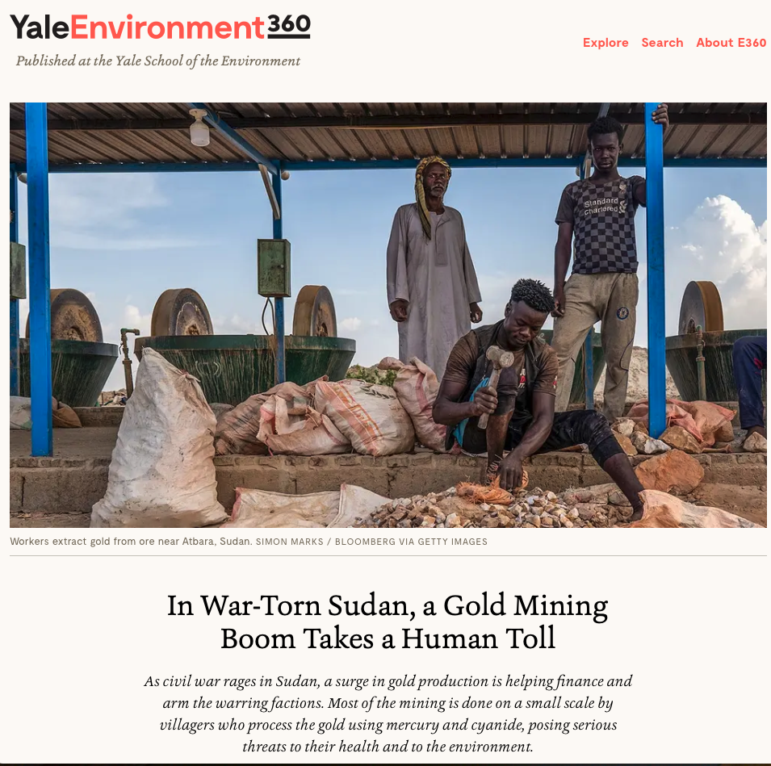
Image: Screenshot, YaleEnvironment360
Solution: Because environmental destruction, like illegal gold processing or the clearing of gum arabic forests, leaves a physical mark, a remote sensing tool like the Normalized Difference Vegetation Index (NDVI) can be used to detect sudden forest loss or thermal imaging to identify heat signatures from industrial activity at “shut down” facilities.
Furthermore, investigators unable to report on the ground can utilize NASA’s FIRMS (Fire Information for Resource Management System) to track fire activity. In the Sudanese context, a cluster of fire alerts in a protected forest or near a mining concession often indicates “clearing” or “scorched earth.” By overlaying these satellite findings with geolocated social media footage, journalists can confirm environmental crimes in real-time using investigative frameworks all without ever having to cross a physical checkpoint.
Problem: Opacity in corporate registries. Military-affiliated conglomerates and shell companies are intended to conceal the origins of commodities and equipment.
Solution: When dealing with opacity in corporate registries, investigative journalists must act like forensic accountants. Military-affiliated conglomerates (like those owned by the RSF) rarely use their own names for international trade, instead they operate through layers of proxies to purchase mining equipment and sell minerals.
To pierce this, journalists must identify the “frontmen,” instead of searching for the company name, they must use the “officers” search in OpenCorporates to search for the names of known military commanders or their known “enablers.” Also, journalists can map the “corporate ecosystem,” using tools like Aleph (by OCCRP), which allows you to cross-reference leaked datasets with corporate filings. For example, if a mining company (Company A) always uses the same transport company (Company B), and Company B is owned by a military-affiliated conglomerate, you have likely found a systemic link between the mine’s profits and the military. Another method is to monitor trade data discrepancies. Since opacity is often revealed by what is missing from the records, journalists can compare export data (from the Sudanese Ministry of Minerals) with import data (from the UN Comtrade database). If the ministry records show 5 tons exported, but the state-affiliated company records show 20 tons imported from Sudan, the 15-ton gap strongly suggests the volume handled by shell companies and smuggled networks. This discrepancy is the journalists’ signal of potential high-level corruption.
Investigative Safety and Risk Mitigation Checklist
When tracking environmental money and corporate exploitation in a conflict zone, risk mitigation is the best practice as it acts as a survival strategy. Because the government bodies and all of the other involved entities treat gold and mineral data as state secrets, journalists might face high risks of surveillance, arrest, or physical violence. This checklist is designed for investigative journalists operating under extreme conditions or in active conflict zones. It prioritizes “zero-footprint” reporting to protect both the investigator and their sources.
1. Digital Defense and Intelligence Prep
- Zero-Footprint Browsing: Access satellite tools and corporate registries only via Mullvad VPN or any other tool that can isolate each website you visit so third-party trackers can’t follow you and to mask your IP from state surveillance.
- Clean Device Policy: Use a dedicated “clean” smartphone for fieldwork. Consult the CPJ Digital Safety Kit to ensure your device is properly wiped.
- Encrypted Channels: Use Signal with “Disappearing Messages” enabled. Review the EFF Surveillance Self-Defense Guide for advanced encryption settings.
- Cloud-Based Workflow: Store all evidence in encrypted vaults like Proton Drive rather than on local hardware.
2. Operational and Field Security
- Remote Monitoring Priority: Utilize “remote sensing” as the primary tool. Follow the methodology in the Zwijnenburg & Ballinger Framework for monitoring conflict zones.
- Metadata Scrubbing: Strip EXIF data from all visuals using ExifCleaner before sharing.
- Emergency Protocol: Register your presence with the CPJ Journalist Assistance Program before entering high-risk areas.
- Low-Profile Capture: In high-risk environments, it’s safer to look like a bystander or a local traveler rather than a professional investigator. To minimize the “tell” of a journalist at work, use a high-quality smartphone for recording rather than a professional DSLR camera or long lens, which are a magnet for security forces. Also consider “decoy” SD cards containing harmless tourist photos to hand over if stopped.
3. Source and Information Protection
- Human Rights-Centric Vetting: For journalists reporting on mining activities, use the OECD Due Diligence Guidance to verify if mining operations are funding armed groups.
- Anonymization Tactics: Review Witness.org’s Video Privacy Tools for blurring faces and landmarks [4].
- Consortium Publishing: Protect your story via the Forbidden Stories SafeBox Network, which ensures your work is published even if you are threatened.
Conclusion: From Data to Accountability
Tracking environmental money in fragile contexts, especially in countries in conflict like Sudan, leads to one destination: documenting the tangible destruction of the environment to open the door for accountability. The destruction of the land and water of Sudan is not only an afterthought of conflict but also a financial decision at its core. When the Ministry of Minerals or a conglomerate linked to the military exempts itself from environmental regulations, it does not simply pollute the Nile or affect livelihoods; it also provides more capital to sustain the conflict. Each satellite-located tailings pond or a shell company uncovered is a piece of a larger puzzle for investigative journalists — and part of the engine that trades the nation’s ecosystem and health for immediate profits.
However, the power in this type of investigative work lies in its longevity. Where the fog of war offers domestic impunity to those prioritizing profit, the digital trail created through remote sensing and corporate tracking can last much longer. By documenting these crimes now, journalists are building a foundational archive for future environmental justice. Ultimately, the role of the journalist within an affected state, such as Sudan, is to serve as a surrogate for the regulators who have failed.
Utilising the concept of “zero-footprint” and working in association with global networks, it becomes possible to connect suffering in the local environment to awareness around the globe. Within this process, journalists can prove that while the environment is often the quiet casualty of war, it is also capable of being the catalyst for holding its exploiters to account.
The path from a mercury-laden waste pit to a Dubai boardroom is long, but with the right tools, it is a path that can be mapped, exposed, and one day, ended.
 Mathani Ahmed is the Founder of Green For Sudan: Sudan Youth Science Communication Journal. She has a multidisciplinary background spanning global climate policy analysis through contributions to the Net Zero Tracker, strategic project design via initiatives like the Climate Hackathon of Sudan Youth Organisation on Climate Change, and youth-focused STEM engagement with organizations such as Youth STEM 2030. She has also served as an Application Reviewer for global innovation platforms including MIT Solve and RISE (Schmidt Futures and the Rhodes Trust Joint Program), and as a Delegate at the Conference of Youth on Environment and Climate (COYED).
Guide to Investigating Organized Crime in Africa: Chapter 1 — Environmental Crimes
Guide to Investigating Organized Crime in Africa: Chapter 5 — Natural Resources Theft
International Research Guide: How to Find Experts and Hidden Documents on Any Topic
Guide to Investigating Tech and AI in Modern Warfare

Exposing the Money Behind Environmental Destruction
Inside the Cross-Border Network Exposing the Environmental Crisis Facing Africa’s Longest River
Investigating Environmental Crimes: Tips From Reporters Covering the Amazon

Following the Digital Trail: How East African Journalists Investigate Corruption through Procurement Data

This work is licensed under a Creative Commons Attribution-NoDerivatives 4.0 International License
Republish our articles for free, online or in print, under a Creative Commons license.
Republish this article
This work is licensed under a Creative Commons Attribution-NoDerivatives 4.0 International License
Read Next
Investigative Techniques News & Analysis
Exposing the Money Behind Environmental Destruction
The Pulitzer Center discusses how it has developed different methodologies to uncover environmental wrongdoing, adapted to the region, jurisdiction, and industry.
News & Analysis
Inside the Cross-Border Network Exposing the Environmental Crisis Facing Africa’s Longest River
Co-founded by two journalists, InfoNile has grown into a sprawling ecosystem of cross-border investigations, multimedia storytelling, and data-driven reporting.
GIJC23 Reporting Tools & Tips
Investigating Environmental Crimes: Tips From Reporters Covering the Amazon
Two reporters whose investigative work has exposed systemic land grabbing and illegal mining in the Amazon share their tips.
News & Analysis
Following the Digital Trail: How East African Journalists Investigate Corruption through Procurement Data
Journalists in Kenya, Uganda, South Sudan, and surrounding countries are using procurement data to reveal corruption, and can offer lessons for journalists around the world.