
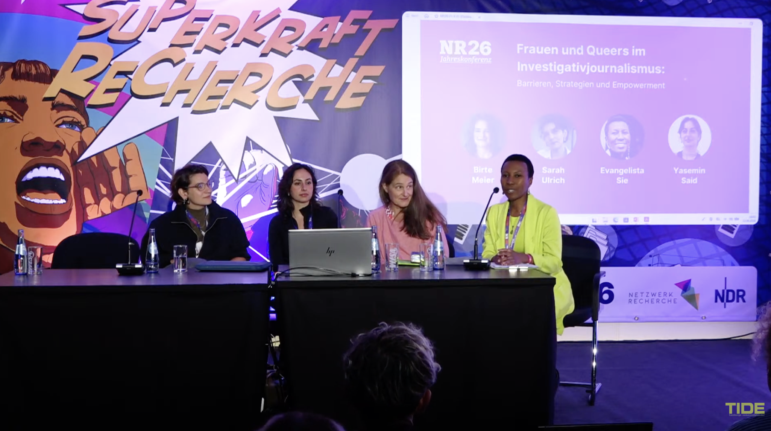
The 2026 Netzwerk Recherche panel on women and LGBTQ individuals in investigative journalism. Image: Screenshot, TIDETVhamburg
Women and LGBTQ+ People in Investigative Journalism: Challenges, Strategies, and What’s Next?
Read this article in
Women and LGBTQ+ journalists face a particular set of challenges in the profession, including pay discrimination, being underestimated or undervalued by senior staff, or hate speech and harassment. A UNESCO and International Federation of Journalists study found that 73% of women journalists reported experiencing online violence. The ways gender, identity, and sexuality intersect with race and class can also bring unique experiences and challenges in the workplace.
In a novel panel format at the 2026 Netzwerk Recherche conference in Germany, three experts discussed their experiences working in investigative journalism as women, LGBTQ+ individuals, and as individuals with intersectional identities — including the areas they’ve seen progress, where they haven’t, and the current state of play as some newsrooms tighten belts and shift rightwards.
Moderator Evangelista Sie, project and communications officer for ACOS Alliance and founder of The Chance, a startup for supporting the representation of Black media professionals in Europe, was joined by Birte Meier, chief reporter for Stern Investigativ / RTL; Sarah Ulrich, freelance investigative reporter and erstwhile GIJN German editor, and Yasemin Said, a documentary filmmaker and journalist and the founder of PERSPECTIVES, a Leipzig-based project supporting migrant communities.
Instead of handing microphones to audience members during the Q & A portion, the speakers kept one seat free on stage for audience members to join them on the panel to discuss their questions more in-depth — “we don’t just have three amazing experts in this field here, but there’s a huge amount of expertise throughout the whole room,” explained Sie as she started the session.
This experiment resulted in a casual, free-flowing but frank discussion covering a spectrum of topics — including potential barriers to entering the profession, pay discrimination, harassment, sexism, isolation, and shared experiences of how gender, sexuality, and intersectional identities such as race have played out in journalism careers. A recurring theme was taking stock of the progress that has been made in the last two decades — and how to keep doing investigative journalism that includes these voices.
Representation, Access, Disillusionment
Even in Germany, where “equal pay for equal work” is a fundamental principle of labor law and LGBTQ+ individuals have federal workplace protections, issues of representation, pay parity, and power dynamics persist in newsrooms, the panelists noted. The financial struggles many publications face can further complicate the picture.
Freelance journalist Sarah Ulrich, whose reporting focuses on gender-based violence and abuses of power — recent projects include The Invisible Front, about sexual violence against women in the Ukraine war — explained that the disproportional lack of women and queer voices in the journalism profession leads to these voices being missing from reporting and stories too.
“Women and queer people are still underrepresented in the reporting world, and that’s of course a consequence of patriarchy, which also shapes the media,” said Ulrich. “There could, for example, be more protagonists or opinions or characters [in reporting] other than white, cisgender men. That’s often not taken into account.”
An audience member named Günter joined the panel to discuss access to the journalism field. Günther worked at Netzwerk Recherche previously and now works for Academy Waldschlossen, an education and conference center founded in 1981 to educate and break down prejudices against the LGBTQ+ community.
“The classic image of an investigative journalist when I was starting out was almost associated with the secret service, or secret agents… I didn’t see myself in that, Günter said. “I had no idea how it could have worked for someone like me to be this kind of journalist.”
“It took years, in some cases, for me to be taken seriously… even when I was doing a good job from the very beginning. Maybe I am not as eloquent, hard, or assertive as some others. So if I were to look back over the last couple of decades, I wonder whether that was an obstacle, and whether anything has changed on that front,” he said. “Whether, just by doing good work — even if you don’t bring typical male characteristics or qualities associated with masculinity to the table — you can still make it in the profession?”
“I wouldn’t say that access has become easier, but I’d say that the discussion about these issues has increased.” Ulrich responded. “The spaces are also changing, and the pressure is rising because we are all there and because we are slowly claiming this space ourselves.”
Ulrich explained that when she was starting out she did not yet have a network of like-minded journalists or feminist networks. “I struggled for a long time with how to bring my own identity and positioning, as in feminist positioning, into this journalism field, because I thought I would be seen as unprofessional. I think that is still partly the case. The risk that we get labeled activists,” she said. “I also had the feeling for a long time that the FLINTA [a German acronym representing Female, Lesbian, Intersex, Non-binary, Trans, and Agender people] in journalism had to have sharp elbows because we were literally fighting for visibility, and I think that’s slowly changing, and there are more people in leadership positions now.”
Yasemin Said, whose work focuses on human rights and power structures and has examined how the German media frames its reporting on migrant communities, said overcoming isolation is key.
“I would still say that my disappointment and disillusionment were pretty big, seeing that even in the journalistic context, in every environment I’ve experienced some form of sexualized harassment,” she explained. “That made it uncomfortable at work, that comments were made. I guess that’s still kind of the norm… And I think that this isolation and the whole ‘I have to figure out my own way of dealing with it’ really weakens our ability to change anything. So I think I would wish that we could gather a bit better.”
‘Selective’ Visibility
The panel and audience also discussed the visibility of LGBTQ+ journalists in newsrooms — and its limits. Said, who is a contributor to the History Unit project Reframing Queer Narratives in Media, argued: “I find that there is no queer visibility at all [in the field]. Zero. I wouldn’t know where. I think it’s almost interesting how invisible it is, even in the [big publishing houses]…But in the meantime I find that using social media works pretty well to connect and meet other people. I think that’s super cool.”
Daniel, an audience participant and openly gay man who works regionally as a journalist, remarked that, in his experience, queer representation and visibility in journalism is “selective” in that some groups are more visible than others.
“Personally, I feel like I know a lot of gay men [in the field] but other groups, especially people of color, or lesbian people or trans people, seem to be hardly visible at all… There are certain groups that are actually already pretty strongly represented, and everyone else kind of falls through the cracks. LGBTQIA+, that’s quite a few letters, and if only one letter is represented, that’s unfortunate.”
Pay Disparity, Yesterday and Today
Award-winning veteran investigative journalist Birte Meier is also an equal pay advocate who in 2020 won a landmark ruling for pay equality at Germany’s federal labor court, where she had taken her case against her employer, ZDF, a major national public broadcaster, for being paid less than her male investigative journalist colleagues. She also wrote a book “Equal Pay Now!”
As moderator Evalngeline Sie noted, not everyone has the resources for a legal battle with their employers. So, they asked, what does Meier advise journalists or colleagues who encounter the same struggle?
“It depends on worker status; whether you are employed or freelance, what kind of contract you have,” she explained Of course, it also depends on the laws and protections in each jurisdiction. But pay disparity frequently persists in practice, particularly in newsrooms.
Meier suggests journalists follow this three-step test before taking any action:
- Is my job/task comparable to my male colleague’s?
- Can I prove that my male colleague/counterpart earns more?
- Is there a legitimate reason the male colleague is paid more?
“Of course, there are real reasons men and women can be paid differently, for example if the man has more work experience. But not if he happened to negotiate better. So, it’s a relatively simple matter — if you can’t rule out discrimination, then it is also advisable, if you don’t want to sue, to go to the employment council, a lawyer, an anti-discrimination office, a union, or any kind of information center that can help you. Because just living on with the realization is surprisingly difficult. It’s hard to stay satisfied at your job,” Sie added.
Meier acknowledged that journalism conferences have come a long way since she started out: “These old men would come up and squint at our name badges, and just move on, because we somehow weren’t important. Now, of course, this conference has all kinds of different people, and particularly young people,” she said.
“But I think, just to put a little check on the optimism, that, in newsrooms, when it comes to who gets which budgets, who gets to do the big investigations, who makes it to the top, and who’s throwing their weight around up there, that now that belts are being tightened again everywhere, the same old mechanisms are still at play. We’re by no means where we should be, and there’s still quite a way to go,” she added.
Moving Forward
The discussion touched on the financial challenges newsrooms are facing and the effects this has on what coverage is prioritized.
An audience member asked how investigative journalists can move forward at a time when resources are becoming scarcer, and more newsrooms are leaning more to the right.
“I have the impression that I can’t sell investigations about structural discrimination among farm workers at the moment, because that’s just not what’s in demand right now,” the audience member said. “I really wonder how we can maintain this space for discussion, but also how we can keep up this type of investigative work — because it’s expensive, it involves a huge emotional effort, it’s sometimes challenging in terms of safety, and afterwards we’re just exhausted.”
In response, Ulrich shared her experiences of trying to launch a feminist investigative newsroom with some colleagues, which at a late stage round did not secure the financing they sought. “I think, the people who still have the resources and the strength, we have to build something ourselves, because it’s not going to be handed to us… The public broadcaster won’t come to us. We have to do it ourselves, and we have to find the funding ourselves.”
Said added: “I find it really inspiring to see how women investigative journalists work worldwide, how they organize, and wonder whether it would be possible, at least in the beginning, to organize ourselves. To do investigative work while also having a job that pays the rent, and then to slowly start building things up… I feel like I don’t want to keep hoping that I’ll end up in newsrooms that are less crappy. I would just like for us to build them ourselves.”
Watch the full NR conference panel below.
Resources
The Association of LGBTQ+ Journalists
Reporting While Trans – Columbia Journalism Review

Alexa van Sickle is a journalist and editor with experience across digital and print journalism, publishing, and think tanks and nonprofits. Before joining GIJN, she was senior editor and podcast producer for the foreign correspondence and travel magazine, Roads & Kingdoms
GIJN’s Resource Center: LGBTQ Resources

Guide to Investigating Tech and AI in Modern Warfare
Turning Copernicus Satellite Data Into Public-Interest Climate Stories
10 Practical Tips for Verifying Scientific Claims
Document of the Day: A Guide to Investigating Anti-LGBTQI+ Hate
Tips and Advice for Investigating the Stories that Impact the LGBTQ+ Community
Editor’s Pick: Best Stories from GIJN Women
‘Picking Up Pens was a Revolutionary Act’: Telling the Stories of Marginalized, Rural Women in India

This work is licensed under a Creative Commons Attribution-NoDerivatives 4.0 International License
Republish our articles for free, online or in print, under a Creative Commons license.
Republish this article
This work is licensed under a Creative Commons Attribution-NoDerivatives 4.0 International License
Read Next
Resource
Document of the Day: A Guide to Investigating Anti-LGBTQI+ Hate
Taboom Media has created a reporting guide for journalists interested in investigating how US-based faith groups and NGOs foment hate against LGBTQI+ communities, both in the United States and abroad.
GIJC25
Tips and Advice for Investigating the Stories that Impact the LGBTQ+ Community
Rising political backlash and harmful policies threaten queer lives. Covering systemic failures that affect LGBTQ+ people requires rigorous, sensitive reporting.
News & Analysis
Editor’s Pick: Best Stories from GIJN Women
From birth control disinformation to cross-border surrogacy, from high-level sexual harassment to the brutality of “everyday” violence against women, 2022 was a year marked by a number of noteworthy investigations into stories with a gender angle.
News & Analysis Press Freedom
‘Picking Up Pens was a Revolutionary Act’: Telling the Stories of Marginalized, Rural Women in India
Meera Jatav, the co-founder of the award-winning, grassroots feminist media organization Khabar Lahariya, has won admiration for her courageous investigations into gender-based violence and caste in India. Here is the keynote speech she delivered at the Centre for Investigative Journalism’s summer conference in London.