

Image: Screenshot from the book “Story-Based Inquiry: A Manual for Investigative Journalists.”
The Hidden Scenario: Building Timelines for Investigations
Read this article in
The creator of Sherlock Holmes, Arthur Conan Doyle, was a trained physician, and studied under one of the great diagnosticians of his time. A proper medical diagnosis, as it happens, proceeds from a hypothesis that is verified by clinical examination and the patient’s history. That’s surely where Doyle’s description of Sherlock’s method came from: “The ideal reasoner would, when he had once been shown a single fact in all its bearings, deduce from it not only all the chain of events which led up to it but also all the results which would follow from it.”
Our work as investigative reporters isn’t fiction, but there are fictions we can learn from. If a hypothesis is the starting point of an investigation — the provisional answer to the question “what do we think happened?” — a timeline and a source map determine the path to verify the answer. By seeking when events occurred, where they occurred, and who was involved, we learn how things occurred.
Starting from the event at the center of our hypothesis, we can therefore construct a chronology that begins with the causes of the event and continues to the moment when the event’s effects are recognized and hopefully repaired.
Along the way, we can use the power of chronology to uncover information. If we know that something happened, we can deduce the causes or conditions that led to it. We can likewise deduce the consequences. Once we frame the causes and consequences as hypotheses, we can verify them.
Consider the banal event of an official announcement. For the announcement to be published, someone had to order that it be written, someone had to compose it, someone had to approve it, and someone had to deliver it, then ensure that the message was heard. We might deduce the individuals involved, if we know the organization they work for. We can imagine a meeting of these people, where decisions are made. If we are lucky, there will be a record of that meeting, and we may be able to obtain it.
That happened in the Watergate investigation, which launched the contemporary era of investigative reporting. Federal investigators observed a change in the communications strategy of Richard Nixon’s White House, and deduced that a meeting had preceded it. They then sought records of that meeting, and eventually found them. Those records revealed a conspiracy to obstruct justice, and Nixon resigned before he could be impeached.
We can use the timeline to indicate the presence of specific actors in the story: Every time something happens, someone had to make it happen. We can deduce who that “someone” might be — a functionary, a lawyer, a scientist? — and then verify that hypothesis.
Typically, the first actors to appear in a story are its victims. They tell us when the effects of a crime or an error erupt — much of what is wrong in the world results from a mistake, which becomes a problem only when its author refuses to recognize or fix it — and they can help to identify the probable agents driving that change.
How to Make and Maintain a Timeline
Composing a timeline is a simple procedure, and it works equally well for research in print, longform features, and documentary or investigative filmmaking. However, for it to be effective, you need to work systematically and add material regularly. If you do that, you will gradually internalize the story. Meanwhile, you compile a precious asset that will be useful for future stories as well as the one you are working on. You will also acquire a vital skill — organizing your material as you collect it.
The Organized Crime and Corruption Reporting Project’s (OCCRP’s) Paul Radu says: “I’m always putting everything on paper first, pointers and ideas and a little bit of timeline. Then I transfer into a spreadsheet.” At that point, he said, “I’m just trying to organize the documents, put structure in the investigation.”
Spreadsheets are the preferred timeline tool of many leading investigators. As the Pulitzer laureate Deborah Nelson comments: “I like spreadsheets better than word processors, because you can ask them questions and they answer back. You can enter events or developments fast and furiously as you discover them and sort by date to put new events in the right place. You can filter to separate out events involving one deal or theme or place or person from others and you can un-filter to see where they fit into the bigger time/place scheme of things. If you are counting things, like dollars, you can quickly add up a column with the sum function.”
I prefer using a word processor for the timeline, and adding in text, images, audio extracts, video clips, tables or spreadsheet extracts as needed. I find the relatively small fields in a spreadsheet less stimulating than seeing images or words spread across a page. Moreover, if the timeline is in a text format, I find it easier to redact before composing the story.
Regardless of the format, the key elements are always the same: What happened? When did it happen? Where? Who was involved? What did they say and do? Did it have an effect?
Here’s the step-by-step procedure:
- Capture the events that left visible evidence — like a tip, a document, a comment, an observation. Begin with the time at which each event occurred, not the time when you learned of it. Include the year, month, and day if known. (If you’re analyzing a crime or disaster, hours and minutes may matter too.) If you don’t know the specific month or day, use the first month of the year and/or the first day of the month so they are roughly in the right vicinity in your timeline. You can color code if needed to flag the imprecision.
- Then add where the event occurred, who appears to have been involved, and what happened. The entry may be more or less detailed. You may include a summary, or quotes from an interview or document, an image, or a link to an original recording. If you’re working with film, keep track of the time codes for those quotes to reduce the time you’ll spend searching for them later. If you’re working with documents, color-code the key passages.
- Now, insert the source of your information. Did someone tell you? Put in their name (unless the source is confidential, in which case you must not record it). Is the information or data contained in a news clip or document? Is the information confirmed by other sources? Give the facts necessary to find the information again, for example, a URL (and download the source document). Wherever the information came from, it is infinitely more efficient to keep your data and sources together as the timeline is being created, than to search through your material for documentation later.
- This is what a typical timeline entry looks like, from an investigation published as The Vanishing Diaspora of Syria’s Doctors. The story documents the flight of tens of thousands of physicians from terror and poverty, and their disappearance from the medical profession as they fail to obtain re-accreditation abroad. The entry includes a date (which can be more or less precise depending on what you need to know), a summary, identifying details for the source, an interview excerpt, and archival information:
01/01/2015: [Dr. X] emigrates to Canada with family after militia attempts to kidnap his son. [Current title, company, location]
“They tried to kidnap my son. They targeted sons of doctors, engineers, kind of known people in the city, who they suppose have money…. And in many cases, we know they kidnap the kids and took the money and killed them and sent dead bodies to their families. Personally, I know two families.”
Source: Interview, 08/24/2022 (recorded: filename)
- It is a good idea to include tangential events in your timeline if they provide you with a deeper understanding of the story. You are not obligated to keep them in your final draft.
- Not every event needs to be documented in the same detail. However, key events, such as reconstructions of meetings, official or criminal procedures, or dramatic scenes, require in-depth documentation that must be gathered (often from interviews) as the story is developed, and recorded as more or less extended quotes in the timeline.
- Now, deduce the events that you believe must have preceded or accompanied the event you have confirmed. Who must have done what, at which moment, for the event to occur? Use a specific keyword term (like “deduction”) to describe these possible events, so you don’t mistake what you imagine for what you have proven.
- Also try to imagine where would this event have left a trace? An official document, a news item, visible damage, or conflict that a witness might recall? Put those ideas in the timeline, and seek to verify them.
- If several interviews or documents refer to the same events, place separate quotes in the timeline, as if you were compiling a conversation about the event. This material can be used later to create dramatic effects in your story, as you juxtapose different points of view.
- As you compile the material, you may wish to insert a hyperlink or use keywords to connect to later or earlier events in the timeline. This makes it easier to navigate among related events.
- Descriptions or illustrations of places where events occurred will be valuable when composing the story. They can likewise be put in the timeline as an image or hyperlink.
- Imagine the consequences of the events for different actors in the story.
- As your timeline becomes more detailed, you will have moments when the data seem to be speaking to you, and your attention becomes creative. You will have ideas in these moments — the meaning of an action, or its connection to another, for example. Capture those thoughts and put them in the timeline; we tag them “note:” with a colon, to avoid false hits when we search for them, and to avoid mistaking them for verified data. If your timeline is in a spreadsheet, create a “note field” by adding a new column.
- Finally, imagine how you would like the story to end. Is a reform necessary? What might it encompass? What would you like to hear the protagonists say, in line with the facts? Of course you can’t speak in their place. But you can verify the idea with them, or from a document. If your idea isn’t right, you’ll find what is.
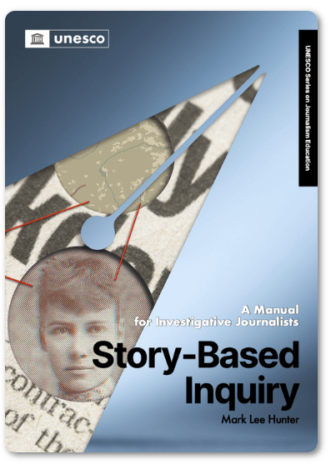
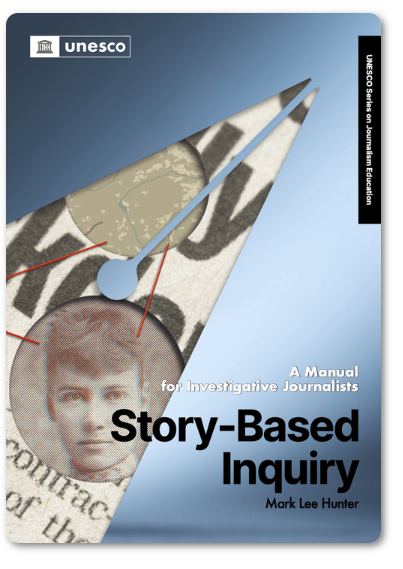
Image: Book jacket
We have made stories without timelines, usually because we were in too much of a hurry, and we always regretted it in the end. A well-executed timeline saves far more effort than is required to make and maintain it — about half an hour a day, once you get the habit — because it imposes order and clarity on what would otherwise be a chaotic stew of facts. It also provides other powerful benefits:
- Like the hypothesis, the timeline helps to define and imagine the story before committing to the investigation. Its most important initial function is to tell you if a story is plausible. For example: Did anomalies occur in an official procedure? Did they affect the outcome?
- The timeline also helps you to foresee which steps will be easiest or hardest to uncover and document. Confidential meetings are far harder to document than public meetings. Generally, sources will only discuss such events when they realize that you have already documented a pattern that points to a conclusion. Instead of asking, “What happened?” you can ask, “Is this what happened?”
- The timeline plays a key role in keeping track of discoveries during the investigation. As each new fact emerges, it will be placed in the appropriate place in the timeline and documented. This facilitates fact-checking and composition, because you won’t struggle to remember where you found the facts.
- Finally, a timeline enables you to structure the investigation as a narrative sequence, progressively, as research continues. By making a timeline, you are already beginning to compose the story.
Editor’s Note: This is an edited chapter from the second edition of “Story-Based Inquiry: A Manual for Investigative Journalists” (UNESCO 2026). You can read and download the full version here for free. The author extends his deepest thanks to Luuk Sengers, who co-developed many of the concepts and techniques in this article.
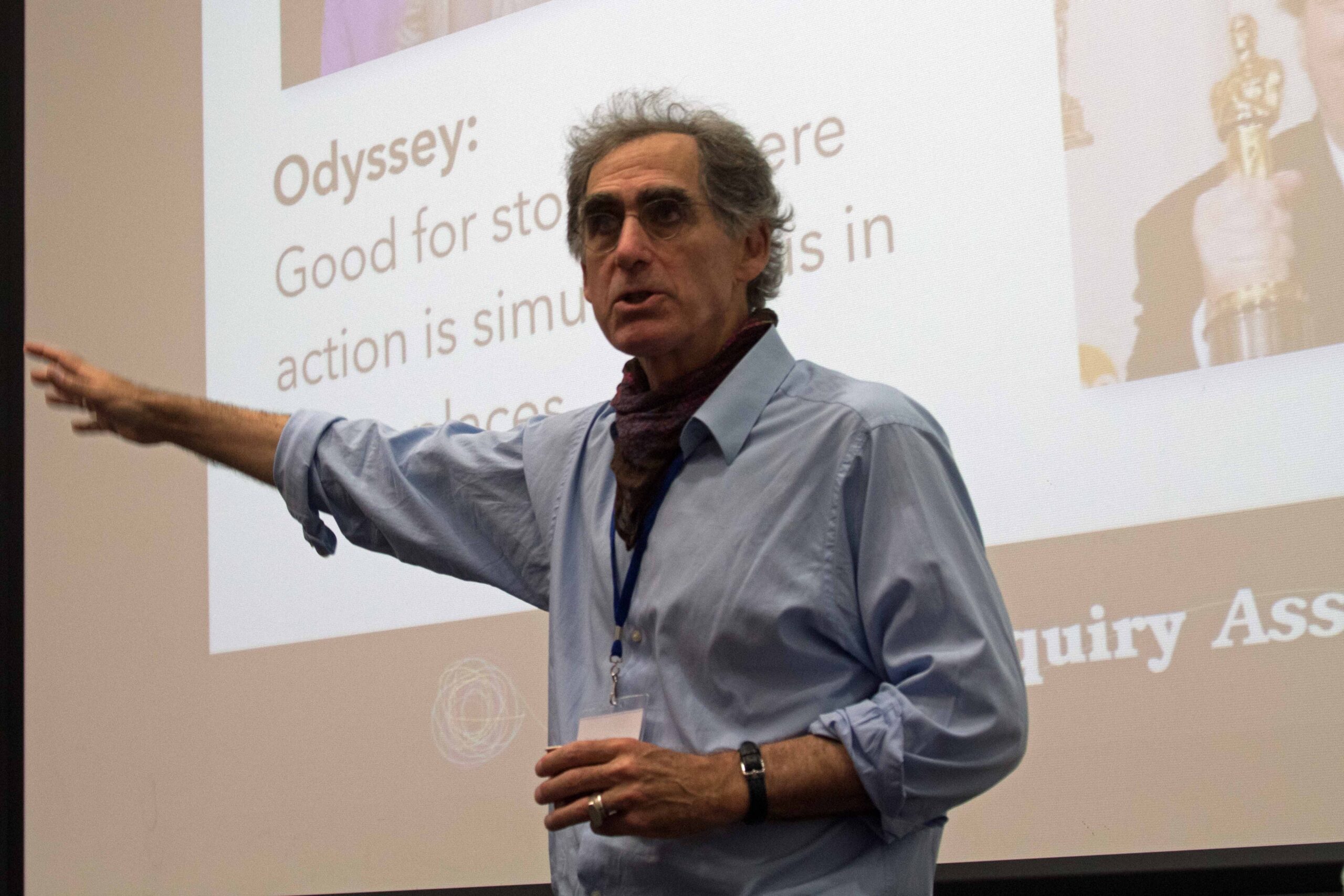 Mark Lee Hunter is the principal author of “Story-Based Inquiry: A Manual for Investigative Journalists” and is a founding member of the Global Investigative Journalism Network. He has trained thousands of journalists to manage and write investigations, and his articles have been published by Harper’s, The New York Times Magazine, Washington Post, Le Monde Diplomatique, and others.

Project Management: Team Dynamics and Collaboration

Introduction to Investigative Journalism

Tech Focus Project

Guide to Investigating Tech and AI in Modern Warfare

Project Management: Planning and Timelines
Managing the Collaboration: The Growing Importance of the Investigative Coordinator
Documenting Gaza: How Journalists Can Collect Evidence Even When Denied Access
Israeli Checkpoints in the West Bank, Arctic Global Warming, Brazil’s Women Legislators, Inventing a Migrant Crisis in Ukraine

This work is licensed under a Creative Commons Attribution-NoDerivatives 4.0 International License
Republish our articles for free, online or in print, under a Creative Commons license.
Republish this article
This work is licensed under a Creative Commons Attribution-NoDerivatives 4.0 International License
Read Next
Resource Guide Chapter
Project Management: Planning and Timelines
In this chapter, we discuss how the project manager helps the investigative team focus on the goals and scope of the project, set the direction, and define the boundaries of the reporting.
Getting the Story Out
Managing the Collaboration: The Growing Importance of the Investigative Coordinator
The role is frequently described as a lynchpin in investigations, and the more moving parts, partners, and countries, the more vital this position becomes.
GIJC25 News & Analysis
Documenting Gaza: How Journalists Can Collect Evidence Even When Denied Access
Journalists have used local reporting, open source analysis, and forensic reconstruction to verify events happening on the ground in Gaza, allowing them to challenge official narratives and preserve evidence for future accountability.
Data Journalism Top 10
Israeli Checkpoints in the West Bank, Arctic Global Warming, Brazil’s Women Legislators, Inventing a Migrant Crisis in Ukraine
Also highlighting how pro-Russian channels fabricated a mass migration threat in Ukraine, charting South Africa’s micro schools, and how beliefs in an afterlife vary around the world.