
Image: GIJN
Editor’s Pick: Best of Data Journalism from 2025



News coverage in 2025 was dominated by several seismic events, with data journalism outlets closely tracking a world shaped by US trade hegemony, the rising influence of AI, and the persistence of conflicts. US President Donald Trump’s second term ushered in sweeping global tariffs and deep spending cuts, and sowed uncertainty across the global economy.
Meanwhile, the rapid proliferation of artificial intelligence and data centers was a focal point worldwide, highlighting the growing impact of technology on economies and society. Conflict and war remained central to the year’s reporting, with many of the stories featured in our list this year focusing on the Russia-Ukraine war and the war in Gaza. Other key topics included the election of a new pope, the spread of wildfires, and issues surrounding social media usage and misinformation.
In 2025, we published 22 editions of GIJN’s Data Journalism Top 10 column, covering well over 200 stories. For this end-of-year round-up, we bring you a selection of global highlights following a criteria that has grouped stories by prominent news topics, and assessed stories for the rigor of their methodology and the quality of execution, while considering the depth and creativity of the reporting.
Conflict
Conflict accounted for roughly 14% of the stories in our columns. Reports on the Russia-Ukraine war, Gaza, and Sudan produced some of the year’s most in-depth investigations, combining open source intelligence, mapping, social media analyses, and on-the-ground reporting to convey the human costs of war.
Russia-Ukraine

Image: Screenshot, Texty
The war in Ukraine was defined by incremental Russian advances, expanded drone and long-range attacks, and intense ceasefire efforts that ultimately failed. At least 19 articles we featured this year focused on some aspect of the war, but assessments of how the proliferation of AI is shaping the conflict online provided a particularly compelling angle. Ukrainian outlet Texty examined how large language models (LLMs) from the US, France, China, and Canada interpreted the war, asking thousands of English-language questions across thematic areas including geopolitics, history, and national identity. Responses ranged from pro-Ukrainian to pro-Russian, revealing significant biases in AI models: Canadian LLMs ranked most Ukraine-friendly, while Chinese models showed the strongest pro-Russian bias.
War in Gaza
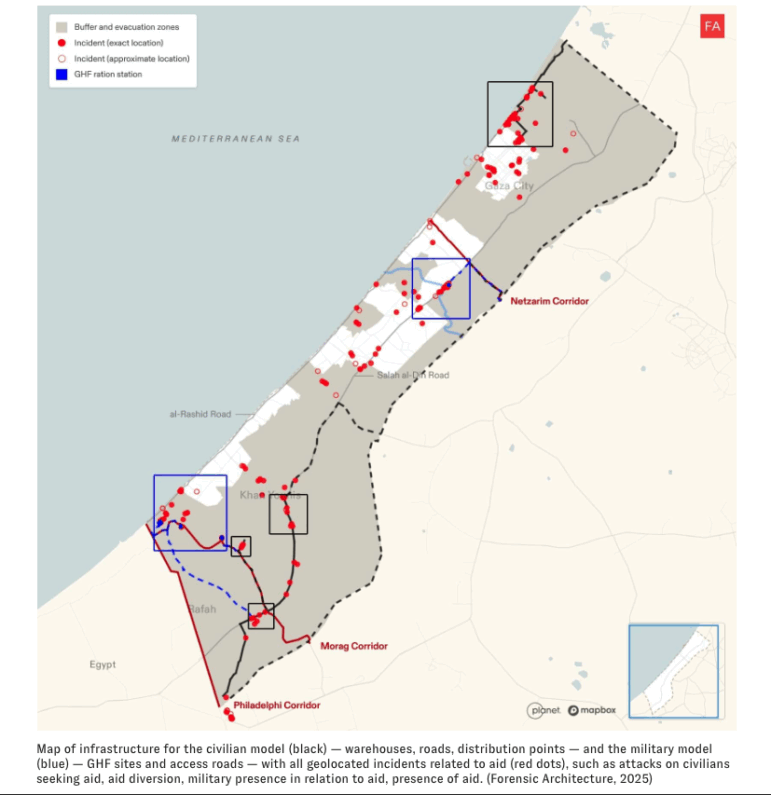
Image: Screenshot, Forensic Architecture
Despite a fragile ceasefire being brokered in October, the war in Gaza has claimed the lives of more than 70,000 people and left more than 170,000 injured. After a cessation of hostilities in spring, fighting in Gaza resumed with repeated Israeli offensives and the blockade of essential aid, which led to one of the most alarming aspects of the war — famine. Building on prior analyses of Israeli attacks on aid in Gaza, a detailed investigation by Forensic Architecture and the World Peace Foundation found that starvation had become a deliberate tactic employed by Israeli forces. Researchers documented attacks on civilians collecting aid and the destruction of critical food infrastructure, using open source data and spatial analysis. Each incident from March 18 to August 1, 2025, was geolocated, timed, and verified with video and satellite imagery, revealing a systematic pattern of intentional targeting of Israel-run aid sites.
El Mundo also released a special report which similarly highlighted the dire humanitarian crisis, following a father’s struggle to access food, with illustrations and maps revealing deadly delays at aid distribution centers.
Sudan

Image: Screenshot, ARIJ
Sudan’s civil war between the Sudanese Armed Forces (SAF) and the paramilitary Rapid Support Forces (RSF) escalated into a catastrophic humanitarian crisis, with mass killings, the 18-month siege of El-Fasher, famine, ethnic violence, and reported “killing fields” that rights groups warn may amount to genocide and war crimes. A joint investigation by Arab Reporters for Investigative Journalism (ARIJ) and Al Mohajer revealed how smugglers and criminal gangs preyed on refugees fleeing the violence. Focusing their investigation on refugees crossing into neighboring Egypt, reporters interviewed a dozen survivors of smuggler-related violence and surveyed 324 refugees, and found that a number of men and women had been raped or sexually harassed. Through interviews, the journalists mapped four main smuggling routes in an interactive visualization showing border stops approaching a quarry region near Aswan, a city in southern Egypt. Similarly, a collaborative investigation by Sky News, Sudan War Monitor, and Lighthouse Reports used open source reporting to expose how paramilitaries hunted down civilians who fled El-Fasher and killed them in surrounding “killing fields.”
Syria After Assad
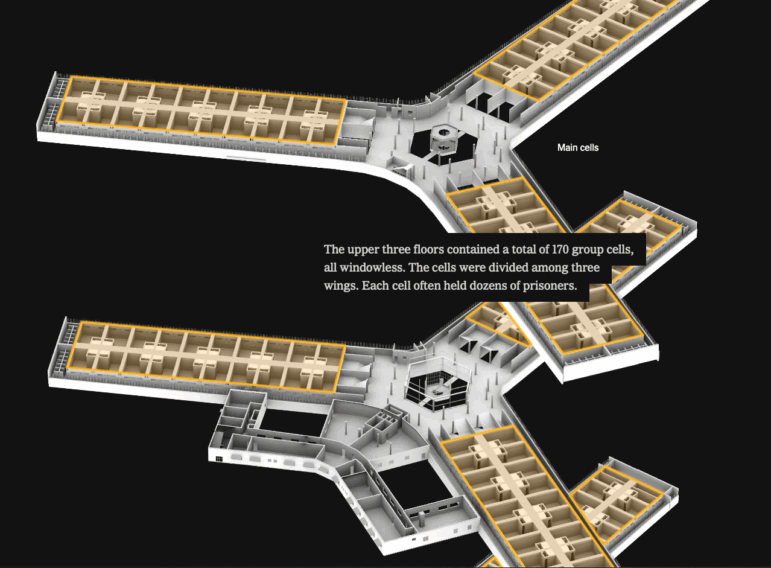
Image: Screenshot, The New York Times
After Bashar al-Assad fled Syria in December 2024, many thousands of exiles — including journalists — were able to return to the country for the first time in decades. Over the following year, local and international journalists embarked on the challenging work of collecting evidence for potential war crimes, finding the disappeared — and investigating Syria’s notorious prisons, where the regime had held and tortured tens of thousands of dissidents. With detailed footage, images, and documents, The New York Times produced a 3D model of Sednaya prison on the outskirts of Damascus, providing an interactive look at the interior, a detailed guide to each part of the building and its purpose, and tracing the individual stories of several prisoners held there.
Climate
Extreme weather and natural disasters in 2025 marked another year of widespread climate change, from Hurricane Melissa making land as the biggest storm to hit Jamaica, to a typhoon in Hong Kong and flooding in Pakistan and India after record-high rains in late April.
California Wildfire Impacts
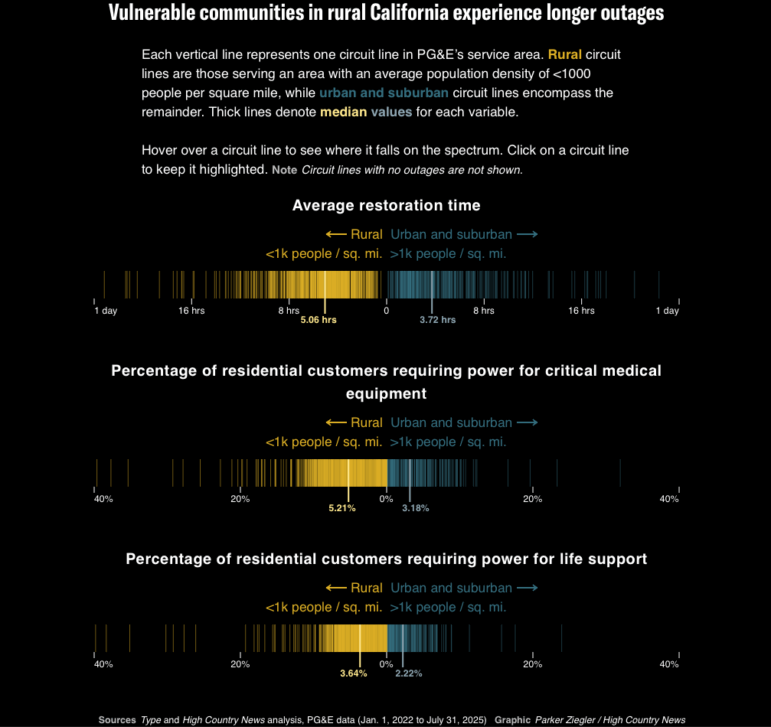
Image: Screenshot, High Country News
Several outlets focused on the devastating impact of wildfires in Europe and the US. In particular, California wildfires featured in several investigations, looking into everything from the structures of homes that survived fires to the failed preventative measures aimed at stopping the spread. Reporters from High Country News and Type Investigations conducted a first-of-its-kind analysis after a catastrophic wildfire sparked by a damaged transmission tower, which led to state regulators in California introducing new wildfire prevention rules. One of the fixes deployed by PG&E, the state’s largest utility company, saw a change to the fast-trip settings that automatically cut electricity when equipment detects a potential physical hazard that might spark a fire. Using data from Cal Fire and PG&E to map service areas and circuit lines against wildfire locations while tracking cumulative power outages from 2022 to 2025, the findings show that rural communities, which often border forests and face higher fire risk, experienced 600% more fast-trip outages than urban areas.
Elsewhere on this topic, we also recommend the The Washington Post’s visual explainer of why some houses survived the Los Angeles wildfires, which mapped fire damaged properties by location, and explored the age of the properties that were destroyed while assessing photographic evidence of the damage.
Drought in the Amazon
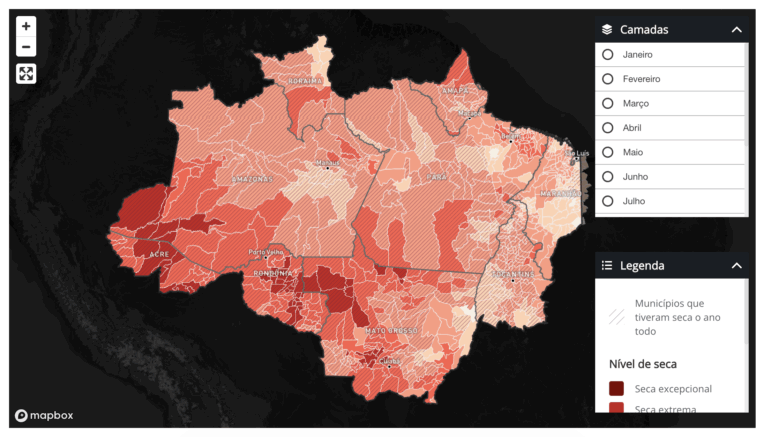
Image: Screenshot, InfoAmazonia, MapBox
In this piece published in early 2025, data outlet InfoAmazonia detailed how more than half of the municipalities in the Brazilian Amazon suffered from drought throughout the previous year. Starting with data analyzed by Brazil’s National Center for Monitoring and Alerting of Natural Disasters (Cemaden), the story found that 59.5% of the municipalities in the region experienced drought in 2024. The InfoAmazonia team also investigated this issue on-the-ground by sailing the Solimões River in the state of Amazonas and visiting riverside communities impacted by drought issues. The report included graphs showing the variation in each month of the year, the situation in the areas worst affected by drought, and data measuring the commitment of politicians to the environment.
Artificial Intelligence
AI dominated headlines in 2025, and data journalism teams tracked its impact on employment, the rapid proliferation of data centers, and the expansion of AI into industries from finance to creative sectors — all of which sparked debate on automation, regulation, and the consequences for society.
Data Centers

Image: Screenshot, Bloomberg
A number of news organizations looked into the growth of energy-thirsty AI data centers, but Bloomberg’s analysis of what it’s costing Americans conveyed the implications of AI use in a particularly effective way. It tracked wholesale electricity prices to understand the impact on the power grid of AI data center proliferation, comparing prices in 2020 with those in 2025. Bloomberg found that in areas near significant data center activity, wholesale electricity prices rose as much as 267% in a single month. After analyzing 25,000 “grid nodes” they found that more than 70% of those showing price increases were located within 50 miles of data center activity. With data centers forecast to account for 9% of all US power demand by 2035, the reporters said the “unprecedented granularity” of their data showed what is at stake for those living nearby this AI infrastructure. Also compelling was this FT story on data centers that included a visual, interactive look at the inside of a data center, including equipment, layout, processes and ultimately, the energy needed to fuel AI data centers compared to conventional ones.
AI and the Workforce
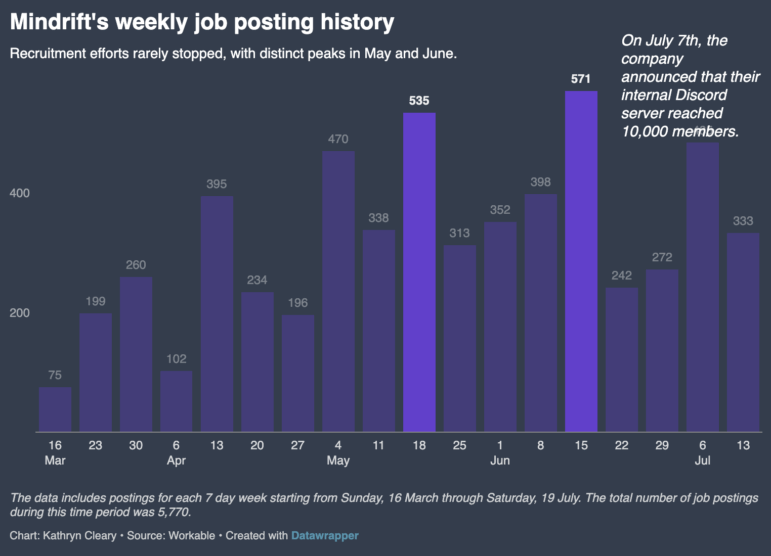
Image: Screenshot, Africa Uncensored
Africa Uncensored, supported by the Pulitzer Center’s AI Accountability Network, investigated how companies recruit thousands of AI “tutors” tasked with training artificial intelligence systems by providing corrections to large language model (LLM) responses. At first glance, these mass hirings alluded to vast opportunities, but rather than providing steady work, they served a different purpose — what experts call “labor hedging,” a tactic to impress investors and Big Tech clients by projecting the readiness of a workforce and scalability to land contracts. To test this, journalists tracked jobs posted by micro-tasking platform Mindrift — a subsidiary of former-Russian-owned tech company, Toloka — from March to July, visualizing 5,770 postings across 62 countries and highlighting how the Artificial General Intelligence arms race exploits a largely Global South workforce.
Social Media and Disinformation
In 2025, the social media landscape was marked by the rise of political extremism and widespread misinformation, with investigations revealing algorithmic biases, coordinated disinformation campaigns, and the manipulation of platforms to influence public opinion.
How X Pushes Extremist, Right-Wing Views
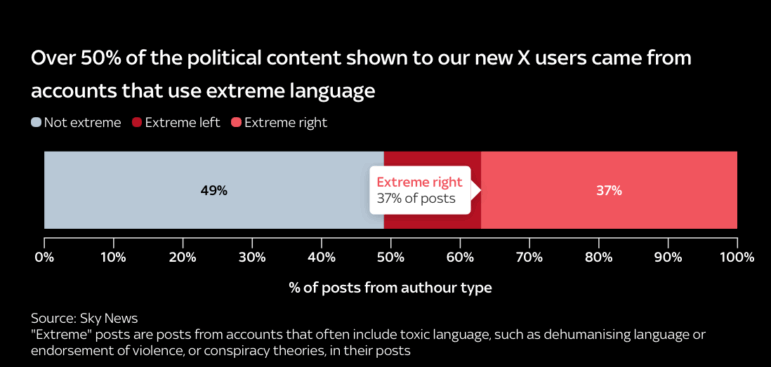
Image: Screenshot, Sky News
Sky News’s data and forensics team set out to test whether X’s algorithm favors right-wing political content by running a controlled experiment using newly created test accounts designed to mimic British users with left-leaning, right-leaning, or neutral interests. Over two weeks, the team collected posts from the “For You” feeds of these newly created accounts, building a dataset of 90,000 posts. Working with academics, they classified the accounts showing up most often in the dataset by political alignment using a custom-trained large language model. Using color-coded, circle-packing charts to illustrate their findings, they showed more than 60% of political content shown to these new users came from right-wing accounts, that neutral users saw twice as much right-wing content as left-wing, and over half of all political posts shown to new users originated from accounts classified as extreme, which they defined as using toxic or dehumanizing language, or which endorsed violence or conspiracy theories.
Online Disinformation

Image: Screenshot, ARIJ
Another noteworthy investigation was an ARIJ collaboration with Code for Africa on social media posts focusing on a cluster of hashtags spreading disinformation and promoting climate change conspiracy theories. The investigation revealed that hashtags were predominantly pushed by accounts with ties to oil interests in Gulf states and uncovered a coordinated effort to amplify climate conspiracy narratives through networks of automated and semi-automated accounts.
Other Topics
Trade and Tariffs

Image: Screenshot, Financial Times
Economic policies under US President Donald Trump, including high tariffs and steep spending cuts, had far-reaching national and global effects in 2025. Trump’s introduction of global tariffs marked the largest overhaul of US trade policy in decades. Several news organizations set up tariff trackers to catalog the flurry of levies placed on everything from film production to cars to steel — the size and frequency of which varied by the week and sometimes but the day. While it was hard to pick the best tracker, we found the Financial Times’ tackling of the topic particularly compelling. Examining the US’s biggest rival, China, whose trade surplus recently surpassed US$1 trillion, the FT highlighted why Trump may have aggressively pursued tariffs, continuing his long-standing strategy of using them to pressure China. Using Chinese customs data, FT reporters presented a series of charts on trade relations between Beijing and other countries, and the products traded that added up to the country’s 2024 trade surplus. The data showed how, for example, China produces almost one-third of all the world’s manufactured goods and how the country is increasing its surplus through strategic trading partners.
New Pope

Image: Screenshot, Atlo
On May 8, Cardinal Robert Francis Prevost was elected pope — adopting the name Leo XIV — marking the first time a US-born citizen was chosen as pontiff. Atlo, the data team from Hungarian investigative outlet Átlátszó, produced a detailed illustrated piece, including a guide to the rites involved in the conclave, which had the largest number of voting cardinals in history. It included a series of maps showing the location of papal tombs in Rome and in Europe that still exist today, and a 3D model of some Vatican buildings and the Sistine Chapel, where the conclave has been held since 1878. It also presented graphs on the diverse origins of the electors, the balloting and voting process, and positions of the main papal candidates on key issues.
Iran’s Sanctioned Oil Fleet
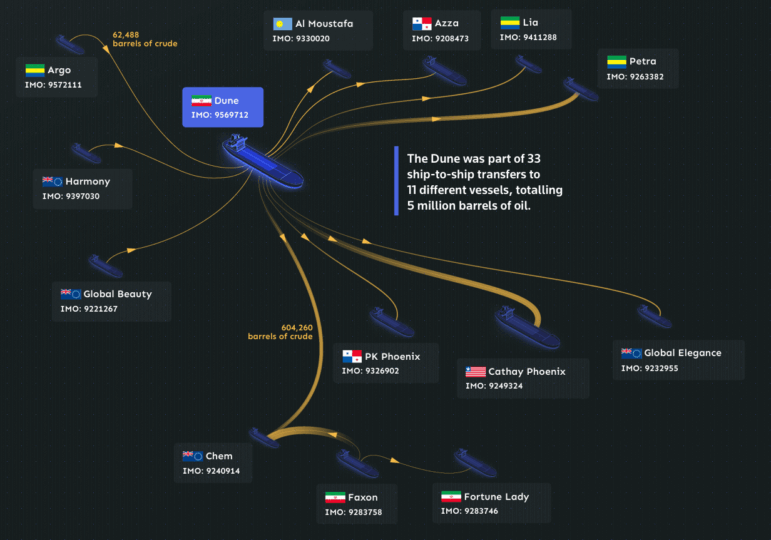
Image: Screenshot, Reuters
The Reuters data team produced a series of notable data investigations this year — with highlights including what it’s like to occupy a hot prison cell and a piece exploring migrant journeys in the Mediterranean. But taking the lead for us this year was a special report in which the team used mapping and satellite imagery, alongside scanned documents and email excerpts, to show how Iran has built a multibillion-dollar global oil trade despite a raft of sanctions by the West. The investigation stemmed from a series of leaked emails exposing granular details about the day-to-day workings of an Iranian company. According to the leak analysis, from March 2022 to February 2024, the company helped deliver 18 different sanctioned oil cargoes from Iran to Venezuela, northern Russia, and a series of ports in China via a ghost fleet of 34 vessels. According to the investigation, the total amounted to nearly 20 million barrels of oil, valued at about US$1.7 billion. To do this, the company and its partners allegedly transferred oil from ship to ship at sea, forged documents, painted ships with new identities, and falsified tracking signals — all to avoid any trace of their relations with Iran.
Indigenous Struggle Against Sexual Violence in Peru

Image: Screenshot, El Comercio
El Comercio explored social problems in the province of Condorcanqui, in the Peruvian Amazon, such as violence against women and teenage pregnancy, and showed how a group of women from the Awajún Indigenous people have been working to protect girls and educate communities with the support of members and leaders. According to the report, the number of pregnant girls and teenagers has soared in the past decade in the region. Through an interactive visualization, the team presented data on cases of sexual violence reported to the Women’s Assistance Centers (CEM), highlighting those committed against minors under 18 years of age, the number of complaints received by the Awajún Women’s Council, and the national figures for pregnant teenagers between the ages of 15 and 19.
Myanmar’s Scam Centers
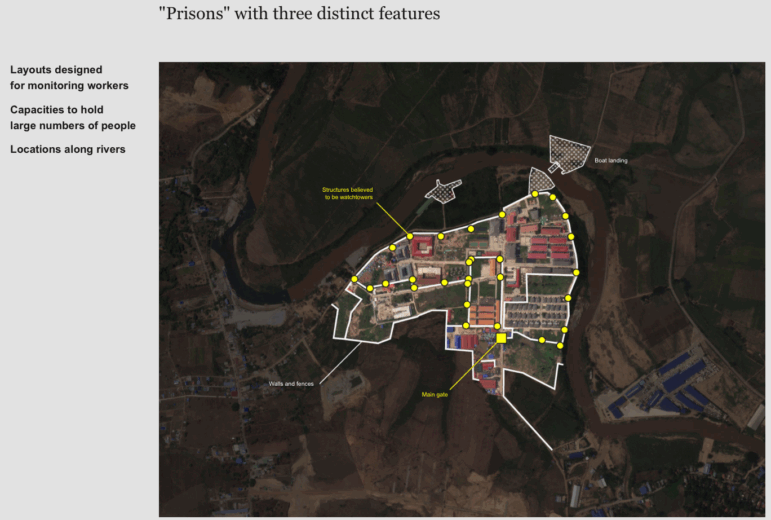
Image: Screenshot, Nikkei
This year, Nikkei’s data teams have dug into the last words of North Korean soldiers killed in Russia, terrorism on the Tokyo subway, Vietnam’s economic growth, and a possible heir apparent into Kim Jong Un in Pyongyang. This visual investigation into scam centers in Myanmar dug into the clandestine compounds where trafficked workers are forced into “pig butchering,” a type of online investment scam that entails building online relationships with victims and tricking them into fake investment schemes. Nikkei’s Vdata team combined satellite imagery, night-time light analysis, public records, expert interviews, and NGO reports to identify and verify suspected scam centers, which are often built along the borders with Thailand, where many workers are from. The team pinpointed the precise locations of these hubs on the borders of Myanmar, revealing how they’ve grown into “prisons” ensnaring those who think they’ve been offered a job but instead find themselves trapped in money-driven exploitation schemes.
Hanna Duggal is the writer of GIJN’s fortnightly Top Ten in Data Journalism column, and a data journalist at AJ Labs, the data, visual storytelling, and experiments team of Al Jazeera. She has reported on issues such as policing, surveillance, and protests using data, and reported for GIJN on data journalism in the Middle East, investigating algorithms onTikTok, and on using data to investigate tribal lands in the US.

This work is licensed under a Creative Commons Attribution-NoDerivatives 4.0 International License
Republish our articles for free, online or in print, under a Creative Commons license.
Republish this article
This work is licensed under a Creative Commons Attribution-NoDerivatives 4.0 International License
Read Next

Data Journalism Top 10 Editor's Picks News & Analysis
Editor’s Pick: Top 10 Data Journalism Projects of 2024
Highlights from a year of data journalism columns, from elections to the Olympics and the evolution of the love song.
Data Journalism Top 10 Editor's Picks News & Analysis
Editor’s Pick: Top 10 Data Journalism Projects from 2023
Featuring stories on climate change, pollution, algorithms, war and conflict, the Turkey-Syria earthquake, and a deadly migrant shipwreck in the Mediterranean.

Editor's Picks
GIJN’s 10 Must-Read Stories of 2025
GIJN’s top stories from the past year, including cutting-edge reporting tools and techniques, in-person conference presentations, and analysis of the state of the IJ community.