

A scene from the game "Predatorgate" at the 2026 Floodlight Investigative Game Jam. Image: Courtesy of OCCRP

How Using Virtual and Augmented Reality Helps Local Journalists Cover Syria

Lessons Learned About Creative Formats for Disseminating Investigative Journalism

Investigative Podcasts from Around the World: 2025 Edition

Using Comics, Music, and Theater to Bring Investigative Journalism to New Audiences
An animated phone vibrates on a blackened screen as ominous piano music tinkles in the background. When you click, speech bubbles appear. “It’s Thanasis Koukakis,” the person on the other end says. “I’m borrowing a phone… Just don’t try to reach out to me for now. Texts, calls, try to avoid it.”
This is the opening scene of “Predatorgate,” a new video game based on an investigation into the Predator spyware scandal in Greece. Koukakis was the reporter at the heart of that real-life story who discovered his phone had been infected with the highly invasive spyware. This narrative game is based on the investigation by Inside Story, and shows what it’s like to be in the shoes of a journalist under threat of illegal surveillance. In the game — which takes an estimated 30 minutes to play — Koukakis is a colleague who discovers his phone has been targeted.
Z. Daniel Barnett is a former investigative journalist and voiceover artist who worked on the “Predatorgate” game project with designer and developer Izzy Fiacco. “A game that deals with the concept of data security and also helps people to think critically about the news they’re reading, and the process that goes into making that news, is super important,” he said. Before this game, Barnett had never really considered how games and the news could be brought together. “Predatorgate” made him realize how a new format can bring stories about investigative journalism to new audiences.
“I think gamifying people’s understanding of journalistic investigations is really important,” he added, “because we live in a time where people’s media literacy is maybe lower than it’s ever been.”
“Predatorgate,” which Barnett has called “a love letter to old school journalism,” won the top prize at the Floodlight Investigative Journalism Game Jam in June this year. Run by the Organized Crime and Corruption Reporting Project (OCCRP) and the Gabo Foundation, the idea behind the project is to encourage game developers to transform investigative stories into video games. Two games from the first edition are already being developed into commercial versions.

Image: Courtesy of OCCRP, Floodlight Gaming Jam
“Investigative reporting is such an amazing source of storytelling for video games because investigative reporting is full of dilemmas,” said Paul Radu, the co-founder of OCCRP, who is also co-creator of the Floodlight gaming initiative. “There are choices that reporters make all the time, and people get to experience these dilemmas and get to understand what investigative reporting is all about.”
And gamifying investigations, he added, helps investigative reporters reach new, younger audiences. “Video games are such a huge part of how society is shaped,” he said. “It’s how young people learn the world around them.”
An Emerging Market
More than three billion people globally play some form of video games. For a media industry with falling revenues and growing audience distrust, games — ranging from simple quizzes to fully-fledged downloadable games and augmented reality experiences — have become a new way to engage and inform audiences.
Experts say games increase visits to the outlet, increase the time people spend on a site, and promote loyalty and brand connection. They can also directly and indirectly help with monetizing through boosting subscriptions or drawing advertisers. Conor Dean, founder and CEO of GamesGrid, said in a webinar last year that games are going to become “just as essential as newsletters or podcasts” for publishers that are “losing audiences and advertising revenues.”
In the UK, the Financial Times launched “The Uber Game,” where players stepped into the shoes of Uber drivers to see if they would survive the gig economy, a game based on actual interviews. The challenge: figuring out if you will make enough to pay your $1,000 mortgage payment, which is due in a week, amid competing demands on your finances, and moral ones, too, like seeing your children.

A scene from the Financial Times’ “Uber Game.” Image: Screenshot, Financial Times
In Nigeria, the Centre for Collaborative Investigative Journalism (CCIJ) turned an investigative series about corruption in the 2023 Nigerian presidential elections into “Data Vault Canyon,” a multi-player Fortnite game.
“We knew that if we are talking about voting, elections, and participation, that young people are not going to be reading 3,000-word stories,” said Nelly Kalu, product and innovation manager at CCIJ. “So how do we get them to be interested and stay engaged? It doesn’t matter to us if they read the stories, as long as they understand the value of protecting their votes.”
Similar concerns exercised the team at the independent digital outlet Cuestión Pública. They have developed four games so far, including one that gamified publicly available data on the country’s previous elections into “Game of Votes”. “People are like, ‘Oh, this [story] is long and boring,’ or ‘Oh, this is too complex. I don’t understand it,’” said Edier Buitrago, the data editor and tech leader. For two of their games, they drew inspiration from beloved offline games like Guess Who and Cluedo to familiarize people with the large cast of officials, politicians, and families that dominate the country’s political landscape and have been involved in major corruption cases.

To help readers make more sense of its reporting on corruption, Cuestión Pública created several games, including this one based on the “Guess Who” format. Image: Screenshot, Cuestión Pública
Newspapers have long had games sections, whether that’s a daily crossword, Sudoku puzzle, or a jumble. Games ensure habit and familiarity for the daily reader and build a continuing loyalty and relationship with a media outlet.
“Games usually bring highly engaged interactions to the outlet,” said Sisi Wei, chief impact officer at CalMatters, a California-focused nonprofit newsroom. “With an article, you might read it for some amount of time, but with a game, that amount of time goes up significantly.”
As with the Nigerian and Colombian cases, there’s often a practical, news-you-can-use element to the game. But games can also be built around humanitarian issues that don’t necessarily feel connected to a person’s daily life. For instance, “Reality Reload,” a game studio founded by a journalist-turned-game-designer, created a simulation around the American work visa process for immigrants. Built from interviews, players had to navigate hurdles and practicalities that an H1B visa applicant would.
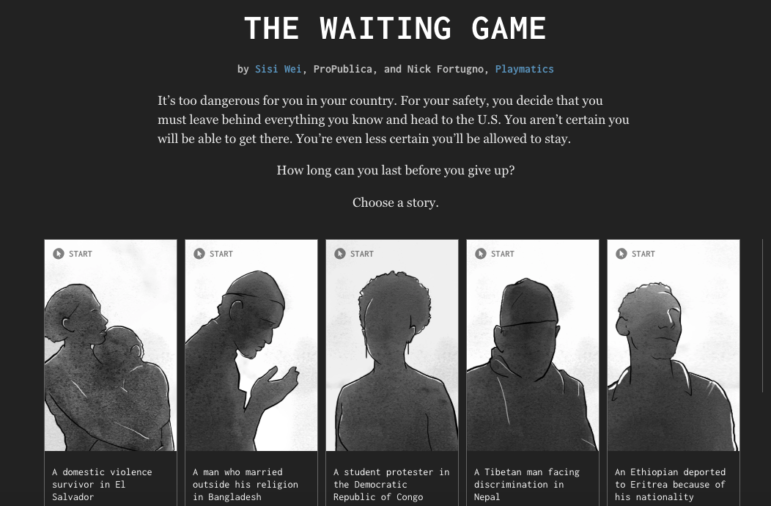
Similarly, ProPublica created “The Waiting Game” based on deep reporting of the lives of five asylum seekers and invited readers to experience that for themselves. It turned asylum-seeking from an abstract tragedy into a lived reality, in a way that transcended what a text piece would have done. “That was a powerful way of creating empathy for the people whose stories we were telling,” said Wei who was then at ProPublica and reported the story. “The written word, video, audio, photography, all those mediums are things you consume,” said Wei. “But games, as a medium, are inherently interactive, and if you are invested in a storyline, you are asked to make a choice in order to progress the game.”
Crafting a game takes time and effort and involves artwork, music, sound design, playability, and needs to be finessed through multiple iterations. When you are dealing with real life, and real people there are also other considerations. “Should we use real names? Should we use completely fictitious names?” Pol Grasland-Mongrain remembers discussing with his teammates when designing “Influence,” a game that was a finalist at the Floodlight jam. Eventually they fictionalized a few names for their game, which puts the player in the shoes of a Mexican journalist.
Choices, conflict, tension, challenges, characters, a process to navigate: these are some of the key features that a news story must have to translate well as a game. “For instance, if I was writing a story about agricultural commodities in Midwest America, that’s not a game, right?” chuckled Barnett. “There’s no dramatic tension there.”
For a longer video game, a narrative arc is crucial, with not just the story itself, but also the process of how the journalist investigated it. For instance, “Hunting the Hunter,” the previous Floodlight winner, was based on a Ghanaian journalist’s undercover exposé of illegal cocoa smuggling. And the runner-up “Dark Money” drew on the OCCRP’s money laundering stories.
There’s no set formula that can ensure a good game, and individual tastes vary. But there has to be an element of fun. “If it’s too serious,” said Julie Dupiat, a French designer who worked on “Influence,” “it is not a game.” At the same time, the game should not trivialize the subject.
Some outlets, for instance, draw a hard line on what kinds of stories should not be gamified, even if they have the narrative potential for it. “Why would you want to make war a game? Why would you want to make abuse a game?” asked Kalu. “That’s a moral choice that you must make as a journalist, an ethical one, to not do that.” Similarly, at the game jam, Radu told developers: “You have one rule: don’t glorify organized crime. That’s it. The rest is up to you.”
Time Commitment vs. Return on Investment
Games can take anything from a few hours to several months to complete, depending on the complexity, style, and cost. “Data Vault Canyon” for instance, would have been costly to develop, but CCIJ cut costs by doing it in-house. Their metaverse designer had to retrain herself in different directions and experiment with various free online tools. “Our goal now, as we’re looking towards the future, is to be able to buy the tools that are needed,” said Kalu.
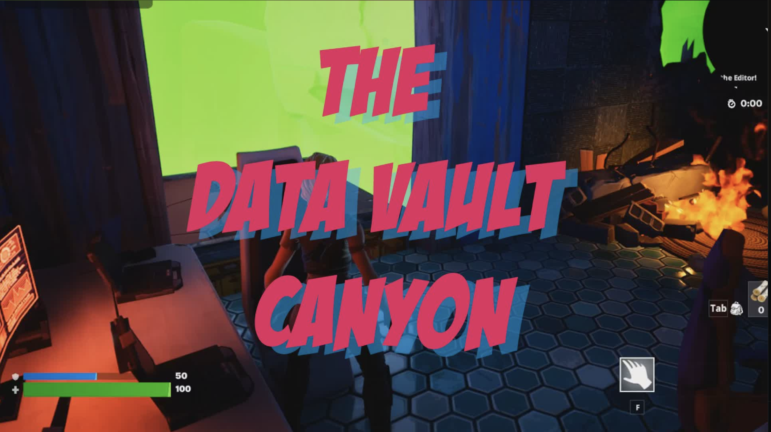
“Data Vault Canyon” is a multi-player Fortnite game that CCIJ created about its investigations into the 2023 Nigerian presidential election. Image: Screenshot, CCIJ
Experts say it’s also easier and cheaper to first try and build browser games that can be played on an outlet’s website itself. Wei advises beginning with simple games that break down practical information for audiences: navigating the school system for instance, or deciding how to vote. “The news-you-can-use type of game is maybe more practical to start with,” said Wei, “because it gives the reader something very tangible they can get from it, and it’s a less daunting task for you because it’s often easier to communicate the information they need.” At a game jam some years ago for instance, Wei created “Heartsaver” to depict how people who needed hospitals were maddeningly far away from them. It took just two days.
Ultimately, one one of the keys is collaboration and finding the right partners. If you are a journalist, “you’ll know what makes a good story, you won’t know what makes a good game,” said Barnett. “And on the flip side I think if a game developer wants to make a journalistic story [into a game], find a reporter to talk to.”
The key, says Kalu, is opening your mind to the possibilities. “We now look at all our stories with the question: is there a potential for productivizing or gamifying this?”
 Bhavya Dore is a journalist based in Hyderabad. She has written for Caravan, Quartz, Wired, the Guardian, and the BBC, and focuses on criminal and social justice. She was a Kim Wall grantee at the IWMF. You can see previous stories she reported for GIJN, on investigating the COVID-19 pandemic in India and on investigating in an election year.
How Using Virtual and Augmented Reality Helps Local Journalists Cover Syria
Lessons Learned About Creative Formats for Disseminating Investigative Journalism
Investigative Podcasts from Around the World: 2025 Edition
Using Comics, Music, and Theater to Bring Investigative Journalism to New Audiences

This work is licensed under a Creative Commons Attribution-NoDerivatives 4.0 International License
Republish our articles for free, online or in print, under a Creative Commons license.
Republish this article
This work is licensed under a Creative Commons Attribution-NoDerivatives 4.0 International License
Read Next

Methodology News & Analysis Reporting Tools & Tips
Tips for Gamifying Your Next Investigation
Gaming and the news have a history, for decades they have been used to increase engagement and reach younger audiences. Here are some tips for getting started with gamification in your next investigation.

GIJC25 Sustainability
‘No Cavalry Is Coming’: How Investigative Journalism Must Rethink Money, Metrics and Survival
This GIJC25 panel discussion surfaced a set of unresolved questions about what investigative journalism can sustainably support — and what it may need to leave behind.
Case Studies
How ProPublica Used a Game to Tell Stories of Five Immigrants Seeking Asylum
Video games and journalism have had a history — the melding of the two has been less successful in breaking news because of the fast turnaround. However, it has seen more successes in longer investigations that take more time to develop. ProPublica’s Sisi Wei shares the process behind the unit’s gamification of five asylum seekers’ stories.

News & Analysis Sustainability
‘Theater, Fact-Checked:’ Investigative Journalism on Stage
Collaborating with Vienna’s Volkstheater, Austrian investigative outlet Dossier is bringing its reporting to the stage.