

Image: Shutterstock
The Power of ‘Positive Deviant’ Data Investigations: How Good Outliers Can Expose Systemic Misconduct or Policy Failure
Investigative reporters often hear from a city or department official that “We just don’t have the budget” to solve some severe problem. Or, say, claims from a hospital administrator that their abnormally high rate of medical procedures is about clinical need or patient choice, rather than profiteering.
One effective approach for holding these actors accountable is with damning contrasts: by presenting their policies and outcomes side-by-side with comparable institutions that avoid those problems despite near-identical resources.
In Argentina, La Nación exposed the needless mass exclusion of children with disabilities from mainstream schools in most of the country by digging into the model of one province, La Pampa, where 98.5% of students with disabilities are enrolled in mainstream schools.

Image: Screenshot, La Nación
Another version of this approach is to delve into innovations by other, similar cities that used to face the same problem, such as a classic investigation by the Cleveland Plain Dealer which showed how a similar city, Baltimore, had dramatically reduced its infant mortality rate; a piece that triggered a new task force in Cleveland, and a similar reduction in infant deaths.
Some newsrooms also add solutions stories after exposing failures, such as this 2024 piece by Journalismfund Europe that detailed three grassroots efforts to combat PFAS water contamination, following investigations into the reckless use of these so-called forever chemicals in Italy, The Netherlands, and the Czech Republic.
Meanwhile, where populist politicians smear minority-controlled institutions with falsehoods about their policies, some newsrooms are exposing the disinformation by digging deeply into exactly how those institutions achieved results opposite to politicians’ claims.
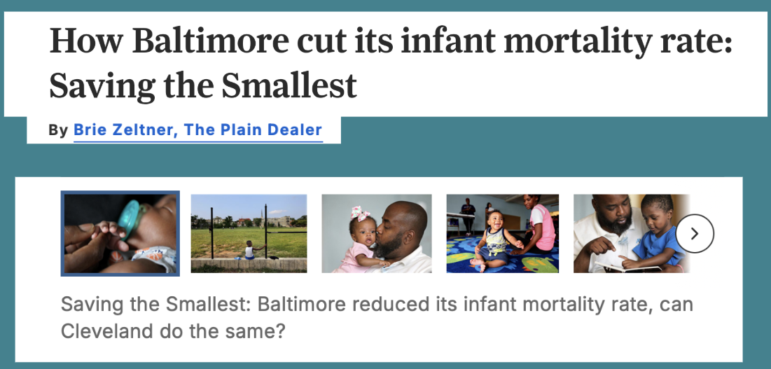
Image: Screenshot, Cleveland Plain Dealer
Source: Cleveland Plain Dealer. Graphic: IRE Presentation, Tina Rosenberg
These contrast investigative angles represent a framework for asking questions about failing systems. For instance, they can shine a light on a corrupt police department by showing how another department cleaned up its own corruption.
At a session on this approach at the recent IRE 2026 conference, panelists insisted that these investigations should be considered much more often on stories of systemic failure, not only because of the impactful pressure of embarrassment they can apply, but also because they connect reporters with new sources for traditional accountability investigations. And they point to research showing that the positive outcomes they uncover can cause apathetic audiences to re-engage with news.
The IRE26 panel included Tina Rosenberg, co-founder of the Solutions Journalism Network; Peter Gill, a transportation reporter at Newsday, and George Chidi, democracy and politics reporter for the Guardian.
Rosenberg said this approach does not work for stories involving individual misconduct – such as an isolated case of abuse, or an executive embezzling money to buy a luxury holiday home. Instead, they work where there is a systems failure involving a widely shared problem – such as farm workers routinely suffering from heat-related illnesses, or contracting systems that are vulnerable to kickbacks, or primary school graduates who are unable to read.
“One of the biggest reasons for doing these stories is to take away excuses,” Rosenberg explained. “Often, investigations can be dismissed by officials saying, ‘I know it’s terrible; we’re doing the best we can.’ Well, you’re not doing the best you can if our neighbor can do better with the same resources. This is rigorous reporting on responses to a problem. This is not advocacy or fluff or PR.”
She said another reason to consider these angles is to connect with the everyday concerns of readers.
“It helps you broaden your idea of what an investigative topic should be,” Rosenberg explained. “What really affects people’s lives is far broader than corruption and abuse of power; readers saying: ‘I’m not so interested about the hospital CFO stealing money as I am that the hospital is running out of medicines; that’s more important to me and my family.’”
Rosenberg said solutions stories that begin with a remark from a source such as “I heard about this cool program…” tend to be human interest features, and do not lead to investigative contrast stories.
“That’s not what you want for an investigation,” she said. “For a big story, you start with ‘What’s the problem? And who is doing better with the same resources?’ We call that the ‘positive deviant.’”
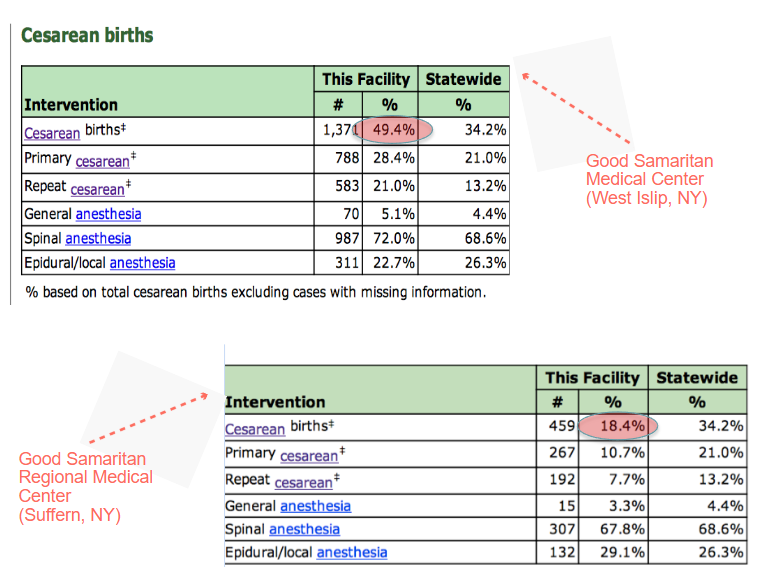
The 18.4% Caesarean birth rate shown for the Good Samaritan hospital in Suffern, New York, represents a “positive deviant” in this dataset, with respect to the much higher rate at a hospital in the same chain in West Islip, New York. Image: IRE Presentation, Tina Rosenberg
The approach can also be used to contrast outcomes for the same institution after major resource changes. For instance, last year, Uganda’s MetroFM 90.8 showed how a combination of rapid response and the use of geospatial contact-tracing tools helped Ugandan health authorities achieve a record-breaking response to an Ebola outbreak — despite the fact that the Trump administration’s USAID cuts had stripped funding from the country’s normal outbreak response system that same month.

Image: Screenshot, MetroFM 90.8
Rosenberg added: “This is also about telling the whole story: if you’re writing only about a rise in crime, and don’t talk about the drops in crime, then you’re misleading the audience.”
The panelists agreed that rigor with evidence was a central requirement for this approach, along with a heavy dose of skepticism and critics’ voices when describing the positive deviant example cases.
While investigating a persistent high rate of traffic fatalities on Long Island, Gill learned of a global initiative called Vision Zero; a multidisciplinary strategy that acknowledges the fallibility of human drivers, and introduces systems that prioritize serious accidents, rather than mere collisions and quick traffic flow. He saw that the best examples of reduced deaths through the program could be found in northern European cities such as Stockholm and Helsinki, but realized that cultural differences would make those places poor comparisons for Long Island audiences.
Instead, Gill identified a very similar community in Montgomery County, Maryland, which had significantly reduced severe accidents using elements of that initiative.
“There were a few factors that led us to compare Long Island with Montgomery County: ongoing efforts on traffic safety and progress on safety; both are dominated by car travel; both are fairly wealthy areas with pockets of poverty; they have similar population density, with dense suburbs going out to agricultural regions,” Gill explained. “They haven’t eliminated deaths, but they have made progress.”
Expert Tips
Think, re-think, and test your comparison case. “Pick that community with intention,” Gill advised. “It doesn’t need a perfect solution, but it needs to be making progress toward a goal. Ask: ‘Is it similar enough to your community in terms of all the relevant categories of characteristics?”
The problem needs to be a systemic, widely-shared one. “If it’s widely shared, lots of people are trying to solve it, and some of those responses will be more newsworthy than others,” Rosenberg noted. “And, second, it needs to be a systems failure, rather than something that is basically one person’s bad behavior.”
Use data to find candidates for comparison. While data reporters are used to picking out negative outliers in datasets, Rosenberg said it’s often worth taking an additional step of looking for the opposite case in the data, and checking whether their resources are comparable.
“We normally just pounce on the bad guys when we see outliers in databases, but a more interesting story is to find ‘What did this [institution or locale] do that the other didn’t do?” he said.
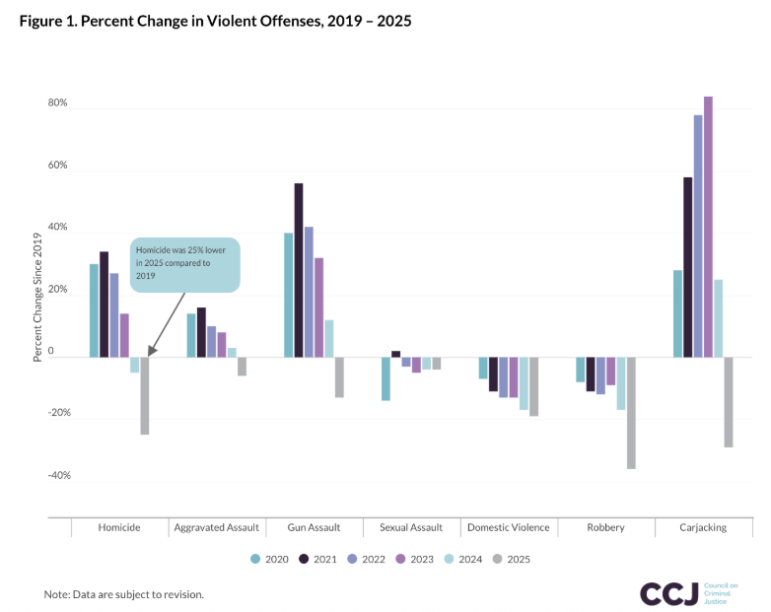
Data showing a consistent reduction in violent crime, across every category, in the city of Baltimore clearly debunked President Donald Trump’s claim that crime had risen to “war zone” levels in that city in 2025. Image: IRE Presentation, George Chidi
Lean on local reporters and their coverage in your comparison entity. “Reading local coverage on the issue is important,” said Gill. “I relied heavily on local newspapers for finding contacts; getting the lay of the land on the issue; doing walk-and-talk interviews.”
Don’t sugar-coat the better strategy. Since the contrasting data should speak for itself, Gill said it was important to simply lay out the evidence, be transparent with readers about any ways the institutions and their environments slightly differ, and include critical voices. “No solution is perfect, and no comparison community is perfectly comparable, so don’t sugar-coat it,” he said. “But do talk to people at home about their thoughts about what you find, and often they’ll say: ‘Why can’t we do that here?’”
Chidi added: “Make sure the critics have an answer in your story, and not somewhere else.”
Use adjectives to guide your investigative angle. Rosenberg revealed that “just picking an adjective” can help define specific avenues of inquiry around larger problems. “Every problem is made up of many smaller problems,” she explained. “What you do is cut a slice of the pie by important obstacles to success. Is it slow? Look for who is faster. Is it too expensive? Who is cheaper? Is it inequitable? Who is more just?” Another approach, she said, is to identify key obstacles to success. For instance, if the investigative “pie” involves primary school graduates who cannot read, slices for scrutiny might include hypotheses such as “class sizes are too large,” “teachers are poorly trained,” and “kids are too hungry to concentrate.”
Use positive deviant stories as a response to rival scoops. Where editors chide reporters for missing revelations of systemic failure published in rival publications, those reporters can respond by finding comparable public institutions that have avoided those failures, and deepen the accountability for the failing institution. “I’d consider that a scoop in its own right,” said Rosenberg.
Be rigorous with evidence. “Solutions journalism is about applying rigor to the problems we journalists surface, whether climate change, immigration, or gun control,” said Chidi. “We need to ask: ‘Are we looking at confirmatory and disconfirmatory information with equal skepticism?’ It’s the whether or not it works that distinguishes this journalism from other news.”
He adds: “This examining of the evidence is your the defense against claims that ‘you’re just doing advocacy journalism.’”
Investigating Success to Debunk Smears
In response to claims by US President Donald Trump that the city of Baltimore was “a hellhole” with rampant violent crime, Chidi decided not only to fact-check the smear, but also to dig deeply into exactly how, on the contrary, the city had greatly reduced violent crime over two years.
“If a lie is starting to distort policy, that is the thing to chase first in these stories,” said Chidi. “I look for impact. When I see Trump lying about something I actually know something about, it’s an itch I have to scratch.”
Chidi found that the city had embraced a collaborative “kitchen sink” approach to crime, where – for instance – a team would identify and engage with the friends of shooting victims and offer them a suite of resources to reduce the chance of retaliation crimes.
“In Baltimore, the powers-that-be – the district attorney, the governor, the mayor, the social services organizations, the hospitals, the cops, and the public — all decided that the number of murders was completely unacceptable, and so were the political problems that prevented an answer,” he explained. “They came together under a plan the mayor had put together, because he saw it had worked in other cities, and had a pool of money from the infrastructure act to play with.”
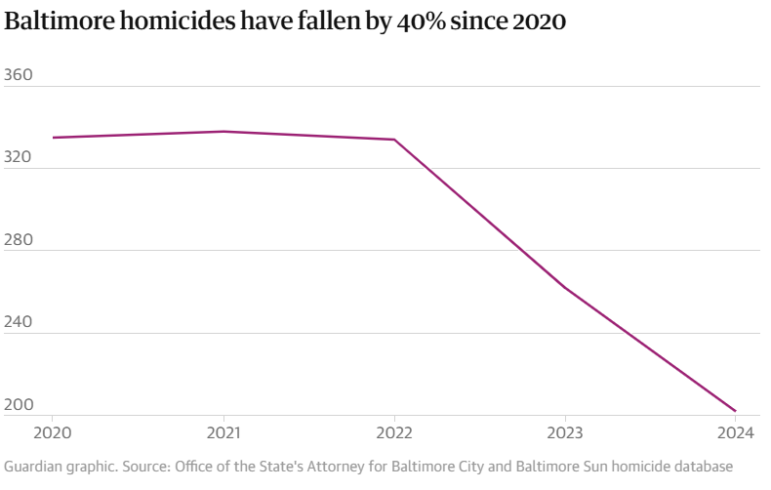
Image: Screenshot, the Guardian
Chidi also delved into data on prior failures by Baltimore city leaders, and included vocal critics of the new strategy. He pointed out that these types of stories can also deepen media trust for minority communities. “It’s a problem that, in general, poor communities only see reporters when something terrible has happened,” he noted.
Rosenberg said digging into successful responses can also boost reader engagement overall. “The top reason for news avoidance is it has a negative effect on people’s mood. In 2023, the Reuters Institute Digital News Report asked news avoiders what would get them back to news, and the answer was ‘we want more positive or solutions stories.’ They showed a preference for work that isn’t so depressing.”
She added: “Another reason is to create excitement with hope – but hope with teeth; not false hope.”
 Rowan Philp is GIJN’s global reporter and impact editor. He was formerly chief reporter for South Africa’s Sunday Times. As a foreign correspondent, he has reported on news, politics, corruption, and conflict from more than two dozen countries around the world.

Step-By-Step Guide for Journalists on the Basics of Google Sheets

Tipsheet for Using Ocean Data in Your Investigations

GIJC23 – The Future of Data Journalism: New Analytical Tools, Data Visualization, and AI

GIJC23 – The Basics of Using Google Sheets

Confront Them With the Numbers: This Former Physicist’s Path to Investigative Data Journalism

Looking Back on Five Years: How the Sigma Awards Have Rallied and Inspired Data Journalism Excellence

Lessons Learned: 10 Common Mistakes in Data Journalism

Developing a Data State Of Mind: Key Tips for Editors

This work is licensed under a Creative Commons Attribution-NoDerivatives 4.0 International License
Republish our articles for free, online or in print, under a Creative Commons license.
Republish this article
This work is licensed under a Creative Commons Attribution-NoDerivatives 4.0 International License
Read Next
10 Questions
Confront Them With the Numbers: This Former Physicist’s Path to Investigative Data Journalism
Anna Behrend is a self-taught data journalist who has found in data-driven reporting and visualization a way to combine her academic background in science with her creative interests.
Data Journalism
Looking Back on Five Years: How the Sigma Awards Have Rallied and Inspired Data Journalism Excellence
After five years and 2,875 project entries from more than 100 countries, the Sigma Awards have become a catalyst for innovation and forever changed the face of data journalism.
Data Journalism News & Analysis
Lessons Learned: 10 Common Mistakes in Data Journalism
GIJN asked speakers and attendees in the NICAR conference hallways for the data journalism gaps they see and for under-covered topic areas newsrooms can address.
Data Journalism
Developing a Data State Of Mind: Key Tips for Editors
Data is woven into how journalists cover everything from local government spending to global climate change patterns, but for editors without a specialist background, it can be daunting.