
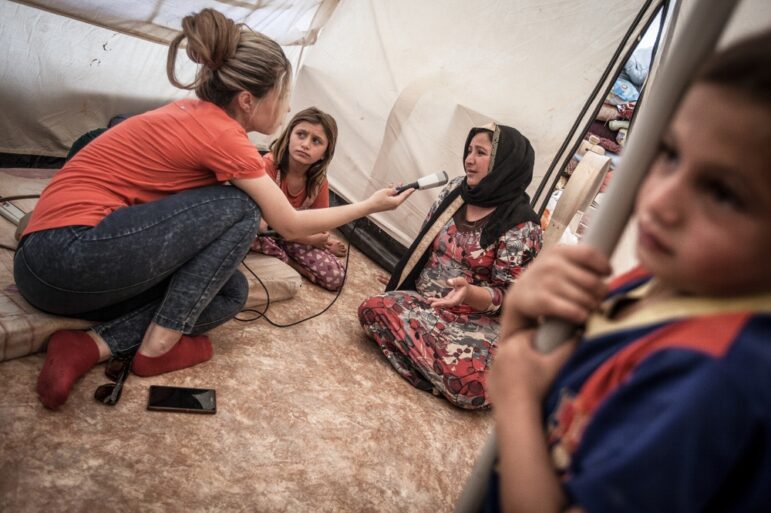
Syrian journalist Sevin Ibrahim interviews Iraqis internally displaced by the seizure of vast swathes of Iraq's territory by the Islamic State. Image: Shutterstock, Sebastien Castelier
Tipsheet on Partnering with Civil Society Organizations and Non-Governmental Organizations
Read this article in
Working with civil society organizations (CSOs) and non-governmental organizations (NGOs) can open doors to hard-to-reach communities, government officials, and sensitive information. For investigative journalists, these organizations often serve as a bridge between the newsroom and real-world impact — but they also require a clear sense of independence and ethical boundaries.
These organizations are often the key to reaching vulnerable and marginalized groups — such as victims of human trafficking, refugees, or migrant workers — communities that journalists might find difficult to access to even getting them to open up.
How to Get Started
- Build trust gradually. Spend time attending an organization’s events and panels, talking to their staff to understand their priorities and identify credible partners. Trust between journalists and civil society groups cannot be built through just one or two meetings. Consistent appearances and expressions of interest in an issue allow journalists to build better relationships with staff.
- Clarify roles early. Journalists need to define what kind of collaboration they’re seeking — information sharing, field coordination, or data access — and ensure all parties agree. Often, organizations don’t understand the information journalists need and tend to provide unnecessary details. Journalists must explain their work using examples of their past projects, which will make it easier for organizations to provide the information they need. Depending on the country’s culture, some organizations may request to review the story before publication. Journalists should make clear the newsroom’s standard practice on this, as it’s considered unethical to provide the story prior to publication. In some cultures, though, reading quotes back to sources is accepted for accuracy reasons.
- Verify independently. Always cross-check CSO and NGO-provided data or claims with other sources such as government officials, academics, or on-the-ground observations. Journalists need to know what the organization’s agenda is in driving each issue. They also need to make sure they accurately represent the experiences of the affected people, even if that contradicts the organization’s or the government’s version.
- Maintain communication. Keep regular contact beyond publication. Long-term relationships help journalists stay updated on developments and potential new leads. Connecting through social media is another way to keep track of what’s happening in civil society and on specific issues.
- Ensure transparency with editors. Journalists need to keep their newsroom informed about their interactions with NGOs/CSOs to prevent conflicts of interest. These discussions usually focus on practical expectations — such as the format of the story (whether it will be a video, article, or other output), the platforms where it will be published, the timeline, and what each side can or cannot facilitate during the reporting process. This kind of clarity helps prevent misunderstandings and ensures that both sides understand the boundaries of collaboration — particularly that editorial decisions remain with the journalist. If a journalist ends up embedding with a nonprofit and have part or all of their expenses paid for, that must be stated in the article so the readers or viewers know. If they encounter difficult decisions, they should consult their editor.
Things to Avoid
- Advocacy bias. Many NGOs operate within specific advocacy frameworks. Be aware of their agendas so they don’t shape the journalist’s reporting angle. Like with any other source, journalists strive to build relationships, but they need to maintain a clear separation between being a reporter versus an activist.
- Overreliance on one source. Relying too heavily on a single organization can narrow the journalist’s perspective and weaken journalistic balance. If possible, approaching more than one civil society or non-governmental organization will give the journalist a more comprehensive set of information.
- Perception of activism. Avoid becoming too closely associated with any group. Maintain professional distance to preserve the journalist’s credibility and independence.
- Data limitations. CSO/NGO data may not always be comprehensive or up-to-date; treat it as a starting point rather than a final fact. You can use civil society groups as a bridge to access information from the government, as these organizations often work closely with public officials as well.
- Be transparent with the public. Disclose your sources where relevant, while keeping editorial independence and source safety at the core.
- Research the organization itself. Make sure the organization you’re collaborating with isn’t accused of any economic wrongdoing or mistreating any vulnerable people it’s supposed to be helping. Even well-respected international organizations with decades of experience have been accused of wrongdoing.
Case Studies
- Scammed, Enslaved, Arrested: The Triple Tragedy of Thailand’s Cyber Scam Victims The partnership with Immanuel Foundation provided the writer of this guide and this story with access to survivors and key government officials, while highlighting the need to balance CSO narratives with state perspectives. The writer closely followed the foundation’s work through the president’s role and incorporated his operational insights directly into the narrative.
- They Were Trafficked for Their Bank Accounts. And Their Faces For this subsequent exposé, the writer of this guide maintained and extended his relationship with the anti-trafficking organization, which led to this investigative report the next year. Most of the information came from the writer’s independent reporting, as he had become more familiar with the issue. Still, throughout the production process, he continued to exchange information, seek advice, and coordinate with the anti-trafficking organization.
- How a Hashtag Made Myanmar Migrants the Enemy. Unlike the previous stories, this report did not rely on closely shadowing a single civil society organization. Instead, it involved coordinating and seeking input from multiple CSOs working on migration issues to gain deeper insight. The story was made possible in part because civil society actors trusted the writer with relatively sensitive information. That trust was built over two to three years of consistently covering migration issues in Thailand, during which many organizations had become familiar with the writer’s previous reporting.
- Egypt Ramps Up Sudan Refugee Deportations with Little UNHCR Pushback, In this story, The New Humanitarian worked with the Refugees Platform in Egypt for more than a year to reveal how “the Egyptian government was deporting Sudanese refugees back to a war zone and the largest humanitarian crisis, using a network of hidden detention sites.” Through their research the two organizations also criticized UNHCR for its “limited and muted response.”
- Uncovering Syria’s Stolen Children Journalists from the BBC, The Observer, Der Spiegel, Lighthouse Reports, SIRAJ, and Women Who Won the War, talked with 54 sources from within global childcare charities to uncover how the Assad regime was abducting hundreds of Syrian children of political detainees.
Additional Resources
Guide to Designing Symbiotic Relationships Between Journalism and Civil Society, 2025 by María Paula Martínez Concha with the support of Ricardo Corredor Cure, Pablo Baños, Jonatan Rodríguez, and Florencia Tuchín. Ceper Uniandes / Fundación Avina / InnContext News Agency / Pulitzer Center.
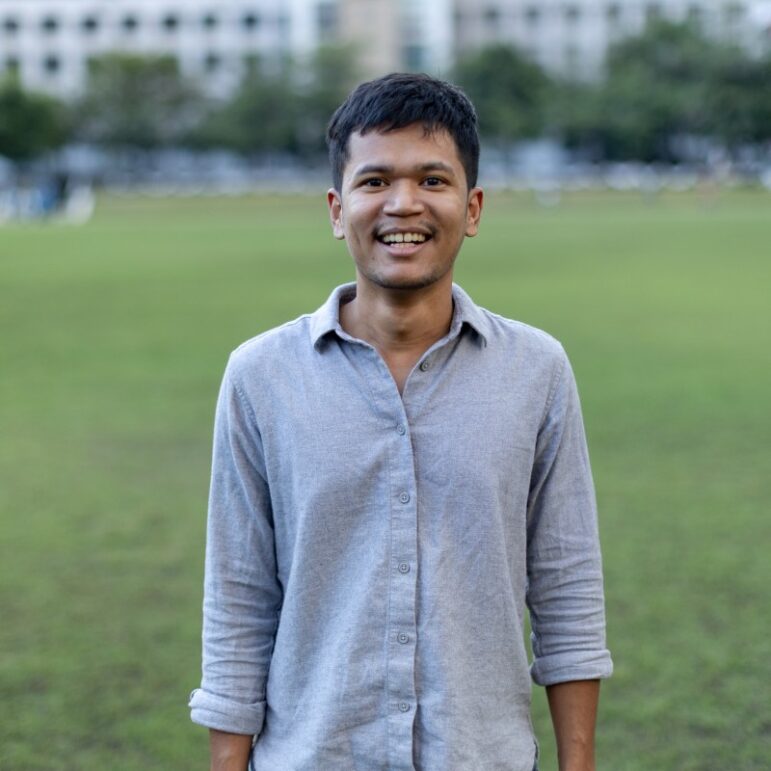 Nathaphob Sungkate is an independent journalist from Thailand. He covers issues related to migration, Indigenous rights, and cyber scams in Southeast Asia. He frequently works closely with civil society organizations to go in deep in the issue.

10 Practical Tips for Verifying Scientific Claims

Reporter’s Guide to Investigating Cryptocurrency

AI Accountability Reporting Guide
Guide to Mapping Analysis Using QGIS

‘Chasing Shadows’: How a Small Civil Society Investigative Team Is Fighting the Growing Cyber Surveillance Threat

When the Story Is Canceled: 8 Practical Tips from RightsCon and World Press Freedom Day
Abzas Media: From Exile, Fighting for Press Freedom and Civil Space in Azerbaijan

Uncovering Syria’s Stolen Children

This work is licensed under a Creative Commons Attribution-NoDerivatives 4.0 International License
Republish our articles for free, online or in print, under a Creative Commons license.
Republish this article
This work is licensed under a Creative Commons Attribution-NoDerivatives 4.0 International License
Read Next
News & Analysis
‘Chasing Shadows’: How a Small Civil Society Investigative Team Is Fighting the Growing Cyber Surveillance Threat
A new book by Ron Deibert, Citizen Lab’s founder and director, details how his small investigative team is fighting back against a rapidly growing commercial espionage industry.
News & Analysis Press Freedom
When the Story Is Canceled: 8 Practical Tips from RightsCon and World Press Freedom Day
When RightsCon 2026 in Zambia was abruptly cancelled, the story at its companion World Press Freedom Day conference shifted from panel coverage to a real-time lesson in access and government power.
Member Profiles News & Analysis
Abzas Media: From Exile, Fighting for Press Freedom and Civil Space in Azerbaijan
Founded in 2016, this news site was created to report on issues often ignored or suppressed in state-controlled media, including corruption, misuse of public resources, and human rights violations.
How They Did It
Uncovering Syria’s Stolen Children
This collaborative investigation brought together international and local journalists to reveal how the Assad regime used a global childcare charity to aid the disappearance of children.