
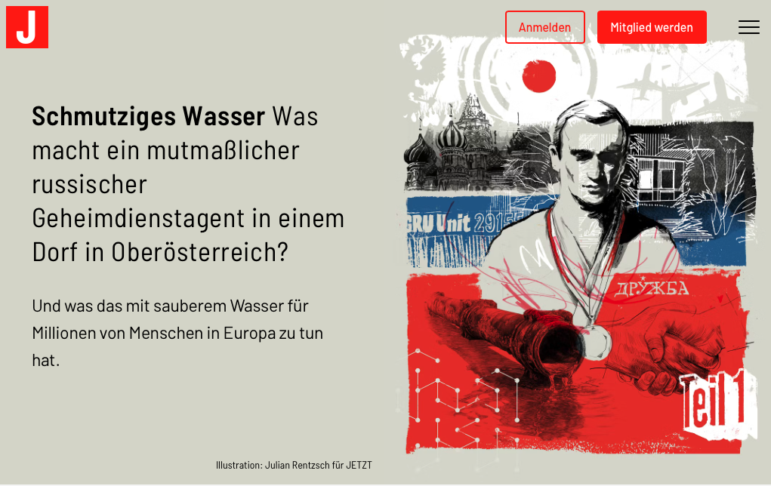
Image: Screenshot, JETZT
Spies, Lies, and ‘Dirty Water’: Q&A with Austria’s Newest Investigative Team
Read this article in

Tipsheet: How Journalists Can Use a UN Process to Evaluate National Human Rights Records

Investigating Latin America’s Global Reach Of Illicit Activities
Full Report: The Investigative Agenda for Climate Change Journalism

The Investigative Agenda for Climate Change Journalism
It’s not easy to start an independent media business in Austria, let alone one that supports investigative journalism. Among other challenges, it was the last EU member state to get a freedom of information law, in September 2025.
The small media market is carved up by powerful tabloids. The Vienna-based independent investigative newsroom — and GIJN member — Dossier’s extensive reporting on inserate — the practice of the government placing lucrative ad supplements in the press — found that it’s fundamentally at odds with press independence, and politicians have exploited this tension by “starving independent media by advertising revenue.” The 2026 RSF Press Freedom Index noted Austria’s “almost complete lack of support for emerging media, especially in the digital sphere.”
That an investigative reporting shortfall exists in a country that is also rife with clandestine activity means many consequential stories remain untold. It is well documented that, thanks to a unique set of geopolitical and legal quirks, Austria’s capital, Vienna, is a hive of espionage. But Russia’s escalation of spying, sabotage, and influence operations and the recent high-profile trial of an Austrian intelligence officer convicted of moonlighting for Russia have prompted Austria’s government to consider a new law to crack down on state-sponsored spying. Last month, Austria expelled three Russian diplomats over the “forest of antennas” installed on the roofs of Russia’s diplomatic buildings in Vienna to gather information.
Late last year, Austria’s newest independent outlet uncovered another Russian gambit in the country, this time targeting critical infrastructure. The digital newspaper JETZT (“NOW”) launched in November 2025 with an investigation into an alleged GRU (Russian military intelligence) operative’s attempts to get close to a water tech firm based in Upper Austria. Bulgarian investigative journalist Christo Grozev — who, as the former lead Russia investigator for Bellingcat, identified the GRU agents behind the Novichok poisonings in the UK in 2018 and the poisoning of Alexei Navalny in 2020 — assisted in the reporting and serves an advisory role with JETZT. As Grozev notes on his bio page, there are many espionage stories to uncover in Austria, particularly related to Russian activities.
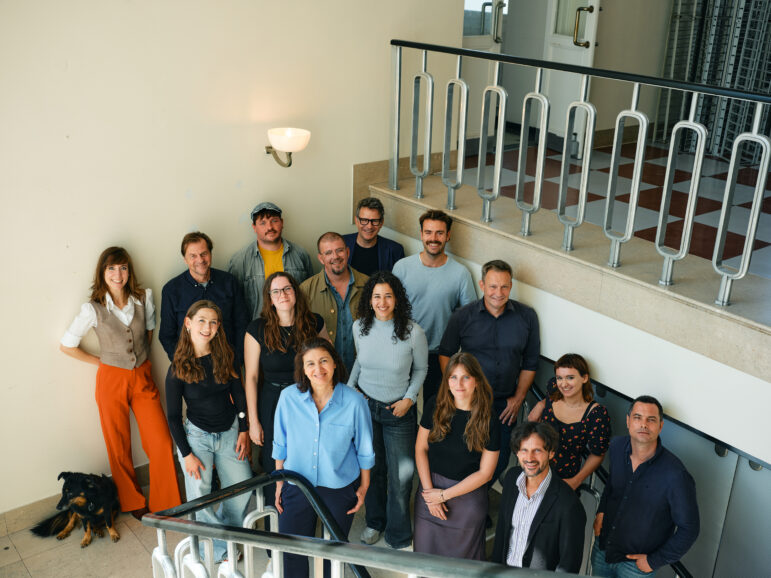
The staff of Jetzt. Photo: Philipp Horak for JETZT
Austrian radio entrepreneur Florian Novak founded JETZT as an attempt to “invent serious journalism anew.” The launch target was a modest — but given the local market, ambitious — 5,000 members paying €17.50 (US$20) per month. JETZT currently has an editorial staff of 12 producing a daily longread, newsletters, analysis of global news stories, a “B-Side” — an audio deep dive into the day’s most important news — and a high-quality audio version of each story. Coverage runs the spectrum from Austropop music to global headlines, and when time and resources allow, investigative journalism.
Dirty Water
Freelancer Nikolai Atefie and JETZT editor Eva Plank worked with Grozev on the launch exposé Dirty Water, which was picked up by international media. Atefie explained that Grozev provided the “smoking gun” by turning them onto a detail in some leaked data he did not have the time to pursue himself: the passport details of a Sergei K., which were similar to government identification used by Russian secret service agents and had been used to travel to Austria several times.
Plank and Atefie then traced how Sergei K. cultivated a relationship — including exchanging emoji-sprinkled comments on social media about judo and invitations to visit Moscow — with a chemical engineer at a major firm whose technology helps clean wastewater for over 250 million people worldwide. They found that Sergei K. had purported to be a wastewater expert for the same company’s Russian and Belarusian entities — but during their reporting, they found that these purported “Eurasian representatives” of the firm never officially existed and the clone websites backing up Sergei K’s cover story have since been wiped.
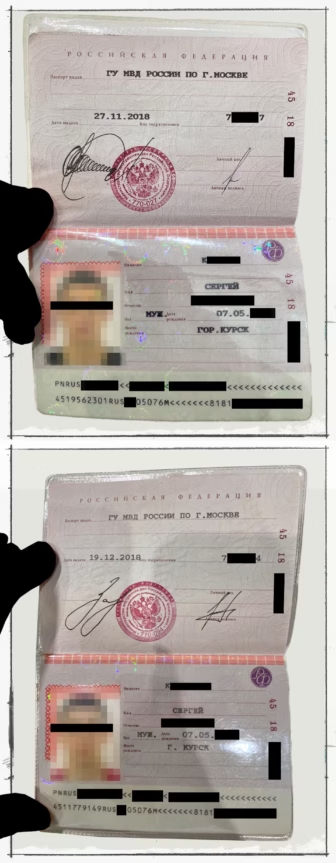
Sergei K. travels as himself (above) and as an alleged intelligence agent. Both passports are identical. Photo: Screenshot, JETZT
“Sergei K. is likely not just any small-time Russian spy,” they write. “According to research by our colleague Christo Grozev, he is believed to belong to Unit 29155. This unit not only conducts espionage abroad, infiltrates strategic companies, and recruits and trains new agents, but is also behind assassinations and poisonings.”
Their attempts to contact Sergei K. were unsuccessful, but with the help of some local knowledge, they managed to contact the Austrian engineer.
GIJN recently met with Atefie and Plank to talk about their collaboration with Grozev, the challenges of investigative reporting in Austria, and why Vienna is still Europe’s spy capital.
This interview has been edited and condensed for clarity.
GIJN: Can you tell us about how your investigative team at JETZT came about and how you work?
Eva Plank: It was definitely an aspiration from the beginning that, in establishing a new quality publication, the founder also wanted to support investigative journalism. There wasn’t the ambition to be a purely investigative medium, but it is certainly one part of JETZT. And we are, of course, a small team, which means that the resources are limited, and I think we realized that quite quickly. Of course, we knew this going in, but producing these kinds of stories takes time and teamwork.
Nikolai Atefie: I am a freelance contributor, and I work on a project basis, when I think I have enough resources, or will get enough resources. The Kitzbühel story [about remarkable real estate deals in a Tirolean ski resort], for example, was a really good investigation. It was in two parts, and the second was more strongly investigative than the first. Both parts were written by two of our excellent colleagues.
The pressure is that a longread must be published every day, and that is quite demanding. We probably have more time to work on stories compared to many other media outlets, but for my taste, there’s still not enough time…
EP: And then of course, there’s the audio [version of each story]. Above all, we don’t just want to simply read the text. We want to rewrite it into a good script, use nice tones and sound, and make it podcast-quality.
GIJN: Can you talk a little about Christo Grozev’s role in JETZT’s investigative work? On his staff page, for example, he mentions OSINT training.
EP: We don’t have training sessions on-site with him or anything like that. It’s more one-on-one, where we are in exchange and in contact with each other.

JETZT editor Eva Plank. Photo: Courtesy of JETZT
NA: Of course, it’s enormously valuable for us to work with Christo. In Austria, there are still very few people who understand how many serious international investigations you could do here. So we are very glad that Christo works with us. And it’s actually a great exchange, because he often provides the ‘smoking gun’ [to investigate a story] he doesn’t have the resources to research and present himself. It’s actually a super symbiosis.
EP: He often has, so to speak, the bigger story at at a more global or European level in mind, but he might give us a hint of some Austrian angle, and then we investigate that.
GIJN: Can you share anything more about your methodology for this investigation, or any updates since you published it? You noted after the investigation was published that there was an underwhelming reaction from Austrian authorities — has that changed?
EP: It’s definitely true that the authorities didn’t do much about this. In the end, it was only because of our research that the matter was examined to see if an investigation was warranted. But in the end, there was no investigation.
NA: There was a nice method we used that I had already half picked up from another investigation, and half happened by chance. We really wanted to talk to the engineer, but we didn’t have his number. So I looked up who their neighbors were and whether we could get the number from them…Then we called the neighbors and spoke in [Austrian] dialect… And it’s just a small, very Austrian thing, but it worked. We got the number after all.

Freelance journalist Nikolai Atefie. Photo: Courtesy of JETZT
We also really wanted to make sure that the engineer knew we meant him no harm. But people are often completely inexperienced with the media in Austria. There’s usually always a press spokesperson, and people have so little contact with actual journalists, compared to Sweden, for example. And when someone investigates you, or investigates something that might be unpleasant… [As journalists], we have the duty to present the best argument. And this person might not know that. They might think we are like [a tabloid newspaper], and of course, when we were doing this reporting, we hadn’t launched yet. We really wanted to make it clear to him — we left a voice message — that we would do it ‘fair and square’.
And in the end, he actually replied to us by email, which was completely unexpected. So there, we also realized that sometimes people have no idea how something like this works.
GIJN: There are many investigative stories to be uncovered in Austria relating to espionage and Russian activities. Can you expand on this subject?
NA: In Austria, it is not illegal to spy on other countries. It is only explicitly illegal to spy on Austria. And that is why Austria is so popular among intelligence services from all over the world.
EP: And because there are many international organizations based here.
NA: And our feeling is that the Austrian intelligence services are watching it happen, at best. Or they simply aren’t aware. That is, a lot happens in Austria that other intelligence services consider provincial.
There are constant reasons for concern. There are many more cases than we have people to report, let’s put it that way.
It was revealed [in late April] that more than 10 staff members of [far-right party] FPÖ members of parliament are being monitored by the DSN [Austria’s Directorate State Protection and Intelligence Service, because the individuals have been active in Identitarian circles that the DSN classifies as right-wing extremist.]
This story hadn’t even been picked up by all of the Austrian media, and in any other Western European country, it would be a huge scandal. But in Austria, one doesn’t do this, because somebody else uncovered it, and you don’t give others credit. We also have this problem with our investigations. For example, Dirty Water was translated into seven languages because AFP picked it up. But in Austria, it wasn’t covered as much as it should have been.
GIJN: What’s next for you and JETZT?
EP: There are definitely stories that we are currently pursuing…
NA: It is an extremely difficult market. But we have a growth manager, and that’s really cool, someone responsible for marketing our journalism. I believe studies and surveys have also been done, and the potential is supposedly there, but it is indeed more difficult than in other countries.
 Alexa van Sickle is a journalist and editor with experience across digital and print journalism, publishing, and think tanks and nonprofits. Before joining GIJN, she was senior editor and podcast producer for the award-winning foreign correspondence and travel magazine, Roads & Kingdoms.
Tipsheet: How Journalists Can Use a UN Process to Evaluate National Human Rights Records
Investigating Latin America’s Global Reach Of Illicit Activities
Full Report: The Investigative Agenda for Climate Change Journalism
The Investigative Agenda for Climate Change Journalism

‘Theater, Fact-Checked:’ Investigative Journalism on Stage
How Italian Investigative Journalists Are Taking on International Mafias (While Trying Not to Go Broke)
Following the Money, from Laundromats to Central Banks

‘Chasing Shadows’: How a Small Civil Society Investigative Team Is Fighting the Growing Cyber Surveillance Threat

This work is licensed under a Creative Commons Attribution-NoDerivatives 4.0 International License
Republish our articles for free, online or in print, under a Creative Commons license.
Republish this article
This work is licensed under a Creative Commons Attribution-NoDerivatives 4.0 International License
Read Next
News & Analysis Sustainability
‘Theater, Fact-Checked:’ Investigative Journalism on Stage
Collaborating with Vienna’s Volkstheater, Austrian investigative outlet Dossier is bringing its reporting to the stage.
Member Profiles
How Italian Investigative Journalists Are Taking on International Mafias (While Trying Not to Go Broke)
Italy’s first center for investigative reporting was created in 2012 with very little resources. Since then it has become a well-established player in the Italian media landscape. The group has grappled with financial challenges, threats, and intimidation, but have big plans for the future. Michele Barbero profiled Investigative Reporting Project Italy for GIJN.
GIJC23
Following the Money, from Laundromats to Central Banks
How did three reporters investigate complex financial stories featuring Nigerian billionaires, Eurasian oligarchs, and the head of Lebanon’s central bank?
News & Analysis
‘Chasing Shadows’: How a Small Civil Society Investigative Team Is Fighting the Growing Cyber Surveillance Threat
A new book by Ron Deibert, Citizen Lab’s founder and director, details how his small investigative team is fighting back against a rapidly growing commercial espionage industry.