AI Without the Guesswork: Smarter Journalism Without Prompting and Hallucinations
Note: Curated courses are fee-based, allowing us to sustainably support our team and trainers while continuing to provide free, high-quality investigative journalism training opportunities worldwide. The training is live and there will be no recording.
If you’re interested in this training, please sign up for our waitlist. We’ll get back to you once we plan a new training with Henk van Ess.
Due to popular demand, GIJN has added a second, six-hour online masterclass for investigative journalists with Henk van Ess.
There is a built-in flaw affecting every AI conversation a journalist has and almost nobody is addressing it: writing an AI prompt does not involve asking it a neutral question. Instead, you are priming the tool to answer a certain way — through your word choice, your framing, and what you leave out. The tool takes in that request and returns it to you, tidied. You read the reply and feel informed. What actually happened is that you had a conversation with a cleaner, faster version of your own assumptions.
In this course, van Ess will explain why you should never ask a bot to “summarize this,” “give me bullet points,” or “what is the main point?”
We start with a striking demonstration. One dataset. Two prompts. Both written in good faith by working reporters. One returns a 40% probability. The other returns 80%. The facts are identical. So how do you get a neutral take on the same material?
From there we break the habit, using a technique van Ess has developed because prompt engineering is worsening the problem, not solving it. Alongside this counterintuitive strategy for making a chatbot actually do what you want, the course will cover the questions that matter on deadline: How to make AI understand large amounts of data?; How to feed it sensitive material without exposure risk?; How to compare documents; How to teach it your own journalistic instincts; and How to build your own reporting tools — we will build one live during the course.
You will also leave the course with a working map of the five models that matter for investigative reporters, and a framework for knowing which one to reach for on which kind of problem. Most AI journalism courses pick a favorite; picking a favorite is how you lose stories.
This is not your usual course on AI. It is a course about finding the story in documents and data, taught by someone who recognizes AI is hallucinating — and has developed best practices to avoid it.
Bonus: Course attendees will enjoy free access for one week to all the chatbots in a sandboxed learning environment.
Goal: By the end of the day, you’ll have a repeatable system for working with AI that gets sharper the more you use it — and the confidence to know when to trust it, and when not to. Participants will explore the concept of meta prompting, learning how to work with prompts without the need for memorization.
Training Note: Curated (fee-based) training courses are not asynchronous or self-paced. They are live and are not recorded.
Date: July 8, 2026
Time: 8:00 am – 3:00 pm EDT (six hours training – one hour break)
Number of trainees: 22
Requirements: Access to Google NotebookLM
On-demand trainings are open only to journalists. If you’re not a journalist and wish to attend, you should first send an email to academy@gijn.org with the reasons you want to attend the training. If you’ve purchased a student ticket, you need to send us your student ID at academy@gijn.org
Trainer’s Bio: Henk van Ess is an internationally recognized expert in online research methods, leveraging the web and AI to uncover information effectively. His expertise is sought after by Pulitzer Prize winners, NGOs, and research firms.
He is a pioneer in AI-powered digital research and open source intelligence (OSINT). His methods for discovering and verifying online information have earned him international recognition. Through hands-on workshops and training sessions worldwide, van Ess empowers his clients with practical digital investigation skills.
With a unique ability to demystify complex digital concepts, he also makes advanced investigative techniques accessible to everyone. His role as an assessor for Poynter’s International Fact-Checking Network and the European counterpart EFCSN demonstrates his commitment to maintaining the highest standards in verification.
An early contributor to Bellingcat, the renowned collective of researchers and journalists specializing in open source investigations, van Ess has authored multiple books on internet research and data analysis, providing practical methodologies for digital investigations.
Cancellation requests must be sent via email to academy@gijn.org. Tickets will be refunded if the request is made two weeks before the training begins, expect for a 10% processing fee, in addition to the Stripe fee. After that date, requests for refunds will be considered on a case-by-case basis.
GIJN offers tailored training programs designed for journalists and newsrooms with specific needs. On-demand courses are fee-based, allowing us to sustainably support our team and trainers while continuing to provide free high-quality investigative journalism training opportunities worldwide. Email academy@gijn.org to book a session or discuss your project or if you are interested in designing a fully customized training program for your newsroom. For more free trainings, please visit: gijn.org/academy.

Reporter’s Guide to Detecting AI-Generated Content

Webinar: Detecting AI-Generated Content – Updated Tools and Techniques

Online Research Guide with Henk van Ess

So You Think You Can Google? – Workshop With Henk van Ess

How AI Is Helping Independent Journalists Track Wartime Casualties of Russia

Investigating Disinformation in the Age of AI
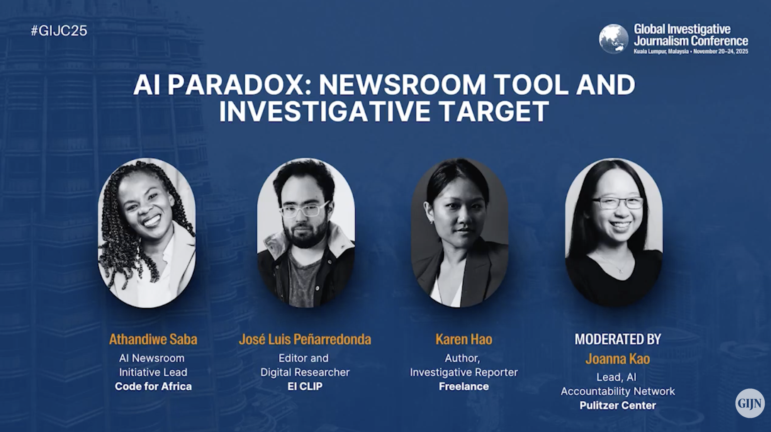
Confronting the AI Paradox: Potential Source of Abuse and Misinformation vs. Game-Changing Newsroom Reporting Tool