

Image: Shutterstock
Following the Digital Trail: How East African Journalists Investigate Corruption through Procurement Data
Corruption often does its damage long before the public notices, issues like hospitals running out of critical supplies or road projects abruptly stopping halfway.
In East Africa, billions of dollars vanish annually because of fake companies, rigged bids, and shady deals between officials and suppliers. This misconduct is mostly hidden, but evidence of it can often still be found in invoices, documents, and sometimes compromised government websites. Journalists in Kenya, Uganda, and surrounding countries are proving that even flawed procurement data can reveal corruption, offering a safer way to achieve accountability without the risks of going undercover or waiting for whistleblowers.
“This work takes real effort,” says Eric Mugendi, managing editor at Kenya’s investigative newsroom Africa Uncensored. “We search through old websites, clean up messy data, and compare records from different places. But these digital trails allow us to track the money and see who’s really benefiting.”
Why Procurement Data Matters
Governments spend a significant portion of public funds on procurement. According to a 2020 World Bank presentation, government procurement contracts total between 10-25% of public spending around the world, but “rampant corruption in the sector” adds anywhere from 10-30% to the cost of capital projects. Secret bidding, weak oversight, and political meddling allow this collusion and bribery to flourish, particularly in countries with weak enforcement or opaque governance systems.
Countries in East Africa are not immune to these global trends, as government audits and academic studies have found oversight failures, irregular financial deals, and widespread graft in Kenya, Tanzania, and Uganda. Funds earmarked for healthcare, roads, and education are routinely siphoned off through collusion between officials and private suppliers, with the heaviest burden falling on poor and vulnerable communities.
“Procurement data is more than just numbers,” Mugendi notes. “It shows what a country cares about, who holds power, and where abuses occur. If journalists can figure it out, they can show who got rich and how corruption leads to empty clinics, fake schools, and unfinished roads.”
These reports collectively demonstrate how failures in compliance with public procurement rules feed into a lack of service delivery, accountability, and effective management of public resources. To journalists, data on public procurement is not simply data; it is a trail of who wins and who loses.
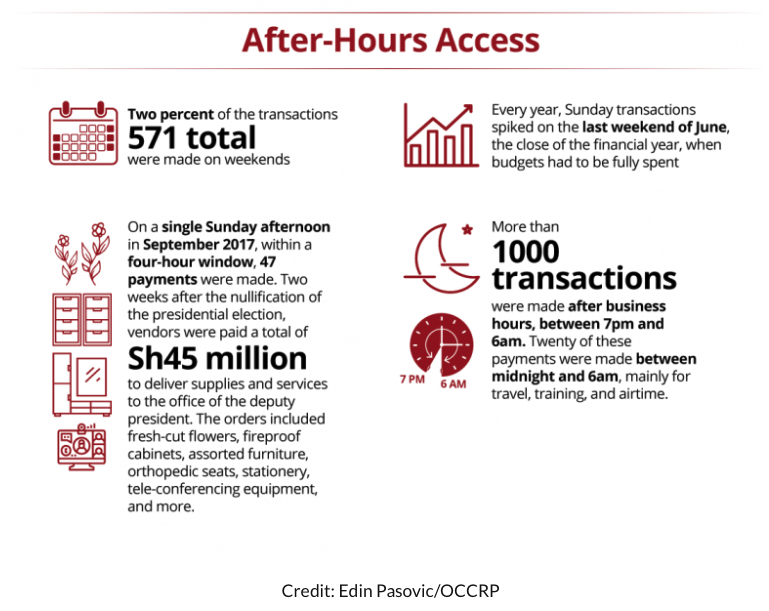
An Africa Uncensored infographic on the suspicious timing and types of payments made to Kenya’s health contractors. Image: Screenshot, Africa Uncensored
Red Flags in the Data
For Africa Uncensored, procurement data is just the starting point. “We look for things that don’t make sense in a fair system,” Mugendi explains. “We use Kenya’s Public Procurement Information Portal and leaked data to find companies that were set up just before winning big contracts, get contracts without competition, or have owners who are buddies with politicians.”
In one Africa Uncensored investigation, journalists tracked at least KSh 24.2 million (US$188,000) in medical supply contracts to companies connected to a member of Parliament who was in charge of the Health Committee.
“These red flags don’t prove corruption,” Mugendi adds, “but they show you where to keep looking. Then we tie procurement decisions to political influence.”
Mungai Ngige, an investigative data journalist, says these patterns happen repeatedly in the region. “Companies registered right before landing contracts, multiple companies with the same owners, contracts split into smaller parts, or bids with only one participant, these are all signs that something’s not right. The data does not shout; it whispers. You have to know what to listen for.”
Tools to Unearth the Buried Story
Much of East Africa’s procurement data is stuck inside PDFs or old websites, Mugendi points out. To make it sortable and searchable, journalists in East Africa rely on a combination of free and special tools.
“We use Google Pinpoint to search PDFs, since spreadsheets are still important, and OpenRefine helps clean up messy data,” he explains. “R is used to check numbers, and Gephi shows networks of companies and people.”
Aleph, a data platform developed by the Organized Crime and Corruption Reporting Project (OCCRP), connects procurement entries to company records, court papers, and leaked files. Code for Africa uses similar methods. (For more best practices on how to use Aleph in your reporting, see GIJN’s tipsheet.)
A spokesperson at Code for Africa says: “In our PesaYetu project, we pulled budget data from different places using Tabula and Excel. Then we cleaned it and showed how public money is spent. It allows journalists to hold officials responsible with evidence.”
For example, this recent PesaYetu data-based story looked into the early 2000s promises of free primary and secondary education in Kenya versus the current reality of significant school spending by parents, more than two decades later.
“You do not need to know how to analyze procurement data, ” Ngige adds. “But you do need to understand procurement law, be good with spreadsheets, and know when something seems off.”
Likewise, Ngige stresses being precise in following the corporate trail. “Legal ownership is different from who really owns something,” she adds. “You have to use words that fit the evidence and let people respond. Data is a tool, but context and checking are everything.”
Connecting Contracts to Power
The hardest part of procurement investigations often involves linking contracts to the people who profit from them. Politicians and powerful people hide ownership through third parties, relatives, or shell companies. Open data is essential.
Ngige says: “Company records, court papers, and procurement records show directors, shareholders, and incorporation dates. Even small details, like shared phone numbers, can reveal hidden connections.”
In Kenya, journalists can also use the Business Registration Service (BRS). The site shows company ownership and directors, but some information is not publicly accessible and is reserved just for banks and law enforcement. So, investigative reporters have to find other sources to complete the full picture.
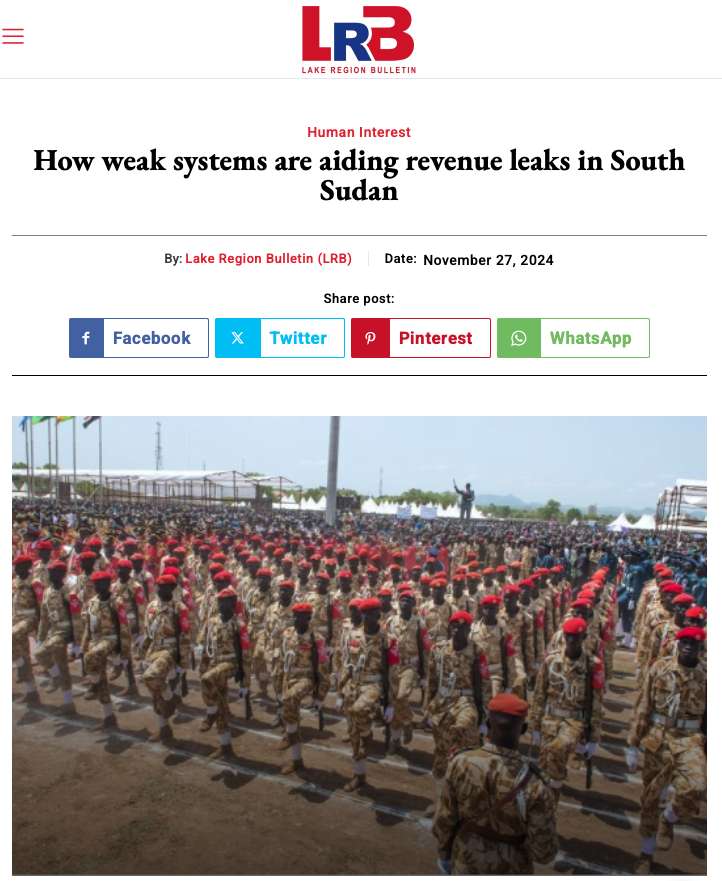
Mamer Abraham Kuot looked into the reasons behind revenue loss in South Sudan, and combined the data with human sources to make the story more powerful and engaging. Image: Screenshot, Lake Region Bulletin
Mamer Abraham Kuot, an investigative journalist from South Sudan, points out that “human sources” are still important, even if the research starts from publicly accessible documents.
“Combining data with people is crucial,” Kuot says. “Former officials or clerks can tell you who actually controls a company or whether the project is real or not. The data is like opening the door; while the people help you go through it.”
As an example, he cites an investigative story he reported from late 2024: “While investigating the tax mess in South Sudan, the secondary data I got was not enough to qualify the story properly until I gave it a human face. I talked to the authorities in charge of tax collection, who were dealing with evasion and even threats, as well as traders affected by multiple and exorbitant taxes, even in areas under the armed opposition forces. Even my own experience was an important input for the story. This is why it is imperative to use both data and human accounts in investigative stories, as it makes the story rich, credible, and real.”
Kuot also stresses the value of in-person, on-the-ground reporting. “Cross-checking is essential,” he says. “You have to compare procurement records with budgets, company records, and leaked documents. Field visits show whether things were delivered. Numbers alone do not mean anything if there is no real work.”
Case Study: Procurement Risks in Kenya
Corruption grows in secret, and certain areas in Kenya are especially at risk, Wangari says. “Kenya’s most recent Corruption Perceptions Index score is 32 points, lower than the average of 33 for sub-Saharan Africa and much lower than the global average of 43,” she notes. “Infrastructure, healthcare, and the government’s digital services are the most likely to be affected. The country loses over Sh600 billion (US$4.7 billion) because of projects that are stalled or poorly managed due to corruption and weak enforcement.”
She further explains that large infrastructure projects come with high levels of corruption risks, and she cites the example of the Standard Gauge Railway (SGR) in Kenya.
“The SGR project was meant to spur development, improve economic growth, and increase the country’s GDP,” Wangari says. “However, poor governance and corruption have hijacked the project in the country. It has also been alleged that the project’s key agreements have remained secret, the procurement process has been ignored in some instances, and the public has not participated sufficiently in the process. As such, the project has been identified as having high levels of corruption risks, requiring its assessment.”
The health sector faces similar problems. “Past issues show that healthcare procurement is very prone to corruption,” Wangari says.
Kenya’s Medical Supplies Authority (KEMSA) is a state-owned agency responsible for procuring, warehousing, and distributing medicines and medical equipment to public health facilities across Kenya, placing it at the center of the country’s public health supply chain. During the COVID-19 pandemic, KEMSA was granted expanded emergency procurement powers to fast-track the purchase of personal protective equipment (PPE), testing kits, and other critical supplies.
Those emergency powers later came under intense scrutiny. The controversy unfolded amid reports from frontline health workers of shortages of basic protective gear, even as KEMSA warehouses held large volumes of disputed or idle stock. A government auditor’s report and parliamentary hearings triggered public outrage, the suspension or removal of senior officials, and follow-up accountability reporting in the press, digging into the document trail of suppliers linked to the COVID-19 contracts.
Lessons for All Reporters
Exposing corruption often means going up against powerful people. Legal threats and harassment are common, including lawsuits meant to drain resources or scare reporters. Africa Uncensored works to reduce these risks through legal advice and partnerships. There are also global organizations like Media Defence and Reporters Shield that help protect journalists in many countries against legal intimidation and SLAPP suits.
Procurement investigations also produce real results, as a Kenya Ethics and Anti-Corruption Commission (EACC) communications official notes to GIJN: “Investigative journalism helps find leads, reveals money trails, and makes the public more aware. Stories have led to enforcement and discussions.”
For example, the East African Business Daily blew open an alleged 5 billion Kenyan shilling (US$38.8 billion) corruption scheme involving Kenya’s Ministry of Health when it obtained and published documents from a leaked audit report. The paper confronted individual officials and companies with the purported evidence of potentially fraudulent transactions — which came to be known as the Afya House scandal — although many of these questions went unanswered or were dismissed and accompanied by threats against the reporters. Years later, as many as 30 Afya House officers were removed by the then-Secretary for Health in a further effort to root out endemic corruption.
“Investigative journalism influences procurement transparency,” Wangari notes. “Pressure led to reforms.”
The lesson from these examples is clear, says Ngige: “Transparency can start with one question: Who benefited from this contract?”
“Start with what you have, even if it is a mess,” Ngige urges. “Know the rules, check everything, connect data to stories, protect yourself and sources, and work together. Corruption thrives in secret, but working together can break that silence.”
Editor’s Note: Two quotes in this story, by Mungai Ngige and Mamer Abraham Kuot were initially misattributed to others. They have now been corrected.
Mkhululi Chimoio is an experienced writer, researcher, and policy-focused professional working at the intersection of science, technology, governance, and development, with a strong emphasis on African and global issues. He focuses on translating complex research, institutional dynamics, and policy debates into clear, accessible, and impactful narratives for diverse audiences. He was awarded the Zimbabwe Achievers Award – Simba Mhere Media Award (2024), honoring excellence, impact, and integrity in media and storytelling.

Researching Corporations and Their Owners

Follow the Money: Investigating Shell Companies

Guide to Investigating Organized Crime in Africa — Introduction
Guide to Investigating Organized Crime in Africa: Chapter 7 — Financial Crimes
How a Journalist Got 80,000 Instagrammers Interested in Procurement in Kazakhstan

Nobel Laureate Urges Journalists to Investigate the Systems and Enablers that Foster Corruption Worldwide

Tips for Investigating New Oligarchs and Novel Corruption Ploys

How ProPublica Exposed a Flawed AI Tool ‘Munching’ Hundreds of Veteran Contracts

This work is licensed under a Creative Commons Attribution-NoDerivatives 4.0 International License
Republish our articles for free, online or in print, under a Creative Commons license.
Republish this article
This work is licensed under a Creative Commons Attribution-NoDerivatives 4.0 International License
Read Next
News & Analysis
How a Journalist Got 80,000 Instagrammers Interested in Procurement in Kazakhstan
At first glance, public procurement may not seem like the most Instagrammable subject. But what it lacks in visual appeal, it makes up for in scandal. So when journalist Jamilya Maricheva started posting stories about contracts and procurement in Kazakhstan, she soon amassed thousands of followers.
Nobel Laureate Urges Journalists to Investigate the Systems and Enablers that Foster Corruption Worldwide
In a keynote conversation, the economist said reporters have a key role to play in probing Western financial institutions and the rules that lead to wealth being laundered from the Global South.
Reporting Tools & Tips
Tips for Investigating New Oligarchs and Novel Corruption Ploys
The oligarchs of the world have a surprising amount in common. Here are tips and resources for investigating their hidden assets and to finding out who is helping them.
How They Did It
How ProPublica Exposed a Flawed AI Tool ‘Munching’ Hundreds of Veteran Contracts
The team used leaked documents and an interview with the AI tool’s developer to reveal numerous mistakes behind the Trump administration’s cost-cutting measures of veterans’ care.