
Illustration: Joanna DeMarco
Clandestine Airstrips, a Mexican Mega Leak, and a Crisis of Unidentified Missing People: 2025’s Best Investigative Stories in Spanish

GIJN Bookshelf: 9 Investigative Titles to Better Understand Latin America

GIJN Webinar: How Latin America Connects to Your Story: Investigating the Region’s Global Reach of Illicit Money, Illegal Mining, Drug Trafficking, and Environmental Destruction
Lessons Learned from Investigating Misinformation Around the World

International Research Guide: How to Find Experts and Hidden Documents on Any Topic
The investigative stories produced in the Spanish-speaking world this year show a vibrant journalistic landscape, despite the challenges reporters now face in many places — from rampant disinformation to job insecurity, and from threats against independent reporters to declining public trust in journalism and news outlets.
Our selection takes you from an investigation into missing children caught up in an internal conflict in Ecuador to Spain, where investigative reporters examined the role of algorithms in healthcare; and from a tool that allows readers to examine the intersection of wealth and power in Peru to Paraguay, where journalists uncovered clandestine airstrips. We also feature a collaboration that uncovered the influence of big tech in Latin America and how it is shaping people’s lives.
These stories highlight the strength of the investigative journalism community, yet the risks are growing. According to Reporters Without Borders (RSF), journalism across the Americas is facing a crisis. This year’s World Press Freedom Index found that news outlets in the region are dealing with “persistent structural and economic challenges,” rising authoritarianism in many places, and press freedom challenges.
“As journalism’s public service role is degraded, propaganda and disinformation fill the void — threatening the region’s democracies,” the authors warned.
But investigative journalists in the region are rising to the challenge. And while it is almost impossibly hard to highlight just eight pieces for the last year that show the scale, breadth, and power of investigative reporting in the Spanish language, the stories selected here prioritized variety in content, location, and format.
Regional: The Invisible Hand of Big Tech
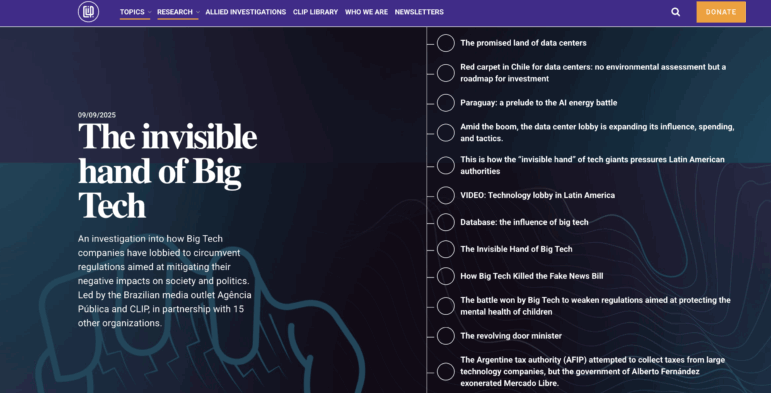
Image: Screenshot, El CLIP
This nine-month investigation, covering 13 countries, goes deep into how major technology companies have been working to create a “web of influence” to shape public policy and profit from weak regulations across Latin America. The stories and data reveal the scale of lobbying and litigation by big tech companies and their allies — and how it blocks policies that could curb online harms. Led by Agência Pública (Brazil) and the Latin American Center for Investigative Journalism (CLIP), the investigation involved an additional 15 media outlets in a collaborative transnational effort. Together, they mapped nearly 3,000 lobbying activities targeting governments and parliaments across the region, tracing lawsuits and legislative proposals alike. The project also delves into the environmental toll of the sprawling data centers being set up across the continent. Readers can access the findings in an interactive database that weaves rigorous data with compelling storytelling.
Mexico: Televisa Leaks
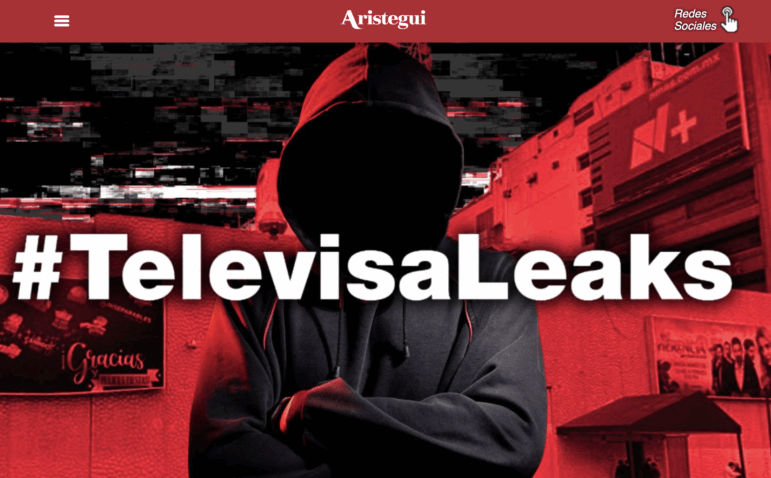
Image: Screenshot, Aristegui
Renowned Mexican journalist Carmen Aristegui and her team of investigative reporters received a huge trove of leaked data that led them to report on a covert operation at the Mexican broadcasting giant Televisa, where members of a secret division were allegedly tasked with fabricating news and destroying reputations. The leak consisted of more than five terabytes of internal communications, including videos, photos, WhatsApp messages, and scripts that reporters said showed evidence of smear campaigns orchestrated from the headquarters of the television company. The leaked information describes an internal team in Televisa’s headquarters known as “Palomar,” which was said to have the objective of manipulating public opinion with fake videos, bots, and fake social media profiles, and discrediting individuals or companies to advance Televisa’s interests. Aristegui was also one of the targets, with her name appearing nearly 300 times. The investigation earned second place in the Javier Valdez Award at COLPIN 2025, the Latin American Conference on Investigative Journalism. Televisa has not issued an official statement on the leaks or about the subsequent departure of one of its vice presidents.
Paraguay: Instructions for Reaching a Clandestine Airstrip
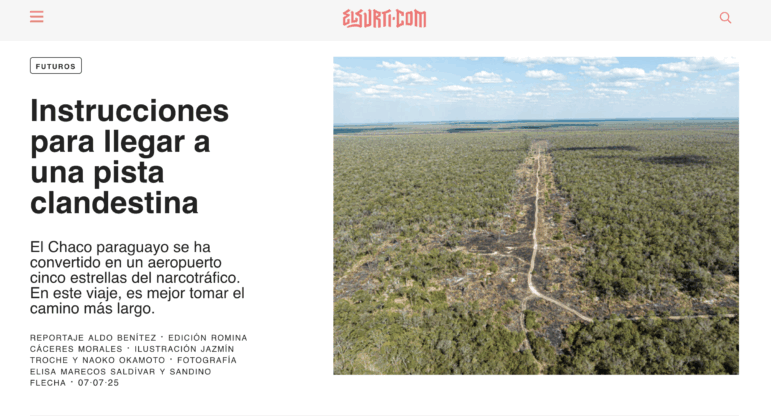
Image: Screenshot, El Surtidor
This investigation reads like a journalistic chronicle, an account by the reporters of their journey to a desolate area in Paraguay where there is no phone service and there are no paved roads — but a thriving trade in narcotics.
In the past, owning a weapon in this area was necessary to defend livestock from wild animals, one local source told them. Now, they are more worried about the drug traffickers.
Reporters for El Surtidor and OCCRP describe how Paraguay’s Chaco region has become a major hub for international drug trafficking, with clandestine airstrips used to move cocaine from Bolivia to Brazil, Paraguay, and beyond. Despite government interventions, these tracks are rebuilt or replaced, showing failures in enforcement. The Chaco’s remoteness, harsh terrain, and lack of radar coverage make it ideal for criminal operations, while local communities, including Indigenous groups and Mennonites, are caught between illegal activity and violence.
Venezuela and Colombia: Lost in the Line
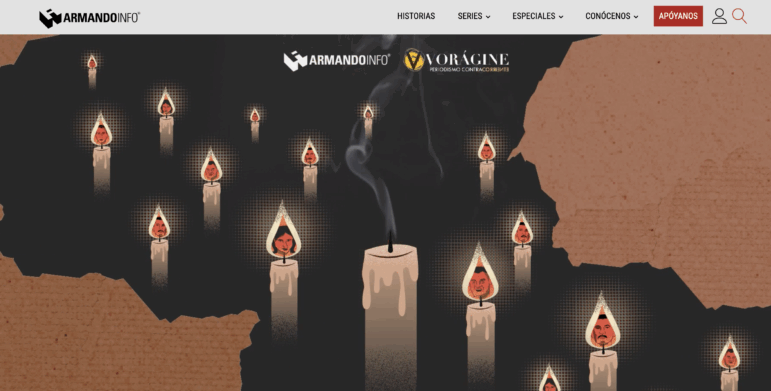
Image: Screenshot, Armando.info
The border region between Colombia and Venezuela has long been porous, complicated, and dangerous. But this investigation explores the dangers of the crossing, and the crisis of missing people who have disappeared in the segment of the border region extending from La Guajira to the Arauca River. Reporters from Armando.info and Vorágine visited several hotspots on both sides of the border, where they confirmed the crisis of the missing. They portray an expanding and largely unspoken situation in areas dominated by criminal networks from both nations and along uncontrolled smuggling corridors. The piece highlights that while Colombian authorities have attempted to document and search for some of the disappeared, Venezuela’s government has responded with indifference, leaving families without answers. See Cartography of Horror, an illustrated story from the investigation.
Peru: Street Wayki

Image: Screenshot, Ojo Público
In an effort to document the wealth of Peru’s leading politicians, investigative reporters from Ojo Público created Street Wayki — a game-like application that is also a valuable resource for journalists tracking money flows, conflicts of interest, and power networks across Peru’s political system. The platform allows users to compare the wealth of the president, members of Congress, and the country’s regional governors, revealing, for instance, how top authorities have significantly increased their assets while in office. It also highlights cases of lawmakers who reported no assets as candidates but now declare holdings worth hundreds of thousands of soles, detailed alongside any complaints, investigations, and judicial processes they currently face. The application was developed by a multidisciplinary team made up of journalists, developers and data analysts, who built the databases through requests for access to information, data extraction from public portals via scrapping, and access to tax and judicial files.
Ecuador: Children Missing in Ecuador’s Internal War
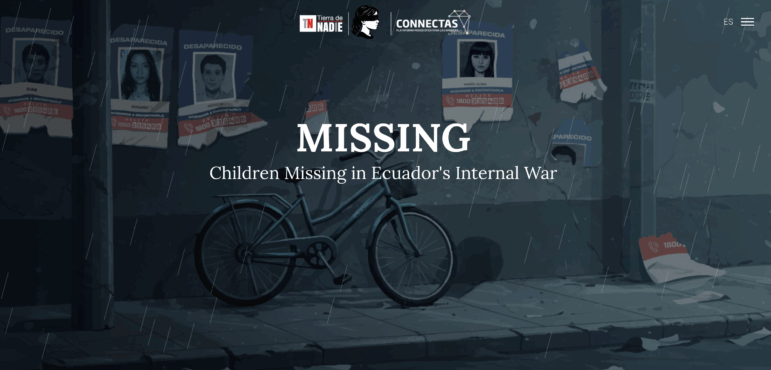
Image: Screenshot, Connectas
Soldiers accused of forcibly removing teenagers from their homes. Mothers looking for their lost children. Drug gangs forcibly recruiting. Investigations going nowhere.
In this report, journalists from CONNECTAS reveal how the wave of violence rocking Ecuador has had a devastating impact on the country’s children — with disappearances among minors nearly doubling between 2023 and 2024, and an average of three children going missing each day in early 2025. The investigation highlights that criminal organizations, including gangs and cartels, are recruiting children, who suffer violence and sexual exploitation. The report also alleges that the State’s security forces are also implicated in a number of forced disappearances — amid allegations of abuse of power linked to the state of emergency (The country’s minister for human rights did not respond to the allegations set out in the piece). The investigation combines data with personal testimonies and shows patterns of forced recruitment, gendered exploitation, and inadequate enforcement of laws to protect minors.
Spain: Mole or Cancer?

Image: Screenshot, Civo
In Spain, about 9,400 melanoma cases are expected to be diagnosed this year. This fast-spreading cancer can metastasize within months, and once it does, outcomes are often poor, so making detection mistakes is potentially deadly. This investigation by the Spanish data journalism outlet Civio explores the risks of privatized AI in medicine and the broader ethical implications of biased datasets. It uncovers discrepancies between marketing claims, independent clinical results, and the actual implementation of a tool that could affect thousands of patients. The story follows one particular AI algorithm being implemented in the Basque region to screen for melanoma skin cancer. Despite a €1.6 million (US$1.8 million) public investment, studies show the tool misses one in three melanomas and misidentifies benign moles as cancerous in roughly 20% of cases. The algorithm was also trained only on white patients, raising concerns about its efficacy for people with darker skin.
Chile: Courts Left Children with Individuals Under Investigation or Convicted for Child Abuse

Image: Screenshot, CIPER
Violence against the little boy started before he turned one month old. He arrived in the hospital with rib fractures and fluid in the lungs. He was admitted to a children’s home and separated from his parents, but three years later, having been returned to the care of his family, he died — his case apparently that of another young victim of domestic abuse.
This investigation by CIPER exposes systemic failures in Chile’s child protection system, showing how children have been placed in the care of adults accused, investigated, or convicted of abuse and maltreatment. It exposes conflicts of interest, poor monitoring, and failures to act on warning signs. Using judicial cases, the reporting reconstructs the stories of children who suffered abuse while supposedly protected by the state. The investigation highlights repeated judicial errors, inadequate oversight by family courts, and inconsistencies in intervention programs, revealing how the best interests of the child are often ignored.
 Andrea Arzaba is GIJN’s Spanish editor and also serves as director for its Digital Threats project. She holds a master’s degree in Latin American Studies from Georgetown University in Washington D.C. and a BA in Communications and Journalism from Universidad Iberoamericana in Mexico City. Her work has appeared in Palabra, Proceso Magazine, National Geographic Traveler, Animal Politico, and 100 Reporters, among other media outlets.
GIJN Bookshelf: 9 Investigative Titles to Better Understand Latin America
GIJN Webinar: How Latin America Connects to Your Story: Investigating the Region’s Global Reach of Illicit Money, Illegal Mining, Drug Trafficking, and Environmental Destruction
Lessons Learned from Investigating Misinformation Around the World
International Research Guide: How to Find Experts and Hidden Documents on Any Topic

‘Don’t Be Scared, Not Even with Presidents’: Tips from a Celebrated Mexican Investigator
Building Memory, Documenting the Truth: The Case of Nicaragua’s Confidencial

How One Reporter Unravelled the Mystery Behind a Field of Starving Horses in Argentina

After Pablo and El Chapo: How Investigative Outlets Are Covering Organized Crime in Latin America

This work is licensed under a Creative Commons Attribution-NoDerivatives 4.0 International License
Republish our articles for free, online or in print, under a Creative Commons license.
Republish this article
This work is licensed under a Creative Commons Attribution-NoDerivatives 4.0 International License
Read Next
10 Questions LATAM Focus News & Analysis
‘Don’t Be Scared, Not Even with Presidents’: Tips from a Celebrated Mexican Investigator
As one of the most respected journalists in Latin America, Carmen Aristegui has investigated political corruption and forced disappearances, never shying away from tough subjects.
Member Profiles
Building Memory, Documenting the Truth: The Case of Nicaragua’s Confidencial
With hundreds of the country’s reporters in exile, the press is under pressure like never before. But this outlet is continuing to report despite all its staff now being based overseas.
How They Did It News & Analysis
How One Reporter Unravelled the Mystery Behind a Field of Starving Horses in Argentina
GIJN spoke to the author of a 2024 Gabo Award-winning investigation into the case of 700 horses found abandoned in a field outside Buenos Aires.
How They Did It LATAM Focus News & Analysis
After Pablo and El Chapo: How Investigative Outlets Are Covering Organized Crime in Latin America
As organized crime in the region metastasizes, investigative journalism is rising to the challenge, using innovative ways to cover ever-changing threats.