
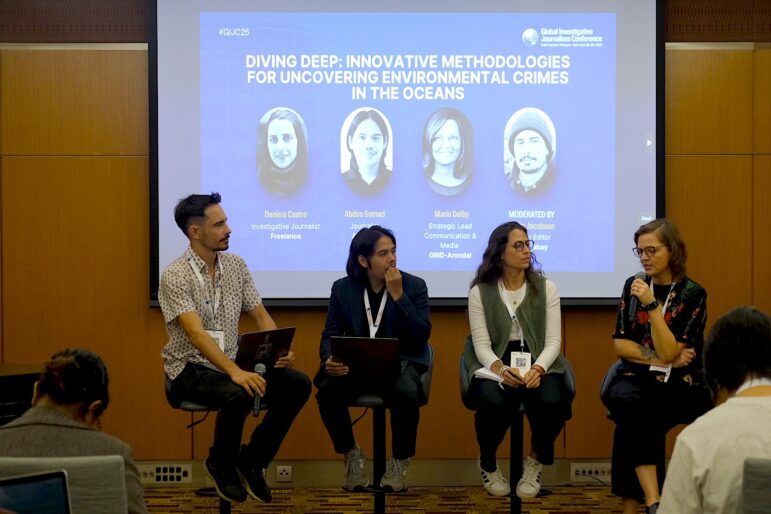
Speakers at the GIJC25 panel on uncovering environmental crimes in the ocean. Image: Alyaa Abdul Aziz Alhadjri for GIJN


Seas and oceans cover more than two-thirds of the planet, yet remain among the least regulated and under-monitored spaces on the planet. Weak oversight, fragmented jurisdictions, and vast unpatrolled areas create conditions where environmental crimes, from illegal fishing to wildlife trafficking, continue largely out of sight.
At the 14th Global Investigative Journalism Conference (GIJC25), speakers from around the world spoke at a panel entitled “Innovative Methodologies for Uncovering Environmental Crimes in the Ocean” to outline practical methodologies that reporters can use to investigate crimes at sea, even when evidence is limited and documentation is incomplete.
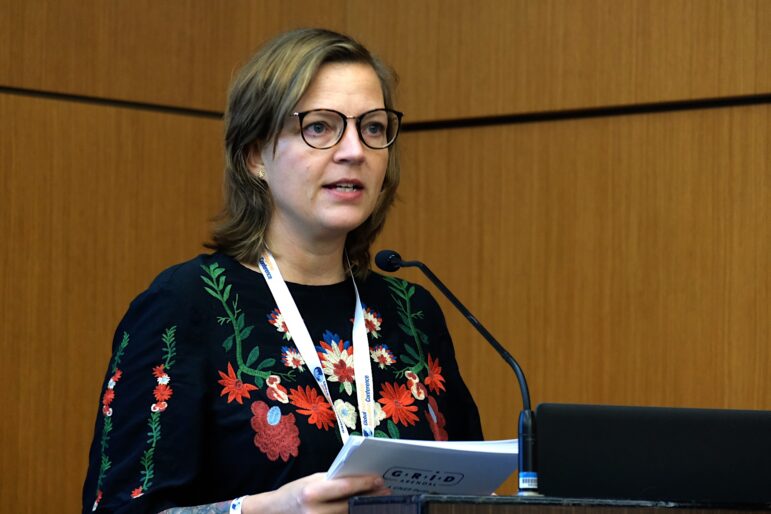
Maria Dalby of GRID-Arendal explains how jurisdictional loopholes are exploited by criminal networks on the open ocean. Image: Alyaa Abdul Aziz Alhadjri for GIJN
Why the Ocean Is So Vulnerable
Maria Dalby, head of media relations for GRID-Arendal, a Norwegian environmental organization, explained that maritime crime thrives where governance is weakest. With overlapping regimes and few enforcement mechanisms, criminal networks exploit the gaps.
She highlighted two major global treaties that will reshape future reporting:
- Biodiversity Beyond National Jurisdictions (BBNJ) Treaty: It introduced environmental impact assessments and governance mechanisms for the high seas.
- Global Plastics Treaty: The negotiations are still ongoing, and it is expected to introduce traceability requirements and new obligations for waste exporters.
Both treaties, she said, will create fresh opportunities for investigative journalists to track how governments and corporations adapt, or fail to comply, with emerging rules.
Investigating Ocean Crime Through What’s Missing
One of the most replicable methods shared came from Daniela Castro, formerly of OCCRP. She presented a cross-border shark-fin trafficking investigation that began with a press release announcing an illicit shark fin trade seizure in Colombia. What stood out was not what officials disclosed, but what they left out. Key elements like the exporter’s identity, permit details, and the legality of the shipment were absent from official statements.
Each of these omissions became a lead for Castro. By combining elements of a previous leak, Narco Files, with public business registries and corporate filings, Castro’s team identified the exporter, whose legal representative was the son of a former Cali Cartel leader.
“You have to build your own record. Government documents alone will not give you the truth,” she said. In maritime crime, she added, these unexplained gaps in documentation often point to where illegal activity is hidden. Her approach is widely applicable beyond wildlife trafficking.
Building a FOIA Matrix
One of Castro’s most useful tools was a structured FOIA matrix. Over nine months, the team filed more than 45 information requests to Colombian agencies, including fisheries authorities, tax and customs offices, and maritime regulators.
Castro’s team created a structured spreadsheet to keep track of the FOIA requests, listing each agency, the objective of the request, and the responses received. This system became essential to stay aligned with the story’s goals over nine months of reporting.
FOIA responses, combined with on-the-ground reporting in Colombia, Venezuela, and Hong Kong, allowed the team to piece together key elements of the shipment and identify gaps in the company’s permits. Castro emphasized that this kind of multi-agency request strategy is replicable for many cross-border ocean investigations.
Hybrid Ocean Forensics: AIS Meets Social Media
Indonesian reporter Abdus Somad of Jaring.id presented a complementary methodology: combining AIS vessel tracking with open source reporting from local communities.
Somad started with AIS (Automatic Identification System) data, but warned that illegal operators often turn off transponders, spoof their location, or make suspicious course changes. “When the AIS signal disappears, that’s when the real investigation starts,” he said.
That is why Somad uses a multi-layered verification process:
- Cross-check AIS data across multiple platforms (Global Fishing Watch, MarineTraffic, FleetMon, VesselFinder).
- Examine satellite imagery to corroborate suspicious vessel behavior.
- Search TikTok, Facebook, and try to enter WhatsApp groups used by local fishermen, who often upload videos of landings, transshipments, and foreign vessels operating near their waters.
- Contact eyewitnesses directly for additional confirmation.
- Tracing vessel ownership through databases like Equasis to identify companies, addresses, and politically exposed persons.
This hybrid digital-community model helps reporters fill gaps in data and document illegal fishing operations even in remote areas.
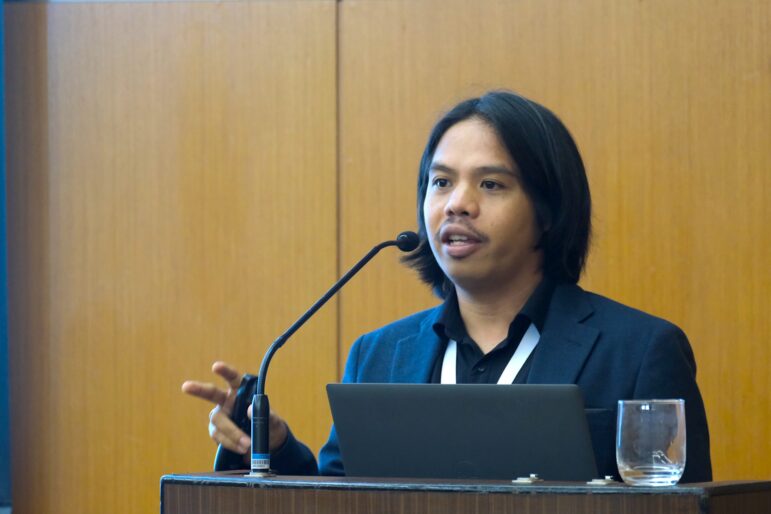
Indonesian reporter Abdus Somad of Jaring.id discusses combining AIS vessel tracking with open source reporting from local communities at GIJC25. Image: Alyaa Abdul Aziz Alhadjri for GIJN
New Treaties, New Story Opportunities
Returning to the broader picture, Dalby encouraged journalists to follow how countries might implement the BBNJ and the future Global Plastics treaties. Issues ripe for investigation include:
- Environmental impact assessments for activities like deep-sea mining tests.
- Monitoring of high-seas protected areas that may only exist on paper.
- Plastic waste shipment declared as “recyclable” but dumped abroad.
- Traceability rules requiring companies to show where their plastics end up.
- Contradictions between treaty commitments and domestic policies.
These emerging frameworks will shape ocean governance for years, offering reporters new entry points for investigations.
Starting Points for Ocean Reporters
The session offered a set of clear starting points for reporters:
- Track suspicious vessel behavior using multiple AIS platforms.
- Combine digital tools with local networks, especially fishermen and coastal communities.
- Map the legal and corporate actors behind vessels using IMO numbers and company registries.
- Use a structured FOIA matrix to gather information from multiple agencies.
- Treat missing information, absent names, vague permits, unexplained routes, as investigative leads.
- Build cross-border collaborations when following transnational maritime crimes.
Environmental crime at sea remains underreported, but the tools and strategies presented at GIJC25 show that even in the world’s least governed spaces, evidence can be found, and stories can be told.

This work is licensed under a Creative Commons Attribution-NoDerivatives 4.0 International License
Republish our articles for free, online or in print, under a Creative Commons license.
Republish this article
This work is licensed under a Creative Commons Attribution-NoDerivatives 4.0 International License
Read Next
Case Studies News & Analysis
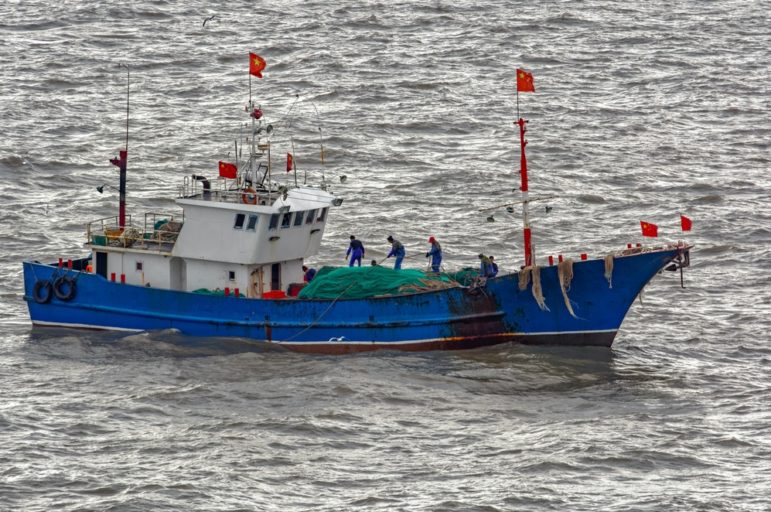
How an Award-Winning, Cross-Border Project Investigated on the Open Ocean
Fourteen newsrooms and independent journalists from 13 countries collaborated on the Oceans, Inc. project, to uncover stories about illegal fishing and forced slavery on the South China Sea and the oceans near Antarctica. Their cross-border reporting won the 2022 SOPA Award for Excellence in Reporting on the Environment.

Investigative Techniques News & Analysis
Exposing the Money Behind Environmental Destruction
The Pulitzer Center discusses how it has developed different methodologies to uncover environmental wrongdoing, adapted to the region, jurisdiction, and industry.
Using AI and Satellites to Track Illegal Fishing in Marine Protected Areas
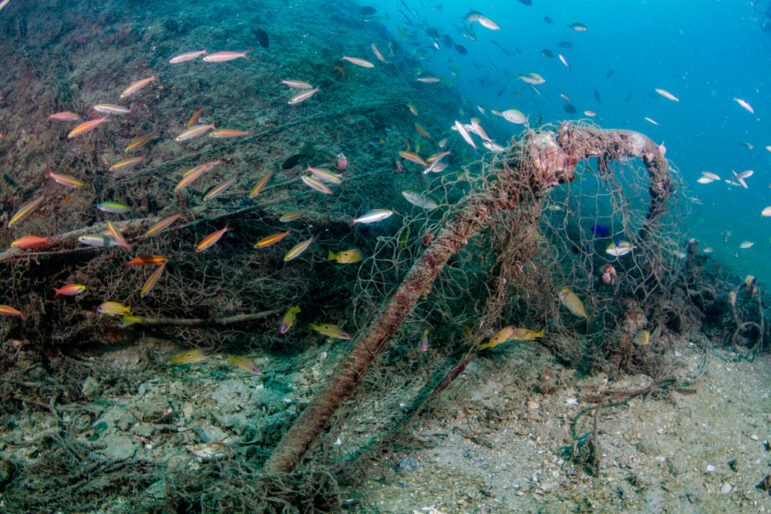
Using artificial intelligence and synthetic aperture satellite technology, investigators can better identify and document illicit activity at sea.
Data Journalism Reporting Tools & Tips
Supercharge your Environmental Investigative Stories with Data and Visuals
At the Pulitzer Center’s recent environmental investigative conference, Interconnected: Reporting the Climate Crisis, a panel of environmental reporters and designers explained how data and visualization can make environmental stories compelling.