
News & Analysis
Credibility Is the New Currency. And that’s Good for Independent Media
Communications lecturer and former Columbus Dispatch business journalist James Breiner on how credibility works to the advantage of independent media.
Communications lecturer and former Columbus Dispatch business journalist James Breiner on how credibility works to the advantage of independent media.

And we’re off! This evening in Johannesburg at the University of the Witwatersrand, we’ll be kicking off four days of unadulterated investigative journalism. For those of you who couldn’t make it to Joburg, here’s how to follow us from home, as well as highlights of #GIJC17.
As we prepare to gather in Johannesburg for #GIJC17, it’s worth noting the many challenges African journalists face. From South Africa to Somalia, July was a particularly ominous month for free expression on the continent.
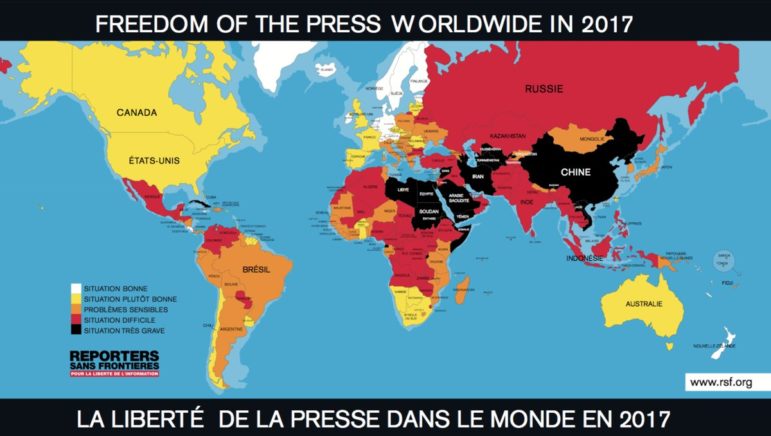
Reporters Without Borders this week released its 2017 World Press Freedom Index of 180 countries, and the news is not good. The report found media freedoms falling in democracies and that “nothing seems to be checking that fall.” Nearly two thirds (62.2%) of countries measured had deteriorated freedoms, while the number of countries where the media freedom situation was “good” or “fairly good” fell by 2.3%.
What a year… We’ve been Trumped and Brexited, blitzed by bogus news, and fighting to protect good journalism pretty much everywhere. But there were flashes of hope and better days. The Spotlight movie and Panama Papers showed the world what great reporting can do. As the year draws to a close, we’d like to share the 10 most popular stories on our site that have grabbed the attention of our dear readers.
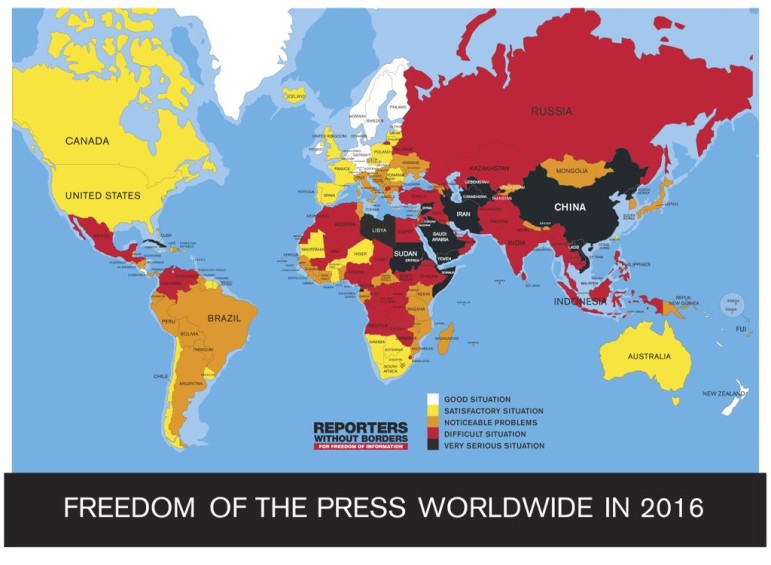
Reporters Without Borders (RSF) has released its World Press Freedom Index, ranking 180 countries according to the level of freedom available to journalists. “It is unfortunately clear that many of the world’s leaders are developing a form of paranoia about legitimate journalism,” wrote RSF secretary-general Christophe Deloire. The index showed a deep and disturbing decline in respect for press freedom, and a climate of fear and tension combined with increasing control over newsrooms by governments and private-sector interests.
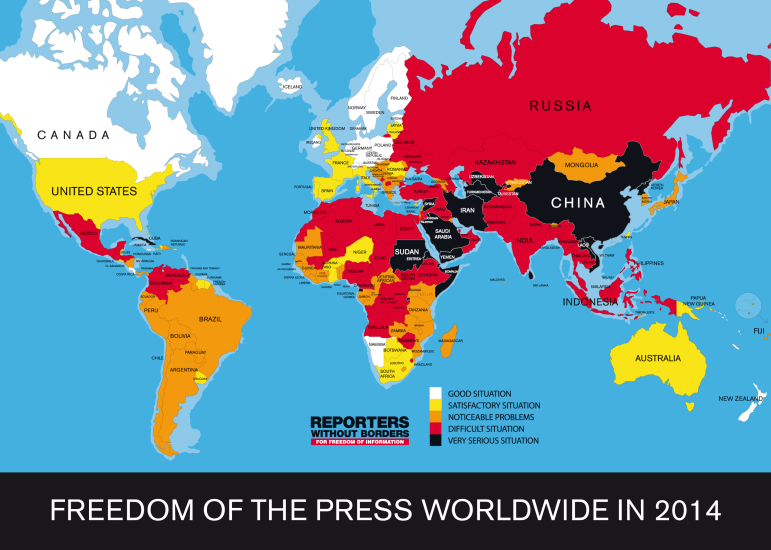
Reporters Without Borders today released its 2014 World Press Freedom Index, spotlighting major declines in media freedom in such varied countries as the United States, Central African Republic, and Guatemala while noting marked improvements in Ecuador, Bolivia, and South Africa. The same trio of Finland, Netherlands, and Norway heads the index again, while Turkmenistan, North Korea and Eritrea continue to be the biggest information black holes, again occupying the last three positions. You can find RSF’s full index and a 3-dimensional map here. The report is also available in several languages other than English.
How can you protect yourself from online snooping? Reporters Without Borders has published an Online Survival Kit on its WefightCensorship.org website with tools and practical advice that will help protect your communications and data. As the website explains, “The tools and techniques presented in this kit do not require advanced knowledge of computers and programming.” In other words, you don’t need to be an IT engineer to protect your emails and stay anonymous online.
The Reporters Without Borders Digital Survival Kit is available in French, English, Arabic, Russian, and Chinese, and is published under a Creative Commons license.
In 2001 GIJN was born, as investigative journalists from around the globe met for the very first time to share ideas, tips, and best practices to strengthen their reporting in a world where journalism was increasingly under threat.
Today the threat has multiplied, and at GIJN we find ourselves under the same pressures as our member organizations. Most urgently: available funding for investigative journalism has been impacted as some longtime funders who supported journalism in the past are no longer doing so or have closed. Yet our work continues, more important than ever before.
GIJN serves as the global hub for the world’s investigative reporters. Our core mission is to support and strengthen investigative journalism—with special attention to those from repressive regimes and marginalized communities.
We are embarking on our first-ever campaign initiative to help us expand our revenue by the end of the year through individual donors. If you have ever joined one of our free webinars, used one of our free resources, learned a new skill thanks to a GIJN training, or simply believe that press freedom is essential to civil society, we ask you to show your support for GIJN’s work with a donation of your choosing. Called “Friends of GIJN,” this campaign includes a more personalized experience, starting in 2027, for individuals who answer the call to join with us during this unprecedented time.
Truth and democracy are under attack around the world. You can fight back by helping GIJN support investigative journalists with free access to the latest tools and techniques — so they can foster justice and hold accountable those who abuse the public trust.
With a staff based in 24 countries, GIJN works in a dozen languages each day, linking together the world’s most enterprising journalists, offering state-of-the-art training, webinars, tip sheets, and a Help Desk that responds to 2,000+ requests for assistance each year. More than 84% of GIJN’s operating budget goes directly to our program work.
Please make a gift today to support journalists on the front lines of the fight for accountability and human rights.