
This Nonprofit-Based Data App Could Change How You Cover Wildfires
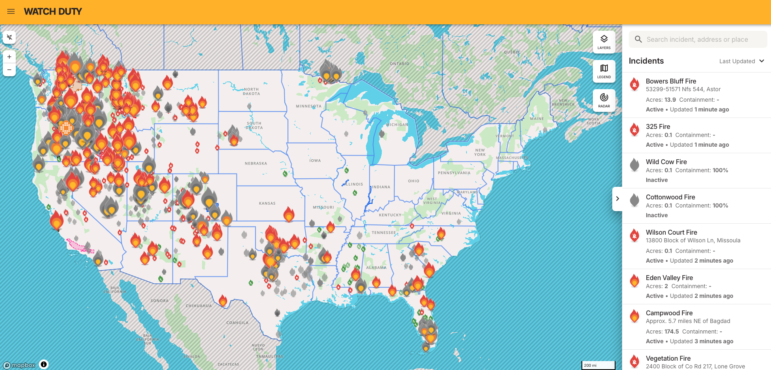
If you are an environmental journalist in the US West, covering wildfires may be a common chore. Watch Duty is a data app that will rescue you.
Not always “data” data, it is still a fire hose of critical information. It will repay your efforts to discover it. SEJournal has, over the years, offered many resources for covering wildfires. But we neglected this one. It is one of the best. Start exploring it here.
Watch Duty is a nongovernmental nonprofit staffed by experienced disaster professionals, tech professionals, and volunteers. It is funded by paid memberships and grants. You can get the basic info for free. It has a huge user base and gets massive online traffic.
If someone in your audience (or you) owns a cozy hideaway in some mountain forest, you need it — because government notification systems don’t always work. Toolbox observes that US President Donald Trump is reorganizing federal wildfire response. Hideaway owners may want to pay the US$24.99 for a yearly membership.
And you can get it on your smartphone as you are racing toward the fire. Or away from it.
Where the Data Comes From
The data is sourced from all over: radio scanners, cameras, satellites, and other public sources such as official announcements from law enforcement and local government. That includes the agencies actually fighting the fire and managing the disaster response.
It’s a wider array of information than you get from typical federal and state sources.
And it’s high-quality data of exceptional timeliness — critical if you want to survive a fire (or the fact-checkers, given that chaos and surprise are often characteristic of disasters). Among other sources, it has volunteers listening to firefighters’ radio. When the evacuation order comes, you will get it on your cellphone.
How Many Layers Do You Want?
Alerts on your cellphone are just a starting point. Reporters doing data projects may want to know more — like where the nursery schools and senior homes are. Or whether people should evacuate. Or where the shelters for evacuees are. Or what power outages to expect even before the fire gets there.
You can even track the flight plans of firefighting aircraft. Or fire weather, red flag warnings, and weather stations.
Do you have asthma? Ever seen the sky turn orange? Watch Duty also includes data on wildfire smoke and air quality.
What’s unique about Watch Duty is not just the wide variety of information it includes, but the effectiveness of how it integrates all this information. The map format is key. A recent news flash is that they are developing a similar utility for flooding.
As always, we urge you to get out there and observe the event and talk to people of all walks about how they are experiencing fire. Get your own scanner. Bring a mask. And put your own safety first. Before you go in, have a plan for getting out.
Editor’s Note: This story was originally published on SEJournal’s Reporter’s Toolbox. It is republished here with permission.
 Joseph A. Davis is a freelance writer/editor in Washington, DC who has been writing about the environment since 1976. He writes SEJournal Online’s TipSheet, Reporter’s Toolbox, and Issue Backgrounder, and curates SEJ’s weekday news headlines service EJToday and @EJTodayNews. Davis also directs SEJ’s Freedom of Information Project and writes the WatchDog opinion column.

International Research Guide: How to Find Experts and Hidden Documents on Any Topic

Guide to Investigating Tech and AI in Modern Warfare
Turning Copernicus Satellite Data Into Public-Interest Climate Stories
10 Practical Tips for Verifying Scientific Claims
New York Times’ Hannah Dreier on Wildland Firefighters and the Deadly Smoke Risks They Face
Wildfire Reporting — Expert Advice on Emerging Issues, Recurring Risks
How Collaboration Exposed Impacts of Wildfire Pollution-Reporting Rules

There Has Never Been a Better Time for Environmental Journalism

This work is licensed under a Creative Commons Attribution-NoDerivatives 4.0 International License
Republish our articles for free, online or in print, under a Creative Commons license.
Republish this article
This work is licensed under a Creative Commons Attribution-NoDerivatives 4.0 International License
Read Next
How They Did It
New York Times’ Hannah Dreier on Wildland Firefighters and the Deadly Smoke Risks They Face
The recipient of the 2026 Goldsmith Prize for Investigative Reporting discusses how she conducted her award-winning investigation on maskless wildland firefighters.
News & Analysis Safety & Security
Wildfire Reporting — Expert Advice on Emerging Issues, Recurring Risks
Two California-based journalists offer some reporting best practices, logistical tips, and safety precautions to take when covering wildfires.
Case Studies Climate
How Collaboration Exposed Impacts of Wildfire Pollution-Reporting Rules
A legal loophole in the Clean Air Act allows air pollution to be erased from EPA statistics and regulatory decisions if the pollution was caused by “natural” or “uncontrollable” events.
News & Analysis
There Has Never Been a Better Time for Environmental Journalism
The press in the US faces daunting challenges with the return of President Donald Trump, but holding his administration accountable makes environmental journalism that much more vital.