

GIJC25
GIJC25 Global Shining Light Award Submissions Now Open
The Global Shining Light Award honors investigative journalism in a developing country or under threat or dire conditions.
The Global Shining Light Award honors investigative journalism in a developing country or under threat or dire conditions.

A collection of the tipsheets, research roundups, and explainers published this past year to help reporters cover the 2024 US election.

Also: mapping crimes in Buenos Aires neighborhoods, Nigeria’s efforts to reduce carbon emissions, and tracking organ donation in Germany.

Investigative reporter Annie Hylton on her journey from law to journalism, overlooked stories, and advice for interviewing sources living with trauma.

Collaborative journalism, feminist perspectives, diverse newsrooms, and support from local journalists can lead to better coverage of migration.

Fariba Nawa, host of the On Spec podcast, discusses how she and her team have used donations and collaborations to build their project.

At Trust Conference 2024, a panel of experts discussed the growing risks to lawyers who defend watchdog reporters, and what this could mean for the future of our democracies.

NASA’s Worldview database is a valuable tool that journalists can use to find data and free graphics on a range of topics, like wildfires, floods, deforestation, and many more.

This October and November, GIJN member representatives will vote to elect three regional representatives and four at-large directors for the 15-person Board of Directors.

The founder of IStories talks about moving his entire newsroom abroad for security reasons and the challenges of reporting on Putin’s regime from outside the country.

Also featuring a look at climate change’s impact on Japanese cuisine, an investigation into US parts used in Russian missiles, and a final progress report on Mexico’s outgoing president.

The oil and gas industry is complex and notoriously opaque. But with new tools, it’s become easier for investigators to dig into this field.

A data investigation looked into the lack of transparency in Brazilian elections that allows candidates wanted for crimes to run for office without public knowledge.

An overview of the many creative or unconventional formats for telling investigative stories — and how to leverage curiosity to overcome news avoidance.

In the spirit of creating the best conference for investigative journalists, GIJC25 is now looking for great ideas for its sessions. Send us your proposals!

An innovative new database, the Open Source Munitions Portal (OSMP), identifies and shows remnants of explosive devices in conflict zones.

The data visualization expert and former academic stresses the importance of having an ‘interdisciplinary mindset’ when approaching data-driven stories.

The toolkit helps reporters discover tools in categories like satellite imagery, maps, and social media, and is designed to help researchers learn how to use each tool with in-depth descriptions.
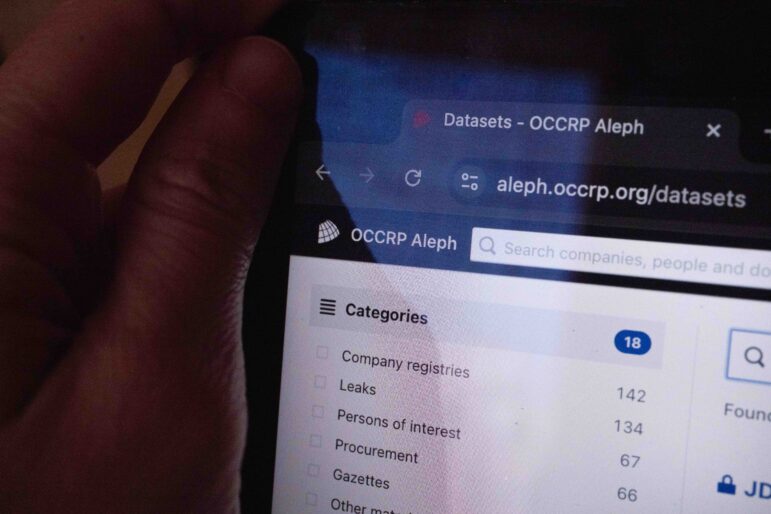
In investigative journalism, connecting data points is often key to uncovering the truth. Aleph helps reporters search, organize, and analyze data, to better trace hidden connections.

At the 2024 iMEdD International Journalism Forum, journalism funders and funding seekers discussed how to demystify the process of fundraising.

The exiled Nicaraguan journalist and editor Carlos F. Chamorro explains the critical need to promote and support journalists who are forced to leave their homelands because of their reporting.

Also featured: the 51 men on trial for a case of shocking sexual violence in France, the wildfires raging in the Arctic, and gaming out a winning campaign for the US presidency.

Three investigations into food systems show how investigative journalists can capitalize on the huge interest in food — and food-related content — to make their reporting more impactful.

Behind-the-scenes of an investigation into a program that gave formerly enslaved people in the US land titles after the Civil War — and then revoked them.

These organizations are developing AI tools and resources that can be used to tackle misinformation, improve data reporting, and help with the storytelling process.

New remote sensing techniques are enabling researchers to monitor how armed conflict can be a driver of greenhouse gas emissions like methane.

Launching as a digital outlet 25 years ago gave Malaysiakini’s founders the freedom to report on stories that others feared to cover.

New members include organizations doing crucial watchdog work in areas from deforestation to African data journalism capacity to the exploitation of child migrants.
In 2001 GIJN was born, as investigative journalists from around the globe met for the very first time to share ideas, tips, and best practices to strengthen their reporting in a world where journalism was increasingly under threat.
Today the threat has multiplied, and at GIJN we find ourselves under the same pressures as our member organizations. Most urgently: available funding for investigative journalism has been impacted as some longtime funders who supported journalism in the past are no longer doing so or have closed. Yet our work continues, more important than ever before.
GIJN serves as the global hub for the world’s investigative reporters. Our core mission is to support and strengthen investigative journalism—with special attention to those from repressive regimes and marginalized communities.
We are embarking on our first-ever campaign initiative to help us expand our revenue by the end of the year through individual donors. If you have ever joined one of our free webinars, used one of our free resources, learned a new skill thanks to a GIJN training, or simply believe that press freedom is essential to civil society, we ask you to show your support for GIJN’s work with a donation of your choosing. Called “Friends of GIJN,” this campaign includes a more personalized experience, starting in 2027, for individuals who answer the call to join with us during this unprecedented time.
Truth and democracy are under attack around the world. You can fight back by helping GIJN support investigative journalists with free access to the latest tools and techniques — so they can foster justice and hold accountable those who abuse the public trust.
With a staff based in 24 countries, GIJN works in a dozen languages each day, linking together the world’s most enterprising journalists, offering state-of-the-art training, webinars, tip sheets, and a Help Desk that responds to 2,000+ requests for assistance each year. More than 84% of GIJN’s operating budget goes directly to our program work.
Please make a gift today to support journalists on the front lines of the fight for accountability and human rights.