
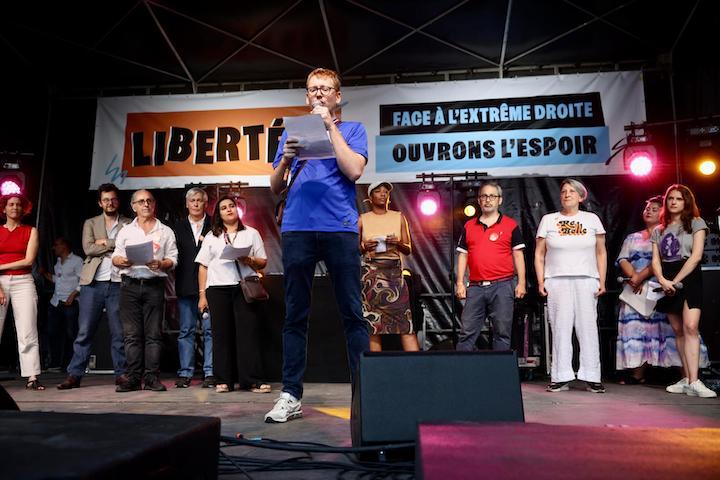
StreetPress co-editor-in-chief Mathieu Molard speaking at a Paris rally organized by a coalition of independent media and civil society groups ahead of France's 2024 snap legislative elections. Image: Courtesy of Mathieu Génon
How StreetPress Became France’s Far-Right Investigations Engine
Read this article in
In the run-up to France’s snap legislative elections in June 2024, the online news outlet StreetPress published a series of explosive investigations into far-right National Rally (RN) candidates. Uncovering racist statements, affiliations with extremist groups, and other controversies, the reporting ultimately prompted several candidates to withdraw from the race. The revelations became one of the biggest media stories of the campaign.
For a small, scrappy independent newsroom with an annual budget of €1.5 million (US$1.65 million) and a full-time staff of just 14 at the time (that number has since grown to 24), this was a significant coup. But over the past 16 years, the Paris-based outlet has quietly built a reputation for consistently punching above its weight, particularly in its uncompromising coverage of the French far right.
StreetPress was launched in 2010 by three journalists in their twenties, none of whom had studied journalism. Backed only by a €5,000 bank loan that co-founder Johan Weisz-Myara had secured under the pretext of renovating his apartment, it initially relied heavily on unpaid citizen journalists.
By 2012, the site had attracted around 140,000 unique visitors per month, with its youthful, urban edginess drawing comparisons to Vice. Today, it reaches up to six million people per month across platforms. Despite its modest means, it has come to play an outsized role in setting the national news agenda.
“A little over 10 years ago, whenever another outlet picked up one of our stories, it was a cause for celebration,” says Mathieu Molard, the site’s co-editor-in-chief, who joined StreetPress as an intern in 2010. “Today, it happens almost every week.”
For Molard, this is the result of steady, incremental growth rather than any dramatic transformation. “We’re the opposite of a startup,” he explains. “A startup raises a lot of money and grows as quickly as possible in the hope of being bought — or it dies.” By contrast, StreetPress has “grown step by step,” typically adding only a few new staff members each year while steadily refining its business model and professionalizing its newsroom.
All the while, the site’s editorial identity has remained remarkably consistent. “Many of the subjects you find on StreetPress today were already there at the beginning,” Molard points out. The site’s original participatory ethos also endures, with StreetPress continuing to cultivate a close relationship with its audience through reader tip-offs, donation campaigns, journalist training, and collaborative reporting projects.
Investigative journalism has become increasingly central to StreetPress’s steady advance. Early high-profile investigations included a 2015 exposé revealing that the French state was chartering private jets to deport migrants from Calais, and a landmark 2017 investigation compiling one of the country’s first nationwide databases of deaths following police interventions over the previous decade. Together, such investigations, which combined traditional shoe-leather journalism with innovative, data-driven techniques, helped establish StreetPress as a source of ambitious, original public-interest reporting.
Over time, however, one subject has increasingly come to dominate the newsroom’s attention. As the former far-right National Front movement steadily broadened its appeal and evolved into today’s RN under the leadership of Marine Le Pen, StreetPress invested heavily in reporting on a beat that, until recently, many larger newsrooms still regarded as peripheral.

in 2024, StreetPress investigated the links between neo-Nazi skinheads and France’s National Rally party. Image: Screenshot, StreetPress
A ‘Pure Player’ Pioneer
For Nikos Smyrnaios, a media researcher at the University of Toulouse, StreetPress’s defining strength was recognizing that this story extended far beyond the RN itself. The outlet’s young, politically engaged and tech-savvy newsroom blazed a trail in investigating what he describes as “the new forms of the far right” — including identitarian groups, YouTubers, and the wider online ecosystem — that had hitherto largely escaped sustained scrutiny. “They were the first to really occupy that ground,” Smyrnaios says, “then they had the staying power.”
For StreetPress co-founder Weisz-Myara, now 43, this reflected longstanding editorial priorities rather than a strategic shift. From the outset, the newsroom sought to shine a light on the under-reported margins of French society. As parts of the contemporary far right gradually migrated from those same fringes into the political mainstream, StreetPress naturally followed them. “Current events left us no choice,” Weisz-Myara says.
This seismic political shift has unfolded alongside profound changes in France’s media landscape. In the late 2000s, the financial crisis, the rise of the internet, and an outdated regulatory framework created fertile ground for an unprecedented wave of corporate takeovers. Today, the holdings of 11 billionaires account for 80% of France’s daily press sales and 57% of the country’s television audience. At the heart of that transformation is Vincent Bolloré, the ultra-conservative magnate whose media empire has become synonymous with the normalization of far-right rhetoric in French broadcasting.
But the initial upheaval also galvanized a new generation of online-only news outlets, known in France as “pure players,” to distinguish them from traditional media with a print or broadcast legacy. Among the first was Bondy Blog, founded in the wake of the 2005 Paris banlieue riots, and soon followed by outlets including Rue89, Arrêt sur Images, and Mediapart, each promising its own digital revolution.
For its part, StreetPress aimed to speak to a generation of young French people who, Weisz-Myara says, had “no news media addressing the questions that mattered to them.” In doing so, it hoped to help rebuild trust in journalism at a time when confidence in mainstream media was plummeting among readers. “They can see that those [mainstream] outlets have an editorial line, yet they continue to insist that they’re neutral, objective and totally detached from their subject,” Weisz-Myara notes. In contrast, StreetPress sought to “champion a form of journalism that is open about its standpoint.”
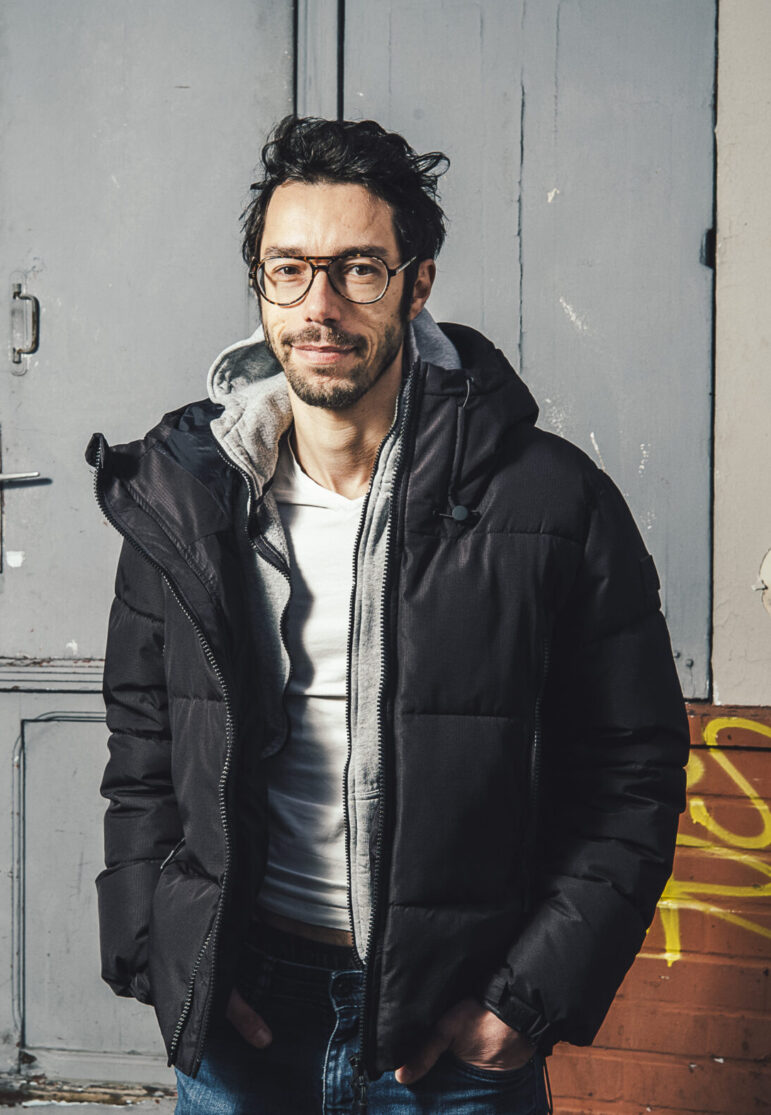
StreetPress co-founder Johan Weisz-Myara. Image: Courtesy of Yann Castanier.
While several early pure players, including Mediapart, relied on subscription models, StreetPress insisted on remaining free. The young readers it wanted to reach, Weisz-Myara explains, were often students, interns, or just starting their careers. “We wanted all the audiences we were speaking to to be able to access that information,” he says.
Keeping the site free as it has grown has required an increasingly dynamic funding model that combines grants, training programs, and commercial partnerships with reader donations. “StreetPress was among the first outlets in France to develop really sophisticated crowdfunding campaigns,” says Smyrnaios.
Following the investigations during the 2024 legislative elections, donations surged as more readers came to see the newsroom’s work as an increasingly important way to document — and challenge — the contemporary French far right. In 2025, the outlet counted 15,500 donors, including 9,200 monthly supporters, whose recurring contributions now provide the financial backbone of the newsroom. “Without recurring donations,” Weisz-Myara says, “it would be difficult to continue developing StreetPress.”
Owning the Far Right Beat
Today, StreetPress has three staff journalists primarily focused on the far right, with the wider newsroom routinely mobilized around major investigations and election campaigns. But reader support has translated into more than just increased reporting capacity. That same community plays an active role in the reporting itself, regularly supplying tips, leads, and local knowledge that often develop into investigations.
Molard points to a recent example in which a reader got in touch after spotting something unusual on LinkedIn. The tip ultimately led StreetPress to uncover that a private security company linked to a network of figures with neo-fascist ties had secured millions of euros’ worth of public contracts. “It’s a common thread,” Molard says. “It starts with a reader, then comes an open source investigation. That allows us to find new sources, develop the story further, and ultimately have an impact. That’s the DNA of StreetPress.”
During the 2024 elections, readers helped turn a systematic open source exercise into a much larger operation. Investigative journalists Daphné Deschamps and Arthur Weil-Rabaud split the RN’s candidate list in half, giving themselves just 30 minutes to scrutinize each candidate’s online footprint. If they found the beginning of a lead, they kept digging. As StreetPress began publishing its findings, readers and local sources started sending in information about candidates in their own constituencies, helping fuel more than 60 investigations in just three weeks.
StreetPress has also experimented with new ways of presenting its investigations. Interactive maps, searchable databases, and short-form video have become increasingly important complements to its traditional reporting. More recently, the newsroom has begun training social media creators covering the far right. “We’re trying to give them the tools to understand how investigative journalism works — and how to share it with their own audiences,” Deschamps explains.
In each case, the underlying principle is the same. “We need to stop saying that people aren’t interested in journalism anymore — that’s too easy,” Molard says. “We’re always asking ourselves how we can get our stories to readers—or readers to our stories. We have to meet them halfway.”

In the run-up to the 2024 elections in France, StreetPress collaborated with readers for a series of rapid-fire investigations of RN candidates, finding examples of extremism and anti-semitic remarks. Image: Screenshot, StreetPress
Reporting Under Pressure
But that growing visibility has come at a cost. StreetPress is currently facing 16 legal actions, overwhelmingly linked to its reporting on the far right, with Weisz-Myara hinting that several more are on the horizon.
According to Reporters Without Borders (RSF), more than half of StreetPress’s newsroom is currently subject to legal proceedings, effectively amounting to a multi-pronged SLAPP campaign against the outlet. “Even in a context where an increasing number of French media organizations are facing legal proceedings, this is a unique case,” says Laure Chauvel, head of RSF’s France-Italy desk.
“These lawsuits aren’t designed to win,” she adds. “They’re designed to exhaust a newsroom. Instead of spending their time investigating, journalists spend it defending themselves in court.”
The pressure extends well beyond the courtroom. StreetPress journalists describe an escalating pattern of online harassment, threats, and intimidation that has forced the newsroom to strengthen security around its offices, public events, and staff.
The combined financial burden is considerable. “Across 2024 and 2025, we’ve spent around €100,000 (US$115,000) on legal fees,” Weisz-Myara says. “We’ve already budgeted around €115,000 this year for legal defense and event security, plus an additional €35,000 to €40,000 for digital security. Those are sums far greater than the cost of hiring four or five journalists instead, or four or five times what we pay to house the newsroom in our offices.”
This has also had a tangible impact on the reporting process, adding hours of legal review and corroboration to investigations that are already painstakingly reported. Deschamps, who is herself the subject of roughly half of StreetPress’s active legal cases, says the pressure has had one unintended consequence.
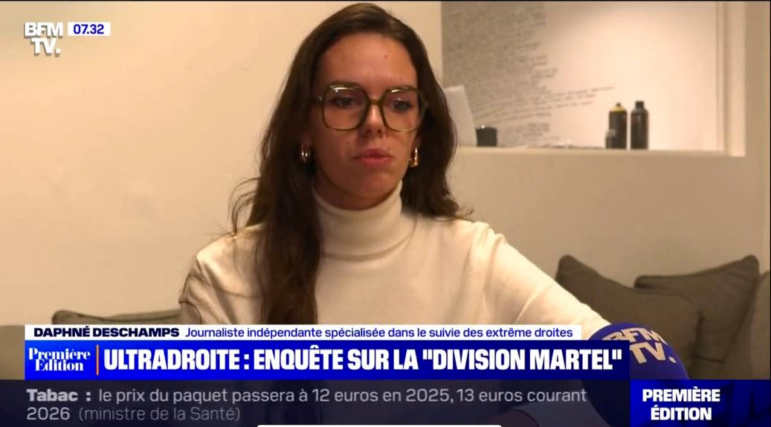
StreerPress investigative reporter Daphne Deschamps discussing one of her stories with one of France’s biggest cable TV networks. Image: Screenshot, BFM TV
“It forces us to be extremely rigorous, because there’s always this threat of legal action,” she says. At the same time, she adds, “this reporting is simply too important for anything less.”
With France’s next presidential election slated for April 2027, both the importance of StreetPress’s reporting and the pressure on its newsroom are only likely to intensify. In early July, an appeals court cleared Marine Le Pen to run for president again, despite upholding her conviction for embezzling European Parliament funds. The RN leader quickly announced her candidacy and now leads opinion polls for the Élysée.
Whatever the outcome, Molard is adamant that StreetPress’s mission remains unchanged. “The role of a media organization is to reveal what people want to hide,” he says. “That’s the heart of what we do. Everything else is almost decoration.”
 Christopher Clark is a journalist, filmmaker, and author based in the south of France whose primary focus is reporting on power, inequality and social change, with a particular interest in long-form features. He has reported from 16 different African countries for outlets such as Al Jazeera, The Atlantic, Foreign Policy, The Guardian, Harper’s, NPR, Reuters, Vice, and The Washington Post. He has also written, produced, and co-directed two 25-minute documentaries for Al Jazeera’s ‘Witness’ series. His solo directorial debut, ‘The Race’, was released in early 2019 as part of a BBC Africa series on African masculinity. He has also made short films for Mongabay, TRAFFIC and the Global Initiative Against Transnational Organized Crime.

Tips for Investigating Right-Wing Influencers and Podcasters

Investigative Tips for Safely Tracking Far-Right Extremist Chatter
International Research Guide: How to Find Experts and Hidden Documents on Any Topic

Guide to Investigating Tech and AI in Modern Warfare
Going Undercover to Reveal a Secret Meeting of Germany’s Far Right
How France’s Mediapart Built a Successful News Model Around Investigative Journalism
Tracking Far-Right Suspects Across Continents: A 10-Year Hunt for Spanish Fugitives

Under Pressure, but Undeterred: How the Investigative Press Corps Perseveres in Argentina

This work is licensed under a Creative Commons Attribution-NoDerivatives 4.0 International License
Republish our articles for free, online or in print, under a Creative Commons license.
Republish this article
This work is licensed under a Creative Commons Attribution-NoDerivatives 4.0 International License
Read Next
How They Did It
Going Undercover to Reveal a Secret Meeting of Germany’s Far Right
Behind the scenes of the blockbuster CORRECTIV investigation that revealed a disturbing far right ‘master plan’ to expel millions of people from Germany.
Case Studies
How France’s Mediapart Built a Successful News Model Around Investigative Journalism
Launched in 2008 with an innovative but untested business model, Mediapart has become a pillar of France’s media landscape and given a new lease of life to investigative journalism in the country. GIJN’s French editor Marthe Rubio explores how the site made a name for itself and how it managed to achieve economic independence.
How They Did It
Tracking Far-Right Suspects Across Continents: A 10-Year Hunt for Spanish Fugitives
As Spain transitioned to democracy, a series of attacks were carried out by the far-right. In some cases, the culprits were never found. To provide some measure of accountability, two journalists from El País have worked for a decade tracking down fugitives in cases forgotten or closed by the authorities.
News & Analysis
Under Pressure, but Undeterred: How the Investigative Press Corps Perseveres in Argentina
In Argentina, investigative reporters are grappling with personal attacks, deteriorating press freedom, and roadblocks when trying to access information, but they refuse to bend or stop their coverage.