

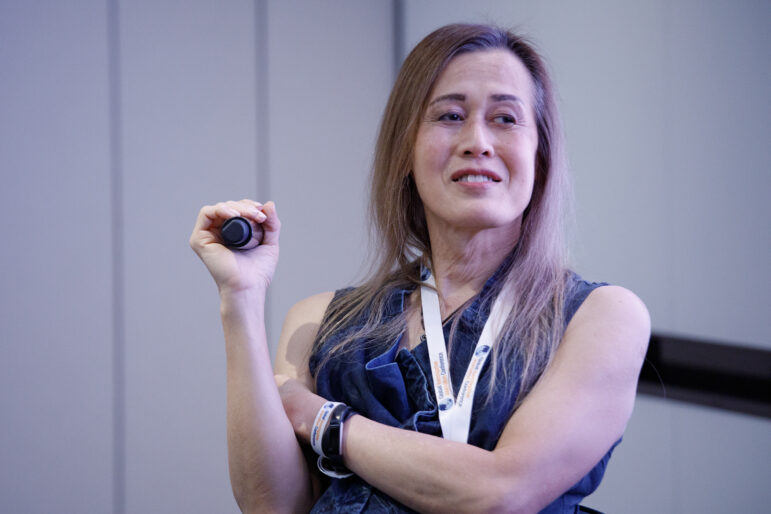
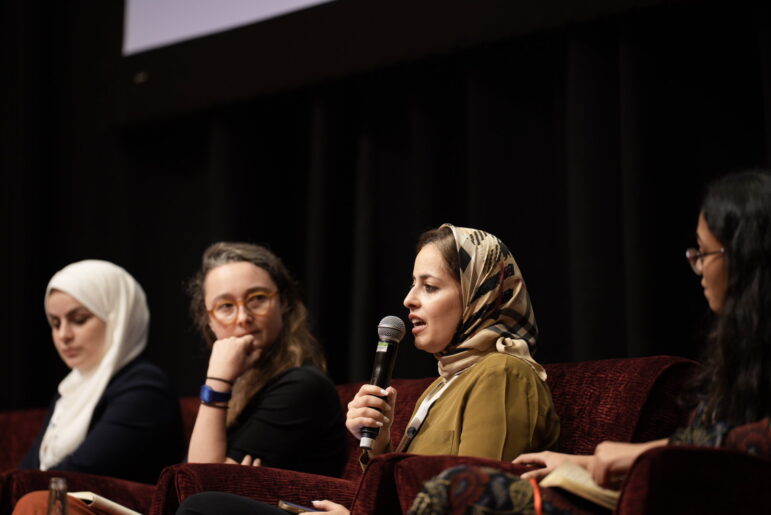
Rawan Damen speaks at ARIJ's 18th Annual Forum in December, 2025. Photograph: Courtesy of ARIJ
‘A Smaller Budget Means You Have Less Time to Work in the Field, Less Time for Everything’: US Foreign Aid Funding Cuts One Year Later
In January last year, US President Donald Trump abruptly froze almost all foreign aid provided by the US Agency for International Development and the State Department, including that earmarked for independent media around the world. He then proceeded to slash more than 80% of USAID programs and to cut some $60 billion in overall development assistance. The move came as a huge shock — and a devastating blow — for many investigative news outlets, particularly in the Global South, which suddenly found themselves grappling with huge holes in their budgets.
GIJN sat down with Rawan Damen, director general of Arab Reporters for Investigative Journalism (ARIJ), a nonprofit organization based in Jordan that focuses on cross-border collaboration and on empowering journalists in the Middle East, to find out how they are coping one year later. Have organizations like hers been able to plug the funding gaps? Have the changes impacted the quality of their work, or their ability to make an impact? And what have sweeping cuts meant for collaborative investigations where reporters from different countries join forces to shed light on complex stories with international ramifications?
Founded in 2005, ARIJ provides training, resources, and collaborative opportunities for reporters across the Arab world, often co-ordinating investigations involving journalists based in different countries in the region, which are then published by multiple news media to maximize their reach. Recent stories it has helped produce include an investigation into a human trafficking ring allegedly set up by a Libyan soldier, an exposé into the crushing of delivery workers’ rights in Egypt, and a report on the harsh living conditions of psychiatric patients in Jordan. It also collaborates with partners beyond the region, for both smaller investigations and wide-ranging ones — such as the Gaza Project on the killings of Palestinian journalists, or the Damascus Dossier on former Syrian dictator Bashar al-Assad’s detention system. On top of that, ARIJ also supports journalists and fact-checkers in the Arab world by providing training, databases, and analysis tools.
The questions and answers have been lightly edited for length and style.
GIJN: What has been the impact of the US cuts on ARIJ’s budget?
Rawan Damen: One year ago, we lost 25% of our annual budget overnight. We worked with the US State Department’s Bureau of Democracy, Human Rights, and Labor. Projects focused, for example, on the environment, fact-checking, diversity, and gender equality. It was the first time ever in our “ecosystem” that contracts that had been signed, with the work already started, were terminated without being honored. For us, it was a big shock, but other organizations, like some Russian and Iranian exile media, lost 100% of their annual budget that day. Nobody was able to help us — or others — because it was a global funding crisis affecting civil society, human rights defenders, and independent media around the whole world. During 2025, there was a “snowball effect” with less funding coming from Europe, too, as more resources were allocated to defense amid the Russian invasion of Ukraine and souring relations between Europe and the US.
GIJN: How did these cuts affect your day-to-day operations?
RD: We managed not to lay people off, but many of our partners and friends had to do that immediately, they had no choice. In our case, because we are a small organization of 30 full-timers and our funding is diversified, we managed to move people from one project to another, although that meant a learning process and adapting to new jobs. But we had, of course, to cut activities and do things in a much cheaper way. This affected our production from a quantitative standpoint, we can’t deny it. Our work typically involves journalists, but also a fact checker, a lawyer, a designer, and a developer, and we had to cut on all levels. The number of investigations we can work on is reduced, but we try our best to preserve quality and do good stories. But when you have a smaller budget, it means that you have less time to work in the field, less time for everything.
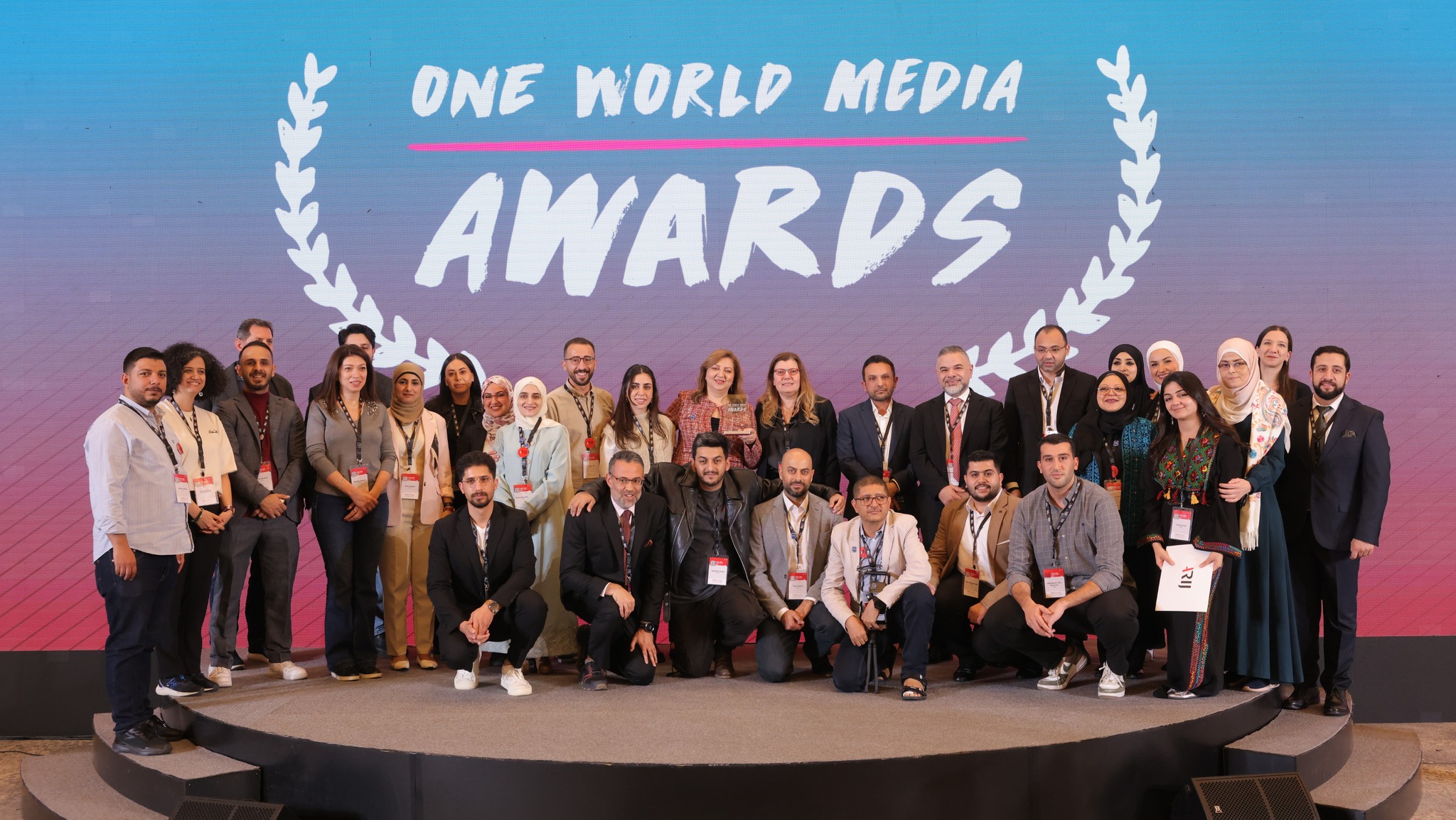
Rawan Damen (center, standing, holding award) with members of the ARIJ team. The organization won the One World Media 2025 Press Freedom Award, which celebrates an independent media organization in the Global South using journalism to spotlight critical social, political, cultural, and economic issues. Image: Courtesy of ARIJ
GIJN: Aside from the impact on resources, what kind of message did these public funding cuts send in a region like yours, with many authoritarian governments keen to curtail the freedom of the press?
RD: The signal this gave to authoritarian regimes is that they can also do whatever they want, [that the US] doesn’t care anymore about what happens in this region. So governments can smash independent media, put their journalists in prison, take down their websites, block foreign grants.
If you go to the Egyptian or the Iraqi foreign minister to talk about an imprisoned journalist, they will look at you, and point out that journalists in Gaza are being targeted and killed in their hundreds by Israeli forces. It has now become very easy to suppress freedom of expression because of what’s happening in the region. Also the way US President Donald Trump himself talks to independent journalists gives the wrong signal to all the regimes in the Global South.
GIJN: Going back to resources, did you manage to find new sources of funding to make up at least in part for the shortfall?
RD: What we ended up doing is receiving smaller grants from more donors. We didn’t use to accept $20,000, $30,000 grants, now we do. They come from a variety of public institutions and private foundations, mainly American and European, and are often for a specific workshop or investigation. We never got back to where we were, but it allowed us to survive, to continue. However this means a lot more admin work to keep the editorial side going, work that could have gone into the creative process.
GIJN: What is your strategy going forward? I am asking you this also in your capacity as chair of the Global Forum for Media Development, a community of organizations committed to fostering strong, independent, and pluralistic media environments around the world.
RD: Since last year there have been very few new donors coming to our “ecosystem” that were not yet involved in supporting the media, and that’s something we are aiming to change at the Global Forum for Media Development in the next few years. To take institutional players and private foundations that, for example, are active in fields like climate change, gender inequalities, public health, or humanitarian aid, but are not involved in supporting the media, and make them understand how much information disorder disrupts their work and how much well-informed citizens help their work.
GIJN: What does this increasingly challenging environment, in which resources have dried up, mean for the cross-national collaborative journalism model that’s at the core of ARIJ’s mission? Is this the beginning of the end, or quite the opposite?
RD: I think everybody feels we need more collaboration, which has become a must with the shortage of funding in the current political climate. Even big US media such as The Washington Post or The New York Times, which thought they could function alone and do their own scoops, are slowly coming around to it, also because you can’t get access everywhere. Even if you are a New York Times reporter, you are not allowed into Gaza, it’s very difficult to work inside Syria, you cannot reach South Lebanon. You need to collaborate.
This year is the 10th anniversary of the global cross-border investigation, on the Panama Papers. Ten years is a very short time for the whole experiment. The COVID-19 pandemic was a milestone, because nobody was allowed to move or travel, so they had to join forces. Now, thanks to technology, people get to meet and trust each other more. Five years ago, if you had asked Forbidden Stories [the French investigative outlet that coordinated the Gaza project] about ARIJ, they wouldn’t have known us. Now they know us very well. Also, AI tools make translations easier, helping to take language barriers down. The golden time of cross-border collaboration wasn’t 2016-2026, it will be the next 10 years.
 Michele Barbero is an Italian journalist based in Paris. After several years at France 24, he currently works for French news agency AFP. His byline has also appeared in a variety of publications, including Foreign Policy, Jacobin, and Wired UK

Introduction to Investigative Journalism

Investigating the Flow of Arms and Military Aid from the US and UK to Israel
Gathering Evidence and Documents in Conflict and War Zones — A MENA Case Study

The USAID Crisis and Funding the Future of Independent Media
‘No Cavalry Is Coming’: How Investigative Journalism Must Rethink Money, Metrics and Survival
Documenting Gaza: How Journalists Can Collect Evidence Even When Denied Access

Investigative Journalism in MENA: Struggling Against Tyranny, Fighting to Survive

This work is licensed under a Creative Commons Attribution-NoDerivatives 4.0 International License
Republish our articles for free, online or in print, under a Creative Commons license.
Republish this article
This work is licensed under a Creative Commons Attribution-NoDerivatives 4.0 International License
Read Next
News & Analysis Sustainability
The USAID Crisis and Funding the Future of Independent Media
Across the investigative journalism community, GIJN has heard uniform voices of solidarity, and numerous creative strategies for surviving this fundraising crisis.
GIJC25 Sustainability
‘No Cavalry Is Coming’: How Investigative Journalism Must Rethink Money, Metrics and Survival
This GIJC25 panel discussion surfaced a set of unresolved questions about what investigative journalism can sustainably support — and what it may need to leave behind.
GIJC25 News & Analysis
Documenting Gaza: How Journalists Can Collect Evidence Even When Denied Access
Journalists have used local reporting, open source analysis, and forensic reconstruction to verify events happening on the ground in Gaza, allowing them to challenge official narratives and preserve evidence for future accountability.
MENA Focus Week News & Analysis
Investigative Journalism in MENA: Struggling Against Tyranny, Fighting to Survive
Investigative journalists across the region talk about their biggest challenges — from repressive laws and surveillance to funding cuts.