

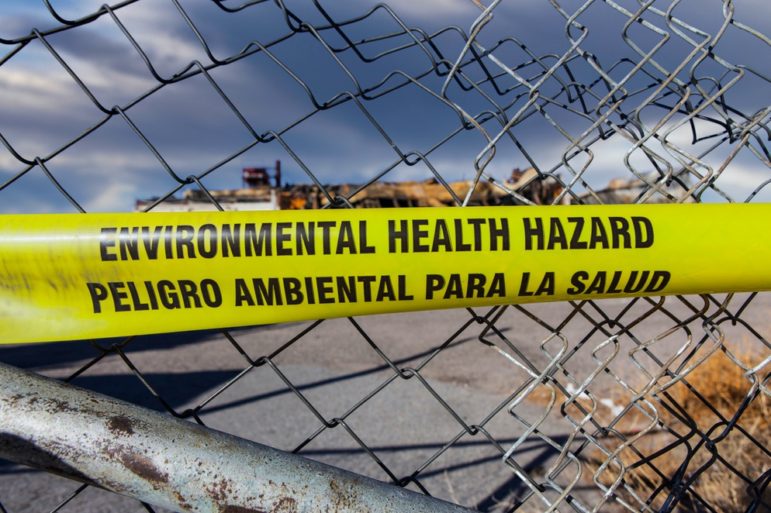
An oil refinery and storage facility in Texas City, Texas. Image: Shutterstock
EPA Facilities Database — Gateway to Environmental Investigative Reporting
There’s a database that’s a key to much of the other data from the US Environmental Protection Agency. And environmental journalists who want to fortify their investigative skills will do well to learn how to use it.
It’s the Facility Registry Service. Think of it as a master index to potential polluters. Start accessing it here.
The EPA has lots of databases: water permits, air permits, Superfund sites, drinking water, toxic chemicals, etc. We are grateful. But we sometimes struggle to use them.
What the FRS does is give a unique number to every “facility” in the whole universe of databases, whether it’s a petrochemical refinery, sewage plant, steel mill, or widget factory. It helps sort them out.
And because the data comes from the EPA or from the EPA’s other databases, Toolbox thinks it will usually be of high quality. Years of real-world disillusionment, however, have taught us to check anyway.
How to Use the Data Smartly
One of the first things you will want to do before diving into the FRS system is to learn about industrial categories. You will probably use these categories to search the FRS.
There are two systems for identifying industrial categories. The older one is the “Standard Industrial Classification” or SIC system (see it here).
The newer one subsumes the SIC system, and is called the “North American Industry Classification System” or NAICS (see it here). You need a number to search a particular industry.
The NAICS site explains all the how-to and what-is questions pretty well. It also allows searches using SIC codes.
One key thing to understand is that the numbers are hierarchical — a system of categories within categories. So underneath “organic chemical manufacturing,” you might find “pesticide chemical manufacturing.”
If you stay aware of this feature and use it, it will help narrow down your searches more quickly.
An even cooler feature of the FRS — indeed an essential one — is that it allows you to find all the facilities owned or operated by a particular company or corporate family, even when they are geographically scattered across the United States.
The Novartis pesticide manufacturing company, for example, has some 184 different sites all over the country. Now you can use other databases (like the EPA’s ECHO) to total up all the violations for the entire company.
So if you wanted to see whether certain oil companies were hit by fewer enforcement actions during the Trump 2.0 administration, for instance, you could construct a set of queries to give you an answer. Just as an example.
The FRS is good for lots of other things, too, some simple, some not. Maybe you just want to know all the facilities in your ZIP code regulated in any way by the EPA. You would get a list including all kinds of drugstores, gas stations and dry cleaners.
One small bit of advice is to relentlessly check what you think you know. Did that tiny drugstore close last year? Is the dry cleaner still using harmful chemicals?
So eyes-on and in-person reporting is a key to the good data journalism you can launch from FRS.
Editor’s Note: This story was originally published on SEJournal’s Reporter’s Toolbox. For more on reporting with EPA databases, check out our recent reporting on the agency’s brownfields data and its safe drinking water information system, as well as an agency grants dataset.
 Joseph A. Davis is a freelance writer/editor in Washington, DC who has been writing about the environment since 1976. He writes SEJournal Online’s TipSheet, Reporter’s Toolbox, and Issue Backgrounder, and curates SEJ’s weekday news headlines service EJToday and @EJTodayNews. Davis also directs SEJ’s Freedom of Information Project and writes the WatchDog opinion column.

Introduction to Investigative Journalism: Data Journalism

GIJC23 – The Future of Data Journalism: New Analytical Tools, Data Visualization, and AI
Investigating Environmental Crimes and Climate Change

Resources on Environmental Data

There Has Never Been a Better Time for Environmental Journalism

NASA’s Worldview Site Expands Data and Environmental Reporter’s Toolbox

Using Data Sources to Track Harmful Climate Crisis-Fueled Algal Blooms

Spill-Tracking Data Sources to Help Cover Hazmat Events and Environmental Disasters

This work is licensed under a Creative Commons Attribution-NoDerivatives 4.0 International License
Republish our articles for free, online or in print, under a Creative Commons license.
Republish this article
This work is licensed under a Creative Commons Attribution-NoDerivatives 4.0 International License
Read Next
News & Analysis
There Has Never Been a Better Time for Environmental Journalism
The press in the US faces daunting challenges with the return of President Donald Trump, but holding his administration accountable makes environmental journalism that much more vital.
Data Journalism Reporting Tools & Tips
NASA’s Worldview Site Expands Data and Environmental Reporter’s Toolbox
NASA’s Worldview database is a valuable tool that journalists can use to find data and free graphics on a range of topics, like wildfires, floods, deforestation, and many more.
Data Journalism Reporting Tools & Tips
Using Data Sources to Track Harmful Climate Crisis-Fueled Algal Blooms
For the SEJ’s Reporter’s Toolbox: datasets and sources useful for tracking the harmful impact of climate change-fueled algal blooms.
Data Journalism Reporting Tools & Tips
Spill-Tracking Data Sources to Help Cover Hazmat Events and Environmental Disasters
Environmental journalists should check out the new database tool Spill Tracker, but should also bookmark these other resources for reporting on hazmat events.