
Image: Better Images of AI, Pauline Wee & DAIR, Creative Commons
The Rise of AI-Generated ‘News’ and Fake Journalists: What Does It Mean for the Present and Future of Accountability Reporting?
Earlier this fall, the digital news site Futurism published a multi-part investigation into a company run by three Australian brothers that had acquired dozens of legitimate news publications. The company published thousands of ostensible news articles under more than 50 author personas, but Futurism’s reporting discovered that many of them had fabricated professional credentials and other stories contained contradictions consistent with unedited AI generation. After Futurism contacted the company for comment, it deleted dozens of fake author profiles and articles, later admitting the bylines “did not identify real people” and contained fabricated credentials. Nonetheless, the company doubled down even after this embarrassing revelation, continuing to publish AI-generated stories under generic “editorial team” bylines or real people’s names at a volume and speed inconsistent with genuine authorship.
Origins of AI-Generated Journalism
There are numerous other similar examples of news outlets a) intentionally relying on fake, AI-generated journalism, b) being complicit in its spread through poor editorial oversight, or c) finding themselves fooled by clever-packaged fake writers and/or sources. Taken together, this alarming spread of AI-fabricated news content has many of the earmarks of an epidemic, one that threatens to undermine society’s trust in the profession as well as inoculate it against actionable revelations published by actual investigative journalists.
So, how did we get here?
Timothy Koskie, a postdoctoral research associate for the Mediated Trust project at the University of Sydney, suggests that as journalism began to use AI as a productivity-increasing reporting tool, other bad actors saw it as a way to mass-produce fake content for commercial or geopolitical purposes, but under the banner of objective journalism.
“Automated journalism, a form of computational journalism, was being adopted by newsrooms by the early 2010s to generate news stories from structured data using algorithms and natural language generation,” he explains. “Generative AI is expanding what is possible, allowing machines to handle less structured information and produce increasingly sophisticated forms of media.”
British technology journalist Rob Waugh says his interest and developed expertise in this phenomenon stemmed from his initial experience as a copywriter. “I had previously seen examples of AI ‘fake people’ in a copywriting job for a marketing agency, so I was on alert,” says Waugh, who is now an investigative journalist for the UK’s Press Gazette.
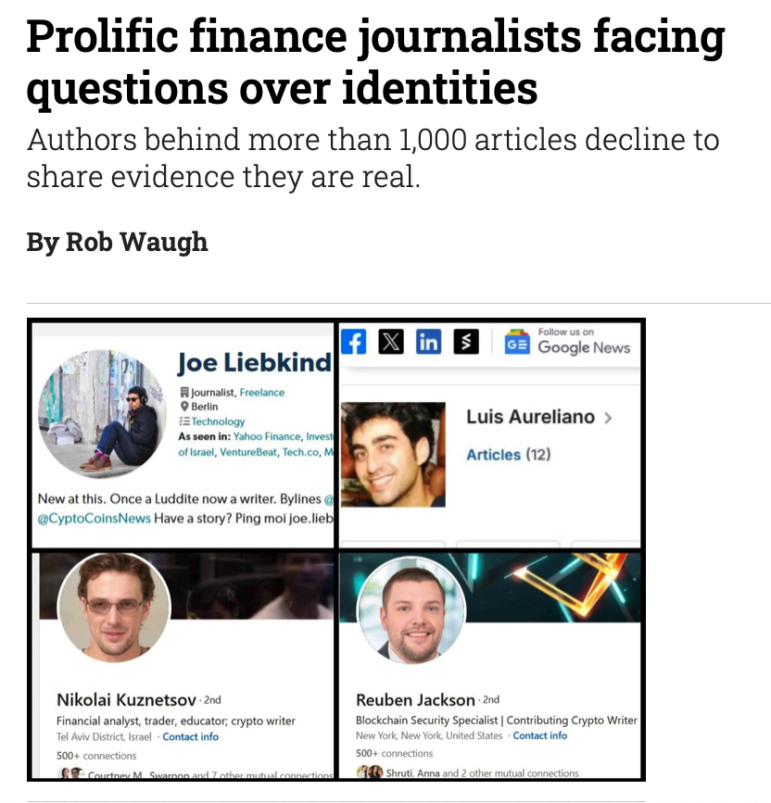
Rob Waugh’s investigation uncovered numerous nonexistent, AI-generated journalists with more than 1,000 articles published under their fake bylines. Image: Screenshot, Press Gazette
In his article on how artificial intelligence was used to fabricate financial experts across publications in the United Kingdom, Waugh identified more than 1,000 articles written by sketchy and unconfirmed identities. His subsequent investigations identified an SEO-driven firm that bought and now operates three sports news websites, which host AI-generated phony journalists whose reports are strewn with errors and fabrications. (The company in question did not respond to Waugh’s requests for comment.)
Detecting these AI-generated journalists comes down to contextual clues, he explains. Some of the warning signs include a complete absence of the person online outside of self-serving media appearances. He says he would usually contact them and try to get them on a call, or, if he suspected they were fake, challenge them to provide identification and evidence of their qualifications. “Most of these fake people were pretty amateurish,” Waugh says. “The key unifying thing was no way to book people for the services they supposedly provide.”
Impact on Information Ecosystem and Journalism
After working as a journalist and foreign correspondent for the BBC for 30 years, Karen Allen started researching the unintended consequences of new technology on human security. “It became clear that some technologies were being used to pollute the information environment, whether through deepfakes or disinformation campaigns,” she explains.
Last year, she co-authored a report for the Konrad Adenauer Foundation on how artificial intelligence was used to impersonate professional journalists across Africa. Her reporting uncovered the practice of so-called ghost journalism, where AI impersonators assume the identities of retired or dead reporters. In one example from her study, an Al Jazeera investigation found that these “ghost reporters” were being used to write pro-Russian propaganda in Western and Central Africa. Allen’s work also highlighted a Forbidden Stories collaboration that conducted an undercover exposé on an Israeli cybersecurity company that had created a fake persona, a French-Ghanaian investigative journalist, who was being used to insert disinformation material into mass African media. The goal was to smear local politicians and reach international audiences.
“The credibility of journalists is being leveraged by people with malicious intent to push their own narratives,” Allen cautions. “Often, these are false narratives, and are dispersed by personalities often indistinguishable from those of real journalists.”
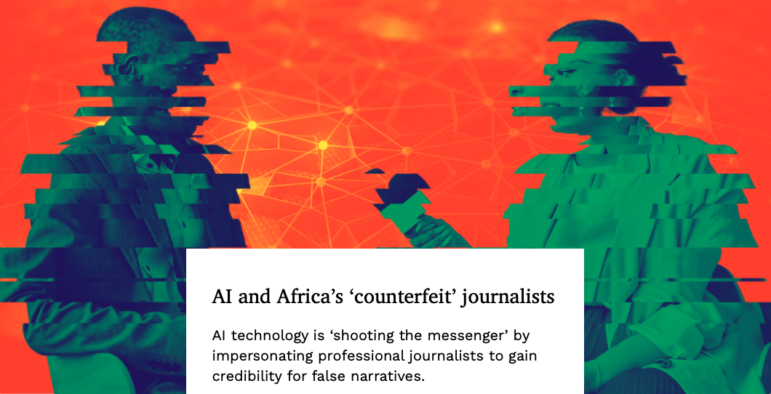
Former BBC correspondent Karen Allen examined the phenomenon of AI-powered fake journalism pushing disinformation across Africa. Image: Screenshot, Institute for Security Studies
The insidious cost of these fake journalists is an erosion of traditional professional media and an undermining of public trust. The existence of these fake journalists has made audiences more skeptical of legitimate reporting, and whistleblowers and other confidential sources more wary of engaging with reporters, giving politicians and other powerful individuals with harmful intentions a way to discredit legitimate reporting by dismissing inconvenient stories as fabricated.
As Allen explains in her white paper: “While the technology behind AI avatar creation is designed mainly for training and marketing, malign actors use it to undermine public trust.”
Allen says discovering that a supposedly real journalist is actually an AI avatar raises serious concerns about the authenticity of the reporting audiences consume. The deception is particularly troubling, blurring the distinction between genuine journalism and manufactured news. She adds: “They’re not even presented as bots; they are presented as real live individuals. And I think that that is where the deception comes in.”
Who’s Behind the Rise of AI-Generated Journalists?
There are numerous motivations fueling the proliferation of artificial journalists generated by AI. These aims may be economic, focused on gaining access to resources, or intended to influence political outcomes.
“The problem is that AI has reduced the amount of effort required to fake expertise, fake journalists, and fake entire publications to zero,” Waugh says, pointing to a number of profit-driven reasons for their deployment and the significant money at stake. “Some operators are earning tens of millions from AI fake people, and that’s not going to change quickly.”
Likewise, this same co-opting of journalism’s role in informing the public can be used by bad actors to achieve a partisan result or shift public perception.
“The person or entity that benefits is someone who is able to either get public opinion to look the other way when they are doing something or achieve longer-term shifts in the way we view society,” Allen says. “It creates a vehicle through which you can create seeds of doubt and question the status quo. I am in favor of open debate, but the covert and deceptive nature of this is chilling.”
University of Sydney academic researcher Koskie adds: “We also know that there are political actors who will hire groups to engage with information campaigns in various contexts, which usually has money behind it as well.”
The continued advent of these fake journalists is also posing new threats to press integrity and credibility, because AI systems can produce content that closely resembles human-written journalism. In response, it’s important for real journalists to re-establish themselves as trusted gatekeepers of information and public accountability.
By creating an equivalence between professional journalists and fabricated AI models at a time when journalism is already massively under threat, it muddies the landscape even further, Allen warns.
How Can the Press Fight Back Against AI Impersonation?
On a strategic level, Koskie recommends more face-to-face interaction between the public and journalists to repair this eroding trust and deflate AI’s remote approach to news. “If news organizations create more opportunities for journalists to engage with the public in person, such as through community forums, public discussions and local events, they may be better placed to build trust,” he says. “AI can’t intervene in this space.” One possible model for includes Andrea Wenzel’s book Community-Centered Journalism: Engaging People, Exploring Solutions, and Building Trust, where she advocates for stronger ties and interaction between journalists and the people they serve, bonds that can’t be replicated by digitally-generated fake personas.
Because accountability journalism has a crucial role to play around the world, Allen believes it must continue doing what it does best: systematically uncovering accurate and well-researched news. “We also need more investigative journalism funding,” she says. “We need to be able to fund investigations that surface exactly these kinds of antics.” Media organizations also need to market themselves globally on trust. “I saw a slogan recently: ‘We don’t just gather the facts. We check the facts, and we question the facts,’” Allen says. “That’s exactly it. News organizations need to go the extra mile to show that they offer something different.”
Waugh believes that direct engagement with people in the industry has never been more important. “I hope that journalists can overcome a historical reluctance to examine the media industry itself to expose this sort of fakery wherever it appears; it does no favors to anyone.”, he says. “Raising awareness and building a newsroom culture where everything is questioned is very important.”
Born out of their investigations into artificial intelligence and its journalism misgivings, Press Gazette recently partnered with enterprise technology company Flip-Pay to launch a pre-publication newsroom verification platform called Made by Humans. This application will integrate directly into a publisher’s Content Management System (CMS) to scan text, images, video, and audio before they are published. By using detection technologies like Pangram Labs and identifAI Labs, it flags synthetic data and classifies submissions into three tiers: AI Generated, AI Assisted, or Human Made.
Similarly, following the numerous reported instances of fake expert exposure, the Chartered Institute of Public Relations (CIPR) and the Public Relations and Communications Association (PRCA) teamed up to campaign against synthetic PR pitches. They’ve insisted on a stricter push for newsrooms to cross-reference and verify source identities via searchable, certified member registers. They ask journalists to verify PR sources via the CIPR register and PRCA directory, publicly searchable registers which list their members.
But the onus and responsibility can’t be entirely on the media industry. “I hate the word ‘multi-stakeholder,’ but it feels quite apt in this setting; our society has to make a decision about whether it values fact-based journalism, and what it is prepared to do to support that,” Allen adds. “Platforms need to be held accountable for allowing content to be published without adequate checks, safeguards and oversight, and companies developing AI avatars should also be transparent about how they are created and used.”
Waugh says he has seen a welcome shift towards publishers accepting they have a role to play and tightening their rules around issues such as fake sources. Yahoo News, for example, now insists on every source being verified with links to show they are who they say they are, with reporters required to verify how they spoke to them.
Consumers also have a role to play by being more critical of the news they consume, questioning where information comes from, verifying claims, and consulting multiple sources rather than accepting everything at face value. As Allen puts it, “You don’t rely on one source for your information; you double-source it. These basic tenets would help to unearth this.” There is a societal responsibility here when it comes to information integrity.
Despite the uncertainty surrounding the future of journalism and the threat from a legion of AI-generated fabulism, Waugh remains hopeful about the long-term prospects of real, original reporting by actual, living, breathing journalists. “I think we are heading into a truly tumultuous time of change due to the impact of factors like Google’s AI Overviews on traffic,” he says. “Business models will have to change, but I remain hopeful that real, human-led reporting will be even more valuable in an AI-driven future.”
 Edikan Umoh is a writer based in Nigeria who uses her insight for storytelling to create pieces that help us form practical ideas about better ways to live. She tells stories about media, communities, the creator economy, e-commerce, and internet culture with simple and engaging language. Her editorial experience includes writing essays, articles, and other texts that tell the stories of a particular audience. She aims to positively resonate with different groups of people with her work.

Reporter’s Guide to Detecting AI-Generated Content

AI Accountability Reporting Guide

Investigating Disinformation in the Age of AI
Guide to Investigating Social Media Algorithms

Chaos and Credibility: A Snapshot of How AI Is Impacting Press Freedom and Investigative Journalism

New York Times’s Malachy Browne on the Future of Visual Investigations in the Age of AI

Building Trust and Authenticity in Visual Journalism in the Age of Deepfakes
‘We Should Not be Avoiding the Big Stories of Our Time’: Leading Brazilian Watchdog on the Need to Investigate Big Tech and Autocracy

This work is licensed under a Creative Commons Attribution-NoDerivatives 4.0 International License
Republish our articles for free, online or in print, under a Creative Commons license.
Republish this article
This work is licensed under a Creative Commons Attribution-NoDerivatives 4.0 International License
Read Next
News & Analysis Press Freedom
Chaos and Credibility: A Snapshot of How AI Is Impacting Press Freedom and Investigative Journalism
GIJN offers a snapshot of how watchdog reporters are confronting algorithmic abuses and misinformation while also employing AI as a key newsroom tool.
Methodology
New York Times’s Malachy Browne on the Future of Visual Investigations in the Age of AI
What began as the niche practice of verifying shaky mobile phone footage in an era of social media chaos has since become one of the most consequential developments in modern journalism.
Investigative Techniques News & Analysis
Building Trust and Authenticity in Visual Journalism in the Age of Deepfakes
Photo editors and AI experts discuss the dangers of generative AI and other synthetic media to visual journalism — and what news organizations can do to reduce them.
GIJC25
‘We Should Not be Avoiding the Big Stories of Our Time’: Leading Brazilian Watchdog on the Need to Investigate Big Tech and Autocracy
Natalia Viana, co-founder and executive director of Agência Pública, Latin America’s largest nonprofit newsroom, has investigated human rights and the spread of online disinformation.