
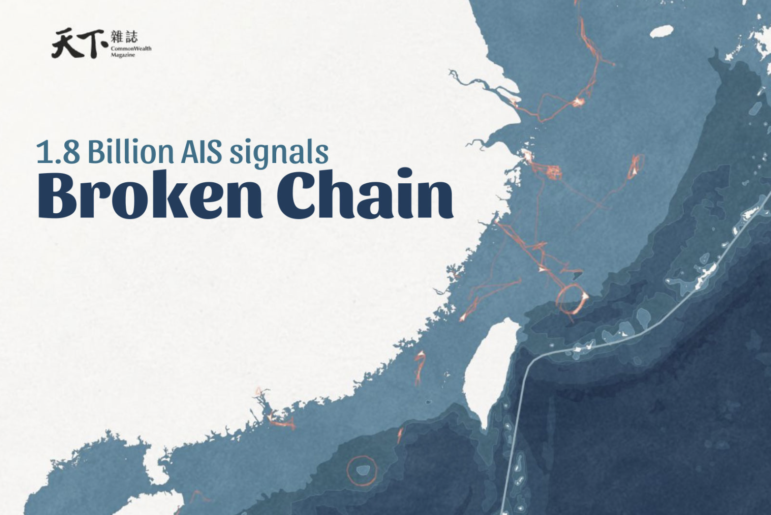
Image: Screenshot, Taiwan CommonWealth magazine
Taiwan’s CommonWealth Magazine Doubles Down on Data-Driven Investigative Journalism
Open Source Guide to Investigating Chinese Companies

GIJC23 – The Future of Data Journalism: New Analytical Tools, Data Visualization, and AI

How Many Journalists Does It Take to Fill an Olympic Swimming Pool? GIJN’s Guide to Size and Number Comparisons
Investigative Journalism Week 2026 Resources
Despite the challenges and costs of investigative journalism, pursuing it is paramount for news publishers: “The externality is much bigger than its cost,” Taiwan CommonWealth Magazine Editor-in-Chief Yi-Shan Chen told participants at WAN-IFRA’s Asian Media Leaders Summit recently in Singapore.
Chen cited Reuters Institute research ranking original investigations and on-the-ground reporting as top priorities for news executives in the AI era.
“The reality is very simple,” Chen noted. “AI and video have already completely changed how people consume news.”
Breakthrough investigative reports, she argued, “send a powerful wake-up call to both society and our subscribers. They remind people the media are here and that we create value that AI can never replace.”
No Investigative Unit, But an Investigative Culture
Chen’s first takeaway was counterintuitive: CommonWealth’s most popular investigations did not come from a dedicated investigative unit.
“Every single beat has the potential for deep investigative work,” she pointed out. The key is “an open editorial culture where all journalists can pitch early leads [and] hold honest discussions.”
Once committed, the newsroom backs the work with proper, not excessive, resources, ensuring that “when we bet our resources, we deliver something significant.”
Reading China Through Unconventional Data

Yi-Shan Chen, editor-in-chief of Taiwan CommonWealth magazine. Image: Screenshot, LinkedIn
As examples, Chen showed two projects built on “unconventional data from China.”
First, CommonWealth worked with scholars from Taiwan’s Academia Sinica, using AI to analyze more than 10 years of CCTV footage of Xi Jinping’s face, speech, and gait. The finding: Xi looked noticeably thinner at the 2025 military parade, but his health was “actually quite stable for his age.”
The second project was personal. “I come from the most dangerous place on earth,” Chen noted. “It’s related to our life.” It began in 2020, when a CommonWealth reporter on holiday in Tainan kept hearing fighter jets scrambling overhead and asked herself: Are we going to have a war?
The available data was terrible, Chen said: two static PDF images a day from Taiwan’s Ministry of National Defense. A team of just three logged every flight path and aircraft type by hand, for a full year.
What emerged was striking. The sorties were not aimed at Taiwan at all.
Coordinated with the Chinese Navy, they pushed southwest towards the South China Sea, a sign, Chen explained, that Beijing’s real goal was to break through the “first island chain” from Japan through Taiwan to the Philippines.
“It’s not only a Taiwan story,” she concluded. “It’s actually an Asia story.”
From Three Reporters to a Live Dashboard
In 2023, AI took over the mapping and data entry. By 2025, the project had become a fully automatic dashboard tracking Chinese military activity every day, later expanded with Japanese and Philippine data.
Then Beijing’s playbook shifted to “gray zone” warfare.
The team began tracing China Coast Guard ships day by day, using AI to scale up to more than 1.8 billion lines of ship-tracking data. Cross-matched with data from US think tank CSIS, Japan and the Philippines, the conclusion was stark: these operations target not only Taiwan, but Japan and the Philippines too.
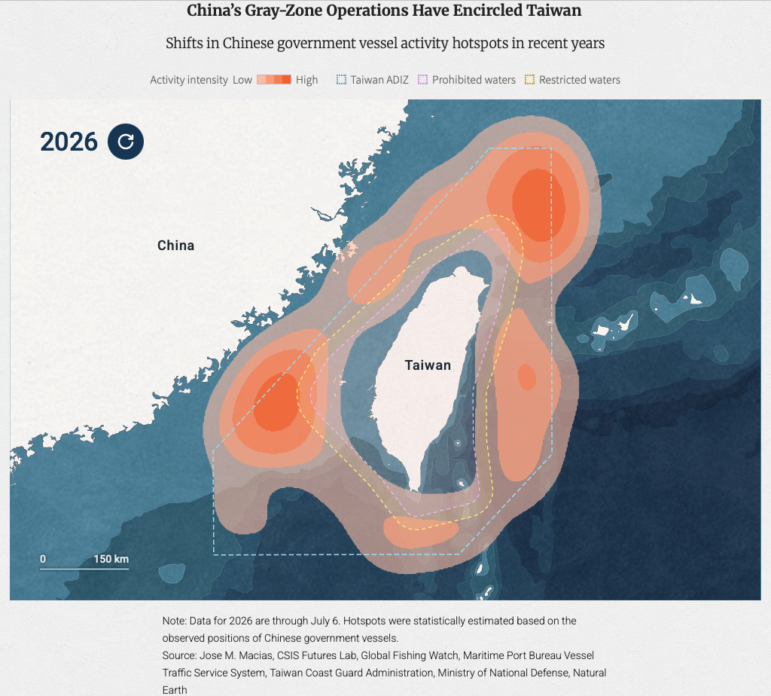
Image: Screenshot, Taiwan CommonWealth magazine
Long-term projects, Chen observed, “give us historical depth” and keep the newsroom from “very sensational panic reporting.”
“With AI, we can process data at a scale we never could before. But the true secret sauce, I will not say it’s AI. I will say it’s still the editorial vision and the research methodology,” Chen added.
Asking the Right Questions and Staying Curious
During a panel discussion, Chen said that the hardest part is not the tools but “asking the right questions and keeping curiosity to discover the right topics.”
She also urged newsrooms to look beyond their walls, as data companies, white-hat hackers and NGOs are often willing to help. “We just need to spend some time to look around,” she added.
Her advice for smaller newsrooms: since covering every topic is rarely possible, choose one or two fields worth investing in and find the right people for them.
Editor’s Note: This story was originally published by WAN-IFRA and is reposted here with permission.
 Maria Lisicka is a young professional in PR and strategic communication, currently pursuing her studies at the University of Amsterdam and Nanyang Technological University, Singapore.
Open Source Guide to Investigating Chinese Companies
GIJC23 – The Future of Data Journalism: New Analytical Tools, Data Visualization, and AI
How Many Journalists Does It Take to Fill an Olympic Swimming Pool? GIJN’s Guide to Size and Number Comparisons
Investigative Journalism Week 2026 Resources

Veteran Reporter Li Sipan on Censorship, the Great Firewall, and China’s Independent Media Landscape

Advice from a Pioneer of Investigative Journalism in the Chinese-Speaking World

Data Journalism in Asia: Rethinking the Relationships Between Newsrooms, Communities, and Evidence

Strategies for Covering Asia in a Shrinking Civic Space for Independence and Accountability

This work is licensed under a Creative Commons Attribution-NoDerivatives 4.0 International License
Republish our articles for free, online or in print, under a Creative Commons license.
Republish this article
This work is licensed under a Creative Commons Attribution-NoDerivatives 4.0 International License
Read Next
News & Analysis
Veteran Reporter Li Sipan on Censorship, the Great Firewall, and China’s Independent Media Landscape
The investigative reporter was writing about sexual harassment years before #MeToo. We get her take on the recent metamorphoses in the country’s information ecosystem.
10 Questions Asia Focus
Advice from a Pioneer of Investigative Journalism in the Chinese-Speaking World
The award-winning reporter and deputy CEO of Taiwan’s The Reporter says public support is the “vital force” that ensures investigative journalism continues to exist.
Asia Focus
Data Journalism in Asia: Rethinking the Relationships Between Newsrooms, Communities, and Evidence
Data storytelling newsrooms have found innovative approaches to navigate closed data regimes, political pressures, and resource gaps.
GIJC25
Strategies for Covering Asia in a Shrinking Civic Space for Independence and Accountability
An All-Asian GIJC25 keynote panel discussed how the continent’s reporters have bravely exposed corruption scandals while facing exile, harassment, attacks, and threats of imprisonment.