
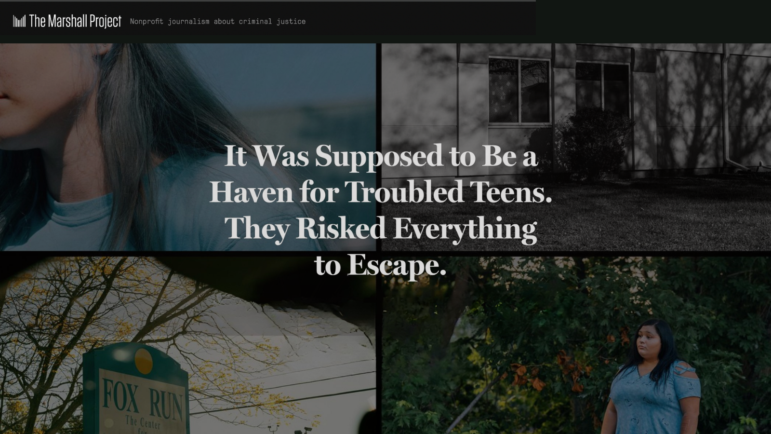
The Marshall Project worked with survivors of the "trouble teen industry" to obtain private records and hold the facilities accountable for allegedly abusive and violent treatment. Image: Screenshot, The Marshall Project
How Survivors Helped The Marshall Project Investigate Youth Residential Treatment Centers
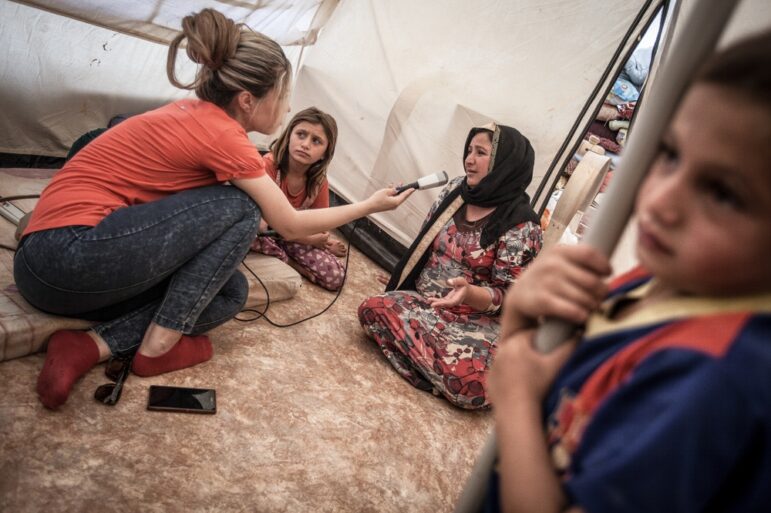

Nearly three years ago, I first made contact with a young woman who had spent time in a residential treatment center as a teenager. I had posted a callout on Reddit asking young people to share their experiences, and she sent me a direct message.
When I got her on the phone, I was astounded by what I heard. She had driven across Ohio, back to the place where she was restrained so violently she was unable to walk and lost control of her bladder to obtain the facility records to prove what had happened to her. She said she knew of so many other girls who had endured the same thing. How could young people be locked away, restrained, and hurt by adults, and so few people seem to know what was happening?
Residential treatment for “troubled teens” is a controversial US industry, but with no comprehensive federal regulation, the level of scrutiny varies from state to state. Children enter locked facilities that aim to address mental health and behavioral challenges through various forms of treatment. Some are placed there through the foster care system because their needs have become too complex for foster parents to manage. Others are sent by juvenile court judges as an alternative to youth prison or jail. Some parents make the decision themselves, desperately seeking help for a child who is struggling with self-harm or violence. Many children in these facilities have intellectual or developmental disabilities.
The private companies that operate these centers receive contracts from counties. Some are backed by private equity firms. And because the facilities are privately owned, many of their records are not subject to public records laws.
The young woman I met on Reddit shared my phone number with other survivors. That same afternoon, I answered call after call from young people who had been taken from their families and placed in locked facilities where they said they had experienced violence.
Over the next two years, the young women I met taught me how the residential treatment system worked. They recommended facilities to investigate. They taught me the language of the centers, from “restraint” and “incident report” to “booty juice,” their term for injectable sedatives. They told me that police officers frequently showed up after riots, medical emergencies, and when children ran away.
I began filing public records requests for police reports, 911 calls, and state oversight records based on what they shared with me. What I learned from these survivors inspired me to create a toolkit to empower other survivors to track down their records as well.
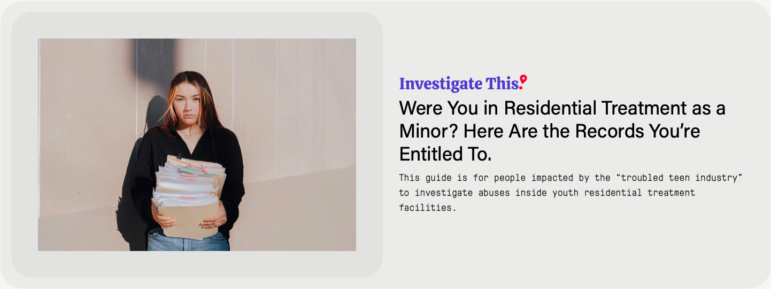
The Marshall Project “troubled teen industry” reporting toolkit seeks to partner with survivors who can access their own private medical records from the facilities where they were previously housed. Image: Screenshot, The Marshall Project
Two women I interviewed had separately described an escape into a snowstorm in a desperate attempt to flee the abuse they were enduring inside a facility in Ohio. They alleged that one of them got frostbite and that they trekked through knee-deep snow and ran barefoot over a highway. Everything they told me was true. We found the police report that verified the details of the escape. Body cam footage showed how the sprinklers of the facility were triggered to unlock the doors, and I could watch as police officers tracked their footprints down the hill in knee-deep snow.
In a statement responding to The Marshall Project’s reporting, the CEO of that Ohio facility, Fox Run, said it “serves children with ‘complex behavioral health needs’ and that incidents involving aggression, self-harm, suicide, and attempts to leave the facility are ‘unfortunately not uncommon among this high-acuity population.’” He added that it “cooperates with state regulators and other oversight agencies, investigates concerns, and implements corrective actions whenever warranted.”
Obtaining those law enforcement records opened a door into a world of violence inside Ohio facilities that had gone largely unreported. My colleague Ilica Mahajan and I discovered allegations of physical and sexual abuse, children rushed to hospitals in ambulances, and caseworkers and parents calling 911 with concerns about the safety of children in these facilities.

Mapping out the multi-part investigation of Ohio’s “troubled teen industry.” Photo: Jovelle Tomayo
As our reporting progressed, the young women began asking how they could get their own records. What kind of email should they send? Who should receive it? If someone denied their request, what should they say next?
I encouraged them to ask facilities to identify the company policy or state law that justified denying access to their personal health information. I suggested they keep following up with the same person every two or three days for several weeks.
Together, we worked to obtain information from government agencies and private facilities that is often hidden from public view.
As our investigation developed, my colleague Michelle Billiman and I talked about the persistence of these young women and the research they were doing themselves. One survivor obtained surveillance footage showing the restraints she had endured inside a facility. Another finally received records documenting her restraints in a stack nearly two feet tall.
We started asking ourselves: What if we developed a toolkit specifically for survivors?
Michelle and I began thinking through the different records a facility might generate when something goes wrong. If someone calls 911 because of a riot, for example, there may be a dispatch recording, a police report, and body camera footage. The young people involved in those incidents may have a right to obtain records about themselves, even when the facilities are reluctant to share information.
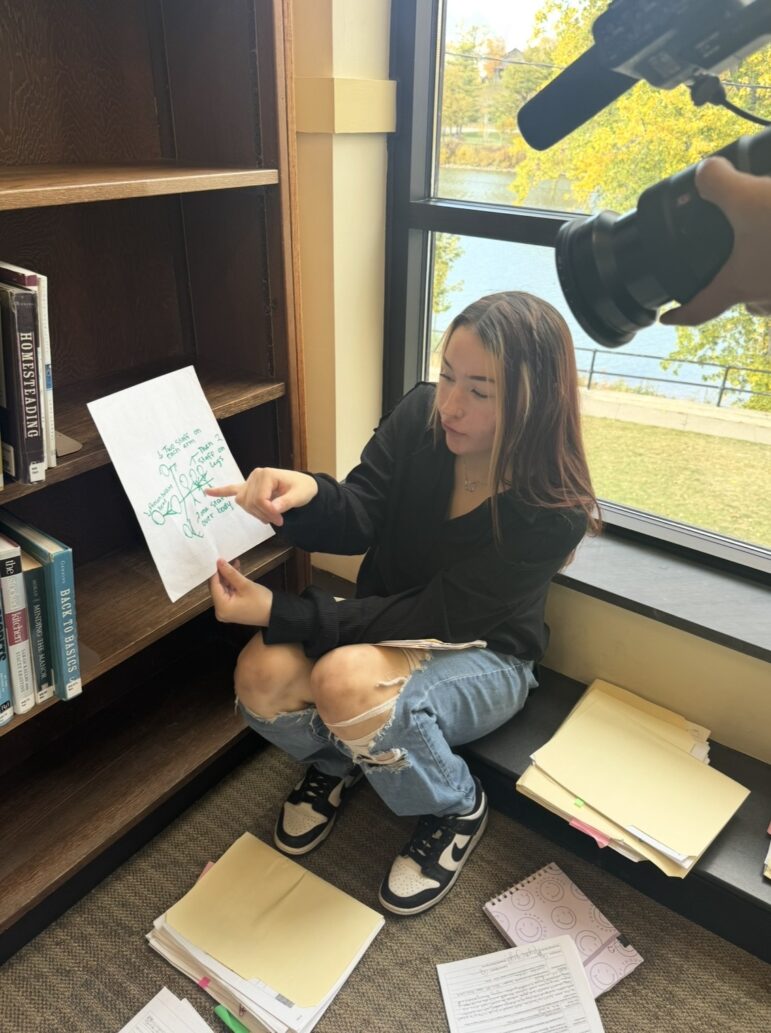
Survivor Jaycee Seele is a survivor of a TTI facility and personally obtained her private medical records to document her treatment. Here, she explains a diagram showing how the facility staff would physically restrain and control her. Photo: Brittany Hailer
We also outlined the state records that should be accessible to survivors and their parents. State oversight agencies are responsible for inspecting facilities and making sure they are safe for children. In some states, facilities must also report critical incidents and emergencies to their oversight agencies. In Ohio, we collected data on these reports and found that emergency incidents documented by police were missing from the state’s self-reported data.
We wanted the toolkit to make this knowledge accessible to survivors and their families, while showing that investigative journalism does not happen in a vacuum. People directly affected by a system can teach journalists about worlds we might otherwise never understand. They know the language, the rules, and the mechanics of the institutions that have shaped their lives.
Their knowledge helped us identify where to look, which records to request, and what questions to ask. In turn, our reporting helped us understand how to navigate the records systems that survivors were trying to access themselves.
This toolkit grew out of that exchange. We hope it gives survivors and their families practical ways to seek answers about what happened to them, and helps them understand what public records can reveal about the facilities entrusted with children’s care.
If you are a survivor of residential treatment but are not emotionally ready to read your records, advocates at Unsilenced, a nonprofit that serves victims of child abuse within the “troubled teen industry,” still suggest requesting them before they are potentially destroyed. Some survivors have asked a trusted friend or family member to store their records until they are ready to read them.
Some survivors are using their records to spread broader awareness of the “troubled teen industry” and offer practical advice on how other survivors can do the same.
This guide breaks down what records you are legally entitled to and strategies for how to get them.
You can watch The Marshall Project’s YouTube video report on this story below.
If you would like to share your story with The Marshall Project, please fill out this form. We cannot investigate every submission; however, in some cases, we may be able to connect you with a journalist in your own community for their consideration. You are welcome to send any related questions to youth-residential@themarshallproject.org.
 Brittany Hailer reports on facilities where young people are placed, jail deaths and other parts of the criminal justice system in Cleveland. She joined The Marshall Project – Cleveland after serving as the director of the Pittsburgh Institute of Nonprofit Journalism, a news outlet she co-founded in 2021. Hailer won the best investigative journalism award in the 2022 Nonprofit News Awards for my reporting on jail deaths and helped build Pennsylvania’s first-ever jail death database as a reporting fellow for the Pulitzer Center on Crisis Reporting.

This work is licensed under a Creative Commons Attribution-NoDerivatives 4.0 International License
Republish our articles for free, online or in print, under a Creative Commons license.
Republish this article
This work is licensed under a Creative Commons Attribution-NoDerivatives 4.0 International License
Read Next

How They Did It Methodology
‘Border of Tears’: Interviewing Victims of China’s Xinjiang Prison Camps
This award-winning investigation into Xinjiang internment camp survivors was nearly silenced. Here are some lessons learned about keeping vulnerable sources safe and telling their stories.

Data Journalism Methodology
How to Tell the Stories of People Behind Data Points
At the NICAR26 data journalism summit, a panel of veteran data reporters shared tips on how to amplify and contextualize data-driven public interest stories with ordinary people at the short end of policy.
Reporting Tools & Tips
Advice for Reporters Working with Survivors of Child Abuse
Three reporters who have worked with survivors of child abuse shared advice on how to build trust with sources, take care of their well-being, and connect with survivor communities. Brenna Daldorph rounded up their tips for GIJN.

News & Analysis
Reading 50,000 Records to Expose a Hospital Bankrupting Poor Patients
When Giacomo Bologna was working on his first freelance story, he reached out to the Fund for Investigative Journalism for help. With a grant to cover his gas mileage, the cost of copying records, and his time, Bologna set up shop in a small room on the third floor of a courthouse in Mississippi and started reviewing paper files to trace a large nonprofit hospital’s practice of aggressively pursuing payment from thousands of poor patients.