
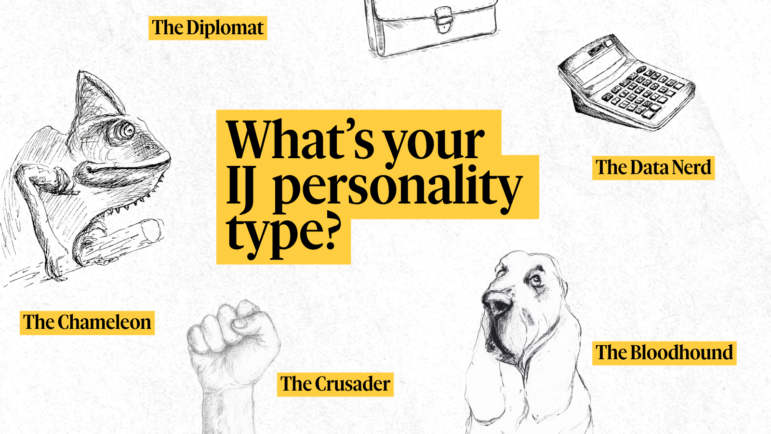
Image: GIJN / Illustrations: Shutterstock
The Diplomat, the Chameleon, the Bloodhound: Understanding Newsroom Personalities
Investigative journalists are a bit peculiar. Many of us carry a strange mix of hero complexes and impostor syndrome. One moment we think we are about to change the world, next, we suffer in agony feeling unable to write a decent story.
“Not another fucking leak!” a colleague cried after I teased them with a new project similar to an investigation we worked on a year earlier. “Why are we doing this to ourselves?” asked another, but not before already coming up with deadlines to start work. One small team: many different personality types.
Despite sharing certain instincts, investigative journalists have different strengths and weaknesses. Some prefer to be left alone, others do their most powerful work when part of a team. Some thrive on data analysis, others on building up impactful personal relationships. But there can be challenges, too, with a genre of journalist known for asking difficult questions: How do you run a newsroom full of people whose job is to question authority? How do you convince them to stick to a workflow when they love to challenge accepted norms?
After talking to reporters and editors, I identified six newsroom archetypes. To be sure, I am not a psychologist, and these are not professional conclusions, and they are certainly not mutually exclusive. But perhaps by thinking about our differences, our strengths and weaknesses, the categories can help editors understand what different reporters bring to an investigation, what may derail them, and what kind of support they need.
So which ones do you recognize in your own newsroom, or in yourself? Are there more we have missed?
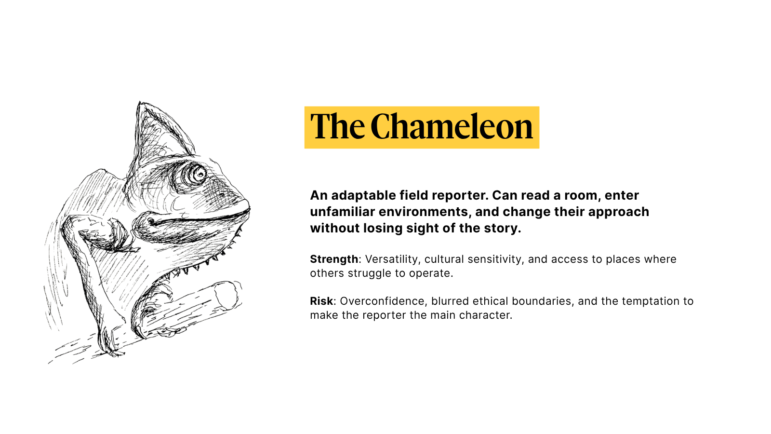
Image: GIJN/ Illustration: Shutterstock
“I thought every journalist needed to be like a chameleon,” says John-Allan Namu, co-founder of Africa Uncensored. “You are covering different kinds of assignments, and where the story takes you, you kind of have to go.”
Marina Walker Guevara, the Pulitzer Center’s executive editor and previously the deputy director of the International Consortium of Investigative Journalists (ICIJ), has seen journalists move comfortably between radically different worlds. “You can see them today addressing a group of high-powered editors and tomorrow having tea in the rainforest, making people feel comfortable,” she says.
The important quality here is not one of performance. It is humility. A genuine chameleon does not enter every environment believing they can control it. They adapt because the story and the people require it, not because they want to demonstrate how fearless they are.
Undercover reporting is the most extreme version of this tendency. It can reveal wrongdoing that would otherwise remain hidden, but it also introduces deception, privacy concerns, security threats and the risk of entrapment – and not every chameleon is able to handle that.
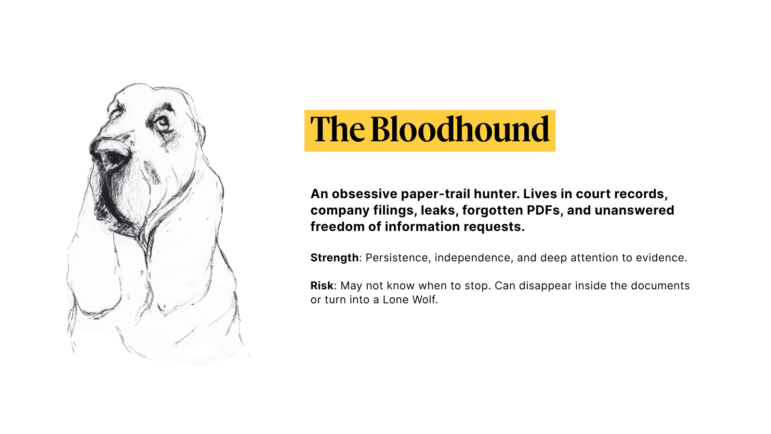
Image: GIJN/ Illustration: Shutterstock
“That is the classic hyper focused person,” says Tina Lee, the editor-in-chief of Unbias The News, a feminist cross-border newsroom.
“They are very valuable members of any team. Somebody must have that natural impulse to do the paperwork, to send the FOI requests. The paper trail is also an addictive part of journalism. It’s like you are pulling the thread and getting more and more. But at one point, there needs to be someone else to pull them out of the weeds and say: ‘We have enough information, let’s go talk to people.’”
Eli Moskowitz, who coordinates environmental investigations for the Organized Crime and Corruption Reporting Project (OCCRP), says: “I like to work with people who are obsessive paper-trail-hunters, as long as they share everything.”
But there is a risk that some paper-trailers keep their findings to themselves. ““When someone says that they’re a lone wolf before joining a collaboration, I get a little bit uneasy,” he adds.
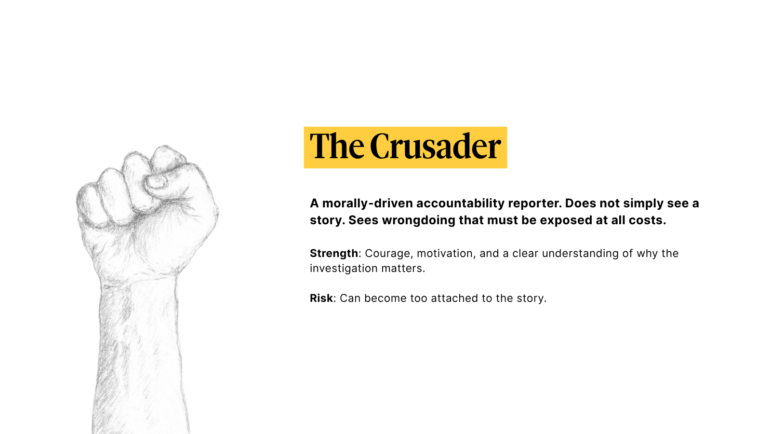
Image: GIJN/ Illustration: Shutterstock
This is a journalist who often works for years exclusively on one topic. They have a sharp vision of the relevance of the story they are working on.
“Their strength is their motivation,” says Lee. “Someone who is very motivated will also be motivated to go through paper after paper, dig in the archives, knock on doors, or build more sources.”
Craig Shaw, editor and director of The Black Sea, says this type of journalist is often very passionate: “Everything is dramatic and everything has to happen now, or this is the end of the world if this doesn’t happen.”
That urgency can keep an investigation alive. It can also make contradictory evidence feel like an obstacle.
Generally, there is a perception that this newsroom personality type is more prone to be categorized as an activist journalist – but that too brings pros and cons. “That impression will cut off certain sorts of people that will speak to you, [but] that will also shine through in your writing,” Lee says.
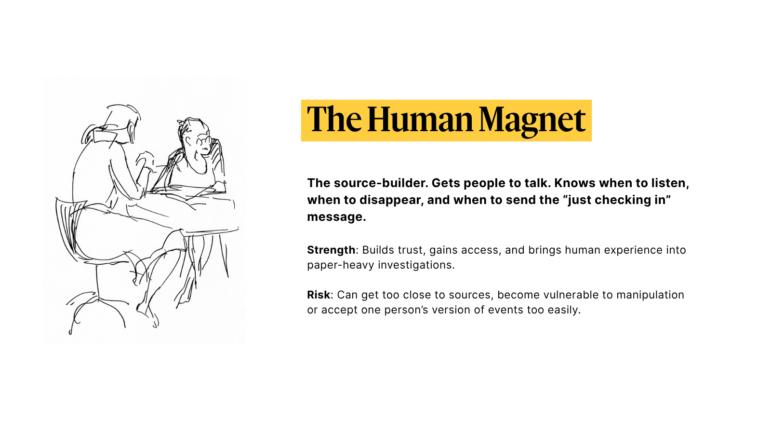
Image: GIJN/ Illustration: Shutterstock
This is the journalist who somehow knows everyone: judges, activists, prosecutors, retired police officers, drug dealers…
“What all of them have in common is at least giving off the vibe that they’re nonjudgmental,” says Lee. “To keep trust after you write stories about people is hard.”
Namu considers that ability fundamental. “We need to be able to get along because journalism is about people,” he points out. “If not, then how are you ever going to be able to get the right kinds of sources?”
OCCRP’s Moskowitz remembers one incident dealing with a “human magnet” colleague who was taking calls from his laptop in smoky bars.
“You’re saying, ‘This person is not taking this seriously,’” he says. “Then, next thing you know, they’ve found the key subject of our investigation and made major breakthroughs.”
Human magnets might be very good at befriending people, but “If you want to be friends with everybody, that’s always a weakness in journalism,” Lee says. “If you have three sources inside and you talk to those sources all the time, but the sources on another side aren’t willing to talk to you, this can produce bias.”
Image: GIJN/ Illustration: Shutterstock
The data-obsessed journalist finds stories in datasets, code, satellite images, and other digital traces.
“One of their strengths is that they are usually sense-checkers in any newsroom,” Namu says. When other reporters reach for an analogy, the data nerd can say: “No, actually, this is what happened.”
“They also help us see beyond the things that are obvious and visible,” he adds. “They have a nose for news, but in a different way.”
Technical knowledge can create a power problem inside a collaboration, however. If only one person understands the analysis, the rest of the team cannot properly challenge what was counted, excluded, or assumed.
“The best kind of data nerd is also the one that can understand how this applies to individuals and how this impacts real lives,” says Lee of Unbias The News.
Walker Guevara has also experienced data specialists who become too attached to their formulas and tools. “They are like: Why is nobody using my amazing tool called Aphrodite? Well, because you built Aphrodite for your own needs. You need to know who your public is before you build your Aphrodite.”
Image: GIJN/ Illustration: Shutterstock
This may be the least heroic type, but it is also the one many cross-border investigations cannot survive without. They often find themselves managing collaborations thanks to their ability to navigate all the other personality types.
“They’re really good at personal relationships. I know a few of these diplomats, and they’re really amazing under pressure and with other people,” says The Black Sea’s Zeynep Şentek.
“They are such an important person in investigative work, especially in collaborations,” Namu adds. “There are times when journalists get lost in the weeds, or you are in the middle of a story and wondering how this is going to pan out. Yet there is someone constantly egging you on, trying to put facts in front of you, and help you collaborate better.”
Namu partly identifies with the type and recognizes its costs. “One thing that you do lose with a person like that who is constantly consensus-building is speed,” he says.
But coordination becomes a power issue when it is expected rather than formally assigned. Lee says women are frequently pushed toward the role because of an assumption that they will be more accommodating.
“There is a feeling that women are nicer. I mean, that’s already shit, right?” she says. “But it’s kind of emotional care work: getting people on the phone but also mediating conflict.”
“What pisses me off a little bit is that it is still largely played by women,” Walker Guevara concurs.
The other danger appears when the team begins to struggle. This person will take over unfinished tasks, resolve every disagreement, and carry the project across the finish line. The story gets published, but the team does not improve because one person has been doing the heavy lifting for everybody else.
But this character must not be confused with a people-pleaser type. “The real diplomat is the one that wants to bring everyone together but has a very clear idea of what the red lines are,” says Walker Guevara.
Their work is often invisible. Lowering the temperature, resolving conflicts, and protecting relationships take time, time that may then be missing from the diplomat’s own reporting.
Who Gets Called ‘Difficult’?
The same behavior can be interpreted differently depending on who displays it. One reporter may be characterized as independent; another as uncooperative. One is uncompromising; another is labeled as aggressive. One is a natural leader, another controlling. Gender, nationality, and economic status often decide which label sticks.
“I have seen a lot of women struggle when they assert themselves as journalists on the basis of the reporting they have done,” Namu says. “They are looked at as being arrogant or standoffish, when really what they are doing is standing by their work and standing for the work.”
Editors or team leaders should consider not only which working style a journalist leans towards, but how newsroom power dynamics shape the way that style is perceived, rewarded, or punished.
“We definitely should add ‘The Conference Guru'” says Will Fitzgibbon from The Examination. “This journalist hasn’t done a new, interesting investigation in years. They still talk about their old one 10 years later.”
Image: GIJN/ Illustration: Shutterstock
The Type No Team Needs: The Brilliant Jerk
Walker Guevara uses a term she credits to her mentor Dawn Garcia, the director of the John S. Knight Journalism Fellowships at Stanford University: “The brilliant jerk.”
“This person is accomplished, confident, and sometimes charming. They may bring a rare skill or an impressive reporting record. But they work for themselves rather than the team. They hoard information, put colleagues down, and challenge decisions without helping resolve them,” says Guevara. The difficult question for an editor is whether the person’s brilliance justifies the damage.
Walker Guevara’s answer is unequivocal: no. “There are enough brilliant, supportive, collaborative people out there in the world and in the journalism industry,” she says. “The brilliant jerks can work among themselves. Good luck to them.”
In reality, most investigative journalists are probably messy hybrids: part bloodhound, part crusader, part exhausted data nerd running on coffee and suspicion, hopefully not the guru.
And most teams that thrive will probably have a mix of people on them bringing their different strengths. As Walker Guevara explains it, team composition is an editorial decision. “The management starts in the selection process,” she says. “And that is what is going to determine how nightmarish or how blissful the rest of the experience is going to be.”
“It is your responsibility to be a judge of character and to know that there are certain characteristics you’re going to need for this team to function well and for everyone to be able to do their best work,” she explains.
Or as Lee puts it: “The best kind of investigation has a bit of all of them.”
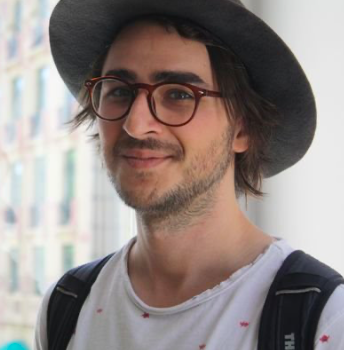 Serdar Vardar is a freelance investigative journalist based in Berlin mainly reporting for Deutsche Welle. His work follows the money, covering power and the political incentives behind environmental harm. He has investigated greenwashing, asbestos risks, toxic mining, political influence networks, and deep-sea mining finance. He has worked on major global investigations including Pandora Papers, Shadow Diplomats, and Deforestation Inc. with his work appearing in Al Jazeera, ICIJ, and OCCRP. He considers himself 20% human magnet, 30% chameleon, 50% bloodhound.

GIJN Guide to Project Management in Investigative Journalism
Building the Team: The Key to Cross-Border Success

Introduction to Investigative Journalism

Tipsheet: How Journalists Can Use a UN Process to Evaluate National Human Rights Records

‘Praise Colleagues, Delegate, and Know That Mistakes are Inevitable’: Tips for Managers in Investigative Journalism

Navigating the Turbulence of an Editorial Crisis
Journalists as Founders — Intrepid Pioneers or Reluctant Managers?
10 Tips for Founding a Successful Investigative Startup

This work is licensed under a Creative Commons Attribution-NoDerivatives 4.0 International License
Republish our articles for free, online or in print, under a Creative Commons license.
Republish this article
This work is licensed under a Creative Commons Attribution-NoDerivatives 4.0 International License
Read Next
News & Analysis
‘Praise Colleagues, Delegate, and Know That Mistakes are Inevitable’: Tips for Managers in Investigative Journalism
Managing teams in journalism is not easy. You can master what you do, but guiding people is quite a different thing and it requires another set of skills.
News & Analysis
Navigating the Turbulence of an Editorial Crisis
The Director General of Norway’s public broadcaster shares valuable lessons learnt from what she called “the most harrowing experience of my professional life.”
News & Analysis Sustainability
Journalists as Founders — Intrepid Pioneers or Reluctant Managers?
There are myriad number of reasons why reporters decide launch their own news sites, but these enterprising journalists often face a series of new, daunting challenges.
Case Studies Sustainability
10 Tips for Founding a Successful Investigative Startup
Veteran Mexican journalist Alejandra Xanic shares the lessons she learned in setting up an investigative nonprofit, from how to move beyond prioritizing survival to the importance of administrative support.