
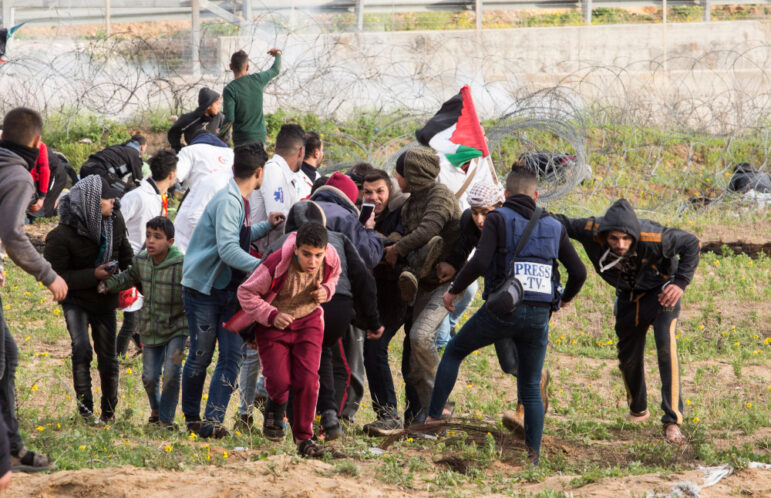
Palestinian civilians fleeing Israeli forces during demonstrations near Gaza-Israel border in Rafah, in the southern Gaza Strip. Image: Shutterstock, Abed Rahim Khatib
Investigating Inside Conflict Zones and Areas Controlled by Armed Groups: Lessons from South Asia and the Middle East
Read this article in

In October 2021, journalist Shahid Zehri was driving home to Karachi through the town of Hub, in Pakistan’s Balochistan province, when a bomb planted under his car seat detonated. He died of his injuries hours later.
The Balochistan Liberation Army (BLA), a separatist rebel group regarded as a terrorist organization by the Pakistani government and several other countries, including the United States, claimed responsibility, accusing Zehri of spying for Pakistan’s security forces, without offering evidence. “It is intolerable that separatist rebels are able, with impunity, to claim the right to kill journalists in a completely arbitrary manner,” Reporters Without Borders (RSF) spokesperson Pauline Adès-Mével said in a statement in response to the killing.
Zehri’s case reflects an enduring paradox of conflict reporting: journalists covering armed groups are often viewed with suspicion by all parties, and being labeled an “agent” by either side can be life-threatening. Through interviews with six journalists and analysts reporting from South Asia and the Middle East, this article explores how to negotiate those competing pressures and the personal, professional, and ethical costs of doing so.
Access Depends on Trust, Not Credentials
In conflict zones, access is rarely secured through official accreditation alone. Instead, it is negotiated through local trust, personal relationships, and an understanding of community dynamics, attributes that often matter more than press credentials or institutional backing.
For Sami Yousafzai, who has covered the Taliban and al-Qaida since 2001, that negotiation starts with by connecting with locals on the ground. “A local fixer or tribal elder is often the first source for understanding a situation, security conditions, local dynamics, risks, and opportunities for an investigative journalist,” he explains, adding that outsiders “may not even effectively operate without a fixer.” A good fixer, in his view, “is often a security adviser, cultural interpreter, local analyst, negotiator, and trusted partner in the reporting process.”
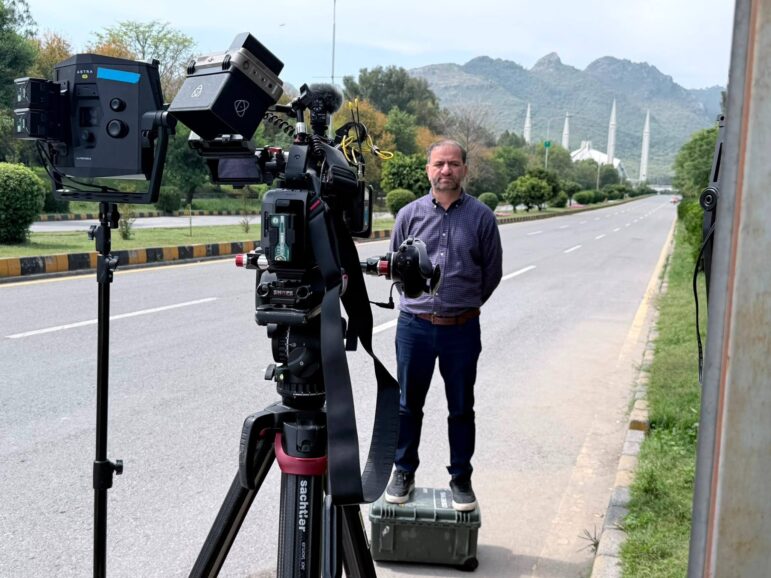
Sami Yousafzai covering a story in Islamabad. Image: Courtesy of the authors
Similarly, Sumera Khan, a Pakistani correspondent who has investigated military counter-insurgency operations, internal displacement, and the war on terror since the early 2000s in both Afghanistan and Swat, a former tribal district in Pakistan’s north, said her bonds with local communities have been central to her reporting on both sides of the border. “They were very helpful, both in Pakistan and Afghanistan. They provided me with the accommodation and transportation to communicate through these tough areas,” she says.
However, she also stressed that access is shaped as much by the prevailing political environment as by the physical challenges of the terrain. While she was able to travel relatively freely across Afghanistan under the former republic, the Taliban authorities now require journalists to disclose their destinations and intended interviewees in advance, retaining the authority to restrict or deny access altogether.
Imtiaz Baloch, an Islamabad-based journalist originally from Balochistan known for his reporting from the province’s remote and conflict-affected areas, said that local roots provide a significant reporting advantage. Familiarity with the region, its people, and its networks has allowed him to reach places and sources that can be difficult for outsiders to access. “Being from Balochistan, it is easier for me to gather information from far-flung areas compared to those who are sitting in Islamabad or other urban centres,” he notes.
Two Audiences Are Always Watching
Conflict reporters today rarely negotiate with a single center of power. Covering armed groups often means operating under simultaneous scrutiny from both sides of a war or dispute, each monitoring journalists for different reasons.
This dual surveillance is simply part of the job, says Khan. “If I say the state is not watching you, that would be wrong,” she notes. “The state has their own reasons, and the insurgent groups have their own reasons.” Reporting from conflict zones requires constant awareness of armed groups since they’re very ruthless, she adds.
Who poses the greater challenge, however, changes with the conflict. Quratulain Rehbar, an independent journalist who has covered the volatile, Indian-administered Kashmir region for eight years, said the balance has shifted over time. While reporters in the 1990s faced threats from both militants and the state, she notes, “Today there isn’t the same kind of direct communication between militant groups and newspapers.”
Another journalist based in Indian-administered Kashmir, speaking on condition of anonymity, said the media environment changed dramatically after 2019, when India revoked the region’s semi-autonomous constitutional status and brought it under direct federal control. “Since then, the pressure has become overwhelmingly state-driven. Authorities scrutinize every word in a story, and journalists are questioned over their reporting,” she said.
Jason Burke, an international correspondent for the Guardian, has more than three decades of experience covering conflicts across the Middle East, Africa, Europe, and South Asia, and is the author of several acclaimed books on terrorism and conflict, including “Al-Qaeda: The True Story of Radical Islam” and “The 9/11 Wars.” He argues that this shift reflects a broader transformation in how armed groups engage with the media.
“Since the 1990s, journalists have been considered more and more as targets by many, though not all, armed groups,” Burke says, attributing the change partly to radicalization and partly to the fact that militants “don’t need journalists in the way they once did because they can reach audiences directly themselves online.” As a result, conflict journalists now operate in an increasingly contested information environment, where both state authorities and non-state actors seek to influence, monitor, or restrict the production of independent reporting.
Verification Is a Process, Not a Checked Box
Because both governments and armed groups seek to shape conflict narratives, verification is not a simple matter, but instead needs to be a disciplined, multi-source process. Ihsanullah Tipu Maseed, co-founder of Pakistan-based The Khorasan Diary, said militant propaganda has become significantly more sophisticated, particularly since 2020, with groups increasingly releasing professionally produced footage of their own attacks.
While such material can help establish that an incident has occurred, Maseed cautions that accompanying claims, particularly casualty figures and operational success, are often exaggerated. His approach is therefore to verify every incident through “local journalists, residents, hospital contacts, security officials, and sources on the ground,” while applying the same level of scrutiny to official government statements. “Journalists should clearly attribute the information rather than present it as a fact,” he adds.
Baloch describes a similarly layered verification process in Balochistan. “We gather information from local sources, then cross-check it with local officials,” he says, characterizing the method as “basically a triangle.” For him, verification extends beyond facts to the language used to describe events. He cautions that adopting state-preferred labels for militant groups “are not always internationally acceptable because they can reveal a reporter’s or publication’s bias,” underscoring how terminology can shape perceptions as much as the facts themselves.
The Guardian’s Burke cautions against a different but equally common reporting pitfall: imposing coherence on armed groups that often operate in fragmented and fluid ways. In reality, he notes, such organizations “are much more chaotic than we think, and above all are based on personal relationships rather than organizational ones.” His observation serves as a reminder that verification is not only about confirming events but also about resisting assumptions that can oversimplify the internal dynamics of conflict actors.
How Gender Shapes Conflict Reporting
For women covering conflict, the dangers extend beyond the battlefield. Routine reporting tasks can carry social and professional consequences that male colleagues rarely face. Khan warns that something as routine as meeting a male source can be read by colleagues as scandalous rather than professional reporting. “The same source, if I’m going to meet them, I’m a bad person,” she explains. “But if a male journalist meets the same source, he’s seen as a very good person.”
Quratulain Rehbar says the challenges are even greater for her because she reports from Indian-administered Kashmir. “Kashmiri journalists carry a double burden,” she points out, explaining that she faces coordinated online abuse because of both her reporting and her identity as a Kashmiri Muslim woman. She recalls being told by an editor to focus on “positive stories” instead, while some colleagues were discouraged from writing for international publications.
Despite these newsroom pressures, Rehbar remains committed to reporting independently and says her responsibility focuses on uncovering the full story. “Journalism means reporting facts and telling the truth. If I cannot do that, then there’s little purpose in remaining a journalist,” she adds.
These experiences illustrate that, for many women in conflict reporting, the greatest obstacles are not only the physical dangers of war but also the gendered social norms, institutional pressures, and professional barriers that shape who gets to report, and under what conditions.
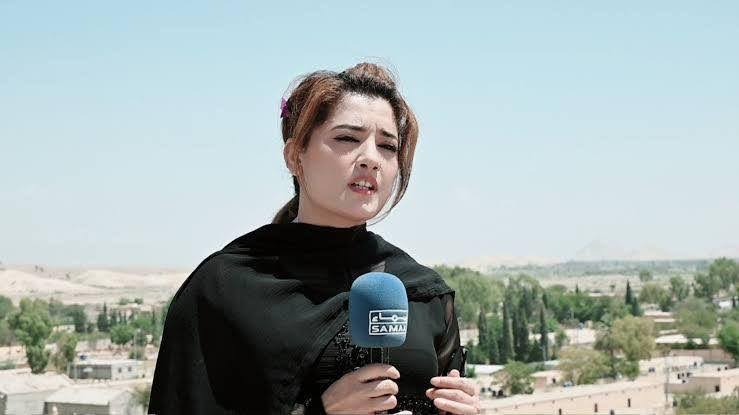
Pakistani journalist Sumera Khan has reported on conflict, counterinsurgency operations, and the war on terror since the early 2000s. Image: Courtesy of the authors
Lasting Cost of Conflict Reporting
The costs of conflict reporting extend well beyond the battlefield. For some journalists, the risks are physical; for others, they are legal, reputational, or borne collectively by the colleagues and organizations around them. Several interviewees said those burdens only deepen as their responsibilities grow.
Maseed said founding his own newsroom fundamentally changed his relationship with risk. “Once you establish an organization, however, the responsibility extends beyond your own safety,” he emphasizes. “You become accountable for the well-being of an entire team.”
For Yousafzai, the costs have been deeply personal. He was detained for 45 days, kidnapped twice, and shot in 2008, leaving a bullet lodged in his arm. “To be honest, after being shot, I seriously considered leaving journalism,” he admits. “But I could not stay away. Journalism is addictive; once it becomes part of you, it is very difficult to leave.”
Their experiences point to a broader truth about reporting from conflict zones: gaining access is only the beginning. The greater challenge lies in maintaining independence while managing competing pressures from governments, armed groups, editors, and the communities living through the conflict. Yet despite differences in geography, politics, and the nature of the conflicts they cover, the journalists interviewed consistently returned to the same principles: earn trust through local relationships, verify every claim rigorously, and protect credibility above all else. In conflict reporting, credibility is not merely a professional virtue; it is the foundation of public trust, the journalist’s most valuable form of protection, and, paradoxically, the very quality that can place them at greatest risk.
 Natasha Matloob is a research assistant at Oxford Global Society. She is pursuing an MPhil in Strategic Studies at the National Defence University, Islamabad and writes on politics, human rights, and security for outlets including The Diplomat, Stimson Centre, and The Friday Times.
 Yummna Hina Khan is a journalist and researcher based in Pakistan. She writes on conflict, security, and strategic affairs, with a particular focus on militancy, intelligence, and regional security in South Asia. Her work has appeared in the Friday Times and the Stimson Center, where she covers contemporary security and geopolitical issues.

This work is licensed under a Creative Commons Attribution-NoDerivatives 4.0 International License
Republish our articles for free, online or in print, under a Creative Commons license.
Republish this article
This work is licensed under a Creative Commons Attribution-NoDerivatives 4.0 International License
Read Next

News & Analysis
Strategies for Investigative Journalism Under Pressure: Insights from Pakistan
Despite numerous press freedom threats, Pakistani journalists continue to publish high-impact investigations — and offer lessons for reporters navigating restrictive environments worldwide.
News & Analysis
How To Do Investigative Reporting in Pakistan
When journalist Umar Cheema launched the Center for Investigative Reporting in Pakistan (CIRP) last week, he did so with a bang: A blockbuster story that hit the headlines around the world. Two-thirds of Pakistani MPs, his report said, do not pay their taxes. Neither did President Asif Ali Zardari – famous for his spending sprees, polo games and luxurious country estates – and more than half the Cabinet.
10 Questions GIJC23
Reporting and Sharing Women’s Stories in the Face of Taliban Oppression
Working as a journalist in Afghanistan has never been harder, but it’s a chance to resist the Taliban’s oppression of women’s rights, says the founder of Zan Times.
News & Analysis
Looking for a Suicidal Job? Try Iraqi War Reporter
Divine intervention appears to be the only thing protecting journalists in Iraq these days. Local reporters are sent off to do conflict reporting with no prior training and equipped with bad, cheaply made and easily penetrable vests. Mustafa Sa’adoun, director of Iraqi Observatory for Human Rights, details the dangers of being an Iraqi war reporter.