
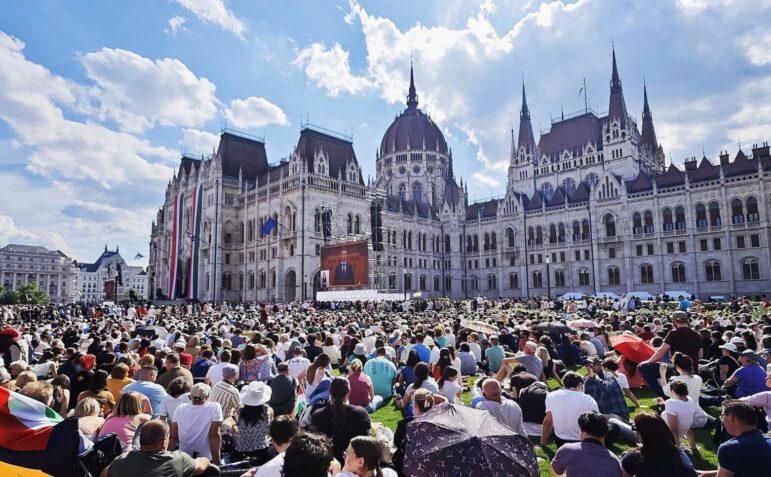
Hungary's newly elected prime minister Péter Magyar speaks at the inaugural session of the National Assembly in May 2026. Photo: Elekes Andor / Wikimedia Creative Commons
‘I Didn’t Really Sleep’: Inside the Investigation That Helped End Viktor Orbán’s Rule
Five Questions on How Independent Hungarian Media Beat Orban’s ‘Propaganda Machine’

Revised Elections Guide for Investigative Reporters: Political Messaging and Disinformation

Guide to Investigating Tech and AI in Modern Warfare
Turning Copernicus Satellite Data Into Public-Interest Climate Stories
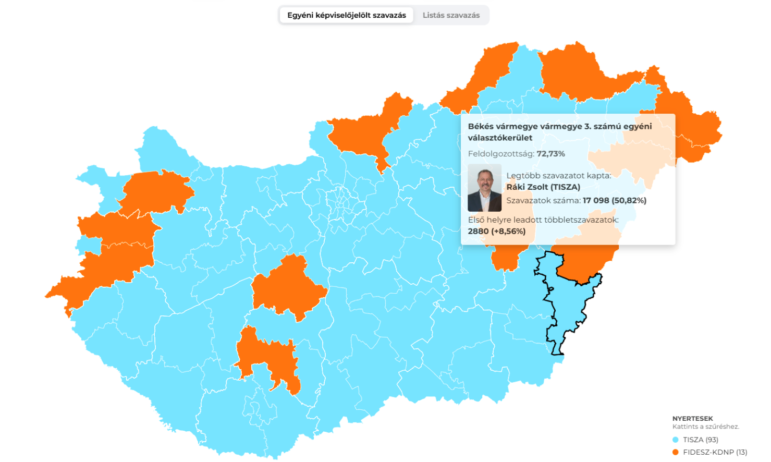
On April 12, Hungary went to the polls. The result was a landslide win for Péter Magyar and the Tisza party, and the end of 16 years of rule by Viktor Orbán and his “illiberal democracy.”
Just three weeks before, Hungarian investigative newsroom and GIJN member Direkt36, in partnership with Telex, broke the story of a secret operation to bring down Tisza — and secret service efforts to sabotage the police investigation into the operation.
“Neither the article nor the interview was a routine journalistic job,” Direkt36 founder and editor András Petho shared in a LinkedIn post. “They were the results of a months-long, complex investigation that we conducted under immense pressure and at high risk.” The story, he adds, was one of the biggest scandals of the election, “if not the whole Orbàn era.”
Direkt36 obtained documents from a source and spoke with multiple whistleblowers familiar with Tisza’s internal affairs — including a former volunteer for the party, a man responsible for protecting its internal systems, and a police officer familiar with the investigation — to confirm details of a secret operation to bring down the party’s IT systems and hack into party databases.
According to Direkt36’s reporting, IT specialists involved with Tisza made plans to expose this operation but faced police raids and pressure from the secret service, which used exaggerated charges to seize phones, computers, and storage devices.
Source and data protection during the investigation were critical. As such, details of the story were deliberately limited to editor Zsuzsanna Wirth and Pethő.

Direkt36 founder and editor András Petho. Image: Courtesy of Direkt36
“We never talked about it [the investigation] when our phones were in proximity,” says Wirth. “We tried to reveal as little as possible to other people, because we didn’t know who would compromise what we were doing.”
They planned for different scenarios with legal advice, including whether they might be surveilled, whether their homes would be searched, how to protect data and sources, and what their rights were post-publication.
“I personally didn’t really sleep during the last weeks [of the investigation] because I was always thinking about how to do it properly, how not to mess things up,” Wirth told GIJN. “I am very happy that none of our fears came to reality, but you could never know.”
The police’s treatment of one source — police detective Bence Szabó, who worked in the department involved in the investigation into Tisza’s IT specialists — was a turning point for the investigation, explains Wirth. The team had previously recorded an unpublished video interview with Szabó, anticipating that he might be investigated after the story was published. His home was searched on the night the story came out, and his lawyer rang Wirth to say he consented to publication of the video.

Image: Screenshot, Direkt36
“Someone in front of a camera talking is much more powerful,” she says. “Although he was basically recalling the same events that we have already published, it had a huge impact. People could see a police officer who was willing to give up his career to fight for justice”.
Wirth believes Szabó’s interview was “a catalyst” for other sources to come forward, including a soldier who gave an interview to partner Telex about power abuses in the military, such as the then-prime minister’s son influencing military decisions, and two IT specialists that had worked or were working with the Tisza party and who faced false accusations and house raids by national security services.
“They became some kind of heroes in the eyes of the public,” says Wirth. “They appeared at rallies and a huge concert a few days before the elections. There was a feeling that something like historical change was in the air during the concert.”
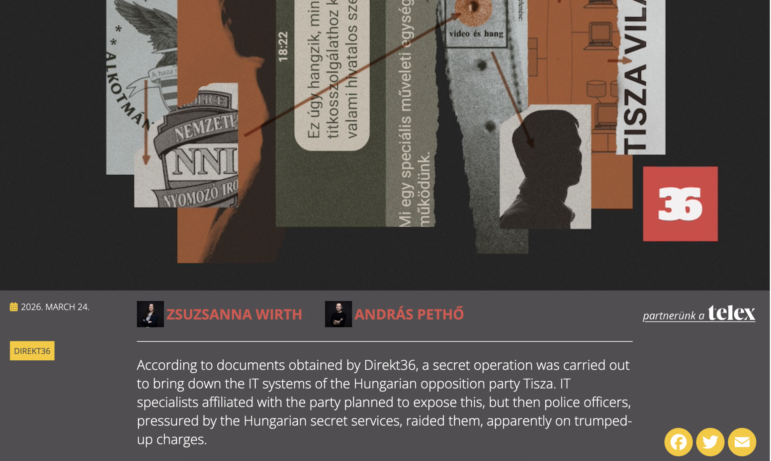
Image: Screenshot, Direkt36
Investigative Journalism Under Orbán
Just weeks after Direkt36 began publishing its investigation, Orbán lost the election. While it is too early to tell the full impact of this change on investigative journalism in Hungary, according to the experts GIJN spoke with, the end of Orbán’s rule marks the end of his specific brand of media repression.
Loyalists of Orbán’s Fidesz party — to which Magyar also belonged until he resigned in February 2024 to form Tisza — were estimated to control roughly 80% of the country’s media. Orbán’s government introduced legislation to dilute Hungary’s Freedom of Information Act and separately to target independent media (under the Sovereignty Protection Act). Legislation was also used to establish the media council, a regulator consisting of the “ruling party’s nominees.
“It was a very deliberate step-by-step process from the government to overtake the majority of the media sector, including the media regulators,” explains Bea Bodrogi, a human rights lawyer who serves as legal counsel for Direkt36 and other independent Hungarian newsrooms. Media control was also sustained through state advertising, only received by 80% of the sector and not by independent media, she adds.
From 2010 to 2025, Hungary’s rank in Reporters Without Borders’ World Press Freedom Index fell from 23rd to 68th, one of the lowest-ranked member states in the EU. Several investigative journalists under the previous regime had their phones infiltrated by Pegasus spyware deployed by the government.
Despite this hostile environment and being cut off from any form of state funding or advertising, several independent and investigative outlets survived or were born during the 16 years of Orbán’s government. This includes Direkt36, which was launched in 2015 by former staff of another Hungarian newsroom, Origo, after its editor and work came under political pressure.
For Wirth, the “most annoying and difficult thing” about working as an investigative journalist under the Orbán regime was the lack of access to information.

Direct36 editor Zsuzsanna Wirth. Image: Courtesy of Direkt36
“We almost never got any answers to our queries. Almost all of our many FOIA requests were denied,” she says. “Sometimes we had to go to court in order to get data, and even if the court decided in our favour, the authorities repeatedly denied our requests.”
Journalists from independent newsrooms were also routinely locked out of government press conferences. For Direkt36, getting information via official routes became impossible, Wirth explains. Background sources, insider information, and anonymous sources became the norm — as did avoiding on-the-phone discussions about stories for fear of surveillance.
“It was kind of exhausting, but at the same time we always had big support from our readership,” she says. “People were relying on us to give them reliable information and that was a huge responsibility but also gave us a boost and energy.”
Independent media played an important role in the final years of the Orbàn regime, Wirth adds: sources and the public began to view other authorities as “dysfunctional,” turning instead to independent media for help in cases of abuses of power.
What Has Changed, What Is Promised
During its campaign, Tisza promised it would stop government propaganda and reform Hungary’s media system, including reform of public service media.
“This is what they promised, and there are good signs and signals towards independent media,” says Bodrogi. At the first press conference held by Magyar, according to Bodrogi, the first question was given to a journalist from an independent newsroom, and that was “symbolic.”
Wirth says she has now been allowed into the parliament building to work as a journalist: “We couldn’t move freely inside the building, we couldn’t actually contact politicians — and even if we managed to, they did not answer. That is a huge change.”
According to Wirth, the new prime minister has appointed three spokespeople who will respond to media inquiries: “I think there will be an order of talking to the press, rules that they will appoint, but they claim to be open to questions.”
The new leader has lashed out against journalists and Hungarian media in the past, she notes, but Wirth doesn’t see this as a concern at this stage: “They don’t have to like us, so he is free to say whatever he wants, as long as they give the information, as long as they can be held accountable. As soon as there is a story that challenges the new government, we will see how determined they are [to reform].”
Speaking at the Netzwerk Recherche 2026 conference in June, Europe Representative for the Committee to Protect Journalists Attila Mong said press freedom in Hungary “survived 16 years of the Orban regime, thanks to this handful of independent outlets and journalists who maintained very high-quality journalism and documented the capture of the Hungarian state. “They reported not just on media capture but the state capture of the judiciary, the prosecution service. It has many, many levels, and journalists in Hungary were actually forced to innovate, to find a way to survive.”
Changes and Long-term Hopes
In one of Magyar’s first decrees as prime minister, he ordered a “comprehensive and immediate” review of public service media. On July 8, outlets close to Orbán suspended broadcasting with several broadcasting messages of apology to viewers for lying or being untrustworthy, the Guardian reported. Magyar’s government has also reportedly replaced the management of state TV and radio.
Speaking to GIJN before the suspension was brought in, Bodrogi urged caution when reforming public service media in Hungary: “It needs to be a long process and a legitimate process to reform the system. It takes time to find the legal ways to close down the propaganda media, to stop the present system of state advertising.”
EU and Council of Europe rules and norms and recommendations need to be followed and applied, and starting to implement these international norms would be a great first step, she added.
In addition to committing to ending public funding for state propaganda in its election manifesto, Tisza also said it would suspend state advertising to the media and investigate spyware abuses from Orbàn’s era, according to BalkanInsight.
Increased access to information and to politicians and reform to rules on secret surveillance are critical areas for the new regime to address if investigative journalism in Hungary is to continue to survive and thrive, says Bodrogi.
Bodrogi adds that she is encouraged by the people who have already joined the new government or have been appointed to positions: “I see good signs from civil society, even from journalists. The people starting to work for the government now are, in my eyes, one of the guarantees.”
“During the last decade, there was a systematic drainage of funding [for independent media] — all the money was directed towards the propaganda machine and the new government has promised to stop that [machine],” adds Wirth. “It would be nice to have a healthy advertising market again, but it’s too soon to know the future.”
Laura Oliver  is a freelance journalist based in the UK. She has written for the Guardian, BBC, Euronews, and others. She is a regular journalism trainer for the Thomson Foundation and Thomson Reuters Foundation and works as an audience strategy consultant for newsrooms. You can find her work here.
Five Questions on How Independent Hungarian Media Beat Orban’s ‘Propaganda Machine’
Revised Elections Guide for Investigative Reporters: Political Messaging and Disinformation
Guide to Investigating Tech and AI in Modern Warfare
Turning Copernicus Satellite Data Into Public-Interest Climate Stories
Hungary’s Historic Election, Artemis II’s Lunar Journey, Strait of Hormuz Shipping Crisis, and Three Years of War in Sudan

Átló: Taking on Corruption in Hungary with Data Journalism
Journalism Under Siege: Five Survival Tips from Editors in India and Hungary

Global Press Freedom Plummets to 13-Year Low

This work is licensed under a Creative Commons Attribution-NoDerivatives 4.0 International License
Republish our articles for free, online or in print, under a Creative Commons license.
Republish this article
This work is licensed under a Creative Commons Attribution-NoDerivatives 4.0 International License
Read Next
Data Journalism Top 10
Hungary’s Historic Election, Artemis II’s Lunar Journey, Strait of Hormuz Shipping Crisis, and Three Years of War in Sudan
Our roundup of the best in recent data journalism also highlights the rise in child detentions under Trump, the causes of Hong Kong’s deadliest fire in decades, and Russia’s Arctic dominance.
Data Journalism
Átló: Taking on Corruption in Hungary with Data Journalism
In Hungary, nonprofit news site Átlátszó has hired a full-time data team to create a wide range of data visualizations and data-driven stories, notably on corruption. Amanda Loviza spoke to the team’s leader Attila Bátorfy about his plans to raise the bar for data journalism in Hungary.
Case Studies News & Analysis
Journalism Under Siege: Five Survival Tips from Editors in India and Hungary
Two editors from India and Hungary, respectively, Ritu Kapur and Peter Erdelyi, offer survival tips based on how their outlets have managed to stay afloat in the face of press freedom challenges in backsliding democracies.
News & Analysis
Global Press Freedom Plummets to 13-Year Low
Global press freedom has continued its decline, now at its lowest point in 13 years in 2016 due to unprecedented threats to journalists and media outlets in major democracies, intensified crackdowns by authoritarian states, and moves by Russia and China to increase their influence beyond their borders, according to Freedom of the Press 2017, the latest edition of Freedom House’s annual report on media freedom worldwide.