
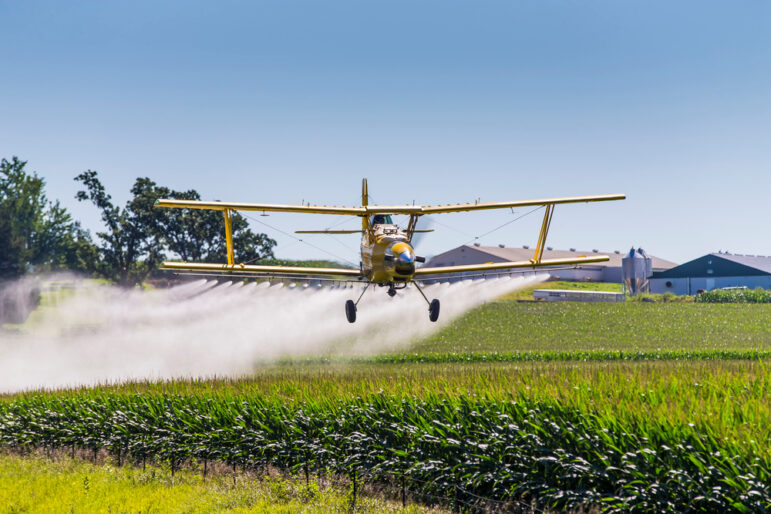
Image: Shutterstock
Tips to Investigate Links Between Pesticide and Cancer
Read this article in
Around the world, journalists investigating links between high cancer rates and pesticide exposure face the classic correlation-versus-causation problem. While research has definitively found certain weed killers and insecticides to be carcinogenic, veteran beat reporters say that it is extremely difficult to link individual agricultural pesticides to cases of cancer, neurological disorders, or birth defects with 100% certainty. At the same time, agri-chemical corporations and their lobbyists often manipulate science to defend their products with claims that merely sound scientific.
Meanwhile, a recent study in Peru that combined environmental data with 150,000 cancer sufferers showed that the combination of different pesticides can itself amplify their effects on human cells.
Nevertheless, in a panel on data-driven investigations into pesticide exposure at the 2026 Investigative Reporters and Editors conference, a panel of expert investigators urged reporters to pursue more of these investigations and shared tips on how to get around the problems of causation and toxicology jargon. The panel included Ben Felder, editor-in-chief at Investigate Midwest; freelance journalist Natasha Gilbert; Mark Horvit, a professor at the University of Missouri School of Journalism; and Cynthia Barnett, director of climate and environment reporting initiatives at the University of Florida.
“Cancer is a complex disease: it can be caused by numerous environmental and genetic factors,” Felder explained. “Finding provable connections between cancer and agri-chemicals can be rather difficult. But these are important investigations to pursue.”
“Even if you can’t prove a link, that doesn’t mean you haven’t got a story,” Gilbert added. “You can also reveal the justified fears people have; who is overusing pesticides; and more.”
Felder said getting farmers to talk represents another typical challenge, “largely because there is a sense of shame: these are products that are extremely important in commodity crops, but farmers worry: ‘Did I cause these illnesses?’”
Despite the difficulty in making a scientific connection between disease and exposure, overwhelming circumstantial evidence remains compelling to readers on health stories. In addition, in many countries in the West, this is one investigative topic with lots of available data online, and which often does not require public records requests. Also, scientists such as epidemiologists, medical geographers, and toxicologists are typically delighted to walk journalists through the data and evidence.
Gilbert noted this beat is rich in leaks and document libraries, and pointed to the Toxic Docs database in particular: a trove of millions of pages of previously secret or internal documents, lobbyist correspondence, and memos from chemical manufacturers in the US and around the world, produced by Columbia University and The City University of New York.
In a notable investigation from February of this year, Investigate Midwest, in partnership with Horvit’s student team, revealed that 60% of the 500 counties with the highest pesticide usage per square mile also had among the highest cancer rates in the US. The team reported that this public health crisis “has not just been ignored by state and federal health officials, but aided.”
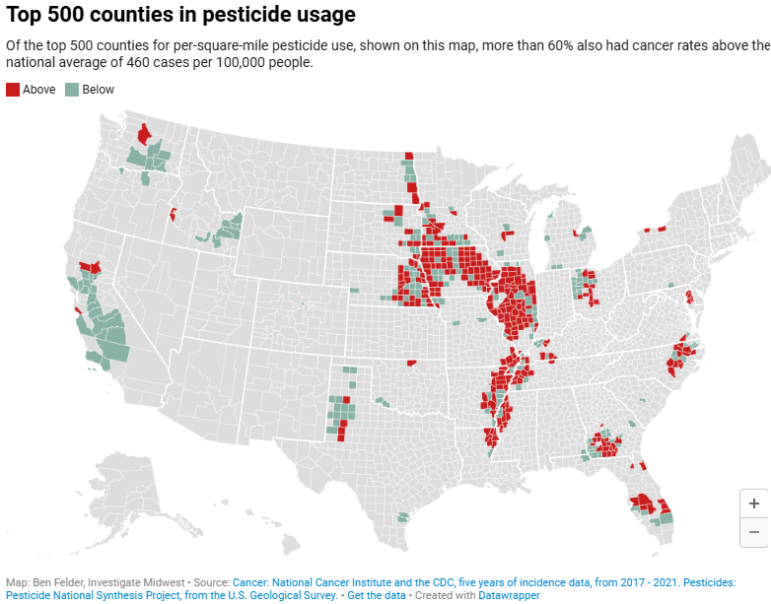
Image: Screenshot, Investigate Midwest (IRE presentation)
In addition to allied stories on regulation and “pesticide drift” — where chemicals have a downstream impact on schools, lakes, and nearby communities — panelists said the key for these linkage stories was to relentlessly lay out the data and the evidence for readers to judge; to be transparent about what cannot be proven; and to find compelling human stories.
Gilbert noted that countries with large agricultural sectors outside the West — including India and Brazil — were ripe for pesticide projects, and that effective reporting strategies were applicable everywhere.
Reporting Tips from the Panel
Look for higher cancer rates in areas that should be the healthiest. Speakers suggested that reporters look for cancer rates that are higher in rural areas than in nearby cities – not only because this seems unusual for reporters, but also because ordinary readers have an existing intuition that country living should be healthier than smog-filled urban areas, and are able to recognize the problem right away.
Describing a recent student investigative project into cancer links, Horvit said: “This really surprised me: rural counties in Missouri have higher rates of cancer than urban ones. That’s just not what you’d expect.”
Tip: Barnett told attendees that a massive database maintained by the Truveta healthcare analytics firm includes anonymized healthcare records for 130 million Americans – and that the media team at the firm’s research arm will actively assist reporters on request.
Find countries that export chemicals they have banned for their own citizens. Barnett said trade databases such as ImportGenius can reveal stunning cases of policy hypocrisy, where some countries gladly export chemicals that they know are too dangerous to be used domestically. “It’s interesting to look at countries that have banned paraquat (a herbicide banned by 74 countries) to protect their own citizens — such as China and South Korea – but which have also exported it all over the world to places that have not yet banned it. An interesting place to look for harms is a lot of African countries.”
Consider silicone wristbands to count exposures. Last year, hundreds of volunteers in The Netherlands wore simple silicone chemical detection wristbands at various distances from farms during spraying periods for a single week for a research study.
The Guardian reported that an average exposure of 20 different pesticides were found for each volunteer, rising to an average of 36 for non-organic farmers, and also included a slew of agrichemicals found on the wristbands of residents far from the farms. The analysis even showed banned substances such as DDT and dieldrin in some cases. Similarly, Univision Noticias placed wristbands on 10 farmworkers as they harvested apples, pumpkins, and blueberries over five days in 2024, and registered 18 different pesticides, including herbicides with known links to cancer, and two banned substances. “This was one of my favorite investigations,” noted Barnett. Brave reporters might consider wearing a wristband themselves at target sites — after consulting with health experts — to show the alarming prevalence of agrichemicals beyond farm borders.
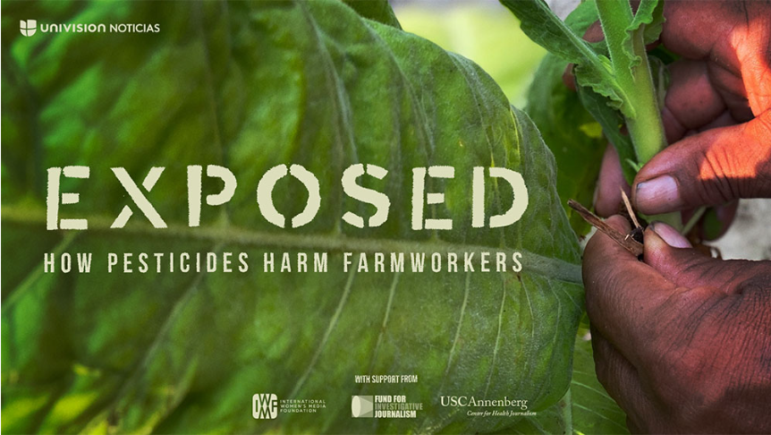
Image: Screenshot, Univision
Publish a short pre-investigation story with a reader questionnaire. Felder noted that one of the best ways to find cancer victims who have made their own links to pesticide exposure is to do pre-reporting — simple interactive visualizations on the issue, with Datawrapper or Flourish — and include a link to online reader forms.
“First, we published mini stories about the connection between cancer and agri-chemicals, and we published online Google forms asking for readers to share their own personal stories,” he said, referring to the Investigate Midwest project. “We tried Facebook, but we found that putting the forms in stories was 10 times more effective in cultivating sources.”
He added: “Ask pointed questions in your pre-reporting: ‘Have you or someone you know developed cancer you think is linked to pesticides?’”
Look for indicators that exclude genetic factors. Felder noted that some cancer sufferers are screened for genetic cancer risks, such as one source living with cancer and exposed to pesticides who was found to have no particular risk among 81 genes typically related to cancer. Barnett added: “Epidemiological evidence strongly connects pesticides with Parkinson’s disease. Only 15% of Parkinson’s cases are linked to genetics, yet the majority of research funding is about genetics.”
Expert opinions count in these stories — including your source’s medical treatment team. While informed conclusions don’t carry the same weight as peer-reviewed academic studies, Felder said it was nevertheless useful to quote patients and their doctors about causality, while qualifying these for readers as opinion. “While doing our interviews, one of the key questions for us was a seemingly simple one: ‘Why do you think your cancer was caused by pesticides?’ and we asked them to share a lot of details,” said Felder. He added that a source’s conversations with their doctor or oncologist could also be helpful, where permission is granted, at least in showing the fear in communities. One of Felder’s sources stated: “My cancer specialist said very directly that my cancer was the result of being exposed to agri-chemicals.”
Lean on scientists and academic sources. “Get familiar with the science, and how to read scientific papers,” Gilbert advised. Often, the industry is trying to distort and manipulate the truth to try to defend their products, “so unless you know what the science really says, you’re not going to be able to catch that misuse. Scientists are very happy to give a lot of their time; they will hold your hand through the science.”
Gilbert listed resources to help reporters with their science literacy, including:
- The Open Notebook’s “Spotting Shady Statistics”
- The Journalist’s Resource media primer on research terms
- The Research Gate studies access dashboard
- “Essential Statistics for Science Writers”
Tell readers what you can’t prove. “Be confident telling your readers what you know, and be OK with telling your readers what you don’t know; that it is not 100% provable,” Felder emphasized. Horvit added that reporters should be willing to set aside sources with unrelated cancers. “Look at what kinds of cancers your sources say they’re getting, and what’s being sprayed, and ask, is there actually a link? Because we found lots of people who came to us and we couldn’t use them, because it didn’t track with what they lived next to.”
Look for litigation and depositions. “Pretrial discovery documents are like the jackpot,” Gilbert noted. Horvit added: “Transcripts from legislative hearings are great; also lawsuits and depositions.”
Put the name of an affected local community in the headline. “Our main story was our national dataset, but our best stories were often focused on specific communities — just having the name of the communities did wonders,” said Felder. “When you can put a specific community in a headline — like ‘High rates of cancer and pesticide use in East North Dakota’ — it’s really captivating, and people respond.”
Get creative for sources — like GoFundMe sites and cancer patient transport nonprofits. While Horvit admitted that reaching out to GoFundMe sites did not work in finding patient sources for his project, several attendees felt that route could work elsewhere. “I had this super-brilliant idea to use GoFundMe sites to find sources; it didn’t work at all,” he conceded. “The way we found people was a lot of organizations in these areas that support people with cancer. We found two small nonprofits that raise money just to transport people with cancer to their chemo sessions. They know the people and their stories.”
Resources
The panel recommended the following databases for US journalists.
- Pesticide data: USGS Estimated Annual Agricultural Pesticide Use – where you can select by compound.
- Updated health statistics: CDC statistics release calendar.
- US cancer rates by county
- Crops by County: USDA National Agricultural Statistics Service
- The Toxic Docs corporate documents database
- The Industry Documents Library, maintained by the University of California, San Francisco
 Rowan Philp is GIJN’s global reporter and impact editor. He was formerly chief reporter for South Africa’s Sunday Times. As a foreign correspondent, he has reported on news, politics, corruption, and conflict from more than two dozen countries around the world.

Resources on Environmental Data
GIJN Reporting Guide for Landfill Methane Emissions and Solutions

Covering the Extractive Industries

Remote Sensing and Data Tools for Environmental Investigations
Tracing Lead Pollution in Nigeria to the Global Auto Supply Chain

Essential Open Source Tools for Journalists Investigating Air Pollution

Exposing Industrial Pollution and Creating the ‘Forever Chemicals’ Beat

Pollution, Corruption, and Illegal Gold Mining: Investigating Nigeria’s Water Crisis

This work is licensed under a Creative Commons Attribution-NoDerivatives 4.0 International License
Republish our articles for free, online or in print, under a Creative Commons license.
Republish this article
This work is licensed under a Creative Commons Attribution-NoDerivatives 4.0 International License
Read Next
How They Did It
Tracing Lead Pollution in Nigeria to the Global Auto Supply Chain
Investigative reporters traced dangerously high lead contamination in Nigeria — revealing that recycled metal from used car batteries entered global supply chains linked to major US automakers.
Reporting Tools & Tips
Essential Open Source Tools for Journalists Investigating Air Pollution
Here is a list of open source data tools that journalists can utilize to track air pollution, uncover its sources, and reveal the corporate networks responsible.
10 Questions
Exposing Industrial Pollution and Creating the ‘Forever Chemicals’ Beat
In a career spanning more than 20 years, Le Monde reporter Stéphane Horel has brought a creative and, at times, humorous approach to groundbreaking environmental investigations.
Getting the Story Out How They Did It
Pollution, Corruption, and Illegal Gold Mining: Investigating Nigeria’s Water Crisis
Investigative journalist and filmmaker Anu Adelakun discusses her investigation into the forces behind water scarcity and pollution in Africa’s most populous democracy.