
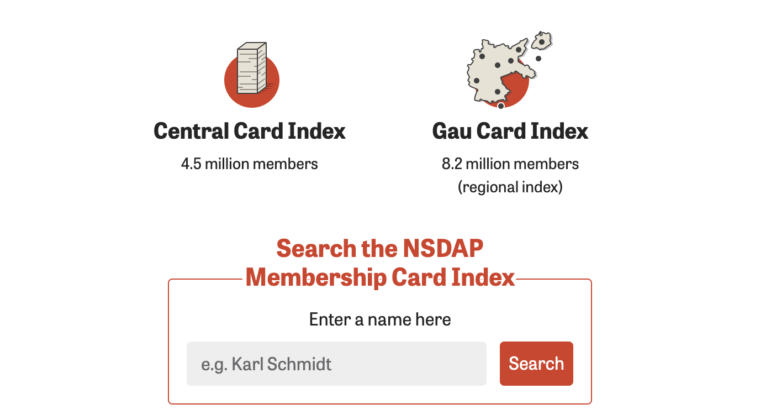
Image: Screenshot, DIE ZEIT
One Name at a Time: How Die Zeit Built a Searchable Database of Nazi Party Members
Read this article in
Muckraking the Past: Using Archives to Seek Accountability

Investigating War Crimes: Tracing War Criminals

Tracking Far-Right Suspects Across Continents: A 10-Year Hunt for Spanish Fugitives

‘Rewriting History’: Tips for Investigating Events Years, Decades, Or Centuries Later
In the final days of World War II, as the German Reich collapsed, Nazi officials ordered millions of party membership cards to be destroyed. The vast card index that documented membership across Germany survived largely because a paper mill operator, Hanns Huber, chose to hand the records over to the advancing US forces rather than pulp them.
For decades, discovering whether a relative had belonged to the Nazi Party — officially the National Socialist German Workers’ Party (NSDAP) — required either a formal request to Germany’s Federal Archives or trudging through microfilm copies housed at the US National Archives in Washington, DC. Earlier this year, when the US National Archives began releasing digitized versions of the records online, public interest was so high that the website briefly crashed.
For German newspaper Die Zeit, the archive presented an opportunity. While the records had become publicly available, navigating them remained a challenge. Millions of membership cards were scattered across thousands of PDF files, making individual searches near impossible.
A team of reporters, data journalists, and data scientists set out to change that. A few weeks after the archive’s release was reported in German media, Die Zeit had built a searchable database that transformed millions of scanned membership cards into an accessible public resource. The project has since attracted millions of searches, with users uncovering the names of grandparents, great-uncles, and other relatives whose party membership had long remained hidden within the archive.
The database is also challenging a persistent misconception about Nazi Germany. While conscription to the Wehrmacht — the German armed forces under the Nazis — was compulsory, membership in the Nazi Party itself was not. Despite some professions carrying heavy social pressure to sign up, it remained voluntary to join.
Gregor Aisch, a visual data journalist at Die Zeit, and Andreas Loos, head of the newspaper’s data science and AI desk, spoke to GIJN about how the project came together, the role artificial intelligence played in making the archive searchable, and the unexpected response that followed publication.
Using AI to Build a Searchable Archive
The foundation of the project lay in two vast collections of membership records: the Central Card Index and the regional Gau Card Index. Political scientist Jürgen Falter, who spent decades studying the Nazi Party, estimates that only 44% of the Central Index and 77% of the Gau Index survived the war. Even so, the surviving material represents one of the largest repositories of information about party membership. Together, the surviving records cover approximately 90% of all Nazi Party memberships between 1925 and 1945, although significant gaps remain.

Andreas Loos, head of Die Zeit’s data science and AI desk. Image: Courtesy of Loos
Transforming that archive into a searchable database required processing 5,442 PDF files, each containing roughly 3,000 pages of scanned membership cards. Many members appear in both indexes, creating duplicate records that needed to be accounted for.
“We used AI mainly to extract textual information from images,” Loos explains. “The models could cope with even difficult visual data: each register card may contain a mix of many fonts and handwriting, including Kurrent and Sütterlin, two old German handwriting scripts. All this could be read.”
Optical character recognition (OCR) converts images into machine-readable text. For the NSDAP project, the team combined several OCR systems, relying heavily on Google’s Gemini LLM to interpret handwritten and printed information from the cards.
For Die Zeit the technology was not introduced as an experiment. Artificial intelligence was already part of the newsroom’s reporting, the NSDAP database simply provided an opportunity to apply those tools at an unusual scale.
“AI was already a major part of our toolkit,” Loos says. “Especially in combination with powerful search applications, it will play an increasingly important role in handling and analyzing large datasets.”
Because the records were created over two decades by different offices, using different administrative systems and inconsistent formats, extracting names, dates, occupations, and places of birth in a standardized way required extensive processing before the data could be searched reliably.
“The combination of name and place of birth is indeed not enough to identify a person with certainty,” Aisch says. “But if you also know the birth date, you can be very certain that you found your relative.”
Accounting for Errors and Gaps
As with many newsroom projects built using AI tools, the database required balancing accessibility with accuracy.

Gregor Aisch, a visual data journalist at Die Zeit. Image: Courtesy of Aisch
“A limitation is that OCR data obtained by LLMs may contain hallucinations, which in fact occurred from time to time,” Loos said. “One way to deal with this was to give our readers the opportunity to report mistakes via email, which enabled us to correct hundreds of records.”
Loos adds that while the team found the OCR to be highly accurate, assessing that accuracy was not always straightforward. The large language model occasionally expanded or interpreted information rather than simply transcribing it. “With LLMs, you often do not simply get a text version of the original, but text with added comments (e.g., “D”. [Düsseldorf]” instead of simply “D.”). This can even be helpful for a search function, but it is wrong when you want to do OCR canonically.”
In addition, some of the original text proved too difficult to decipher, so the team had to decide whether the data was completely unreadable.
“We thought at first that the handwriting would become our biggest problem — but that proved to be a solved issue by LLMs. So among the biggest problems were in the end, the costs and the performance of the backend,” said Loos.
Collaboration Across the Newsroom
The project drew together multiple desks across Die Zeit, each contributing a different layer to the story.
The data science and AI team handled the extraction and structuring of the records, transforming millions of scanned membership cards into searchable data. The data and visualization desk built the search interface and the scrollytelling features surrounding the project. Meanwhile, the Science and History departments provided archival research and historical expertise, helping frame the records within the broader history of Nazi Party membership.
“We wanted to make these membership records searchable in a way that would get you an immediate response,” Aisch explains. “But more importantly, we also want to provide the much-needed context for the story: what does it mean if you find your relatives in these records?”
While a search result could throw out the name of a party member, understanding historical joining patterns had the potential to add much needed historical context that extended beyond just finding a family member in the search.
Contexualizing Nazi Party Membership
Die Zeit treated the searchable database as only one part of the investigation. Alongside the search tool, the team conducted a broader analysis of party membership patterns, using the records to examine who joined the NSDAP, when they enrolled, and how membership evolved over two decades.
Previous researchers, including Falter, had spent years studying the party through samples of membership cards. Access to millions of records offered an opportunity to view those patterns at an unprecedented scale.
The analysis traced the growth of the party from its re-establishment in 1925 through to the end of World War II. Membership surged after Adolf Hitler became chancellor in 1933, the influx so large that party officials temporarily froze admissions before reopening enrollment in 1937.
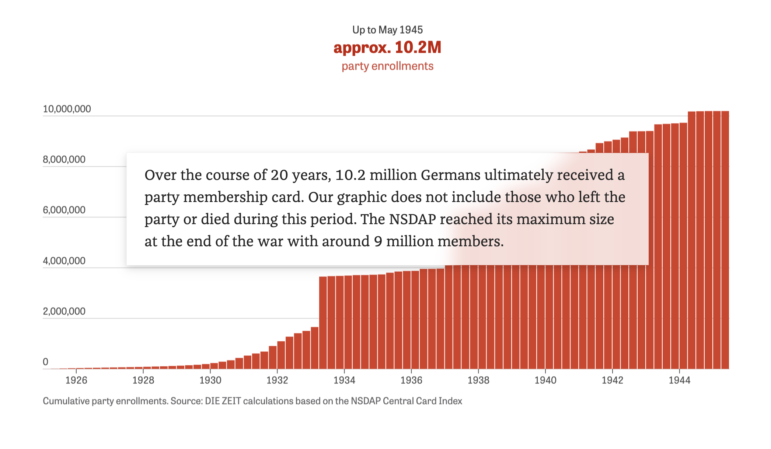
Image: Screenshot, Die Zeit
In total, roughly 10.2 million Germans received Nazi Party membership cards between 1925 and 1945.
The data also provided insight into who joined. Drawing on a 50,000-card sample previously compiled by Falter, the team visualized how membership was particularly common among civil servants and white-collar workers, while many industrial workers remained aligned with Social Democratic and Communist political organizations.
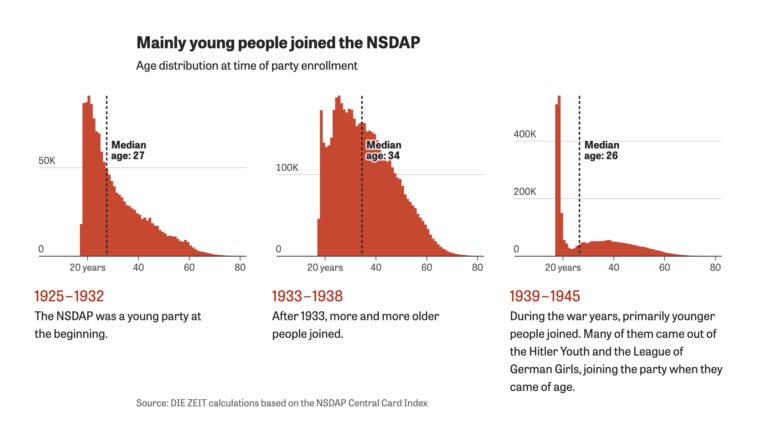
Image: Screenshot, Die Zeit
The records revealed changes across generations as well. During the war, enrollment increasingly shifted toward younger Germans who had previously participated in organizations such as the Hitler Youth and the League of German Girls.
“We know from these records who joined the Nazi Party, but we don’t know why they did it,” Aisch said. “People joined the Nazi Party in several waves. Only a relatively small fraction joined before 1933. After the Party took power, there was a huge spike in new memberships, and they closed the Party to new members. When they reopened it in 1937, you see the second huge spike. Timing is a key factor in understanding the motives.”
At the same time, the team chose to be cautious about the conclusions they drew. While the database proved effective for finding individuals, inconsistencies within the records limited the reliability of certain large-scale analyses.
“We would have loved to do more analysis like that,” Loos says. “However, for these purposes you need highly normalized data, and the dataset is at the moment much better for finding persons by name search.”
Personal Histories Revisited
Since publication, users have searched for family members, former neighbors, local officials, and others whose lives intersected with the history of the Third Reich. In many cases, the searches confirmed suspicions that had lingered within families for decades. In others, they raised entirely new questions.
The experience was not limited to readers. During the reporting process, Aisch himself discovered a membership card belonging to his own great-grandfather. “I knew from family stories that he was a ‘proud’ NSDAP member who boasted about joining before the party took power. Seeing his actual member record card with his photo attached somehow made this feel a lot more tangible,” said Aisch.
By making the records searchable, the database placed information that had long remained buried in archival collections into public view. For some users, that visibility has complicated family narratives that had remained largely unquestioned for generations.
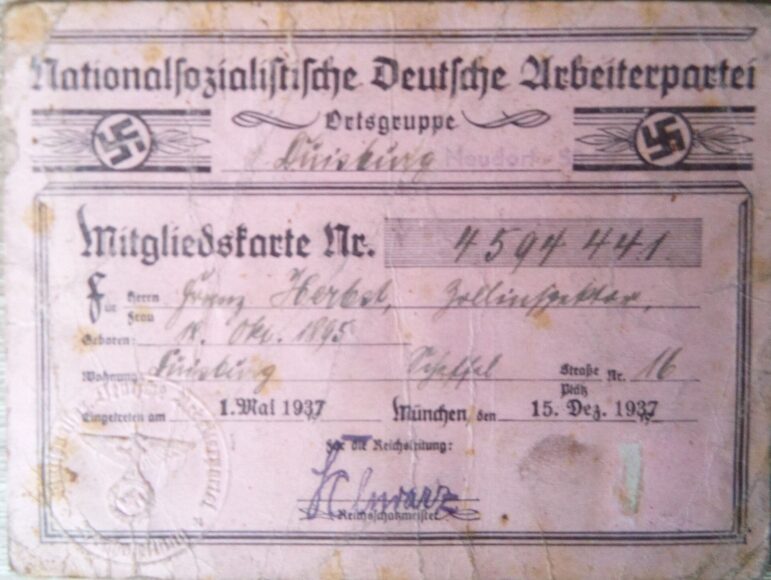
An NSDAP membership card from 1937 belonging to a Franz Herbst, found in his estate. Image: Skallaub, Wikimedia, Creative Commons
International Attention and Public Response
The project quickly attracted attention beyond Germany, with the team eventually publishing an English-language version of the project to accommodate non-German readers.
International coverage largely focused on the database itself rather than conducting independent analyses of the underlying records. Outlets including CNN, the BBC, the Guardian, and Le Monde reported on the project, with many stories centered on the reactions of users who had discovered relatives within the records.
“We certainly did not expect the story to be picked up internationally so widely,” Aisch said. “In hindsight, it makes a lot of sense. The story that a German newspaper used AI to create a ‘Nazi search engine’ is just too good to ignore.”
The response in Germany was equally notable. Before publication, the newsroom anticipated criticism from readers who might be reluctant to revisit difficult aspects of family history, but the team were surprised at the positive reaction from Germans.
“Many readers thanked us for making these archives more accessible,” Aisch says. “Many were touched to find their relatives, even if they already suspected them.”
Building Stories Beyond the Search
Since publication, Die Zeit has continued reporting from the records, with many of the stories focused on providing additional context for interpreting individual search results.
“We have built many follow-up stories around this dataset,” Loos says. “Many of them addressed user reactions or provided historical context for how the data should be read and understood.”
For the newsroom, ensuring that readers understood the limits of the database became almost as important as building it. A membership card can establish that someone joined the Nazi Party. It cannot fully explain why they joined, what role they played, or how their views evolved over time. The team viewed the search tool as a starting point for investigation rather than a definitive judgment on an individual’s life.
Hanna Duggal is the writer of GIJN’s fortnightly Top 10 in Data Journalism column, and a data journalist at AJ Labs, the data, visual storytelling, and experiments team of Al Jazeera. She has reported on issues such as policing, surveillance, and protests using data, and reported for GIJN on data journalism in the Middle East, investigating algorithms onTikTok, and on using data to investigate tribal lands in the US.
Muckraking the Past: Using Archives to Seek Accountability
Investigating War Crimes: Tracing War Criminals
Tracking Far-Right Suspects Across Continents: A 10-Year Hunt for Spanish Fugitives
‘Rewriting History’: Tips for Investigating Events Years, Decades, Or Centuries Later
Going Undercover to Reveal a Secret Meeting of Germany’s Far Right

What I’ve Learned: Lessons and Advice from a Veteran of the Panama Papers Investigation

CORRECTIV, Germany’s First Nonprofit Newsroom, Leads With Innovative Journalism

Inside ‘Projekt Helpline’: Germany’s Mental Health Phoneline for Journalists

This work is licensed under a Creative Commons Attribution-NoDerivatives 4.0 International License
Republish our articles for free, online or in print, under a Creative Commons license.
Republish this article
This work is licensed under a Creative Commons Attribution-NoDerivatives 4.0 International License
Read Next
How They Did It
Going Undercover to Reveal a Secret Meeting of Germany’s Far Right
Behind the scenes of the blockbuster CORRECTIV investigation that revealed a disturbing far right ‘master plan’ to expel millions of people from Germany.
10 Questions
What I’ve Learned: Lessons and Advice from a Veteran of the Panama Papers Investigation
Several years ago a whistleblower reached out to the German newspaper Süddeutsche Zeitung with an enticing message: “Hello, this is John Doe… Interested in data?” That story would become the Panama Papers, the first in a number of international collaborations for investigative reporter Frederik Obermaier. Read his tips and advice about investigative reporting.
Member Profiles
CORRECTIV, Germany’s First Nonprofit Newsroom, Leads With Innovative Journalism
CORRECTIV boasts a €4 million annual budget, a staff of 60, and has become one of the world’s largest nonprofit centers for investigative journalism. As founder David Schraven had hoped, the outlet has delivered blockbuster investigations and trained aspiring journalists, as well as staged plays and exhibitions inspired by current affairs that serve to bridge the gap between art and news.
Safety & Security Sustainability
Inside ‘Projekt Helpline’: Germany’s Mental Health Phoneline for Journalists
A dedicated mental health helpline for journalists facing anxiety, stress, and burnout was a long time coming. Can it survive?