
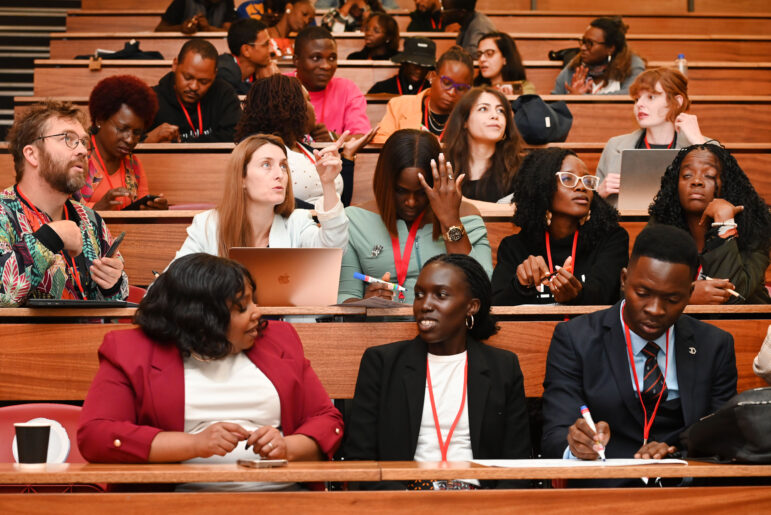
The AIJC took place in November 2025. Image: Leon Sadiki for the AIJC
From the Pitch Stage to the Write Up, the Line Edit to Publication: How Editors Can Help Investigative Stories
Read this article in
In an era where investigative journalism serves as a key instrument for societal change, editing watchdog reporting can be pivotal in making or breaking a story’s impact. From narrowing complex stories to ensuring accuracy, great editing turns strong reporting into powerful journalism.
At the 21st edition of the African Investigative Journalism Conference (AIJC) in November, in this session moderated by Eric Mugendi, managing editor at Africa Uncensored, three leading investigative editors shared how journalists and editors can work together to refine stories that not only expose wrongdoing but also drive change.
Sharpening Investigative Pitches
Editors can play a key role, even in the pitching stage — by challenging vague story angles, questioning unclear targets, and insisting on concrete source material. A dialogue in the early stages can help turn a general topic into a precise investigative plan that can withstand scrutiny.
Daneel Knoetze, an investigative editor, founder, and director of the accountability journalism project Viewfinder, noted that one of the most common problems at the pitching stage is that reporters offer expansive background and context but fail to identify the specific allegation they want to prove or the target they intend to investigate. Many pitches, he explained, are rich in description but lack the source material required to substantiate wrongdoing.
According to him, editors should encourage journalists to frame each pitch as a hypothesis similar to a criminal investigation: with a potential crime, a suspect, and evidence that already exists or can realistically be gathered. The clearer the hypothesis, the easier it becomes to test and refine.
“Do not bring speculative ideas like who might be benefiting from illegal mining,” he says. “Bring the closest nugget of evidence you have seen, the smallest but clearest piece that can be developed. Editors must help reporters take a broad idea and tighten it into a specific, recognisable hypothesis with sourcing already in hand.”
Knoetze noted that essential source material is often buried deep in the pitch or entirely absent. For editors, the task is to interrogate the evidence available and determine whether there is enough minimum substantiation to justify moving forward. Only when that baseline is met should a newsroom commit time and resources to a longer-term investigation.
Image: Leon Sadiki for the AIJC
Building a Case
Once a pitch is approved, the true investigative work begins, but according to Knoetze, this is also the point where many reporters lose focus. He says investigative journalists often drift into side research, academic-style reading, and other tangents that contribute nothing to the core allegation. He often urges reporters to step away from academic-style backgrounding and instead deepen their strongest real-world access.
“People think they’ve got all the time in the world,” he says. “They do a lot of sidetrack research and secondary reading. They don’t recognise the value of primary sources that get you closer to real insights and something genuinely expository.”
To prevent reporters from getting lost in the volume of information they collect, Knoetze said editors should frequently check in and guide them back to the essentials. What is the specific allegation? What finding is being pursued? What does the minimum story look like today, based on the evidence in hand?
He advises reporters to imagine the story going on the front page this weekend. How would it read with the material they currently have? And if the team had an additional few weeks of reporting time, what could the maximum version of the story become, and what source material could realistically be accessed within that timeframe?
Challenging Blind Spots
An editor’s role can also be key in challenging blind spots and helping reporters see the bigger picture. This involves asking tough questions, verifying facts, and encouraging critical thinking about balance and fairness. The aim is to make the story more complete, accurate, and impactful.
Ida Jooste, a South Africa-based health and science journalist who has led newsrooms in Durban, Johannesburg, and Nairobi, says that she always advises journalists to approach their stories as though no one believes them. She tells them to imagine that only their mother, grandmother, and best friend believe what they have uncovered is true.
The editor’s role, she said, is to help journalists gather sufficient evidence, and the best way to do that is to work as if the story must convince even the most skeptical audience.
Edit for the Big Picture — and Impact
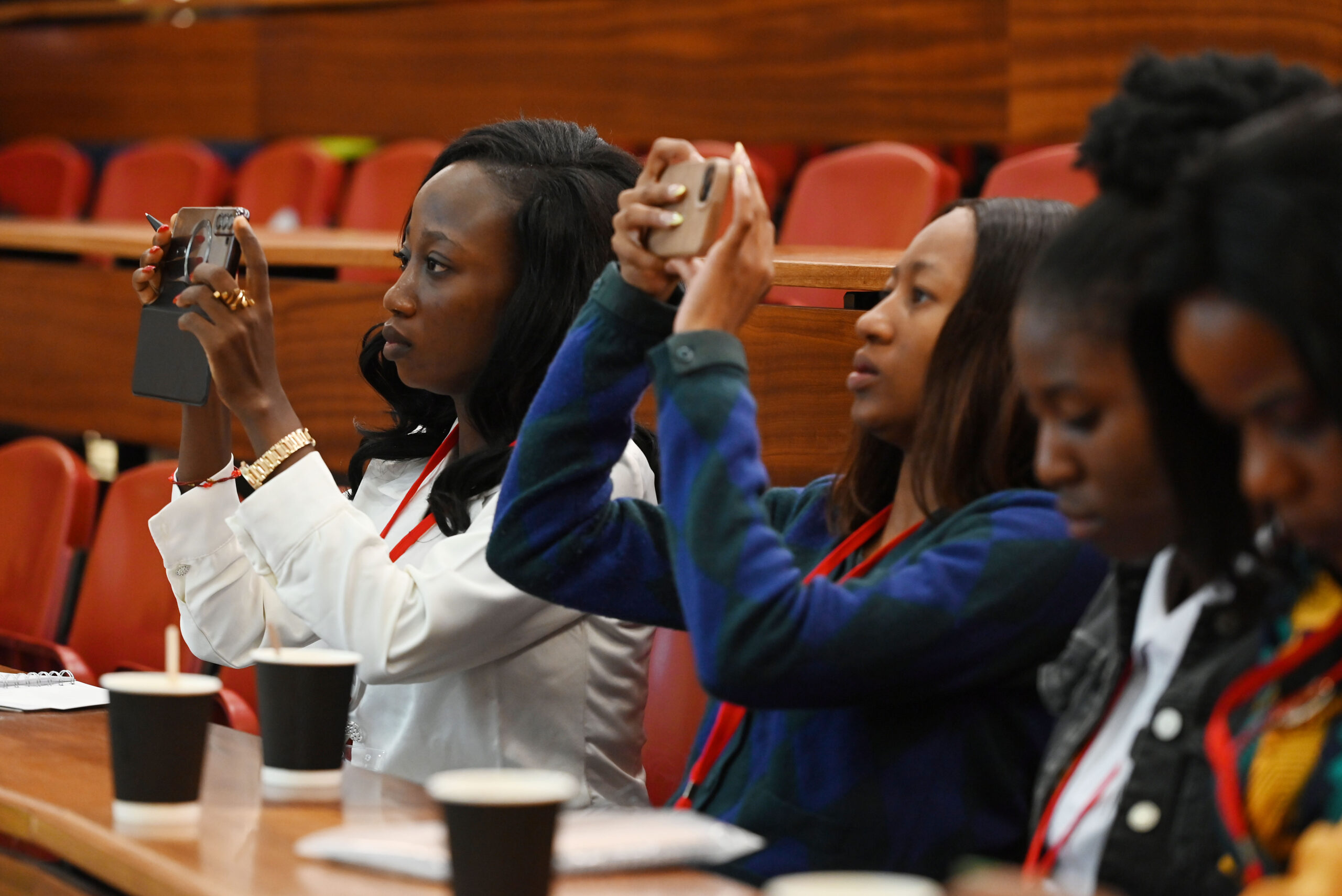
Image: Leon Sadiki for AIJC
By the time journalists reach the writing stage, they are often so immersed in their material that they lose sight of what truly matters. Knoetze, director of Viewfinder, stated that this closeness frequently leads reporters to bury the lead simply because they have lived with the story for so long. “Journalists are very close to it, they’re in the bubble,” he says, noting that they can become so attached to the various pieces they’ve gathered that “they don’t really see the wood from the trees.”
Knoetze explained that one of the editor’s most important responsibilities at this stage is to identify and elevate the most consequential elements of the reporting. This includes foregrounding the strongest sourcing, the most original discoveries, and the most damning findings so they become impossible for the reader to miss.
Hamadou Tidiane Sy, founding editor-in-chief of Ouestaf News and a leading investigative journalist in Francophone Africa, recalled an investigation he co-produced over two-and-a-half years. His initial draft was 4,500 words. Editors recommended cutting it by more than half, a decision he initially resisted. In hindsight, he said, the shorter 2,000-word version was far more accessible and concentrated the investigative quality, making it stronger. “Every sentence and phrase has to pack a punch,” he noted. “If it doesn’t, you’re probably better off tightening and cutting for impact.”
Keeping the audience in mind is essential, Knoetze added. Readers arrive with no context, no prior knowledge, and no emotional investment in how the story was gathered. Editors must therefore ensure the narrative is structured with clarity and intention, guiding the audience from paragraph to paragraph in a way that is accessible and engaging.
He added that effective structure requires purposeful framing. Stories should make their objective clear from the outset and be shaped toward accountability, whether that means prompting regulators to act, enabling prosecutors to take up a case, or equipping civil society with evidence that strengthens advocacy efforts.
Edits Make for Stronger Investigations
Now in the editing chair, Sy has spent years guiding reporters, shaping stories, and navigating the balance between accuracy and narrative. From his work at CENOZO, a network of investigative journalists across West Africa, to his own newsroom, Sy has seen the intricacies of editing up close and has judged numerous journalism awards.
“Most of the time, the first story a reporter writes is one they are very proud of,” explains Sy, who hails from Senegal. “Submitting it to an editor is a moment of accomplishment. The journalist believes they have done everything they could. Yet the story often returns, marked with questions, corrections, and requests for revisions.”
The process, he notes, can be relentless, but it’s a vital part of the editorial process.
“The minute you are told you are the editor of the story, there’s a responsibility,” Sy said. “If the story has flaws, if it is unclear, if it is misleading, I am responsible.”
He noted that award-winning stories are often the product of this invisible labor. Editors shape the narrative, refine the prose, and ensure the integrity of the reporting, even when recognition goes elsewhere. In this way, he explains, editing is both a craft and a commitment.
“The most difficult parts are the narration and the style,” he added. “If you are an editor, you look at all of those things. It’s not just reading and correcting a couple of typos.”
Fact Check as if Your Story Could Face Blowback
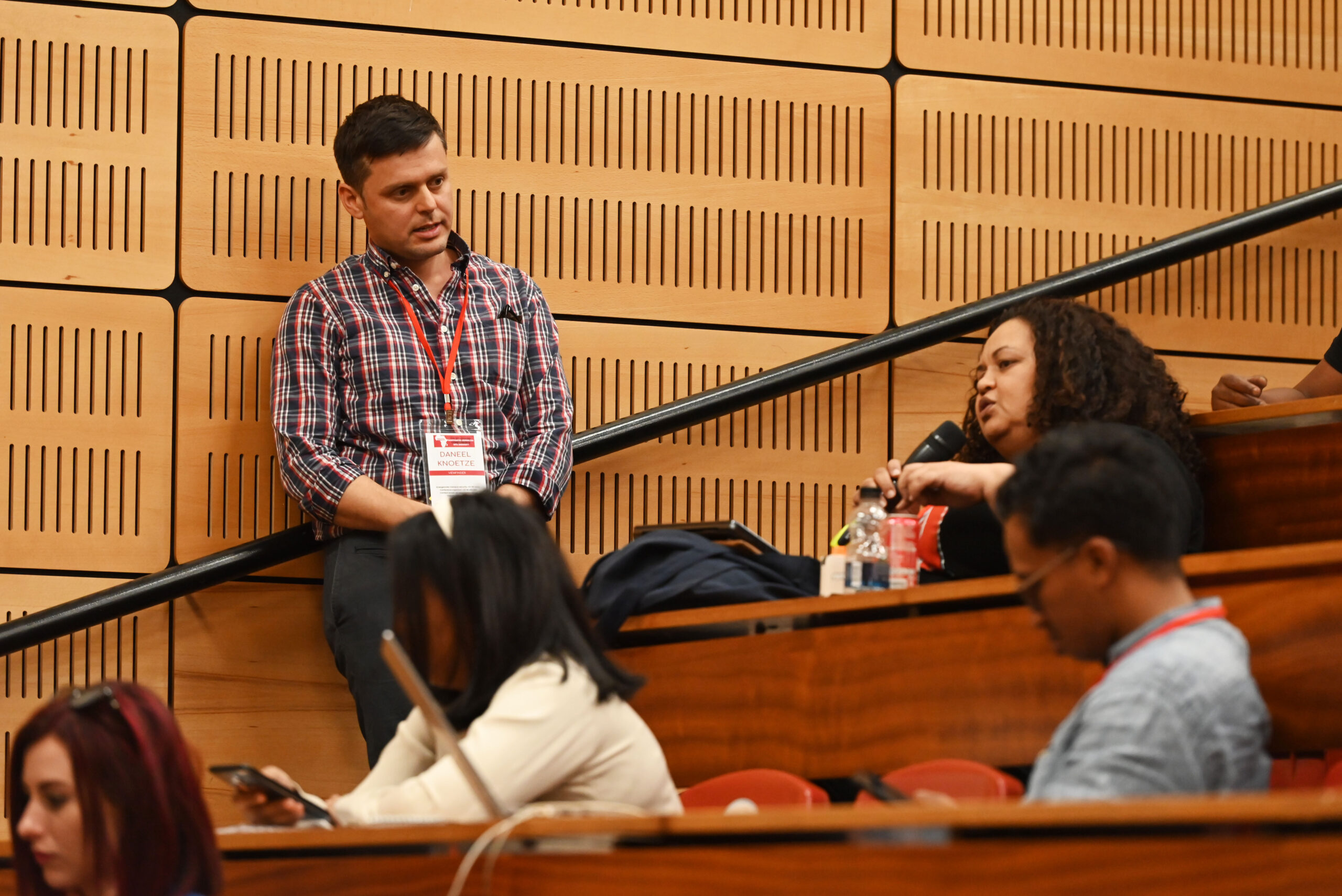
Daneel Knoetze, standing, an investigative editor, founder, and director of the accountability journalism project Viewfinder, in a session at the AIJC. Image: Leon Sadiki for AIJC
Knoetze stressed the importance of the final line-by-line edit and fact check. Investigative reporting carries consequences, and assumptions cannot be left unchallenged. Every sentence must be substantiated, especially when the story may trigger strong reactions or legal repercussions. This final stage ensures the story is strong enough to withstand skepticism, pushback, and public scrutiny.
By thinking as if no one believes the story, working as if external doubt must be overcome, and editing as if any assumption could be wrong, reporters and editors can strengthen the investigation, uphold fairness, and produce work that stands up to make an impact.
Pressures in the Field
Since investigative journalism requires more time, attention, and closer editing than other kinds of reporting, resources can be a constant challenge. Small newsrooms often struggle to provide sufficient editing support for every story. This can delay publication because the editorial process itself needs to be as thorough as possible.
“Either you spend a lot of time and energy on each story, which means fewer stories overall, or you hire more people, but where do you get the money from?” said Sy.
One way around this resource squeeze in recent years has been collaborative investigative journalism, where different newsrooms work together, but this presents its own editing challenges. Different news organizations bring varying standards of rigor and style, which can complicate the publishing process. Sy recalled reviewing a story already approved by a partner editor and finding it unpublishable. Reconciling these differences, he explained, requires careful judgment, negotiation, and the courage to prioritize quality over convenience.
“Uneven standards, particularly in collaborative projects, are challenging. You have one team with their standards, another team with theirs,” he said. “How do you reconcile the two to produce a strong, publishable story?”
Editing as a Measure of Quality
For Sy, a story’s true test of its quality is whether it keeps the reader engaged from beginning to end. When evaluating journalism for awards, he said he asks colleagues whether they would have read a story to the end if they were not judging it. Many stories, though factually correct and technically sound, fail because they do not engage the reader. Investigative journalism, he emphasized, must be both accurate and compelling. Data, facts, and evidence are essential, but storytelling gives the story life and reach.
Editing with this storytelling in mind, he acknowledged, is both an art and a science. It demands patience, insight, and constant attention to the audience. It is about shaping a narrative that is truthful and human, precise and readable, immediate and enduring.
“If I found a story in a newspaper, I would read the first two paragraphs, and then decide whether to continue,” he noted. “Investigative journalism is about facts, and at times those facts can be dry. But how can we make it compelling? How do we make it a story everyone wants to read? The numbers are there, the facts are there, the data is there; it is accurate, it is brilliant. But if it’s not a good read, nobody is going to finish it.”
 Abdulrasheed Hammad is a Nigeria-based lawyer and award-winning freelance journalist who reports on science, climate change, accountability, health, education, and data-driven governance. His work has appeared in The Cable, HumAngle, Minority Africa, El País, The Continent, and Dataphyte. He is a recipient of the Africa Science Journalism Award, won best investigative journalist in the 2025 Diamond Awards for Media Excellence, and was a finalist for the 2025 Thomson Foundation Young Journalist Award.

Introduction to Investigative Journalism: Editing: The Investigative Article
A Guide to Fact-Checking Investigative Stories

Project Management: Collaborative Journalism
GIJC23 – Investigative Editing: Best Practices
8 Tips for Upping Your Game as Investigative Editor
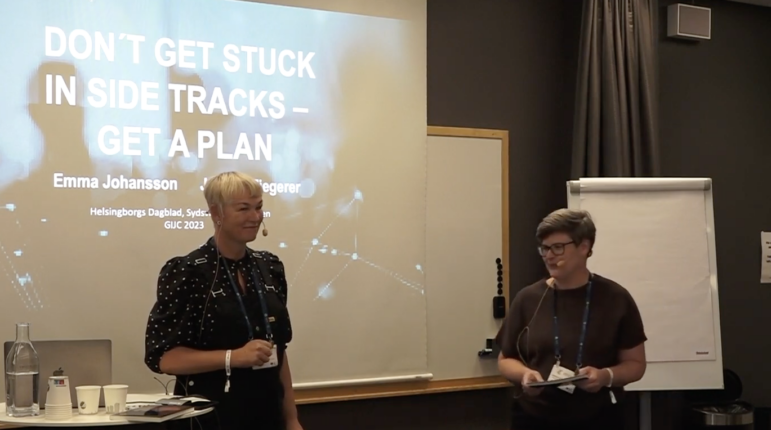
Don’t Get Sidetracked: Tips for Planning and Staying Focused on an Investigation
‘Remember to Zoom Out’: Pioneering Jordanian Editor on Keeping a Big-Picture Perspective in Your Investigations

Navigating the Turbulence of an Editorial Crisis

This work is licensed under a Creative Commons Attribution-NoDerivatives 4.0 International License
Republish our articles for free, online or in print, under a Creative Commons license.
Republish this article
This work is licensed under a Creative Commons Attribution-NoDerivatives 4.0 International License
Read Next
GIJC23
8 Tips for Upping Your Game as Investigative Editor
Great investigative editors make stories stronger, protect and motivate reporters, and make investigations more efficient.
GIJC23 Methodology
Don’t Get Sidetracked: Tips for Planning and Staying Focused on an Investigation
To avoid getting lost while reporting a story, reporters and editors need to take dedicated steps to plan their investigations, from the hypothesis to the publishing stage.
GIJC25
‘Remember to Zoom Out’: Pioneering Jordanian Editor on Keeping a Big-Picture Perspective in Your Investigations
GIJC25 speaker Lina Ejeilat co-launched 7iber as a blog in 2007 and it has grown into an award-winning investigative site covering Jordan and the Middle East.
News & Analysis
Navigating the Turbulence of an Editorial Crisis
The Director General of Norway’s public broadcaster shares valuable lessons learnt from what she called “the most harrowing experience of my professional life.”