

The ICIJ's Scilla Alecci who was part of Deforestation Inc., an investigation involving 43 media partners. Image: Vivian Yap Wei Wen for GIJN
Reporting on climate change and global finance may seem like separate beats, one burning, the other boring. One driven by spreadsheets, the other by fossil fuels. But in reality, the world’s warming is tightly interwoven with private capital flows. Investment funds, insurers, banks, and other corporate actors are shaping the future of the planet arguably more than any single climate summit. And while these financial structures may appear far removed from everyday lives, the impacts are painfully real.
Communities lose their homes and livelihoods, forests vanish, oceans heat up, and emissions keep rising. From Asia to the Americas, powerful politicians, tycoons, and well-connected investors are positioning themselves to profit from the “energy transition.” Liquid natural gas (LNG) terminals are rising next to vulnerable coral reefs, rainforests are cut down and turned into wood pellets, “sustainable” timber is flowing from conflict zones, and Indigenous communities from the Amazon to sub-Saharan Africa are being pushed off their ancestral land for a fraction of its value.
Some places where these impacts hit hardest are humid tropical regions that depend on vulnerable forests, reefs, and rivers to survive. Yet the decisions that shape their futures are often taken in distant, air-conditioned boardrooms. As the speakers in Kuala Lumpur at the 14th Global Investigative Journalism Conference (GIJC25) session “Exposing Private Money Fueling the Climate Crisis” argued, any journalist can learn to read the financial documents behind these decisions, unmask hidden owners (including powerful politicians), and confront the banks, auditors, and regulators enabling environmental destruction. The key is not expertise. Instead, it’s about methodology, persistence, and collaboration.
The Governor, the Coral Reef, and the Gas Rush

Mongabay’s Philip Jacobson (left), The Gecko Project’s Ed Davey (center), and moderator and climate reporter Nimra Shahid (right). Image: Vivian Yap Wei Wen for GIJN
The Verde Island Passage in the Philippines is one of the most biodiverse coral regions on Earth, and an unlikely hotspot for a wave of LNG terminals. LNG is vastly more expensive than renewable energy, but several of these facilities are already operational, with many more planned. But local fishing communities say their catch has collapsed since the terminals have been built.
For journalist Ed Davey, something didn’t add up. Why would a province rich in wind, tidal, and solar energy push a resource that could endanger both the environment and the local economy?
This contradiction was his entry point. Then he learned something important: years earlier, a company tied to the provincial governor had quietly bought some of the most strategic coastal land. Later, the governor claimed he had divested, transferring the company to his wife. He argued that because the company was now under his wife’s name, he had no involvement. But the timing, the location, and the scale of the landholdings raised red flags. LNG terminals require huge stretches of strategic coastal land.
So, Davey went door to door, asking residents about land sales, ownership, and company visits. Many residents were reluctant to speak with him. “Let’s say I am not the most welcomed person on that island anymore,” he acknowledged. But some who talked to him repeatedly mentioned the same companies.
Tracing these companies through the Philippine Stock Exchange revealed one shell company after another — not a single real owner appeared.
At this point, most investigations stall. But Davey persisted. Even though the Philippine registries failed to show the true owners, he looked for another way in: Orbis, a powerful (and expensive) international corporate database. Most newsrooms cannot afford Orbis alone, and Davey didn’t have access to it either. This is where the real power of collaborative journalism came in. A colleague of his at another organization granted him access to the database. In it, he found hundreds of documents that didn’t show up in the Philippines registry.
All of them pointed to the same person: the governor himself. Davey’s investigation for the AP showed that the governor was still effectively profiting from the LNG boom. (In response, the governor “denied his associated businesses were involved with the buildout and called natural gas the best choice for the country.”)
Davey’s full method, in simple steps:
- Spot the economic contradiction.
- Identify who owns the strategic asset (in this case, land).
- Knock on doors to get information, then verify the local knowledge.
- Trace companies through stock exchanges and registries.
- When local registries fail, use Orbis or other databases to crack shell structures.
- Confirm findings with field reporting.
When economics makes no sense for the public good, Davey explained, sometimes private interests can provide an explanation.
The ‘Certified Green’ Forest That Wasn’t

Image: Screenshot of one of the stories produced as part of Deforestation Inc by the ICIJ
ICIJ reporter Scilla Alecci examined another hidden engine of climate harm: the private auditors who certify forests, palm oil, and timber as “sustainable.” Labels such as FSC, PEFC, and others shape global markets and burnish corporate standing in consumers’ eyes. But ICIJ kept encountering the same troubling pattern: these certifications did not match the reality on the ground. The forestry industry is global, highly fragmented, and governed largely by voluntary oversight. So Scilla’s team built the dataset the industry refused to provide, and launched a major investigation involving 43 media partners with reporters from 28 countries called Deforestation Inc.
The investigation led by Alecci and her team at the ICIJ took numerous, detailed steps.
- Scraped the certification databases from FSC, PEFC, and ASI.
- Created a global list of certified forestry companies.
- Cross-matched the list of companies with national violation records from different jurisdictions like Brazil’s IBAMA, the EU’s Timber bulletins, legal filings, FOI-obtained inspection reports, and NGO alerts.
- Read sustainability reports closely, especially the fine print.
- Consulted independent forestry experts.
- Conducted field visits to verify whether certified forests were actually being managed responsibly.
The investigation exposed how flawed environmental auditing and certification systems have allowed companies to greenwash products linked to rainforest destruction, illegal logging, and human rights abuses. This exposure prompted major brands to drop suppliers and sparked government probes in different parts of the world.
One striking example discussed at GIJC was the Blood Teak scandal, where lumber harvested under a brutal military regime ended up in luxury yachts in Europe, even though the EU placed sanctions against it. The investigation showed that the imports continued, and sometimes under misleading sustainability claims, thanks to gaps in auditing and enforcement.
The Deforestation Inc. exposé found numerous cases of misconduct.
- 340+ certified companies worldwide faced allegations of wrongdoing.
- 50+ companies held sustainability certificates while being fined or prosecuted.
- In Canada’s Fort St. John Pilot Project, a major US consulting firm was auditor, consultant, and accountant, a clear conflict of interest according to experts.
- Clear disregard for the EU’s sanctions against Myanmar.
Alecci’s investigation also showed that a sustainability label is not evidence. It is a lead. One that journalists should investigate, not trust. Scraping certification lists and comparing them with violation databases is a highly replicable method across industries.
The Rainforest Traded for US$60 a Hectare

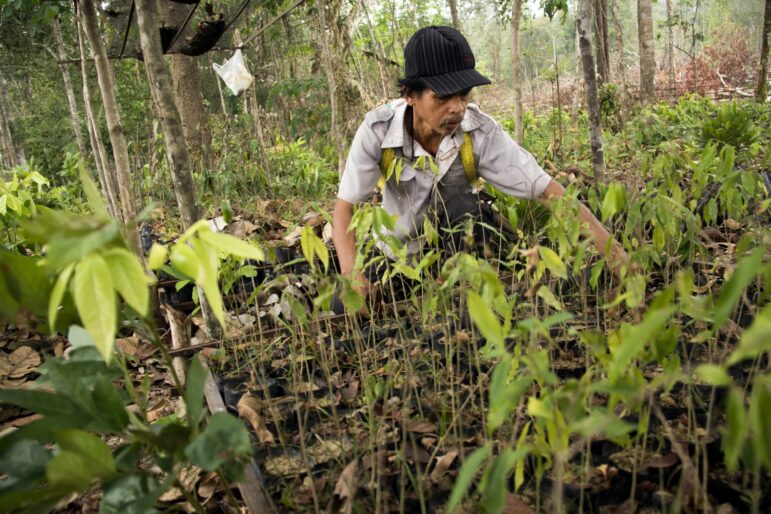
Image: Vivian Yap Wei Wen for GIJN
Mongabay’s Philip Jacobson showed how climate reporting can expose harm before it happens. It is an unusual challenge for journalists: how do you report on deforestation before the chainsaws arrive?
His starting point was a contact in North Kalimantan, an Indonesian province on the island of Borneo. This person reported that villagers were being approached by a company seeking land for a massive wood-pellet biomass plantation. Biomass is marketed as carbon-neutral and is in high demand by Japanese and Korean energy firms, but numerous studies and experts have shown that wood pellets are not truly sustainable and can even increase emissions.
Jacobson located the company’s deforestation location permit, revealing a concession of about 19,000 hectares. That is nearly twice the size of Paris. He and his team decided to visit four villages inside the zone. They found that each village had been offered a different deal, a sign of how little information communities received about the project’s actual impact.
- One village accepted a one-time payment of US$60 per hectare.
- Another accepted under duress, and the villagers now regret the decision.
- A third negotiated a stronger deal: a 20% profit share.
- A fourth rejected the project entirely.
Many villagers didn’t understand the future impact because they were not fully informed about its true impact: loss of hunting grounds, loss of clean water, loss of forest products, loss of income, and permanent loss of ancestral land. They only realized later that a monoculture plantation meant the forest, the foundation of their livelihoods, would disappear.
Jacobson’s investigation also uncovered that the biomass company was linked to a coal conglomerate repositioning itself as “green.” The foreign consumers, especially Japanese and Korean power utilities justify this as sustainable through deeply flawed carbon accounting rules, while villagers lose their ancestral land with little information.
Their reporting helped draw international scrutiny and contributed to broader questioning of biomass sustainability in Asian energy markets.
The takeaway: Deforestation can be documented long before the first tree falls, if journalists obtain permits, map concessions, and speak directly with affected communities.
Spotting Greenwashing at Scale
Panel moderator and award-winning freelance journalist Nimra Shahid showed how even a single contradiction can spark a major investigation. Her work uncovered greenwashing at some of the world’s largest banks and “green loans” involving a global fossil fuel company.
Her method was simple:
- Ask stock exchanges for lists of sustainability-linked loans and bonds.
- Compare the deals with the bank’s own environmental policies.
- Look for contradictions.
Her analysis showed one British bank helped arrange US$41 billion in sustainability-linked financing for fossil fuel companies. Her reporting contributed to the introduction of a new anti-greenwashing rule in the UK.
Climate finance is not abstract. It is the story of who profits while ecosystems collapse. And as this session showed, journalists can expose the hidden engines of climate harm with simple, powerful methods: follow the filings, test the green labels, trace the owners, and speak to the people whose lives change long before investors feel the impact.

Climate Change Reporting Guide: Methane — Holding Countries Accountable
Full Report: The Investigative Agenda for Climate Change Journalism
Reporter’s Guide to Investigating Carbon Offsets

Climate Change: Investigating the Story of the Century

Overcoming Four Big Challenges to Investigating the Water Crisis
New Approaches for Investigating Environmental Crimes in the Ocean
How Newsrooms are Uncovering Asia’s Climate and Environmental Crises, from Illegal Sand Mining to Sinking Cities
Climate Change Reporting and Mental Health: Practical Tips for Newsrooms and Journalists

This work is licensed under a Creative Commons Attribution-NoDerivatives 4.0 International License
Republish our articles for free, online or in print, under a Creative Commons license.
Republish this article
This work is licensed under a Creative Commons Attribution-NoDerivatives 4.0 International License
Read Next
Climate GIJC25
Overcoming Four Big Challenges to Investigating the Water Crisis
Journalists reporting on water scarcity often face a lack of transparency, limited access to sites and sources, unwieldy data, and a resistant media environment.
GIJC25
New Approaches for Investigating Environmental Crimes in the Ocean
At GIJC25, veteran journalists from Indonesia, Norway, and Colombia shared practical, replicable strategies for uncovering illegal fishing and maritime wildlife trafficking at sea.
Asia Focus
How Newsrooms are Uncovering Asia’s Climate and Environmental Crises, from Illegal Sand Mining to Sinking Cities
Outlets across the region are collaborating to investigate the environmental harms that cross borders.
Research
Climate Change Reporting and Mental Health: Practical Tips for Newsrooms and Journalists
In a recent Reuters Institute webinar, experts discussed the latest research into the impact of climate reporting on journalists’ mental health.