

South China Morning Post analyzed the Hong Kong's deadliest apartment fire in decades. Image: Screenshot, South China Morning Post
Hong Kong’s Deadly Fire, Tuna Fishing’s Labor Abuses, AI Deepfakes Target Ukraine Press, China’s ‘Shadow’ Fleet Preps for Invasion
The South China Morning Post reconstructed how one of Hong Kong’s deadliest fires swept through a housing complex, with illustrations and 3D modeling showing how construction materials and wind fueled the blaze. In this edition of our Data Journalism Top 10, covering stories from November 18 to December 2, we also highlight the Financial Times’ exposé on human rights abuses experienced by mainly longline tuna fishing workers, Der Tagesspiegel’s analysis of heckles, shouts, and other gestures in Berlin’s parliament, The Washington Post’s interactive comparing Elon Musk’s pay package to the earnings of US workers, and how Investigate Europe and Watershed Investigations have mapped toxic risks from landfill sites across the continent.
Hong Kong’s Deadliest Fire in Decades
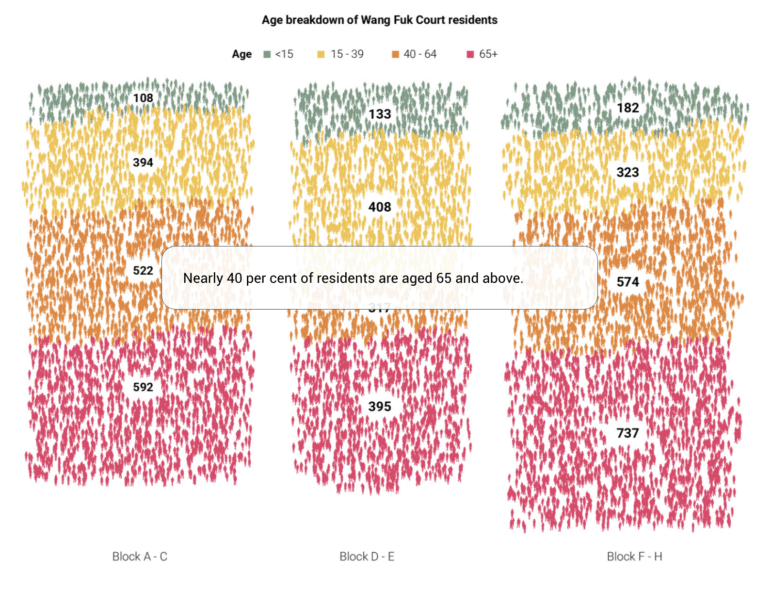
Image: Screenshot, South China Morning Post
The South China Morning Post reconstructed Hong Kong’s deadliest fire in more than 70 years. The blaze, on November 26, tore through Wang Fuk Court — a subsidized housing complex in the Tai Po district — whose eight 31-story towers house over 4,600 residents. Using video footage, on-the-ground reporting, and a minute-by-minute timeline, the team showed how bamboo scaffolding, mesh netting, and tarpaulins installed as part of the site’s renovation became a vertical conduit for flames. Illustrations of the towers and 3D interior modelling reveal how the mesh may have created a chimney effect and how winds pushed the fire laterally across the scaffolded facades, while flammable polystyrene foam sealing the windows helped the blaze leap indoors. Waffle charts showed the demographic breakdown of the towers, including which blocks housed the largest concentration of elderly residents, how many people were likely home when the Level-5 emergency unfolded, and residents’ working status. The story closed by placing the disaster, which has killed more than 156 people, in context with Hong Kong’s history of major fires.
Also worth checking out: The Straits Times feature on the Hong Kong fire.
Human Rights Violations in the Tuna Fishing Industry
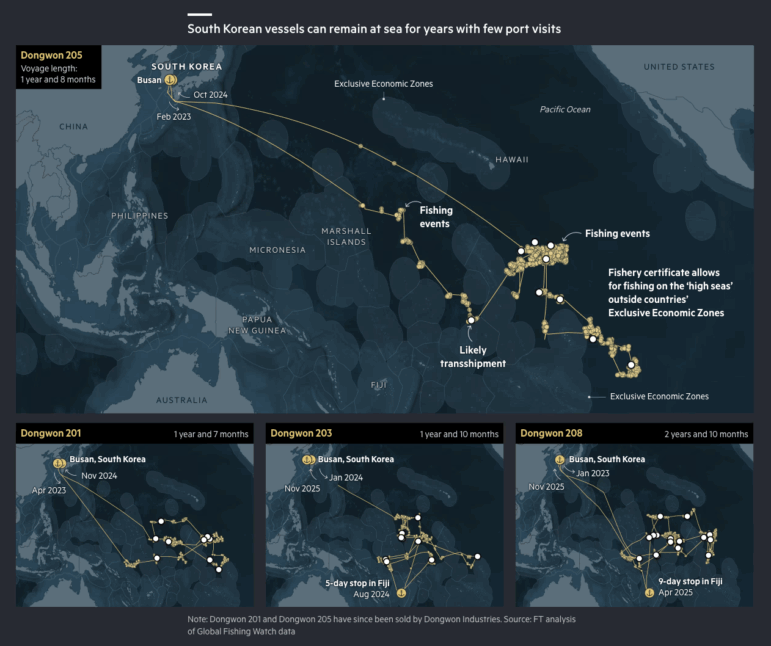
Image: Screenshot, Financial Times
The Financial Times traced how tuna fishing could be linked to vessels where migrant crews have reported forced labor, violence, and years-long voyages at sea. The investigation focused on testimonies from Indonesian fishermen who describe beatings, confiscated IDs, poor food, and 20-hour shifts on longline fishing vessels in the Pacific. Drawing on Global Fishing Watch tracking data, the FT mapped voyages that stretch over 12 months without port calls, and overlaid that with footage obtained from Chinese and Taiwanese vessels between 2018 and 2024. Using a 3D vessel model, it showed the claustrophobic, coffin-like bunks below deck, while analyses linked South Korean boats fishing excessive hours — indicating working rights violations — in UK supply chains. Combining details from retailers, data from the Ocean Disclosure Project, and interviews with crew, the FT connected abuses across the world’s dominant tuna fleets — which account for 42% of all recorded human-rights violations between 2000 and 2020 — directly to products on UK shelves in a market where canned tuna is consumed more than any other imported fish.
Ukraine Journalists Deepfaked to Spread Misinformation
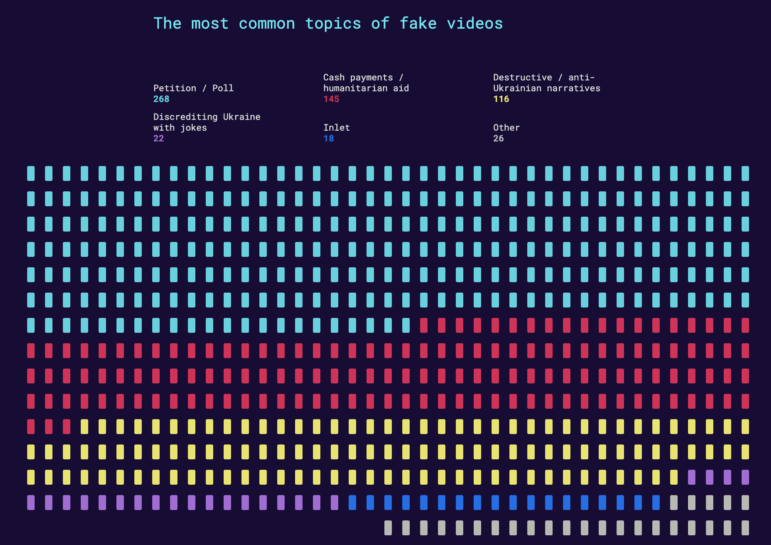
Image: Screenshot, Texty
Texty analyzed how AI deepfakes have turned prominent female Ukrainian journalists into “digital avatars,” which are then used to spread disinformation. Between August 1 and September 30, 2025, reporters compiled 595 AI-generated TikTok videos using a snowball sampling technique to find hashtags related to female journalists, which they then checked with the Hiya Deepfake Voice Detector to verify whether the content was AI-generated. They found 328 clips with audio manipulation and 267 with both image and voice manipulation — which had racked up more than 24 million total views. Attackers most often repurposed presenters’ credibility to push petitions and surveys or anti-Ukrainian narratives. Texty flagged this as technology-facilitated gender-based violence (TFGBV), where the misuse of journalists’ images and voices has become a calculated tactic of manipulation that blends online harassment, reputational attacks, and threats to national security.
Tracking China’s Civilian ‘Shadow’ Fleet
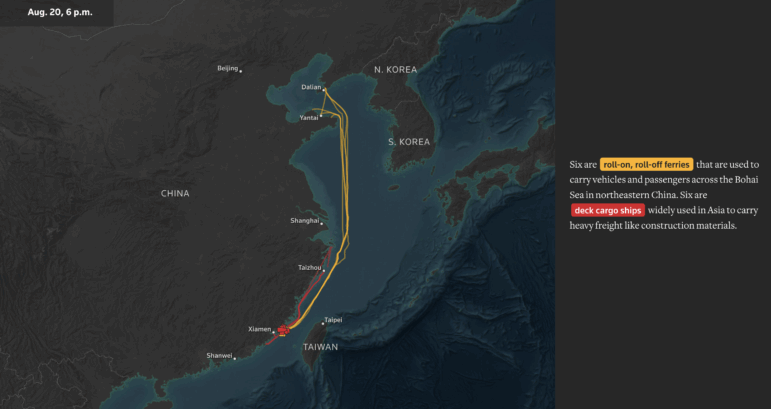
Image: Screenshot, Reuters
Reuters conducted a year-long visual investigation into China’s expanding civilian “shadow navy” by combining London Stock Exchange Group (LSEG) ship-tracking data, high-frequency satellite imagery from BlackSky and Planet Labs, and a custom tool that monitored over 100 commercial vessels known to participate in People’s Liberation Army (PLA) maritime drills. By tracing transponder signals and validating them against satellite images, reporters were able to watch a full amphibious landing exercise unfold in real time. The data revealed that China is now rehearsing concrete invasion tactics for Taiwan, using civilian ferries and deck cargo ships. Satellite imagery captured cargo ships unloading vehicles directly onto a beach, alongside floating pier systems, amphibious assault vehicles, and ferries loading armor offshore. Experts say this marks a major leap in China’s first-wave landing capacity and shows the PLA experimenting with ways to rapidly deliver troops and equipment at multiple points along Taiwan’s coast.
Europe’s Toxic Landfill Risks
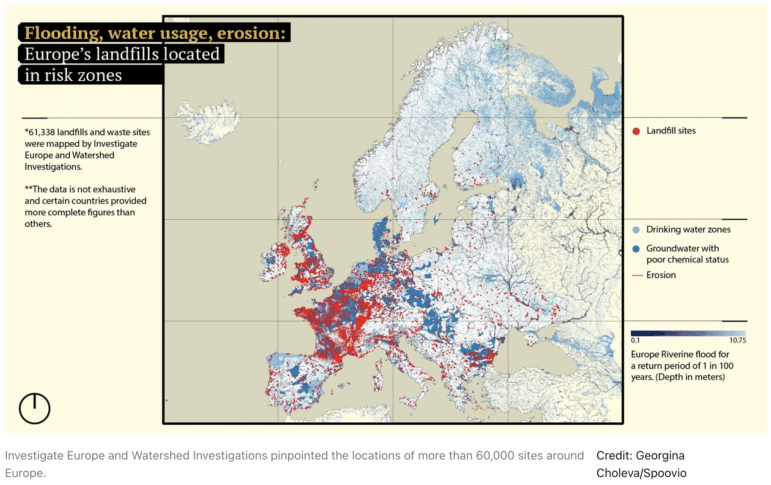
Image: Screenshot, Investigate Europe
Investigate Europe and Watershed Investigations identified more than 60,000 landfill sites sitting in flood-risk zones across Europe, raising the threat of polluted drinking water and damage to conservation areas. By analyzing and mapping data from FOI requests, government departments, and public sources, the teams found that nearly 30% of landfills fall in areas vulnerable to significant flooding, meaning toxic waste could be swept into water systems, with the highest-risk clusters along erosion-prone coasts in France, England, and Wales. Using color-coded layers marking landfill locations, drinking-water zones, polluted groundwater, and coastal erosion, the reporters built a continent-wide picture of where chemicals and hazardous materials could leak into the environment. Their modeling shows the massive scale of the issue: 140,000 sites are at risk of flooding, 30,000 are inside protected conservation areas, and almost 300,000 sit above groundwater in poor chemical health. While modern, well-managed landfills pose lower danger, older dumps predating the EU’s 1999 Landfill Directive represent the greatest threat, and illegal waste sites add another layer of risk, with Europol warning that waste dumping is now one of Europe’s fastest-growing organized crimes.
How Much Money Could Elon Musk Make?

Image: Screenshot, The Washington Post
In November, Tesla shareholders approved an unprecedented US$1 trillion 10-year pay package for Elon Musk, an average of US$100 billion a year. Drawing on Bureau of Labor Statistics occupational wage data, The Washington Post used human-figure illustrations to show how Musk’s incentive-based annual payout would dwarf the combined earnings of entire professions, including every US elementary school teacher. The piece also lets readers compare Musk’s projected pay to other industries. For example, he would earn more in a single year than the 41,550 US news analysts, reporters, and journalists who collectively make about US$4 billion — nearly US$96 billion less than Musk’s potential average yearly intake.
Peru Locks Up Teenagers in More Dangerous Prisons
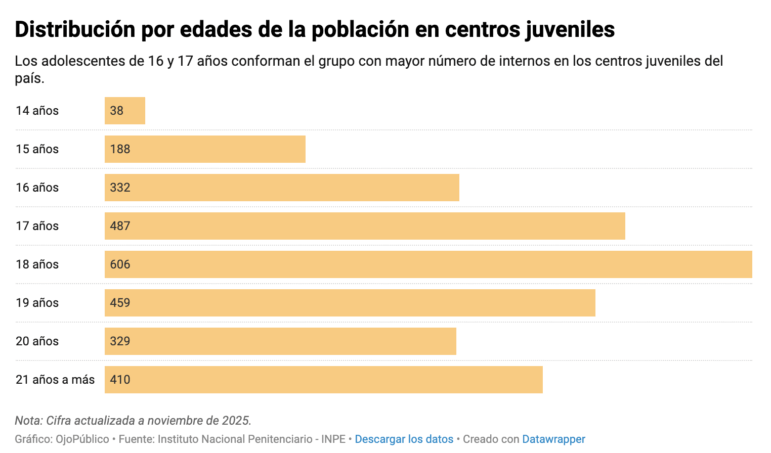
Image: Screenshot, Ojo Público
In May, a new law took effect in Peru, allowing 16- and 17-year-olds to be tried as adults. Since then, nearly 100 teenagers have been incarcerated in adult prisons, a number that has risen sharply from 14 in May to 99 by September, with Lima ranking as the city with the most young incarcerated people in this situation. OjoPúblico accessed case files of minors sent to prison and found, for example, a 16-year-old ordered into seven months of pretrial detention for extortion. According to data from the National Penitentiary Institute (INPE), these adolescents are now being investigated and prosecuted as adults for crimes ranging from attempted aggravated robbery and extortion to illegal possession of weapons and drug trafficking. Through public information requests, OjoPúblico gathered details from fiscal districts on minors under investigation under the new law, in addition to visualizing the age distribution of detained teens in juvenile detention centers and the offenses for which they have been charged.
Cost of Deportations from the US
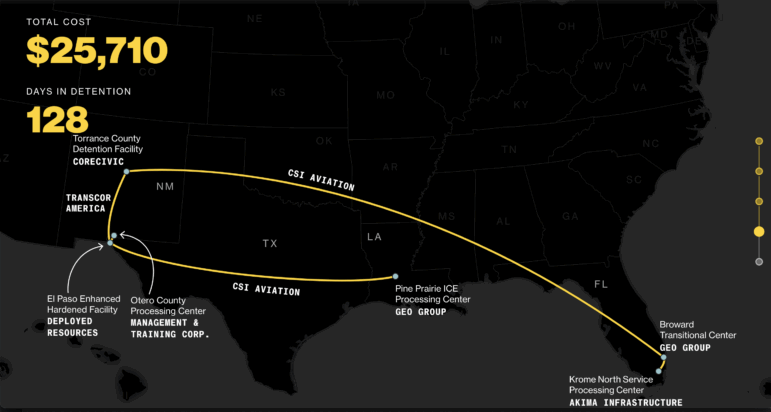
Image: Screenshot, Bloomberg
Bloomberg Businessweek examined the real cost of deportation from the US by closely tracking a single case inside its immigration system. Reporters reconstructed the 128-day detention of one man, who was taken into custody despite holding a valid residency — so-called green — card. Using anonymized individual-level ICE records from the Deportation Data Project, facility cost agreements obtained through public records requests, and flight data from ICE Flight Monitor, which tracks immigration enforcement flights, Bloomberg mapped the man’s transfers through six ICE facilities and thousands of miles of transport. While the government says deporting a person costs US$17,121 on average, this many’s journey cost the government at least US$25,700 — a conservative estimate that excludes legal and administrative expenses. The data also showed how common long-distance shuttling has become under Trump’s renewed enforcement approach, with more than 80,000 detainees transferred more than 200 miles and over 5,000 moved that distance three or more times.
Do Fashion Brands Keep Their Green Promises?
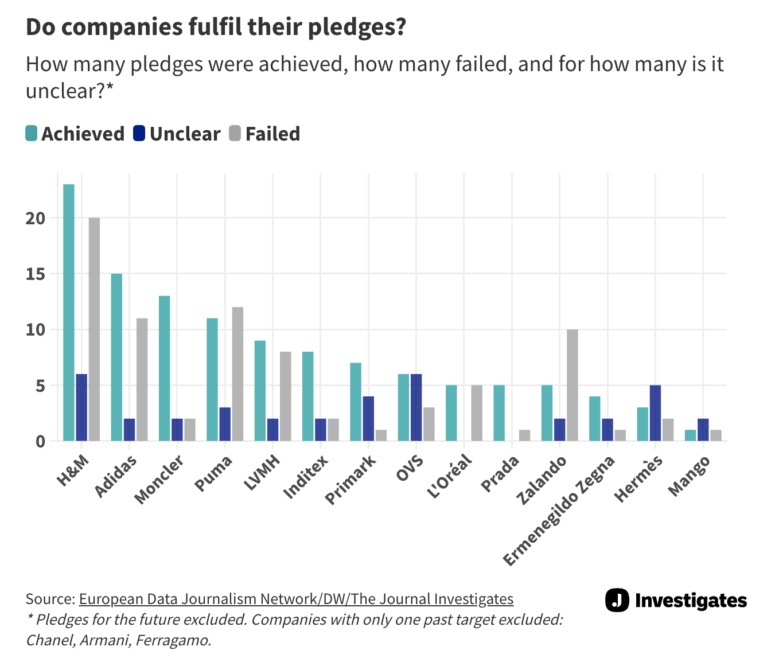
Image: Screenshot, The Journal
The Journal (Ireland), in collaboration with the European Data Journalism Network, delved into the green pledges made by fashion houses and brands, from specific targets to more general pledges. Using data collected from various sources, The Journal and partners selected the most relevant companies for their respective countries and analyzed annual and sustainability reports starting from the year 2000 to find any publicly stated pledges, looking in particular at the target year for these promises to be met. They evaluated 468 sustainability commitments from more than 200 corporate reports by 17 of the biggest European fashion companies and found that some companies, such as Puma, were very vague in their pledges, while others, like Adidas, were quite detailed. Presenting data in a series of bar and pie charts, the investigation found that only 117 of the 468 commitments have been met so far.
Is North Korea Already Grooming Its Next Leader?
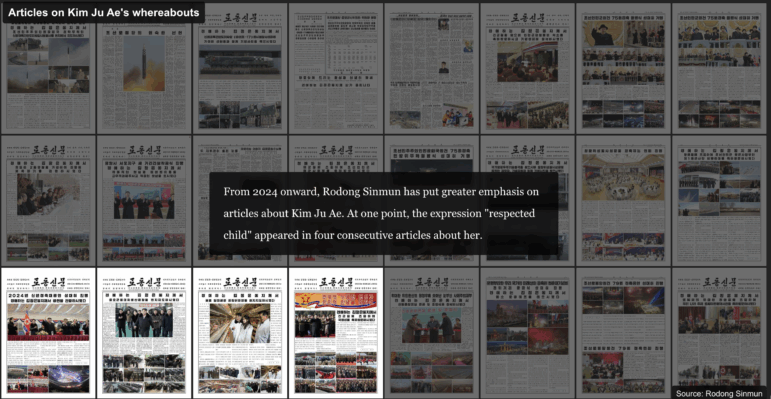
Image: Screenshot, Nikkei
North Korean leader Kim Jong Un’s daughter appears to be making more public appearances according to Nikkei’s visual investigations team, which analyzed more than 14,115 hours of Korean Central Television footage. The team built an AI-facial recognition program to identify Kim Ju Ae, flagging every appearance that reporters then manually verified. The results show an interesting pattern, since her public debut three years ago, Kim Ju Ae has appeared on KCTV for more than 600 days, averaging 24 days per month in 2025 alone, suggesting that she may be heading for the role of successor in the future. In addition, Nikkei reviewed 6,500 pages of Rodong Sinmun — the Workers’ Party newspaper — to show a similar shift, where the language used to refer to Kim Ju Ae has changed from “loved child” to “respected child.” While this doesn’t confirm succession, the trend points to the careful scripting of North Korean leader’s heir, who has notably appeared more in public than Kim Jong Un’s wife.
Rise of Heckling in Berlin’s State Parliament
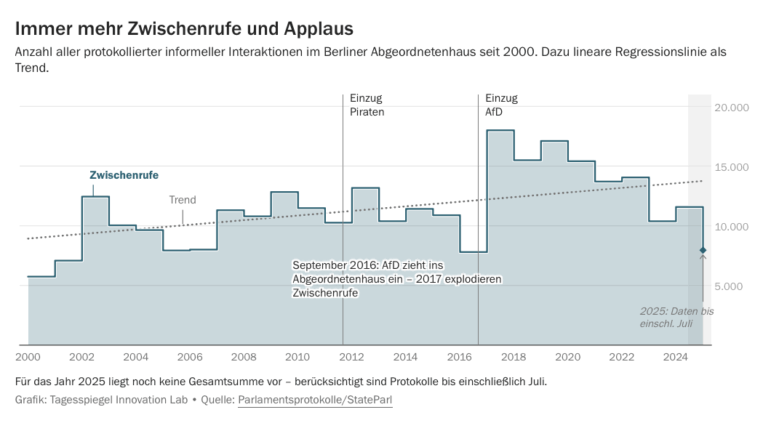
Image: Screenshot, Der Tagesspiegel
Berlin-based daily Der Tagesspiegel looked through the Stateparl transcripts of the city’s parliament plenary sessions from 2000 to July 2025, tracking informal interactions such as exclamations, insults, and applause. The analysis showed that the number of heckles and other interruptions has doubled over 25 years: from about 5,700 in 2000 to 11,500 in 2024, with spikes whenever new parties enter the parliament, notably after the Pirate Party in 2011 and the far-right Alternative für Deutschland (AfD) in 2016. The AfD is also responsible for the most insults. According to the article, the parliamentary office responsible for transcripts follows specific rules, whereby heckles are recorded with the name of the heckler and their wording whenever possible. Torsten Schneider, of the Social Democratic Party of Germany (SPD), holds the 25-year record for most interruptions, while in the current legislative period Linke leader Anne Helm is the most frequent interjector. Linguists say interjections are “part of the game” and are often done to increase attention, with many clips being shared on social media.
Hanna Duggal is a data journalist at AJ Labs, the data, visual storytelling, and experiments team of Al Jazeera and a GIJN contributor. She has reported on issues such as policing, surveillance, and protests using data, and reported for GIJN on data journalism in the Middle East, investigating algorithms onTikTok, and on using data to investigate tribal lands in the US.

Mapping Data Journalism on Twitter

2025 Conference Resources

Guide to Investigating Food Insecurity

Open Source Guide to Investigating Chinese Companies
Data Journalism

Video Resources for Data Investigations
X’s Right-Wing Bias in UK, Tigray’s Illicit Gold Rush, Financial Risks of AI Bubble, and What People Ask ChatGPT
Afghanistan’s Deadly Earthquakes, West Bank Settler Violence, Mississippi’s Prison Homicides, Chile’s Data Center Boom

This work is licensed under a Creative Commons Attribution-NoDerivatives 4.0 International License
Republish our articles for free, online or in print, under a Creative Commons license.
Republish this article
This work is licensed under a Creative Commons Attribution-NoDerivatives 4.0 International License
Read Next
Data Journalism Reporting Tools & Tips
Video Resources for Data Investigations
To share best practices and other lessons learned from our most recent global conference, GIJC21, we are releasing a series of videos from the event’s many seminars, panels, and workshops. The second installment focuses on how investigative reporters can better utilize data tools and visualization techniques.
Data Journalism Top 10
X’s Right-Wing Bias in UK, Tigray’s Illicit Gold Rush, Financial Risks of AI Bubble, and What People Ask ChatGPT
Our round-up also highlights which countries are following through on their climate change commitments, a deep-dive into the challenges facing Saudi Arabia’s vertical city, and modelling whether today’s AI boom is headed for a dot-com style crash.
Data Journalism Top 10
Afghanistan’s Deadly Earthquakes, West Bank Settler Violence, Mississippi’s Prison Homicides, Chile’s Data Center Boom
Our round-up of the best in recent data journalism also features stories on Russia’s military equipment losses, Pacific deep-sea mining, and Paralympic swimming.