

Illustration: Joanna DeMarco
Digital Scam Trails, Deadly Hospital Infections, Harrowing Immigration Journeys: 2025’s Best Investigative Stories from India
Read this article in
The year 2025 saw investigative journalism in India persist against increasingly difficult odds. Reporters pursued stories that exposed how power operates through money, policy, coercion, neglect, and silence at a time when access to information has been curtailed.
Reporters traced illicit gold laundered from Africa, mapped global cyber-scam networks linking Southeast Asia and Indian cities, and examined illegal migration pipelines stretching from Indian villages to detention centers in the United States. Reporters examined hospitals where preventable infections quietly kill patients, and tuberculosis programs are undermined by erratic funding and broken supply chains. They documented the human cost of administrative neglect to injuries suffered by women workers in industrial supply chains and children bearing disproportionate environmental risks. Across cities and towns, journalists showed how policy paralysis and political sensitivity allow problems such as stray cattle, unsafe infrastructure, and regulatory capture to endure year after year.
This work has unfolded amid a visibly deteriorating climate for press freedom in India. Though India inched up the global press freedom rankings in 2025, concerns about legal harassment, surveillance, newsroom pressure, and shrinking space for dissent have not decreased. Journalists still face defamation cases, criminal investigations, raids, and prolonged legal battles for reporting that challenges those in power. Access to public data has become more restricted, while the use of national security, public order, and anti-terror laws to thwart transparency and chill reporting has expanded. In this environment, investigative journalism is not merely difficult; it is an act of courage.
Even as constraints tighten, a new generation of investigative reporters has come forward. Many of the stories listed below were produced by young journalists in small teams, independent newsrooms, and nonprofit groups. They often use data analysis, cross-border teamwork, and document-driven reporting. They build investigations patiently, despite limited resources and risks. These journalists are redefining what accountability journalism means in today’s India.
Investigative journalism is gradually moving from the English-language media to vernacular newsrooms. Hindi newspapers and independent YouTube journalists, especially in local languages, are taking up investigative reporting.
Digital Scam Trail Tracked
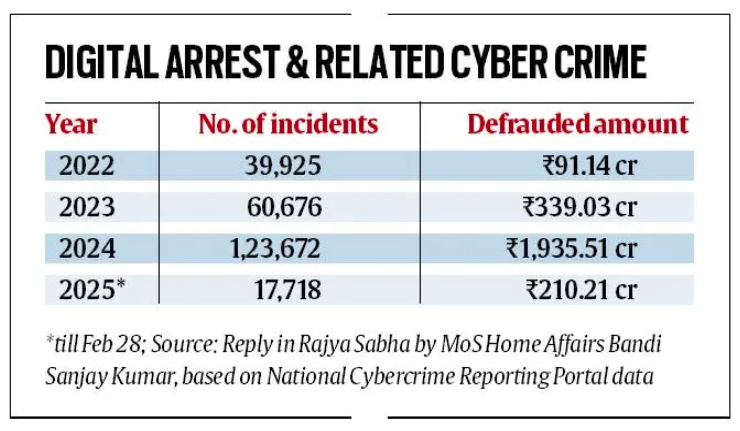
Image: Screenshot, Indian Express
The investigation by Indian Express tracked how money stolen in digital frauds moves rapidly across banks and state borders in India, often within minutes. Using official data and interviews with law enforcement officials, the report showed that cybercriminals route crores of rupees (equivalent to hundreds of thousands of US dollars) through networks of “ghost” or mule accounts that are repeatedly used despite being flagged. These accounts are opened using forged or misused identities and operate across multiple banks, making recovery difficult. The story explained how delays in coordination between banks, police, and cybercrime units have allowed funds to be withdrawn or transferred before accounts are frozen and it highlighted weaknesses in real-time monitoring systems and uneven enforcement of Know Your Customer (KYC) norms. Officials quoted in the report acknowledged that, although suspicious transactions are detectable, institutional gaps prevent timely action. The investigation underscored how systemic failures enable organized digital fraud to flourish while victims struggle to recover lost money.
UK Scrap Tires Dumped in India to Extract Oil, Creating Health Hazards
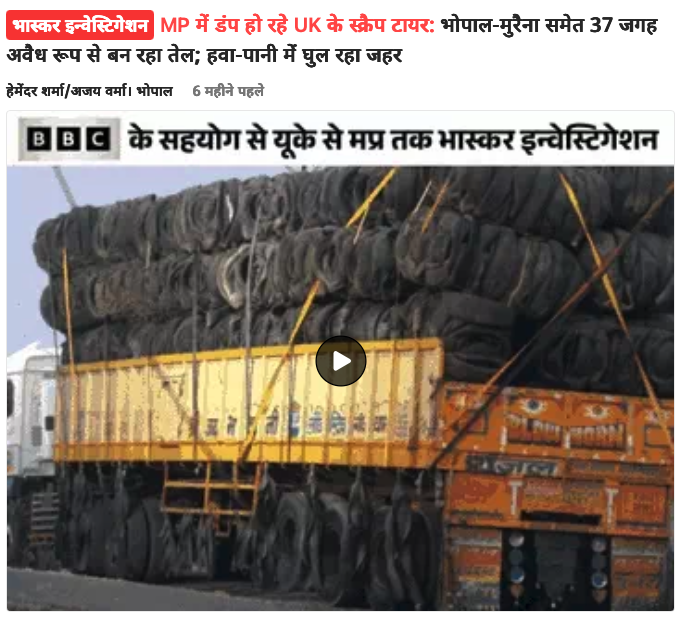
Image: Screenshot, Dainik Bhaskar
India’s leading Hindi daily, Dainik Bhaskar, produced a two-part report on the illegal dumping and processing of scrap tires imported from the United Kingdom to the central Indian state of Madhya Pradesh. The investigation revealed that large quantities of these waste tires are being processed illegally at at least 37 locations to extract oil. This activity, which releases toxic gases into the air while residue and effluents contaminate soil and water bodies, is being carried out without environmental clearances or safety standards. Local residents reported breathing difficulties, eye irritation, and crop damage. The investigation showed that despite clear environmental violations, regulatory oversight is weak and enforcement is inconsistent — several units shown as closed in official records were found to be operating on the ground. By combining documents, official data and field reporting, the series exposed how hazardous-waste management failures are allowing environmental pollution to spread, raising serious concerns about public health, regulatory accountability, and cross-border waste-dumping practices.
Human Trafficking Horror Stories of Indians Being Smuggled Into the US
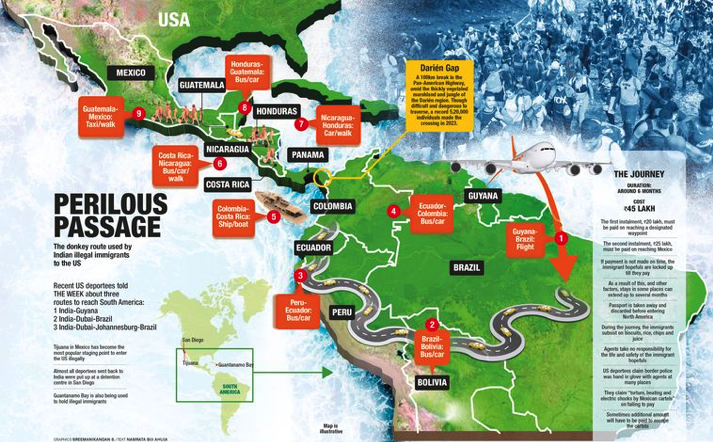
Image: Screenshot, The Week (India)
This investigation by The Week looked at the rise in undocumented immigration to the US and how many of these migrants end up deported. It explained how people from Punjab, Haryana, Gujarat, and other Indian states pay large sums to agents for job promises and safe US entry via long, risky routes through Latin America. Many migrants face danger, detention, and uncertainty. Once caught, they are held in harsh conditions in US detention centers. The report also examined the roles of human smugglers, fake documents, and social media in this network. Using official data and migrant interviews, it showed that US enforcement has increased and deportations are rising. In addition, it highlighted the economic pressures behind this migration trend and the trauma caused by being forced to return to India.
Politicizing the Archaeological Survey of India
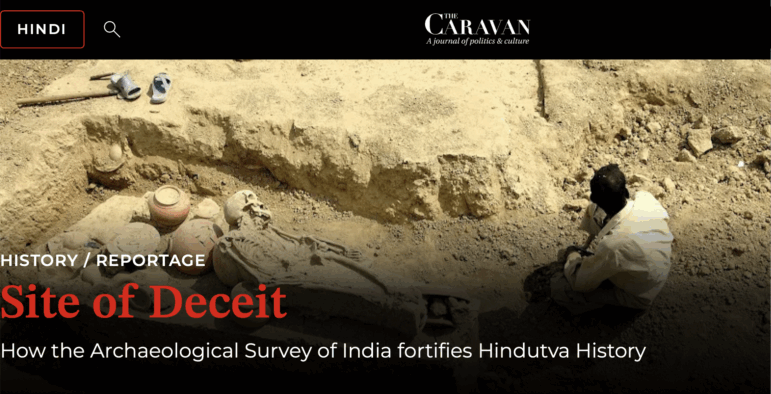
Image: Screenshot, The Caravan
The story by The Caravan magazine examined how the Archaeological Survey of India (ASI) has increasingly come under political pressure to align archaeological interpretation with Hindutva narratives of history, which are promoted by the ruling Bharatiya Janata Party (BJP). The Caravan traced the institution’s evolution from a colonial-era body grounded in scholarly method into a contemporary organization where excavations, reports, and public statements are often shaped by ideological expectations. Using examples from high-profile sites, court proceedings, official ASI reports, and expert opinions, the story showed how archaeological findings are selectively presented, delayed, or overstated to support claims of ancient Hindu continuity or of temple remains beneath disputed religious sites. The story also documented concerns raised by former ASI officials, historians, and archaeologists about departures from established scientific practices, a lack of transparency, and restrictions on peer review. It concluded that this politicization undermines the credibility of archaeology as a discipline and reshapes public understanding of India’s past, with lasting consequences for academic freedom, heritage management, and communal relations.
Illegal Gold Bound for India Laundered Clean by Ghana’s Government
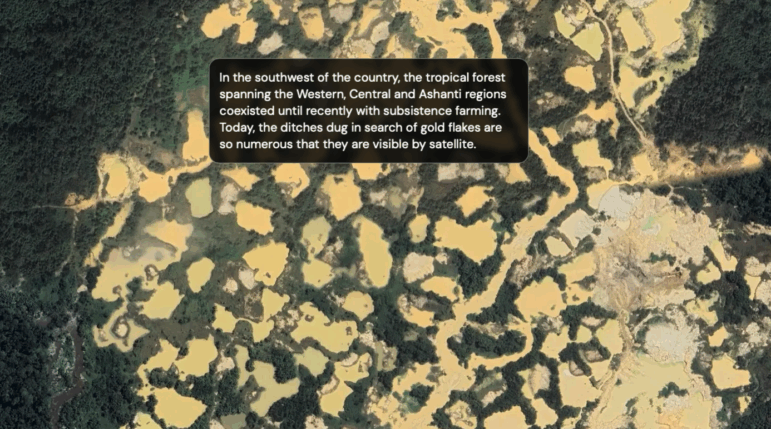
Image: Screenshot, Reporters Collective
This investigation by The Reporters’ Collective looked at illegal gold mining in Ghana and its links to the large amounts of that precious metal imported into India. Using leaked documents, customs records, and trade data, the report uncovered the involvement of Ghanaian state agencies and explained how gold mined through informal, harmful methods was “cleaned” through fraudulent documents and then exported abroad, including to India, a major destination. The investigation traced the route from illegal mines to refineries and state-backed export channels and pointed to weak checks and poor enforcement. The report also documented environmental damage, labor exploitation, and loss of public revenue in Ghana, raising questions about global gold supply chains and how weak regulation allows such trade to continue. In late 2025, Ghana’s recently formed authority, the Ghana Gold Board, issued a US$90,000 bounty for an Indian gold trader, but the country’s president also announced that the Gold Board would no longer make any distinctions between gold mined legally or illegally — all gold was eligible for sale and export.
Inside the Hidden Epidemic of Killer Infections in Indian Hospitals
Image: Screenshot, The Scroll
This series, produced by a group of three reporters from The Scroll, investigated the conditions inside hospitals and the infections that can kill patients. Their findings showed that many of these infections are not openly acknowledged and that the resulting deaths are rarely labeled as preventable. The team pulled from medical studies, government data and court records, and interviews with doctors, nurses, patients, and families. The series showed how overcrowding, poor hygiene, lack of training, and weak infection-control systems have allowed these deadly infections to spread. The investigation also detailed how systemic misuse of antibiotics has increased resistance, making infections harder to treat, as well as how victims’ families struggle to get clear answers or compensation for the hospitals’ actions.
How Injuries Impact Women in the Automobile Supply Chain
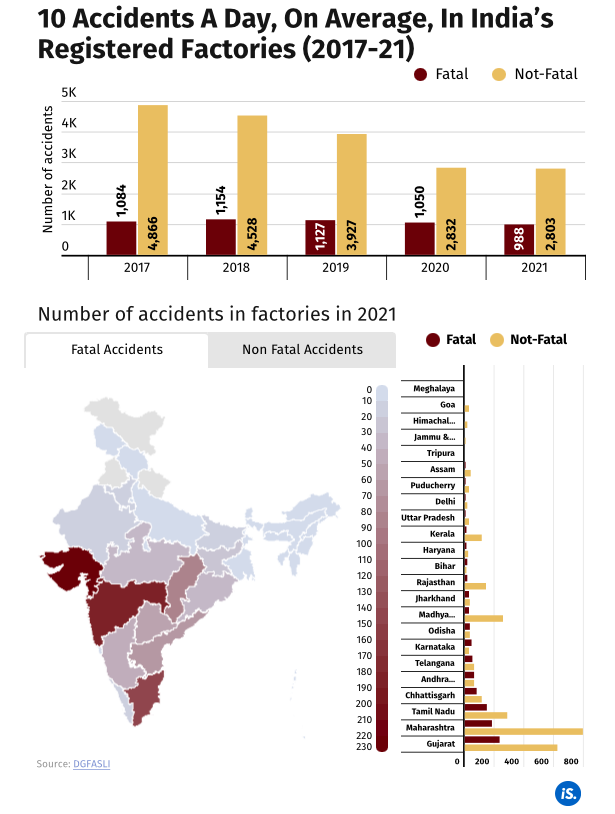
Image: Screenshot, IndiaSpend
This data-led story in IndiaSpend investigated how injuries affect women working in India’s automobile supply chain. It showed how many women get very little support despite facing serious physical risks like back pain, joint problems, cuts, burns and long-term disabilities when routinely performing repetitive, physically demanding tasks in component factories. This phenomenon is complicated by the fact that many injuries are not reported because these women work under informal contracts, lack safety equipment and health benefits, are unaware of labor rights, and fear losing wages. The story, backed by data and interviews with workers and activists, also highlighted the weak enforcement of labor laws and poor workplace safety conditions.
Unraveling the Stray Cattle Crisis in Delhi

Image: Screenshot, Newslaundry
This locally focused report by Newslaundry investigated the growing problem of stray cattle in Delhi, revealing that thousands of cows and bulls roam the city’s streets daily, resulting in traffic accidents, injuries, and even fatalities. Stray cattle also damage homes, shops, and public property. The story pointed to the lack of civic coordination and failure of municipal bodies to manage the protected shelters for stray cows, known as gaushalas, and how many of these shelters are overcrowded and poorly funded. Using data, field reporting, and interviews, the story documented the gap between policy and reality, noting how court orders and civic drives have not solved the problem and that political sensitivity and administrative neglect have kept the crisis alive.
 Deepak Tiwari is GIJN’s Hindi Editor. He is a senior Indian journalist and former vice chancellor of Makhanlal Chaturvedi National University of Journalism and Communication, Bhopal. With over 31 years of experience as a reporter, sub-editor, television commentator, media consultant, and managing editor of a media startup, he is also the author of two books on the political history of the Indian state of Madhya Pradesh.

Guide to Investigating Caste

Guide to Investigating Land Conflicts in South Asia

How Environmental Journalists Can Use NASA’s New Landsat 9 Satellite

International Research Guide: How to Find Experts and Hidden Documents on Any Topic

Tracking Election Donations, Illicit Gold Markets, Parliamentary Stonewalling: 2024’s Best Investigative Stories in India
Asking Tough Questions, Publishing ‘Without Fear’: The Reporters’ Collective in India

Investigating India: How Smaller, Independent News Outlets Are Digging into Politics in a Key Election Year

‘Impact is Often Subliminal’: A Nepali Journalism Veteran on the Highs — and Lows — of His Reporting Career

This work is licensed under a Creative Commons Attribution-NoDerivatives 4.0 International License
Republish our articles for free, online or in print, under a Creative Commons license.
Republish this article
This work is licensed under a Creative Commons Attribution-NoDerivatives 4.0 International License
Read Next
Editor's Picks News & Analysis
Tracking Election Donations, Illicit Gold Markets, Parliamentary Stonewalling: 2024’s Best Investigative Stories in India
Also featuring a look at algorithmic bias in dispensing food aid, corruption in the country’s largest civil service exam, and a tragic construction accident.
Asia Focus Member Profiles
Asking Tough Questions, Publishing ‘Without Fear’: The Reporters’ Collective in India
This small yet notorious investigative outlet was formed almost by accident — but has gone on to investigate electoral issues, conflict, and the death of an Indian journalist.
Data Journalism Investigating Institutions News & Analysis
Investigating India: How Smaller, Independent News Outlets Are Digging into Politics in a Key Election Year
Smaller investigative news outlets have been behind challenging and impactful accountability reporting leading up to the country’s elections.
10 Questions Asia Focus
‘Impact is Often Subliminal’: A Nepali Journalism Veteran on the Highs — and Lows — of His Reporting Career
Kunda Dixit speaks to GIJN about the challenges he has faced in a storied career in investigative reporting, from going into exile to reporting in the face of legal attacks.